Understanding Diffusion Through Membranes and Its Key Concepts
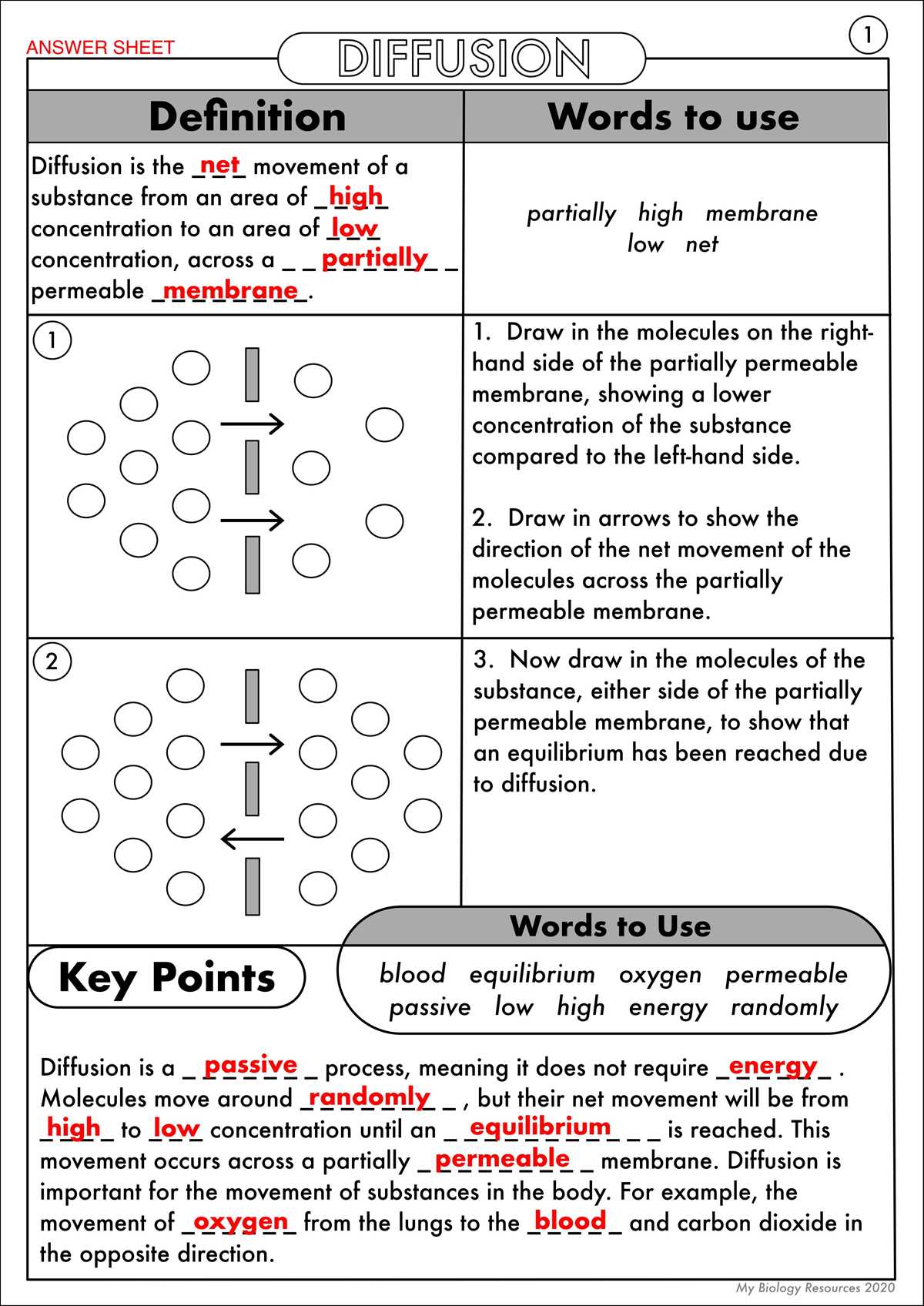
To better grasp how substances cross biological barriers, focus on the factors that control molecular movement. The concentration gradient plays a significant role in directing the flow of particles from areas of high concentration to areas of low concentration. This is a fundamental concept in the study of cellular processes.
Temperature, size of molecules, and the permeability of the barrier are critical in determining the speed and direction of movement. Smaller molecules tend to move faster, while larger ones encounter resistance. Similarly, barriers with higher permeability allow molecules to pass more easily than those with lower permeability.
Understanding these principles is crucial for interpreting biological functions such as nutrient absorption, waste removal, and gas exchange. Practical applications in medicine, particularly drug delivery and targeted therapies, also rely on these principles to develop effective treatments.
Movement of Molecules Across Biological Barriers and Key Concepts
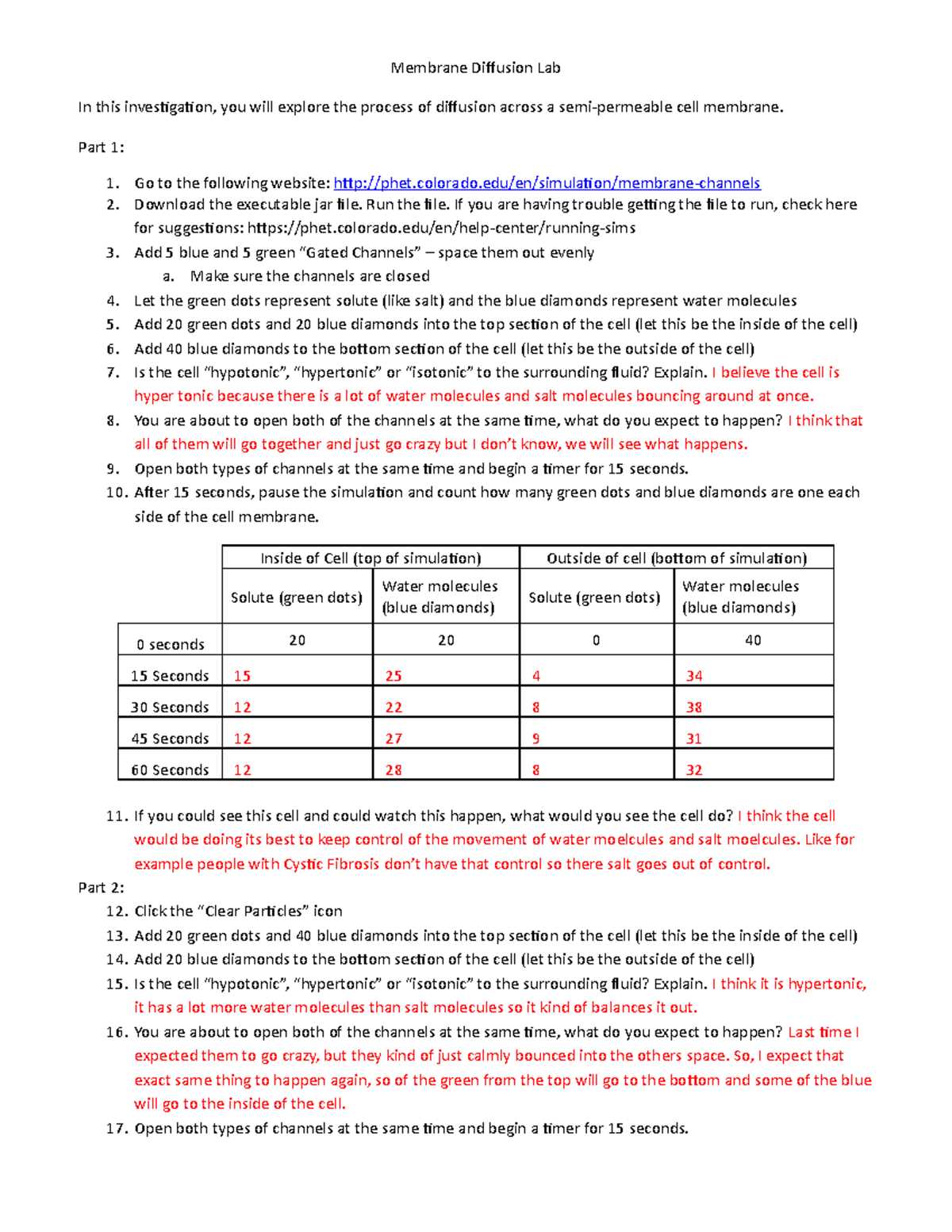
To understand how molecules move across biological barriers, focus on these fundamental concepts:
- Concentration Gradient: Molecules tend to move from areas of high concentration to areas of low concentration, seeking equilibrium.
- Permeability: The ability of a barrier to allow molecules to pass through. This can depend on the size, charge, and solubility of the molecule.
- Membrane Proteins: Specialized proteins in the barrier that facilitate the movement of specific substances, either by forming channels or by acting as carriers.
- Passive vs Active Movement: Passive movement does not require energy and occurs along concentration gradients, while active movement requires energy to move molecules against the gradient.
- Factors Influencing Movement: Temperature, molecular size, and charge all influence how quickly and efficiently molecules cross the barrier.
These concepts are crucial for understanding processes such as nutrient uptake, waste removal, and cell signaling in various biological systems.
Understanding the Process of Molecular Movement Across Barriers
The process of molecules moving across a barrier relies on the concept of concentration gradients. Molecules naturally move from areas of high concentration to areas of low concentration until equilibrium is reached. This spontaneous movement does not require external energy.
In order for molecules to cross a barrier, they must either pass directly through the structure or utilize specific protein channels embedded in it. These channels allow substances to bypass the lipid structure of the barrier, which otherwise restricts larger or charged particles from freely passing through.
The rate of movement can be influenced by several factors, including:
- Size of Molecules: Smaller molecules typically move more easily compared to larger ones.
- Temperature: Higher temperatures increase the kinetic energy of molecules, speeding up their movement.
- Permeability: The ease with which a barrier allows specific substances to pass depends on its permeability to certain molecules.
Understanding how molecules move across barriers is key to explaining how cells acquire nutrients, expel waste, and maintain homeostasis.
Factors Affecting Molecular Movement Rates Across Barriers
The rate at which substances pass across barriers is influenced by several factors. These factors determine how quickly equilibrium is reached and how efficiently molecules can cross the boundary.
Key factors include:
- Concentration Gradient: A greater difference in concentration on either side of the barrier increases the rate of movement. Molecules move faster when there is a large difference in concentration.
- Temperature: Higher temperatures increase the kinetic energy of molecules, making them move faster. This generally speeds up the rate at which substances cross the barrier.
- Size of Molecules: Smaller molecules generally move more easily across barriers, as larger molecules may struggle to fit through channels or the lipid bilayer.
- Permeability of the Barrier: The structure of the barrier affects how easily different molecules can cross it. Some barriers are selectively permeable, allowing only certain molecules to pass through.
- Surface Area: A larger surface area allows more molecules to pass at once, increasing the overall rate of movement.
- Presence of Carrier Proteins: If specific proteins are involved, they can facilitate the passage of certain molecules, either by active or facilitated processes.
Each of these factors plays a significant role in the efficiency of molecular movement across barriers and can impact biological processes such as nutrient uptake, waste removal, and signaling.
How Concentration Gradients Influence Movement Across Barriers
Concentration gradients are a driving force behind molecular movement across biological barriers. When there is a difference in the concentration of molecules between two regions, the molecules naturally move from the area of higher concentration to the area of lower concentration.
In the case of substances moving across a barrier, the concentration gradient plays a direct role in the rate and direction of movement. Key points include:
- Steeper Gradient: A larger difference in concentration across the barrier results in faster movement of molecules. The steeper the gradient, the more rapid the molecular shift.
- Equilibrium: Movement continues until equilibrium is reached, meaning the concentration of molecules on both sides of the barrier becomes equal. At this point, net movement slows, but individual molecules continue to move.
- Gradient Reversal: If the concentration on one side increases and the other decreases, molecules can move in the opposite direction. This reversal influences how substances accumulate or exit a particular region.
- Diffusion Efficiency: A strong gradient ensures that molecules are moving quickly and efficiently, whereas a weak gradient results in a slower rate of movement.
Understanding how concentration gradients impact molecular movement is fundamental for many biological processes, such as nutrient uptake and waste removal. The steeper the gradient, the faster the process occurs.
Role of Permeability in Molecular Movement Across Barriers
The permeability of a biological barrier directly influences how easily substances can pass through it. Molecules encounter different rates of movement depending on the characteristics of the barrier and the substance being transported.
Factors affecting permeability include:
- Size and Charge of Molecules: Smaller and non-polar molecules typically pass more easily than larger or charged molecules. For instance, gases like oxygen and carbon dioxide cross barriers more freely than ions or large proteins.
- Lipid Bilayer Composition: The fluidity and composition of the lipid bilayer can either facilitate or hinder molecular movement. The presence of unsaturated fats increases fluidity, allowing easier passage of molecules.
- Presence of Transport Proteins: Specific proteins embedded in the barrier can increase permeability for larger or charged molecules. Channels, carriers, and pumps are key components in this process.
- Environmental Factors: Conditions such as temperature and pH can affect the permeability of barriers. Higher temperatures generally increase permeability by making the lipid bilayer more fluid.
Understanding membrane permeability is critical in fields like drug delivery, where the goal is to either facilitate or control the movement of substances into cells. The permeability can be adjusted through various techniques, such as modifying the lipid composition or using specific transport proteins to assist in moving desired molecules.
For further details, refer to the National Institutes of Health (NIH).
Identifying Different Types of Molecular Movement in Biological Systems
Biological systems rely on several types of molecular movement across barriers to maintain homeostasis and facilitate essential processes. These processes vary in terms of the mechanism and the nature of the substances being moved. Below are the primary types:
- Passive Movement: Occurs without the input of energy. Molecules move from regions of higher to lower concentration. Examples include:
- Simple Movement: Small, non-polar molecules like oxygen or carbon dioxide passing freely through a lipid bilayer.
- Facilitated Movement: Larger or charged molecules, like glucose or ions, move via specific protein channels or carriers embedded in the barrier.
- Active Movement: Requires energy to move substances against their concentration gradient. Examples include:
- Primary Active Transport: Direct use of energy (usually ATP) to move molecules, such as sodium-potassium pumps.
- Secondary Active Transport: Uses the gradient created by primary transport to move other substances, such as glucose transport coupled with sodium ions.
- Bulk Movement: Involves the movement of large quantities of material and is carried out by processes like:
- Endocytosis: The process by which cells ingest external substances by engulfing them in a vesicle.
- Exocytosis: The release of substances from the cell when a vesicle fuses with the outer membrane.
Understanding these different mechanisms is crucial in fields like pharmacology, where controlling molecular movement can influence drug delivery, and in disease processes where impaired molecular movement may be a contributing factor.
Calculating Movement Rates Using Fick’s Law
Fick’s Law provides a method for calculating the rate of molecular movement across a barrier. It is based on the following equation:
J = -D * (ΔC / Δx)
Where:
- J is the flux, or rate of movement of particles (typically in moles per second per unit area).
- D is the diffusion coefficient, which depends on the type of molecule and the medium in which it moves.
- ΔC is the concentration gradient (difference in concentration between two points).
- Δx is the distance over which the molecules are moving.
To calculate the rate of movement:
- Determine the concentration gradient (ΔC). This is found by subtracting the concentration at one point from the concentration at another point.
- Measure the distance (Δx) between the two points where the concentration difference exists.
- Find the diffusion coefficient (D) for the molecule in the specific environment.
- Plug these values into the equation to solve for J.
For example, in the case of gas exchange in the lungs, if the concentration difference of oxygen between the alveoli and the blood is known, and the thickness of the alveolar wall (Δx) is measured, Fick’s Law can be used to estimate the rate of oxygen uptake.
Applications of Movement in Medicine and Biology
The process of molecular movement plays a critical role in various biological and medical systems. Understanding these processes is key to developing treatments and improving health outcomes. Below are several key applications:
- Drug Delivery Systems: Medications often rely on molecular movement to enter tissues and reach target areas. The effectiveness of drug delivery methods such as transdermal patches, inhalers, and intravenous injections is influenced by the rate at which substances pass through biological barriers.
- Gas Exchange in the Lungs: Oxygen and carbon dioxide move across lung tissue into the bloodstream based on concentration differences. This process is vital for respiration and is influenced by factors such as lung surface area and thickness of the alveolar wall.
- Kidney Filtration: The kidneys use filtration to remove waste from the blood. Substances like water, salts, and urea move from the blood into the renal tubules through concentration gradients, enabling the body to maintain balance.
- Osmoregulation: Organisms regulate water and ion balance through selective movement of molecules across cellular barriers. This process is crucial for maintaining cell structure and function, especially in plants and aquatic animals.
- Wound Healing: The movement of nutrients, oxygen, and other molecules is necessary for tissue repair. Growth factors and immune cells travel to the site of injury, promoting healing and defense against infection.
- Neurotransmitter Release: In the nervous system, neurotransmitters move across synaptic clefts to transmit signals between neurons. This process is critical for brain function, motor coordination, and cognition.
Understanding the principles behind molecular movement aids in improving diagnostic tools, drug development, and therapeutic strategies for a wide range of conditions.
Common Mistakes in Interpreting Movement Across Membranes
Misunderstanding how substances pass across biological barriers can lead to incorrect conclusions. Below are some common errors to avoid:
- Confusing Active and Passive Movement: Many incorrectly assume all movement occurs without energy expenditure. Passive transport occurs due to concentration gradients, while active processes require energy to move molecules against gradients.
- Overlooking Membrane Selectivity: A common mistake is assuming that all substances pass freely. Membranes are selective, allowing only specific molecules through based on size, charge, and solubility.
- Ignoring the Effect of Temperature: It’s easy to overlook how temperature affects molecular movement. Higher temperatures generally increase the rate of movement, but not all processes react similarly to heat.
- Assuming Linear Rates of Movement: Movement rates do not always increase linearly with concentration differences. After reaching equilibrium, movement slows down significantly, as no concentration gradient remains.
- Neglecting the Role of Membrane Thickness: Membrane thickness is often underestimated, but it plays a significant role in the rate at which substances pass through. Thicker barriers slow down the movement considerably.
- Overestimating Permeability: Not all molecules permeate the membrane at the same rate. Lipid solubility, molecular size, and presence of transporters significantly affect permeability.
By recognizing and addressing these common mistakes, a more accurate understanding of how substances move across barriers can be achieved.