Surface Area and Volume of Spheres Answer Key Worksheet with Solutions
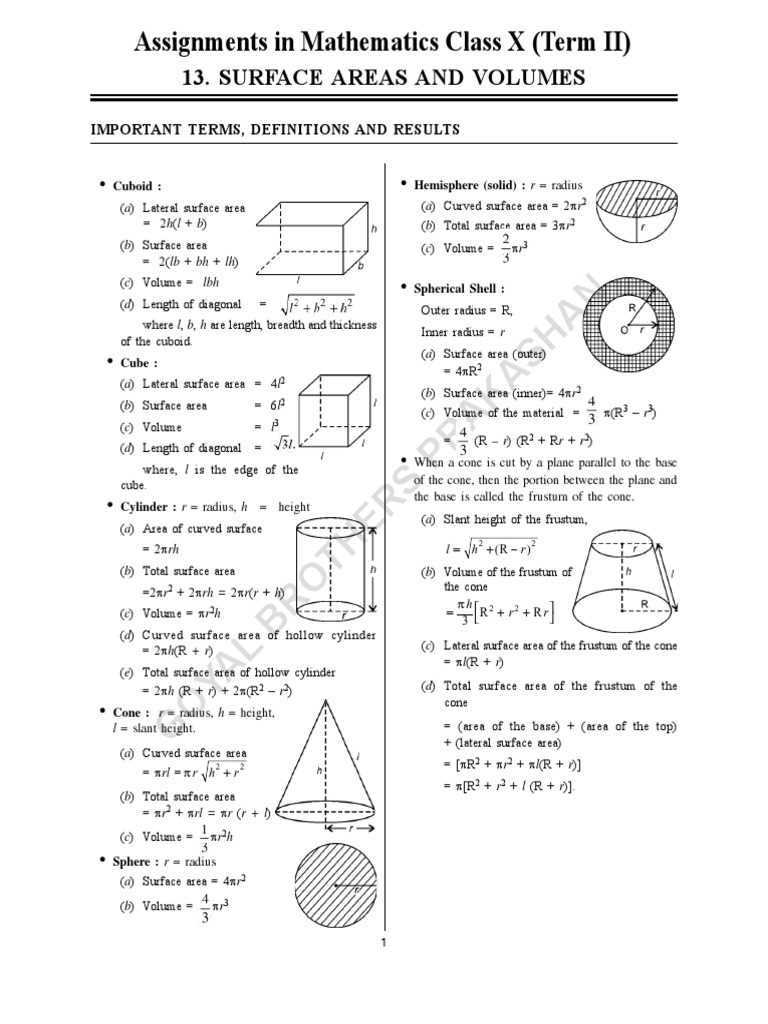
The formula for calculating the external measurement of a curved object requires understanding the relationship between the radius and the total extent around the object. The primary equation for determining this involves squaring the radius and multiplying by a specific constant, which is a fundamental principle in geometry. This simple yet powerful calculation helps you figure out how much material would cover the shape in question if it were a perfect sphere.
For determining the internal holding space, the formula is centered on the radius raised to the third power, then multiplied by another constant. This allows for the determination of the amount of space contained within the object, which is essential for practical applications, such as determining the capacity of spherical containers or volumes enclosed by curved surfaces.
In practice, using these formulas enables quick and accurate evaluations for both theoretical problems and real-world situations. Mastery of these calculations simplifies understanding complex shapes in geometry, helping with everything from basic mathematics to engineering challenges. You can also apply these concepts to various objects found in nature, such as planets or bubbles, further illustrating the wide-reaching utility of these fundamental principles.
Spheres Volume and Surface Calculation Guide
To calculate the result for a sphere, use the following formulas:
For the total surface calculation:
Formula: ( A = 4 pi r^2 )
Where ( r ) is the radius.
To find the result, square the radius, multiply by 4, and then multiply by ( pi ).
For the capacity inside the sphere:
Formula: ( V = frac{4}{3} pi r^3 )
Here, cube the radius, multiply by ( pi ), then multiply by 4/3 to get the internal space amount.
Example 1:
Radius = 5 cm
For surface calculation:
( A = 4 pi (5)^2 = 4 pi times 25 = 100 pi approx 314.16 , text{cm}^2 )
For volume calculation:
( V = frac{4}{3} pi (5)^3 = frac{4}{3} pi times 125 approx 523.6 , text{cm}^3 )
Example 2:
Radius = 10 cm
For surface calculation:
( A = 4 pi (10)^2 = 4 pi times 100 = 400 pi approx 1256.64 , text{cm}^2 )
For volume calculation:
( V = frac{4}{3} pi (10)^3 = frac{4}{3} pi times 1000 approx 4188.79 , text{cm}^3 )
Ensure correct input values, double-check calculations, and apply these steps when solving each problem.
| Radius (cm) | Surface Result (cm²) | Volume Result (cm³) |
|---|---|---|
| 5 | 314.16 | 523.6 |
| 10 | 1256.64 | 4188.79 |
| 7 | 615.75 | 1436.76 |
| 12 | 1809.56 | 7238.23 |
Formula for the Outer Shell of a Sphere
To calculate the external surface of a sphere, use the formula: 4πr², where r represents the radius. This equation expresses the total expanse covering the spherical object.
The radius is the key measurement, which is the distance from the center to any point on the boundary. To apply the formula, square the radius value and multiply by 4π (approximately 12.566). This result gives the full extent of the outer covering.
If the radius is doubled, the total increases by a factor of four. This reflects the quadratic relationship between the radius and the outer size. Therefore, increasing the radius significantly expands the outer dimension.
How to Calculate the Volume of a Sphere
The formula to determine the size of a sphere is: V = (4/3)πr³, where r represents the radius. To begin, measure the distance from the center of the sphere to its surface. This is your radius.
Once the radius is identified, cube this value, then multiply the result by π (approximately 3.14159). Afterward, multiply the result by 4/3 to obtain the final measurement.
For example, if the radius is 5 units, cube it to get 125. Multiply 125 by π (3.14159), which gives approximately 392.699. Then, multiply this result by 4/3, yielding 523.598. This is the total measurement of the sphere’s size.
For more accuracy, use a calculator or mathematical software to ensure the result is as precise as needed. The method works for any sphere regardless of its size.
Step-by-Step Example for Calculation of Outer Measurement
To find the total measurement of a shape, use the formula: 4πr², where r is the radius of the sphere. For example, if the radius is 5 units, apply the following steps:
1. Square the radius: 5² = 25.
2. Multiply the squared radius by π (approximately 3.14159): 25 × 3.14159 = 78.53975.
3. Multiply by 4: 78.53975 × 4 = 314.159.
The total measurement of the outer surface is 314.159 square units.
Step-by-Step Example for Calculating the Volume of a Sphere
To calculate the capacity of a sphere, apply the formula: V = (4/3)πr³, where r is the radius.
1. Measure the radius of the sphere. Suppose the radius is 5 cm.
2. Cube the radius: r³ = 5³ = 125.
3. Multiply by π (approximately 3.1416): (4/3) * π * 125 ≈ (4/3) * 3.1416 * 125 = 523.6 cm³.
The volume of the sphere is about 523.6 cm³. This method ensures precise results, as long as accurate measurements are taken.
For further information, refer to trusted educational sources such as Khan Academy.
Common Mistakes in Calculating Dimensions of a Sphere
Incorrectly applying the radius is one of the most frequent errors. Always verify the radius is correctly identified, as it’s key for all computations. In some cases, the diameter may be given, which requires dividing by two to obtain the radius.
A common misstep involves using incorrect formulas. Ensure the proper formula is used for the specific calculation, such as using the volume formula for surface calculations or vice versa. Mixing up the formulas can lead to major discrepancies in results.
Another mistake is neglecting units. Pay close attention to whether measurements are in centimeters, meters, or other units, and ensure consistency throughout. Converting all units to the same system before starting will avoid mistakes during the calculations.
Rounding errors can also accumulate quickly. Avoid rounding intermediate steps in your calculation; round only at the very end to minimize inaccuracies.
Lastly, confusion between radius and diameter often leads to miscalculations. Ensure clarity on whether the given dimension is the radius or diameter. Incorrectly assuming one when the other is provided can drastically affect the final result.
Using the Diameter to Find Surface Area and Volume
To calculate the total outer coverage and the internal space of a sphere using its diameter, first find the radius by halving the given diameter. Then, apply the following formulas:
- Outer coverage: Multiply the radius squared by 4π. Formula:
4πr². - Internal space: Cube the radius and multiply by 4/3π. Formula:
(4/3)πr³.
These two expressions allow quick calculation of the sphere’s characteristics when only the diameter is known. The diameter is a direct indicator of the sphere’s size, and halving it gives the radius needed to apply these calculations efficiently.
For example, if the diameter is 10 units:
- Radius = 10 / 2 = 5 units.
- Outer coverage = 4π(5²) = 4π(25) ≈ 314.16 square units.
- Internal space = (4/3)π(5³) = (4/3)π(125) ≈ 523.60 cubic units.
Real-Life Applications of Sphere Volume and Surface Area
Understanding the calculations behind the shape’s dimensions is critical in many fields. For instance, calculating the capacity of water tanks involves precise measurement of a rounded container’s internal size. This ensures that tanks are built to hold the required volume for specific needs, whether for industrial, agricultural, or residential purposes.
In sports like basketball, engineers use these formulas to determine the ball’s design specifications. By knowing the exact measurements of the ball, manufacturers can optimize performance characteristics, such as bounce height and stability. This contributes to consistency in the game’s playability across different environments.
Another application can be seen in the aerospace industry. When designing rockets or satellites, designers account for the rounded shape of certain components to ensure aerodynamic efficiency and maximize payload capacity. The proper computation of the object’s size allows for better planning of fuel needs and structural integrity.
In the field of medicine, spherical containers are used to store medical gases like oxygen. Accurate calculations are crucial for ensuring the correct storage pressures and safe transportation of these gases. This prevents accidents and ensures the reliability of medical systems.
In the realm of environmental science, spherical models are employed to study and predict the movement of air masses in the atmosphere. The volume of these models directly impacts how accurately predictions can be made, aiding in the understanding of weather patterns and climate shifts.
How to Check Your Answers with Different Methods
To verify your calculations, apply the following approaches:
- Use the formulae to double-check results: Cross-reference your computations by recalculating with the original equations, ensuring you follow each step precisely.
- Compare with a reliable calculator: Input your values into a scientific or online calculator for a quick verification. Ensure you select the correct formula type.
- Reverse-engineer the numbers: Start from the results and work backward, testing the relationship between the given and the calculated quantities.
- Use approximation: If exact values are cumbersome, estimate using simple rounding techniques to see if the order of magnitude aligns with expectations.
- Visualize the concept: Sketch a diagram or graph to confirm whether the calculated relationships align with the spatial representation of the problem.
- Check units: Always verify that your final results are expressed in the correct units and that unit conversions, if necessary, were handled properly.
By applying one or more of these techniques, you’ll identify errors faster and gain confidence in your results.