Free Fall Laboratory Experiment Solution and Calculation Guide
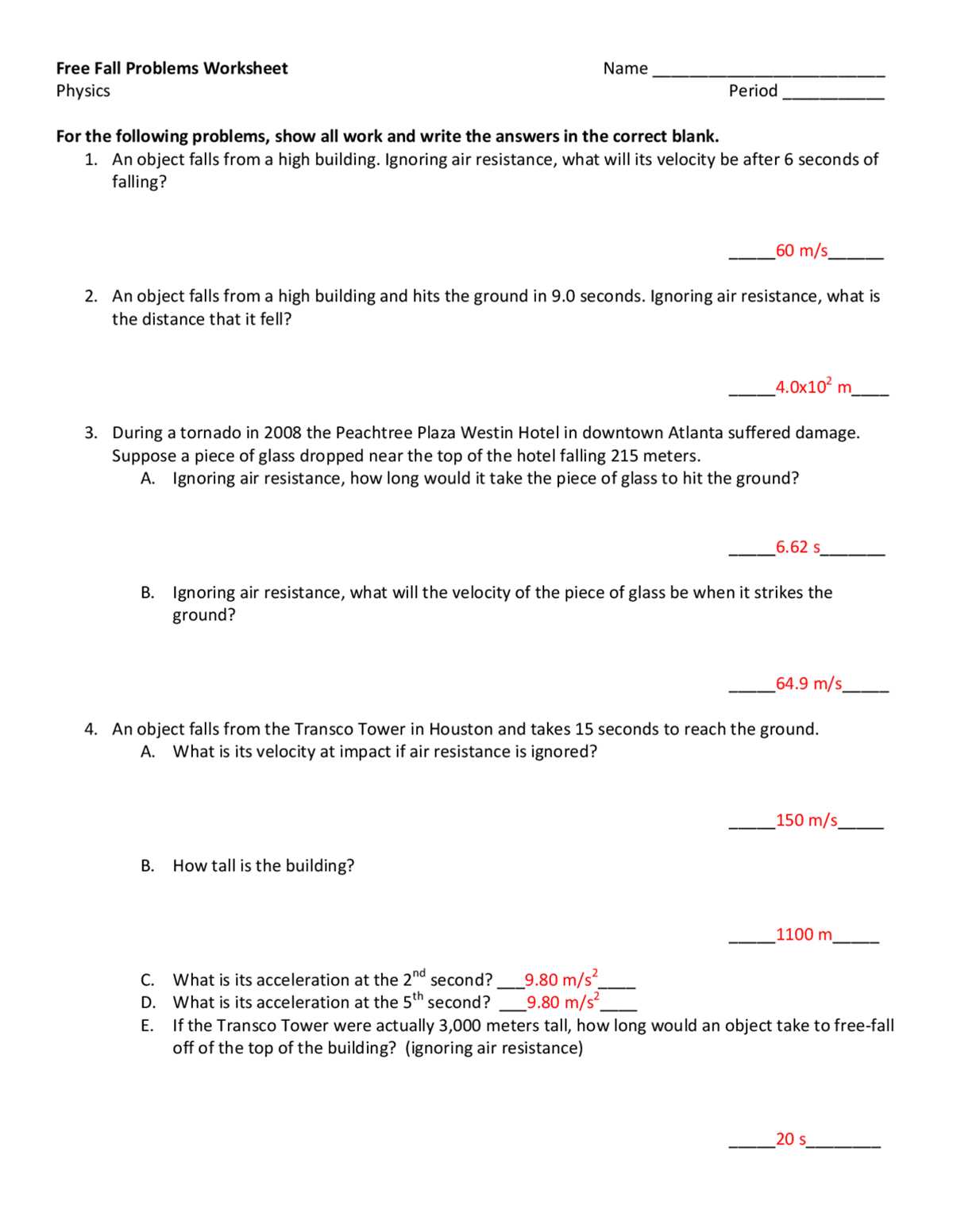
To ensure your experiment is accurate, always begin by carefully checking the experimental setup. Double-check that the height from which the object is dropped is measured precisely. Also, confirm that timing devices are properly calibrated to avoid any errors in recording the object’s descent time.
In analyzing your results, focus on comparing the experimental data to the theoretical value for gravitational acceleration. Pay attention to potential errors caused by air resistance, measurement inaccuracies, or slight deviations in drop height, all of which can influence the outcome. These common variables need to be addressed for more precise results.
The provided solution guide can be used to verify your data and help you identify any mistakes in calculations. Cross-reference your findings with the expected values for velocity and acceleration to confirm the consistency of your experiment. If discrepancies arise, revisiting the procedure and adjusting for common issues like timing delays or measurement inconsistencies can often help resolve them.
Free Fall Laboratory Solution Guide
In order to verify the results from your experiment, check the following steps: Measure the distance the object has traveled accurately using a ruler or measuring tape. Ensure that the timing device used for the fall is synchronized correctly to start with the release of the object and stop when it hits the ground. If possible, use multiple trials to confirm consistency in your measurements.
For calculating acceleration, use the formula: a = (2d) / t², where d is the distance fallen and t is the time taken. Comparing your calculated acceleration to the standard gravitational acceleration of 9.8 m/s² will help identify potential sources of error, such as air resistance or timing inaccuracies.
If your results differ significantly from the expected value, consider checking for common issues like air resistance, angle of drop, or errors in timing mechanisms. Also, review the height measurement to ensure the object fell the correct distance.
For more detailed insights, you can refer to authoritative sources such as PhysLink, which provides extensive resources on physics experiments and calculations.
Understanding the Basic Principles of Free Fall
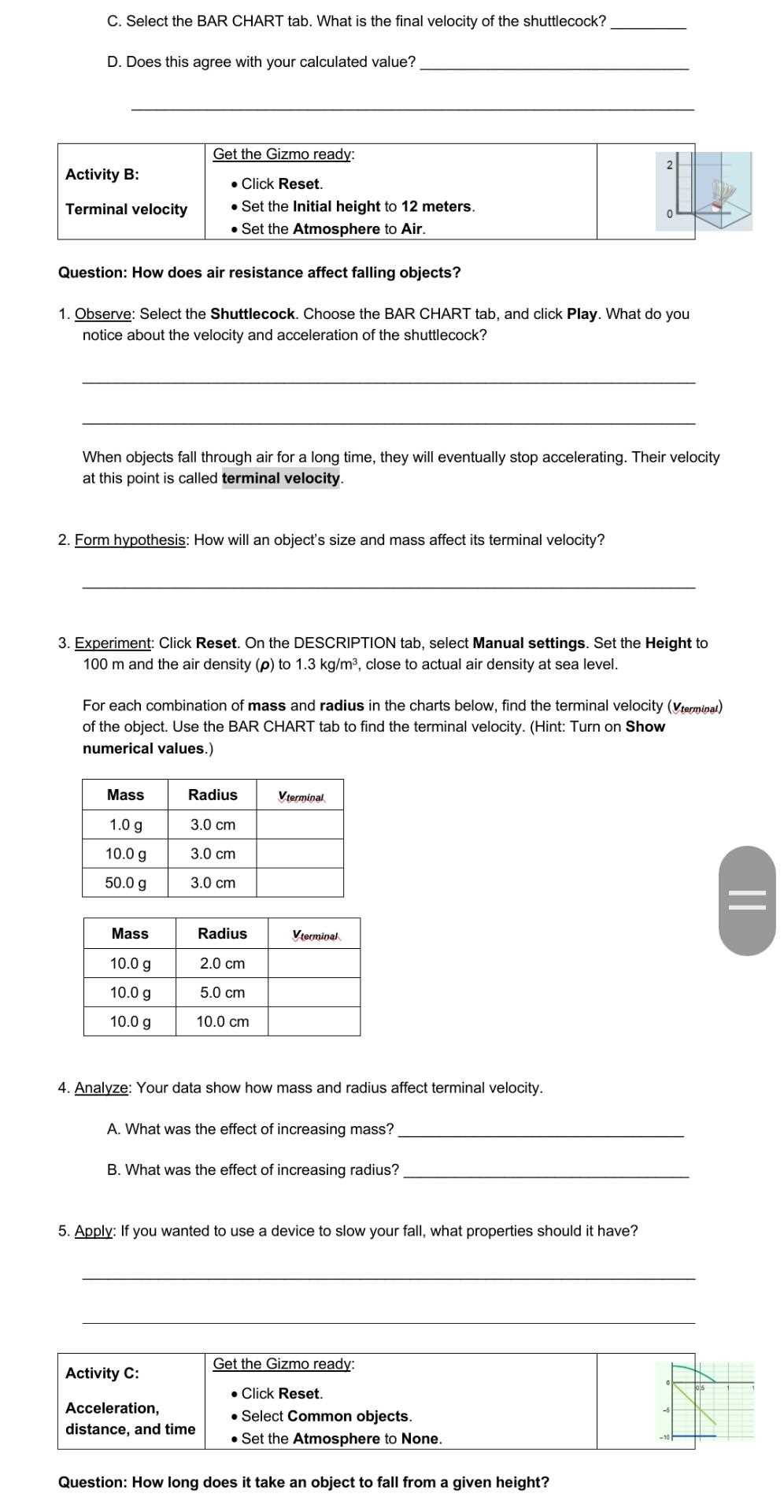
Objects under the influence of gravity alone experience uniform acceleration. This acceleration is denoted by g and is approximately 9.8 m/s² on Earth. It means that for each second an object falls, its velocity increases by 9.8 meters per second, assuming no other forces are acting on it.
During this type of motion, air resistance can be neglected for simplicity, meaning that all objects, regardless of mass, will fall at the same rate. This principle was first demonstrated by Galileo, who showed that heavier objects do not fall faster than lighter ones when other forces are disregarded.
The motion can be described using kinematic equations. For an object dropped from rest, the key equation is: v = g * t, where v is the final velocity, g is the acceleration due to gravity, and t is the time of fall. Another important equation is: d = 1/2 * g * t², where d is the distance traveled during the fall.
By measuring time and distance, you can determine the object’s velocity and acceleration, helping you verify if your results are in line with theoretical predictions.
Setting Up Your Free Fall Experiment for Accurate Results
To ensure reliable data during your experiment, follow these steps for optimal setup:
- Choose the Right Height: Select a height that allows the object to fall for several seconds but is not too high to cause errors from air resistance. A height between 2 and 5 meters is ideal for most setups.
- Minimize Air Resistance: Use a smooth, dense object like a metal ball to reduce the effects of air resistance. Avoid objects with large surface areas that could be affected by wind or drag.
- Accurate Timing: Ensure you have precise timing equipment. Use a stopwatch with a resolution of at least 0.01 seconds or a motion sensor to record the time it takes for the object to fall.
- Measure from a Fixed Point: Measure the distance from the object’s release point to the ground accurately. Ensure the object is released from a fixed height without any initial velocity.
- Repeat Trials: To increase accuracy, perform multiple trials. Record the time and distance for each trial and calculate the average results for better reliability.
- Record Data Consistently: Log the time, height, and distance for each trial. Consistency in data collection is key to minimizing errors and ensuring reproducibility.
Following these guidelines will help you gather precise data and verify your calculations with confidence.
Common Tools and Equipment Used in Free Fall Experiments
To conduct accurate experiments involving gravitational acceleration, these tools are typically required:
- Stopwatch: A precise timing device, often with a resolution of 0.01 seconds, to measure the fall time of the object.
- Measuring Tape or Ruler: Used to accurately measure the distance the object will fall. A measuring tape with clear markings is ideal for ensuring precision.
- Motion Sensor: A sensor that tracks the movement of the object during its descent. It records time and displacement automatically for highly accurate data collection.
- Drop Mechanism: A release device that ensures the object starts from a stationary position with no initial velocity. This can be a simple mechanical release or an electronic trigger.
- Object with Known Mass: The object should have a measurable weight and be dense enough to minimize the impact of air resistance. Common choices include steel balls or small metal disks.
- Level or Plumb Line: Used to ensure the object drops vertically, preventing angular motion that could skew results.
- Camera or Video Recording System: High-speed cameras or video recording equipment can be used to capture the fall and analyze it frame by frame for further precision in timing measurements.
Using the right combination of tools ensures accuracy and consistency in your measurements, leading to reliable conclusions in your study of gravitational motion.
Calculating Gravitational Acceleration from Free Fall Data
To calculate the acceleration due to gravity (g) using data from an object’s descent, follow these steps:
- Step 1: Measure the Time of Descent
Use a stopwatch or motion sensor to record the time (t) it takes for the object to fall a known distance (d).
- Step 2: Record the Distance Fallen
Accurately measure the distance (d) the object travels from its starting point to the point it reaches at the end of the descent.
- Step 3: Use the Kinematic Equation
Apply the following kinematic equation to calculate acceleration (g):
d = (1/2) * g * t²
Rearrange the equation to solve for g:
g = 2d / t²
- Step 4: Plug in Values
Substitute the measured values for distance (d) and time (t) into the equation to calculate the acceleration due to gravity (g).
- Step 5: Analyze the Results
Compare the calculated value of g to the known average value of 9.81 m/s². The accuracy of your result depends on the precision of your time and distance measurements.
Example Calculation:
| Distance (d) (m) | Time (t) (s) | Calculated g (m/s²) |
|---|---|---|
| 4.9 | 1.0 | 9.8 |
By following these steps and ensuring accurate measurements, you can calculate the acceleration due to gravity from free fall data.
How to Interpret Experimental Results in Free Fall Studies
To properly interpret results from an experiment measuring acceleration during a descent, follow these guidelines:
- Check for Consistency:
Ensure that multiple trials show similar results. Large variations in the time of descent may indicate measurement errors or external factors affecting the fall.
- Compare to Theoretical Value:
Compare the calculated acceleration with the expected value of 9.81 m/s². A significant difference may suggest issues with your equipment or methodology.
- Account for Air Resistance:
If your object is large or light, air resistance might play a role, causing the actual acceleration to be lower than the expected value. Ensure the object is compact and dense to minimize this effect.
- Examine Timing Methods:
Verify the accuracy of your timing method, especially if you’re using a manual stopwatch. Small delays in starting or stopping the timer can lead to errors in your results.
- Consider Measurement Accuracy:
Ensure that the distance you measure for the fall is accurate. Using a ruler or measuring tape with precise calibrations will help reduce errors in calculating the acceleration.
- Evaluate Equipment Calibration:
Ensure that all equipment, such as timers or motion sensors, is properly calibrated before use. Faulty calibration can cause incorrect data collection and lead to misinterpretation of results.
- Identify Sources of Error:
Look for potential sources of error, such as uneven surfaces or vibrations during the experiment. These factors can distort the time of descent and affect the accuracy of your results.
- Interpret Trends Over Multiple Trials:
Analyze data from multiple trials to determine if the results follow a consistent trend. Outliers should be carefully examined to ensure they are not due to experimental mistakes.
By following these steps, you can accurately interpret the results of your gravity-based experiments and draw meaningful conclusions based on the collected data.
Addressing Common Errors in Free Fall Measurements
Inaccurate Timing: One of the most frequent mistakes in gravity-based experiments is the inaccuracy of timing. Using a manual stopwatch often introduces delays in starting and stopping, affecting the accuracy of recorded times. To mitigate this, use automatic sensors or digital timers that start and stop with the release of the object.
Incorrect Distance Measurement: Inaccurate measurement of the drop distance can lead to significant errors in calculating acceleration. Ensure the measuring tape or ruler is placed directly beneath the object’s starting point and that the distance is measured precisely from top to bottom.
Neglecting Air Resistance: For lighter or larger objects, air resistance can cause a deviation from the expected results. When conducting these experiments, use small, dense objects that minimize the effect of air drag. Alternatively, ensure that the object’s shape does not significantly affect the descent speed.
Faulty Equipment Calibration: Timers, motion sensors, and other measurement tools must be properly calibrated before use. Faulty calibration can skew the results, leading to incorrect conclusions. Regularly check and calibrate all equipment to avoid errors.
Failure to Conduct Multiple Trials: Relying on a single trial can lead to misinterpretation of the data. Conduct multiple drops and calculate the average to account for random variations in timing and distance measurements. This helps to ensure more reliable results.
Ignoring Systematic Errors: Look for consistent patterns of error. If a particular measurement consistently deviates from the expected value, investigate possible causes such as uneven surfaces, vibrations, or variations in temperature that could affect the timing mechanism or object’s descent.
Human Error in Data Recording: Manual recording of data can sometimes lead to mistakes, such as misreading timers or incorrect unit conversion. Double-check all recorded data and, if possible, use software that automatically logs the results for added accuracy.
Improper Handling of Objects: Improperly releasing the object can introduce initial velocity, which skews the results. Ensure that the object is dropped without any additional force to maintain consistent conditions for each trial.
Verifying Your Results with Theoretical Predictions
Compare Experimental and Calculated Times: After recording the time taken for an object to reach the ground, compare it with the theoretical time predicted using the equation for motion under gravity: d = 0.5 * g * t², where d is the drop distance and g is the acceleration due to gravity (approximately 9.8 m/s²). Ensure the measured and predicted times are consistent.
Calculate Expected Acceleration: Use the formula a = 2 * d / t² to calculate the acceleration. Compare this value with the known gravitational acceleration constant, g = 9.8 m/s². Any significant difference may indicate experimental errors such as timing inaccuracies or equipment calibration issues.
Use Multiple Data Points: To improve accuracy, collect several data points and calculate the average acceleration. Compare this average with theoretical predictions. Variations can arise from experimental setup, air resistance, and measurement errors, so analyzing multiple trials helps minimize inconsistencies.
Check Units and Conversions: Ensure all measurements are in consistent units. Distance should be in meters, time in seconds, and acceleration in meters per second squared. Incorrect unit conversions can lead to discrepancies between measured and predicted results.
Consider Air Resistance: In a real-world experiment, air resistance affects falling objects, especially those with larger surface areas. Compare your results with the ideal case, and if discrepancies occur, try to identify the impact of drag on your measurements. For smaller, denser objects, the effect may be negligible.
Verify Equipment Accuracy: Double-check the calibration of any timing devices, sensors, or measurement tools used in the experiment. Poorly calibrated equipment can skew results and make them deviate from theoretical predictions.
Account for Starting Conditions: Ensure the object is released without any initial velocity or added force. Any additional push or movement will alter the results and cause discrepancies when comparing experimental data with theoretical values.
How to Use the Answer Key to Check Your Calculations
Compare Your Results Step-by-Step: After performing the necessary calculations, check each step against the provided solution. Ensure your method aligns with the calculations in the reference. Look for any errors in basic arithmetic or misunderstanding of formulas.
Cross-Check with Known Values: Validate your results by comparing them with standard values. For instance, if your calculations involve acceleration due to gravity, compare your results with the known value of 9.8 m/s². Any large deviations can indicate errors in measurement or calculation.
Verify Units Consistency: Ensure that the units used in your calculations match those in the solution key. Convert units where necessary, such as changing seconds to minutes or meters to centimeters. Unit inconsistencies are a common source of error.
Revisit Assumptions and Methods: Double-check your assumptions and the methods used in your calculations. If the solution key uses a different approach or assumption, such as neglecting air resistance, compare how this affects the outcome.
Use the Key for Troubleshooting: If your results are different from those in the reference, trace the specific step where your calculation diverges. Often, reviewing the provided solution can point out where you may have made a misstep, whether in data interpretation or formula application.
Validate Significant Figures: Pay attention to the precision used in the reference solution. Ensure your results reflect appropriate significant figures based on the precision of your input data. Rounding errors or over-precision can skew the comparison.
Identify Common Mistakes: The solution key may highlight frequent errors, such as incorrect time measurements or wrong application of formulas. Compare your approach to the key and see if you have made similar mistakes, such as overlooking initial velocities or neglecting certain factors.