How to Write Chemical Formulas Using the Criss Cross Method
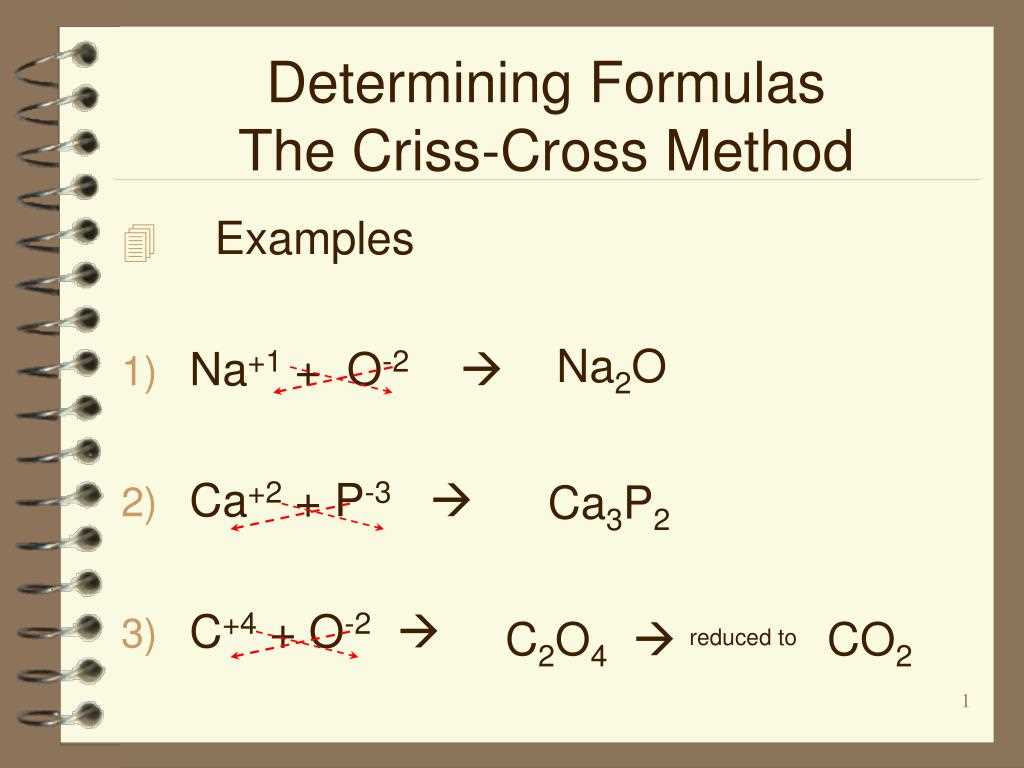
To determine the correct proportions of elements in a compound, use the simple process of balancing charges. Begin by identifying the charges of each ion involved, ensuring you account for their oxidation states. Then, swap the charges between the ions and use them as subscripts for the opposing ion. This technique simplifies the process and ensures accurate results for binary ionic compounds.
For example, in the case of sodium (Na) and chlorine (Cl), sodium has a +1 charge and chlorine has a -1 charge. Swapping these charges results in a neutral compound, NaCl. If the charges differ, such as in calcium (Ca) with a +2 charge and chloride (Cl) with a -1 charge, the ratio is adjusted accordingly, resulting in CaCl2. This method makes it easy to write formulas for compounds without having to memorize complex rules.
By mastering this technique, you can confidently construct chemical formulas for ionic compounds in a few simple steps. Understanding the charge balance between ions is key to correctly representing their proportions and ensuring the compound’s neutrality.
Constructing Chemical Compounds Using the Charge Swapping Technique
To determine the correct proportions of ions in a compound, begin by noting the charge of each ion. The positive ion (cation) and the negative ion (anion) will combine to form a neutral compound. For simplicity, swap the charges between the ions and use them as subscripts for the opposite ion.
For example, if combining sodium (Na) with a +1 charge and chlorine (Cl) with a -1 charge, the charges are exchanged, resulting in NaCl. When combining magnesium (Mg) with a +2 charge and chloride (Cl) with a -1 charge, the charges are swapped, leading to MgCl2.
If the charges are not equal, the subscript for the ion with the higher charge will reflect the magnitude of the opposite ion’s charge. This technique ensures that the compound’s total charge is balanced to zero, providing an accurate and simple way to write chemical compounds.
Understanding the Charge-Swap Technique for Compound Formation
The charge-swap technique simplifies the process of determining how elements combine to form compounds. First, identify the charge of each ion involved. For example, sodium has a +1 charge, while chloride has a -1 charge. The charges are then swapped, using the magnitude of the charge as subscripts for the opposite ion.
When combining ions, the charge of one ion becomes the subscript of the other, ensuring that the total charge of the compound is neutral. In cases where the charges differ, such as magnesium (+2) and chloride (-1), the subscripts will reflect the opposite ion’s charge. Thus, magnesium chloride is written as MgCl2.
This approach provides a clear and systematic way to determine the correct stoichiometry for compounds, ensuring both accuracy and simplicity in chemical nomenclature.
Step-by-Step Guide to Using the Charge-Swap Technique
To apply the charge-swap technique for combining ions, follow these steps:
- Identify the charges: Determine the charge of each ion involved in the compound. For example, sodium (Na) has a +1 charge, while chlorine (Cl) has a -1 charge.
- Swap the charges: Take the magnitude of the charge from one ion and use it as the subscript for the other ion. For example, Na+ and Cl- will become NaCl.
- Balance the charges: If the charges are not equal, adjust the subscripts. For instance, magnesium (Mg) has a +2 charge, while chloride (Cl) has a -1 charge. To balance the compound, the subscript for chloride becomes 2, resulting in MgCl2.
- Write the final compound: After swapping and adjusting the charges, write the chemical formula. Ensure that the compound is electrically neutral. For instance, calcium (Ca) and fluoride (F) form CaF2, as the charges +2 and -1 are balanced with subscripts of 1 and 2, respectively.
Following these steps will give you the correct molecular formula for ionic compounds, ensuring they are balanced and stable.
Common Mistakes to Avoid When Using the Charge-Swap Technique
Avoid these common errors when applying the charge-swap technique to create chemical compounds:
- Incorrect identification of ion charges: Always ensure you correctly identify the charges of both ions. For example, magnesium (Mg) has a +2 charge, and chloride (Cl) has a -1 charge. Misidentifying charges leads to wrong results.
- Swapping the wrong values: The magnitude of the charge should be swapped, not the charges themselves. For instance, if you have calcium (Ca2+) and oxygen (O2-), you swap the numbers to get CaO.
- Overcomplicating simple combinations: If both ions have equal but opposite charges, no subscripts are necessary. For example, sodium (Na+) and chloride (Cl-) simply combine as NaCl, not Na1Cl1.
- Incorrect handling of polyatomic ions: When dealing with polyatomic ions, ensure to keep them in parentheses if their subscripts need to be adjusted. For example, calcium carbonate is written as CaCO3, not Ca(CO3).
- Ignoring charge balance: Always check that the overall compound is neutral. If the charges don’t balance, adjust the subscript numbers until the compound is electrically neutral. For example, magnesium (Mg2+) and chloride (Cl-) combine as MgCl2, not MgCl.
- Misusing Roman numerals for transition metals: Some transition metals require Roman numerals to indicate their charge. For instance, iron(III) means Fe3+, not Fe2+. Always check the correct oxidation state of transition metals.
By avoiding these mistakes, you can correctly apply the charge-swap technique and form the right chemical compounds.
How to Balance Charges When Writing Compounds
To balance charges correctly, first identify the charge of each ion. The total positive charge must equal the total negative charge in a neutral compound. Follow these steps:
- Step 1: Identify the charges of the cation (positive ion) and anion (negative ion). For example, sodium (Na) has a +1 charge, and chlorine (Cl) has a -1 charge.
- Step 2: If the charges are equal and opposite, the ions combine in a 1:1 ratio. For instance, Na+ and Cl- form NaCl.
- Step 3: If the charges are not equal, cross the charges to form subscripts. For example, magnesium (Mg) has a +2 charge, and chloride (Cl) has a -1 charge. Cross the 2 and 1 to form MgCl2.
- Step 4: Check that the total charges balance. For example, magnesium chloride (MgCl2) has a +2 charge from Mg and two -1 charges from the chloride ions, resulting in a neutral compound.
- Step 5: In cases of polyatomic ions, keep them in parentheses if you need to adjust the subscript. For example, calcium carbonate is written as CaCO3, not CaCO3.
By following these steps, you can ensure that the charges are balanced and the compound is neutral.
Examples of Writing Chemical Compounds Using the Criss Cross Method
Below are step-by-step examples that demonstrate how to combine ions using the technique where the charges “cross” to form a balanced compound:
| Example | Step-by-Step Process | Resulting Compound |
|---|---|---|
| Magnesium and Chlorine |
|
MgCl2 |
| Calcium and Oxygen |
|
CaO |
| Aluminum and Sulfur |
|
Al2S3 |
| Potassium and Nitrogen |
|
K3N |
These examples show how the charge values are used to create balanced compounds with appropriate subscripts, ensuring neutrality between the positive and negative charges.
How to Write Chemical Compounds for Ionic Substances Using the Criss Cross Technique
To correctly write the compound for two ionic substances, follow these steps:
- Identify the charges: Determine the charge on each ion involved. For example, sodium (Na) has a +1 charge, and chlorine (Cl) has a -1 charge.
- Swap the charges: Take the absolute value of the charge on each ion and use it as the subscript for the other ion. In this example, Na becomes Cl1, and Cl becomes Na1.
- Simplify the ratio: If the subscripts are the same, they can be omitted or simplified. If the subscripts are different, write them as they are. For instance, Na and Cl both have a subscript of 1, so no subscript is needed for either.
- Write the final compound: Combine the ions with their subscripts to form the compound. The final result for this example is NaCl.
Repeat these steps for each ionic pair you work with. Remember to ensure the charges balance, meaning the total positive charge equals the total negative charge.
Handling Polyatomic Ions with the Criss Cross Technique
When dealing with polyatomic ions, follow these steps to correctly combine them with other ions:
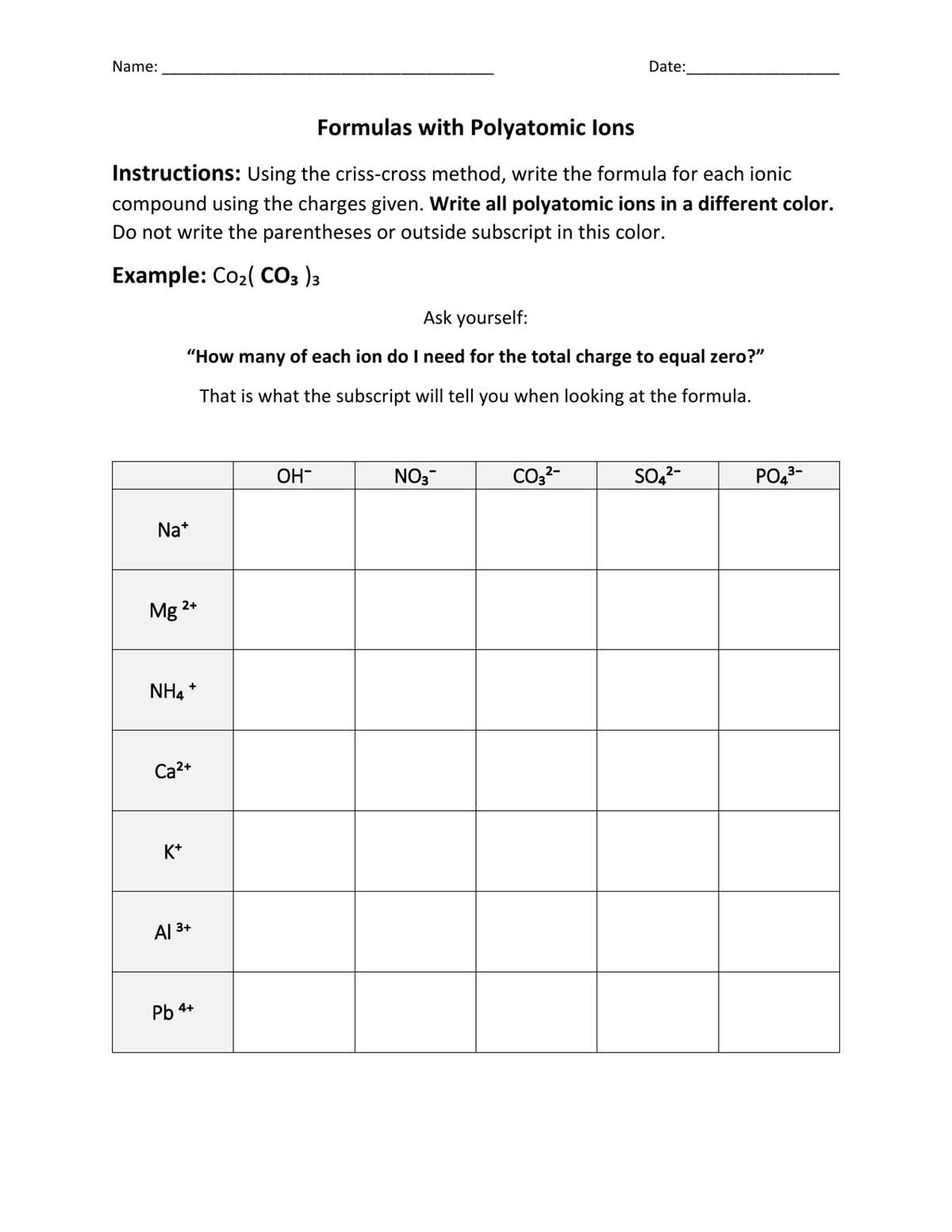
- Identify the charge of the polyatomic ion: Polyatomic ions like sulfate (SO₄²⁻) or ammonium (NH₄⁺) have specific charges. It’s important to remember these charges when applying the technique. For example, sulfate has a -2 charge, while ammonium has a +1 charge.
- Apply the charge swap: Take the absolute value of the charges from both ions and use them as subscripts. For instance, if you’re combining ammonium (NH₄⁺) with sulfate (SO₄²⁻), swap the charges: ammonium gets a subscript of 2 and sulfate gets a subscript of 1.
- Write the formula: Place the polyatomic ion in parentheses if it needs a subscript greater than 1. For the example above, the formula becomes (NH₄)₂SO₄. This ensures that the ammonium ions are counted correctly while maintaining the proper balance of charges.
- Simplify the ratio: If the subscripts can be reduced to a simpler form, do so. For example, if the charges result in a compound where the ratios are 1:1, no parentheses are needed.
For more on polyatomic ions and their uses in chemical reactions, refer to authoritative sources like Chemguide, a trusted educational resource.
Tips for Mastering the Criss Cross Technique in Chemistry
1. Memorize ion charges: The first step in applying this technique is knowing the charges of common ions. For example, sodium (Na) has a +1 charge, and chloride (Cl) has a -1 charge. Keep a chart of common ions for quick reference.
2. Swap and simplify: After identifying the charges, swap them and use them as subscripts. If the result has a common factor, simplify the ratio to its lowest form. For instance, if you combine calcium (Ca²⁺) and sulfate (SO₄²⁻), the subscripts would both be 1, resulting in CaSO₄.
3. Use parentheses for polyatomic ions: When working with polyatomic ions (like nitrate NO₃⁻ or ammonium NH₄⁺), place the polyatomic ion in parentheses if the subscript is greater than 1. For example, combining ammonium (NH₄⁺) and sulfate (SO₄²⁻) gives (NH₄)₂SO₄.
4. Double-check charge balance: Ensure the overall charge of the compound is neutral. The total positive charge should equal the total negative charge. If the charges don’t balance, adjust the subscripts accordingly.
5. Practice with different ions: Experiment with various ionic compounds to build confidence. Practice with simple combinations like NaCl and more complex ones like K₂SO₄ or Mg(NO₃)₂ to reinforce your skills.