Special Right Triangles Worksheet with Step-By-Step Solutions for Common Ratio Problems

Use fixed ratio patterns such as 45–45–90 and 30–60–90 to determine missing sides, relying strictly on established numeric relationships rather than guesswork. This approach removes unnecessary calculations and allows immediate verification of each step.
Apply constant multipliers to each leg or hypotenuse whenever the base figure is scaled. For instance, doubling the shortest segment in a 30–60–90 form requires doubling the other two segments according to their designated proportions, preventing misalignment between expected and calculated values.
Check conclusions against a structured solution guide: compare ratios, confirm unit consistency, and inspect whether each computed value aligns with known geometric rules. This process supports accurate problem-solving across all angle-based forms included in the exercise set.
Special Right Triangles Worksheet with Answer Key
Use fixed numeric ratios–such as 1 : 1 : √2 and 1 : √3 : 2–to compute missing sides without relying on trigonometric functions. Apply each proportion consistently to avoid misalignment between expected and derived values.
- Check every figure for angle labels; a 45–45–90 form always uses equal legs, while a 30–60–90 form assigns the shortest segment opposite the 30° angle.
- Confirm whether each provided measure refers to a leg or a hypotenuse; incorrect placement breaks the ratio structure.
- Rewrite irrational components–such as √2 or √3–only after finishing all multiplications to avoid rounding errors.
- Cross-compare your results against a structured solution set by matching ratios, verifying scale factors, and confirming that no segment violates its designated relationship.
Apply these steps consistently to maintain accuracy across every geometry task that depends on predictable angle-based segment patterns.
Identifying Ratios in 45-45-90 Triangle Tasks
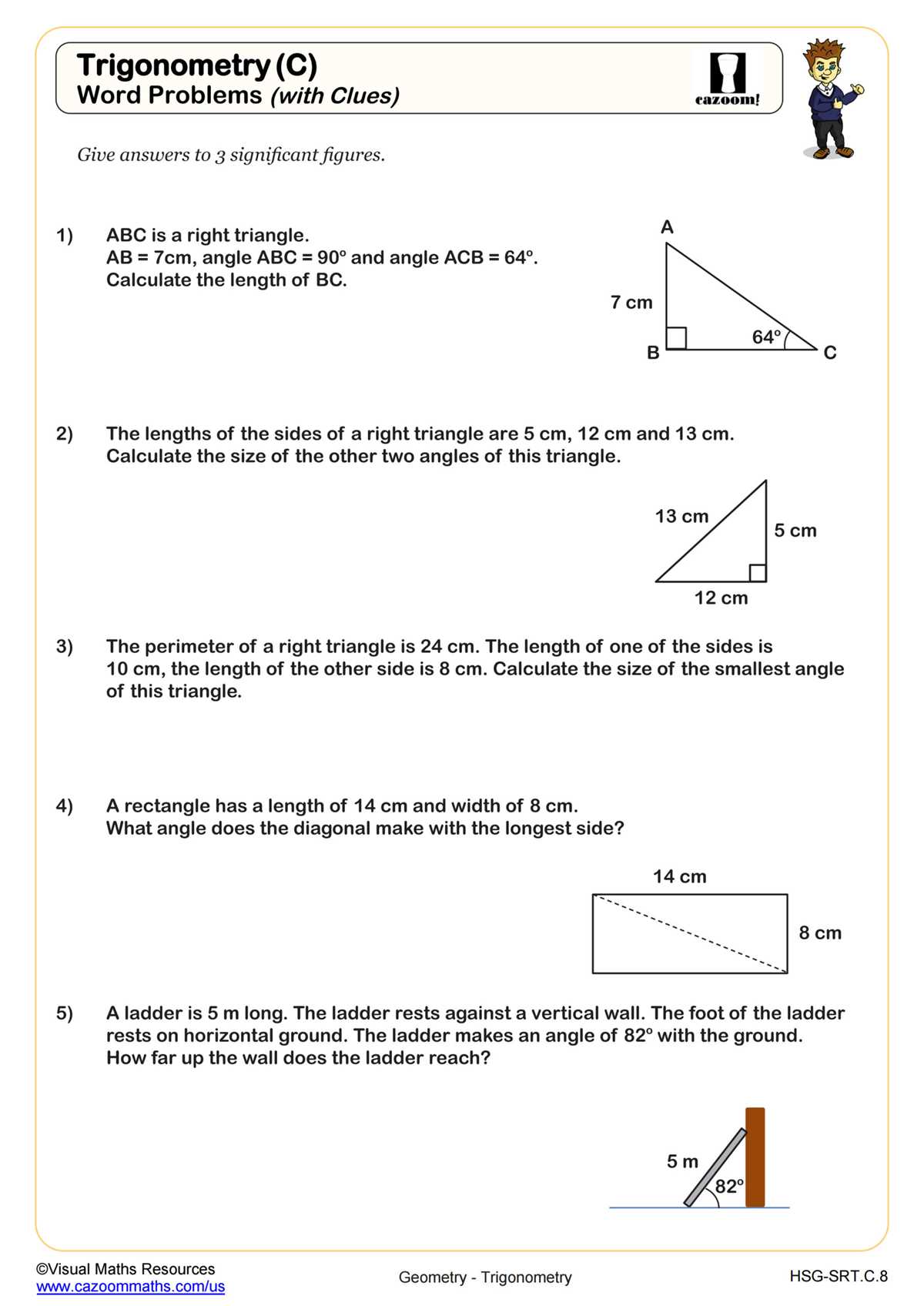
Apply the fixed pattern 1 : 1 : √2 by first confirming that the two legs share identical length; any mismatch signals either a labeling error or an incorrect value in the prompt.
Assign the hypotenuse last by multiplying either leg by √2; avoid rounding until all computations are complete to preserve accuracy, especially when later steps require scale adjustments.
Verify each result by reversing the ratio: divide the hypotenuse by √2 and confirm that both legs match. If the two derived leg values differ, recalc the numbers before proceeding to dependent geometry tasks.
Applying the 30-60-90 Pattern to Solve Missing Sides
Use the fixed proportion 1 : √3 : 2 by first designating the smallest segment as the one opposite the 30° angle; treat this value as the unit from which the other two measures are generated.
Multiply the shortest segment by √3 to obtain the length opposite the 60° angle, and multiply the same baseline by 2 to obtain the longest segment. Avoid rounding until the final numerical expression is required.
Confirm the outcome by reversing the relationships: divide the longest side by 2 to retrieve the smallest, then check that the medium side divided by √3 yields the same baseline.
| Angle Position | Required Ratio | Operation |
|---|---|---|
| 30° | 1 | Assign given shortest segment |
| 60° | √3 | Multiply baseline by √3 |
| Opposite 90° | 2 | Multiply baseline by 2 |
For additional verification of angle–ratio relationships, refer to the geometry resource at https://www.khanacademy.org/math.
Using Pythagorean Relationships to Verify Triangle Outcomes
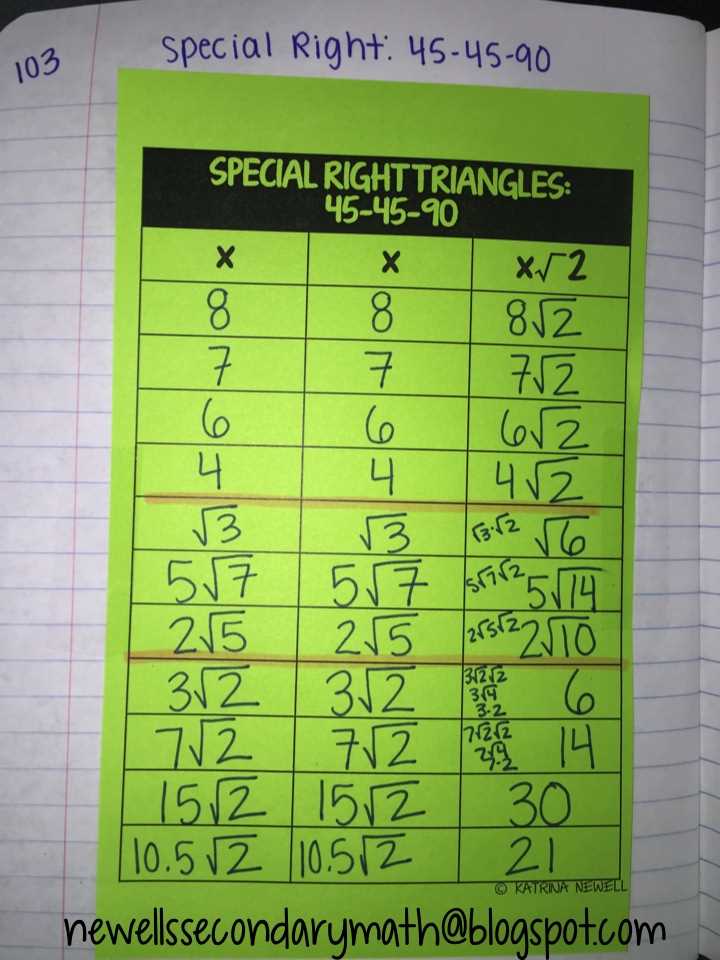
Check the outcome by squaring the two shorter sides and confirming that their sum equals the square of the longest segment; any mismatch indicates an incorrect value assignment.
Rearrange the relationship when the longest part is unknown: compute the square root of the sum of the two smaller squared measures and compare it to the provided length. Reject any result that differs beyond rounding tolerance.
Apply the converse test by verifying that the longest segment exceeds each of the other two and satisfies the inequality constraints before using the squared-sum check.
| Given Data | Operation | Expected Match |
|---|---|---|
| Two short sides | a² + b² | Must equal c² |
| Longest side | c = √(a² + b²) | c must match provided measure |
| All three sides | Check c > a and c > b | Then apply squared-sum test |
Use the verification outline above whenever ratios or angle-based patterns suggest specific side lengths; the Pythagorean form guards against arithmetic slips.
Checking Scale Factor Adjustments for Three-Sided Shape Side Lengths
Confirm proportional changes by dividing each modified segment by its original measure; all ratios must match a single multiplier.
Use a constant factor to project missing segments: multiply every known measure by the same coefficient and verify that no side violates the inequality rules of a three-edge figure.
When comparing two similar forms, compute the factor in both directions. If the ratio from figure A to figure B differs from the ratio from figure B to figure A, the data set is inconsistent.
For quick auditing, apply an inverse factor: if the enlargement uses k, the reduction uses 1/k. Testing both operations helps detect arithmetic slips.
- Identify the proposed multiplier: k = new ÷ original.
- Apply k to all original segments.
- Check that the adjusted values preserve segment inequality rules.
When measurements are decimals, round only after all multiplications to prevent propagation of small errors.
Solving Multi-Step Problems Involving Mixed Patterned Three-Sided Forms
Break each item into segments by isolating every angle set and applying its fixed proportion rules separately before merging results.
- Identify whether a region follows a 45-45-90 ratio or a 30-60-90 ratio, then label the position of the shortest edge, the longer leg, and the stretch opposite the broadest angle.
- Compute each missing measure using its specific proportion:
- For the 45-45-90 setup: leg : leg : outer span = 1 : 1 : √2
- For the 30-60-90 setup: short leg : long leg : outer span = 1 : √3 : 2
- Substitute these derived values into the next section of the problem, particularly when one figure feeds its edge length into another figure’s ratio.
- Confirm that intermediate outputs maintain consistency by rechecking all proportions before proceeding.
Combine sections only after validating edges individually to prevent propagation of miscalculations.
- Use exact radicals until the final step to avoid rounding drift.
- Label shared boundaries clearly when one figure sits adjacent to another.
- Recompute any shared segment from both angle-based structures; mismatched values indicate an earlier arithmetic slip.
Analyzing Common Student Errors in Ratio Application
Prioritize checking whether the smallest edge has been correctly identified before applying any proportional rule, as mislabeling this segment is one of the most frequent sources of incorrect outputs.
One recurring mistake arises from reversing the roles of the short and long legs in the 30-60-90 structure, which typically produces values smaller than required. A quick correction is to compare the computed long leg to the short leg: the long leg must equal the short leg multiplied by √3.
Students also often substitute approximate decimals prematurely. This creates rounding drift that compounds through later operations. Maintaining radicals until the final step preserves accuracy and prevents mismatches during verification.
Another pattern of error appears when learners assign the √2 multiplier from the 45-45-90 setup to the wrong edge. The extended edge in this structure must always be the segment opposite the angle formed by the two equal legs. Rechecking that both legs remain congruent before applying the √2 factor prevents this issue.
Finally, confusion often occurs when transferring a value from one figure to another in multi-stage tasks. Ensure that the shared boundary is clearly labeled and re-evaluated under the correct ratio model before continuing any computation.
Comparing Worksheet Solutions to Standard Geometric Rules
Verify each numeric step by matching it to the proportional model expected for 45-45-90 or 30-60-90 structures; this prevents accepting results that visually appear reasonable yet contradict established ratios.
Check the segment tagged as the shortest value first, as many incorrect solutions stem from assigning the √3 or √2 multiplier to the wrong edge. Align each computed length to the rule set: in a 45-45-90 form, both legs must remain identical, while in a 30-60-90 layout, the shortest leg dictates the scale.
When comparing student outcomes to formal references, highlight discrepancies that originate from rounding too early. Retaining radicals until the closing line maintains consistent alignment between computed values and the standard geometric table.
Cross-reference the final numbers against a trusted ratio chart or instructional guide. This double-check ensures that no segment violates the expected proportional structure and provides a clear distinction between isolated calculation slips and conceptual misunderstandings.
Practicing Real-World Scenarios Involving Special Triangle Ratios
Apply standard ratio sets to scale distances in practical layouts such as ramps, roof frames, or surveying sketches; this ensures each computed segment maintains a consistent proportional base.
Use structured tasks that mirror field applications:
- Estimate ladder reach by pairing the 45-45-90 pattern to a fixed height, then adjusting the leg length through integer or radical scaling.
- Model hillside inclines by matching the 30-60-90 pattern to elevation gain and deriving horizontal displacement through the √3 multiplier.
- Determine cable lengths in support structures by linking the smallest segment to the known side and generating the remaining lengths through the standard ratio progression.
- Translate blueprint drafts into actual dimensions by confirming each scaled segment matches established proportional rules before material calculation.
Integrate mixed scenarios to reinforce adaptability, such as alternating between both ratio sets in a single project plan. This gives students repeated exposure to identifying which pattern applies and prevents reliance on memorization tied only to isolated diagrams.