Molarity Worksheet Answer Key with Detailed Solutions
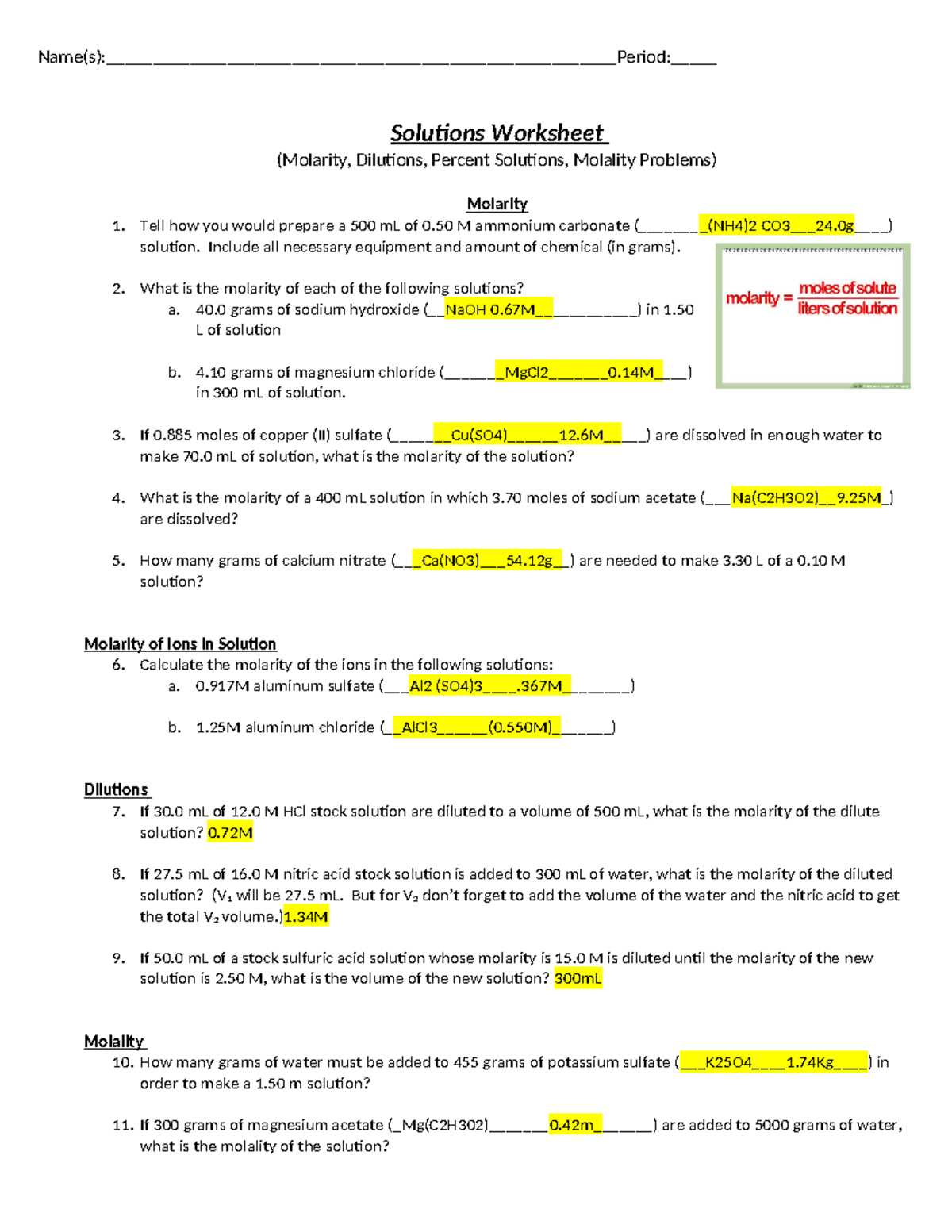
To solve molarity problems, first ensure you understand the formula: molarity (M) = moles of solute / liters of solution. You will need to identify both the amount of solute in moles and the total volume of the solution in liters. Once you have these values, simply divide the moles of solute by the volume of solution to find the concentration.
For example, if you have 0.5 moles of sodium chloride dissolved in 2 liters of water, the concentration is 0.25 M (0.5 moles ÷ 2 liters). Always double-check that your units match, as improper unit conversion can lead to incorrect results.
When working through similar problems, remember that unit conversions are often required. If you are given grams instead of moles, you’ll need to convert the mass to moles using the molecular weight of the substance. For example, if you are given 58.5 grams of NaCl, divide by its molar mass (58.5 g/mol) to get 1 mole. Once you have the moles, proceed with the calculation of concentration.
If the volume is given in milliliters, convert it to liters before calculating concentration. Keep in mind that common mistakes include using incorrect units or misinterpreting the volume of solvent versus solution, which can affect the final answer.
Molarity Problem Solutions and Common Pitfalls
To solve concentration problems correctly, it’s important to first identify the given values and the formula required. For instance, if the problem provides grams of solute, you need to convert them into moles. Multiply the number of moles by the molar mass of the compound to find the required amount. Then, divide this by the total volume of the solution (in liters) to find the concentration.
Example: If you’re asked to find the concentration of a solution made by dissolving 10 grams of sodium chloride (NaCl) in 500 milliliters of water, first convert 10 grams to moles. The molar mass of NaCl is 58.5 g/mol, so 10 grams equals 0.171 moles (10 g ÷ 58.5 g/mol). Next, convert 500 milliliters to 0.5 liters. Finally, divide 0.171 moles by 0.5 liters to get a concentration of 0.342 M.
Common Errors: A frequent mistake is failing to convert the volume of the solution to liters or forgetting to convert grams to moles. Always double-check unit conversions to avoid these mistakes. Another error is assuming that the volume given is the volume of the solvent when it’s actually the total volume of the solution, which can lead to inaccurate results.
Another useful tip is to cross-verify your final result. If the concentration seems unusually high or low for the amount of solute and solvent, revisit your calculations and ensure all values are correct and appropriately converted.
How to Calculate Concentration Using the Formula
To calculate the concentration of a solution, use the formula:
Concentration (M) = Moles of Solute / Volume of Solution (in Liters)
Here’s the process:
- Step 1: Convert the mass of solute to moles if needed. Use the molar mass (g/mol) to perform this conversion.
- Step 2: Measure the total volume of the solution. Ensure the volume is in liters (1 liter = 1000 milliliters).
- Step 3: Divide the number of moles of solute by the volume of the solution in liters to obtain the concentration in mol/L.
Example: If you dissolve 10 grams of NaCl in 500 milliliters of water, first convert the mass to moles using the molar mass of NaCl (58.5 g/mol). This gives you 0.171 moles. Then, convert 500 mL to 0.5 L. Finally, divide 0.171 moles by 0.5 L to get a concentration of 0.342 mol/L.
For more detailed information and examples, you can refer to resources such as LibreTexts Chemistry, which offers comprehensive guides on solution concentrations and related calculations.
Step-by-Step Solution to Concentration Problems
Follow these steps to solve concentration problems accurately:
- Step 1: Identify the given information: the mass of solute, the volume of the solution, and the molar mass of the solute.
- Step 2: Convert the mass of solute into moles using the molar mass. This is done by dividing the given mass by the molar mass.
- Step 3: Convert the volume of the solution into liters if it is not already in liters. Remember, 1 liter = 1000 milliliters.
- Step 4: Apply the formula for concentration: Concentration (M) = Moles of Solute / Volume of Solution (in Liters)
- Step 5: Perform the division to find the concentration.
Example Problem:
Given: 15 grams of NaCl dissolved in 250 mL of water. Find the concentration.
| Step | Calculation | Result |
|---|---|---|
| 1. Convert mass to moles | 15 g ÷ 58.5 g/mol | 0.256 moles |
| 2. Convert volume to liters | 250 mL = 0.25 L | 0.25 L |
| 3. Apply the formula | 0.256 moles ÷ 0.25 L | 1.024 M |
The concentration of the solution is 1.024 mol/L.
Common Mistakes in Concentration Calculations
A frequent mistake in concentration problems is failing to convert units correctly. Always ensure the volume is in liters, not milliliters, before performing calculations. If the volume is given in milliliters, divide by 1000 to convert it to liters.
Another common error is miscalculating the number of moles. When given a mass of solute, always divide by the molar mass of the compound to convert grams to moles. Forgetting this step or using an incorrect molar mass leads to inaccurate results.
Some problems require attention to the difference between the volume of the solution and the volume of the solvent. Be sure to use the total volume of the solution, not just the solvent. This distinction is often overlooked, causing errors in the final concentration.
Double-check that the correct formula is being used. It’s easy to confuse formulas for calculating concentration with other formulas related to different types of solution calculations.
Finally, rounding too early in calculations can lead to significant errors. Keep extra decimal places throughout the steps and round only in the final result to maintain accuracy.
Understanding Concentration in Real-World Applications
Concentration calculations are used in numerous fields, from medicine to environmental science. In pharmaceuticals, precise solution concentrations ensure correct dosages of medication. For example, a doctor may prescribe a specific concentration of an intravenous saline solution, which must be calculated using the volume of solvent and amount of solute.
In environmental science, concentration is used to measure the levels of pollutants in water or air. The amount of a particular chemical in a sample is often expressed in terms of its concentration. For instance, the concentration of dissolved oxygen in water is crucial for assessing the health of aquatic ecosystems.
In chemistry labs, concentration determines how reactive a solution will be in various reactions. Knowing the concentration of a reactant allows chemists to predict the speed and outcome of chemical processes, such as in titration experiments where the concentration of an unknown solution is determined by comparing it to a standard solution.
Similarly, in food and beverage industries, concentration calculations are critical in ensuring the correct strength of syrups, juices, or flavorings. Accurate measurements ensure consistency and safety in the final product.
Converting Between Concentration and Molality
To convert from concentration (mol/L) to molality (mol/kg), you need to use the following relationship:
Molality (m) = Molarity (M) × (Density of Solution in g/mL) / (1000 + (Density of Solution × Molar Mass of Solute))
Follow these steps for accurate conversion:
- Step 1: Determine the molarity of the solution, which is given in moles of solute per liter of solution.
- Step 2: Find the density of the solution, usually given in g/mL. This may be provided in the problem, or it can be found in reference materials.
- Step 3: Obtain the molar mass of the solute, which is required for the final conversion.
- Step 4: Apply the formula above to calculate molality.
To convert from molality to concentration, use the inverse of the formula:
Molarity (M) = Molality (m) × (1000 + (Density of Solution × Molar Mass of Solute)) / Density of Solution in g/mL
Example: If a solution has a concentration of 2 M (moles per liter) and a density of 1.2 g/mL, you can calculate the molality by applying the formula above, once you have the molar mass of the solute.
Interpreting Concentration Problems with Different Units
When solving concentration problems, always check the units of the given data. If the volume is provided in milliliters instead of liters, you must convert it by dividing by 1000. For example, 500 mL becomes 0.5 L. This ensures that the units are consistent with the concentration formula, which requires liters for volume.
If the mass of solute is given in grams instead of moles, convert it to moles by dividing by the molar mass of the solute. For instance, if 10 grams of NaCl is given, divide by its molar mass (58.5 g/mol) to get 0.171 moles. This step is necessary to calculate the concentration accurately.
In some cases, the solution may be described by its molality (mol/kg) instead of concentration (mol/L). To convert from molality to concentration, use the formula that relates the two, taking into account the solution’s density and molar mass. Conversely, to convert from concentration to molality, you must know the solution’s density and perform the appropriate calculations based on the solution’s mass and volume.
Always pay attention to the specific units used in each part of the problem, as errors in unit conversion can lead to incorrect results. Carefully converting between milliliters and liters, grams and moles, or concentration and molality is crucial for accurate calculations.
How to Use Concentration in Titration Calculations
In titration, the concentration of a solution is used to determine the amount of solute in an unknown solution. The formula for titration is:
M1 × V1 = M2 × V2
Where:
- M1 = concentration of the known solution
- V1 = volume of the known solution used in the titration
- M2 = concentration of the unknown solution
- V2 = volume of the unknown solution used in the titration
To solve for the concentration of the unknown solution (M2), rearrange the equation:
M2 = (M1 × V1) / V2
Example: If you know the concentration of a hydrochloric acid solution (M1 = 0.1 M) and use 50 mL of it (V1 = 0.05 L) to titrate 100 mL of sodium hydroxide (V2 = 0.1 L), you can find the concentration of the sodium hydroxide solution (M2) by rearranging the equation:
M2 = (0.1 M × 0.05 L) / 0.1 L = 0.05 M
The concentration of the unknown sodium hydroxide solution is 0.05 M. Always ensure units are consistent, and convert volumes to liters when necessary for accurate results.
Tips for Teaching Concentration Concepts in Chemistry
When teaching concentration calculations, start with a simple and clear explanation of the formula: moles of solute divided by the volume of solution. Ensure students understand the importance of units and conversions, especially when moving between milliliters and liters, or grams and moles.
- Use Real-World Examples: Connect the concept to everyday applications like preparing solutions in the lab, calculating medicine doses, or analyzing pollutant levels in water. These examples make the topic more relevant and engaging for students.
- Introduce Unit Conversion Early: Emphasize the importance of converting volume to liters and mass to moles. Provide practice problems that require these conversions to reinforce the process.
- Demonstrate Step-by-Step Problem Solving: Walk through problems slowly, breaking down each step. Show how to identify the given information, apply the formula, and check units at each stage.
- Incorporate Visuals: Use diagrams and charts to show the relationship between solute, solvent, and solution. Visual aids can help clarify how the concentration changes with different amounts of solute or solvent.
- Use Interactive Activities: Allow students to conduct simple experiments, like preparing solutions of known concentrations and calculating their molarity. Hands-on practice reinforces theoretical concepts.
Lastly, give students plenty of opportunities to practice with different types of problems, including those involving conversions and titration. This will build their confidence and deepen their understanding of the concept.