Understanding the Differences Between Mitosis and Meiosis Worksheet
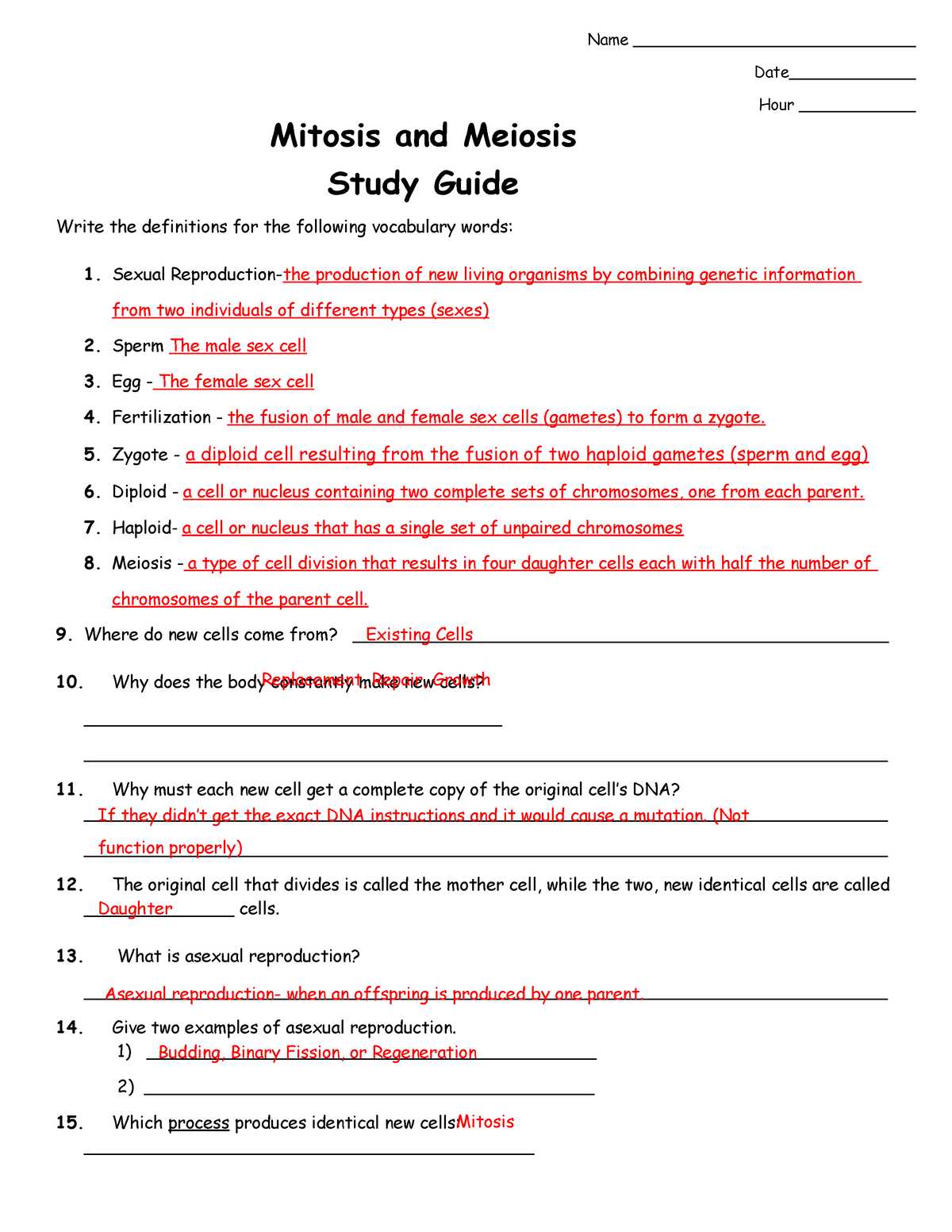
To accurately understand the processes of cell division, it’s crucial to differentiate between two types of division: somatic cell division and reproductive cell division. Both processes are vital for organism growth, repair, and reproduction, yet they operate in distinct ways. This guide provides a detailed comparison to help clarify the steps, outcomes, and significance of each process.
The first process, involving the division of somatic cells, results in two genetically identical daughter cells. The second process, which occurs in gametes, leads to four non-identical cells, each with half the chromosome count of the original cell. By breaking down each step methodically, students can better grasp how these mechanisms contribute to the overall function of living organisms.
This article highlights the key stages, including the roles of chromosomes, genetic recombination, and how each process influences inheritance. Each phase is important in its own right, but understanding the differences ensures that one can apply this knowledge to real-world biological concepts like genetic variation, disease transmission, and cellular repair.
Mitosis versus Meiosis Worksheet Answer Key
To distinguish between the two primary types of cell division, it’s important to focus on key characteristics such as the number of daughter cells produced, chromosome number, and genetic variation. The division of somatic cells produces two identical daughter cells, while reproductive cell division produces four non-identical gametes with half the original chromosome count.
Key differences include:
- Somatic division: One division resulting in two diploid cells, genetically identical to the parent cell.
- Reproductive division: Two divisions that produce four haploid cells, each genetically unique due to recombination during the first division.
- Chromosome reduction: Somatic division maintains chromosome count, whereas reproductive division halves it, which is crucial for sexual reproduction.
- Genetic variation: The second process generates genetic diversity through mechanisms like crossing over and independent assortment.
By understanding these processes, students can grasp how genetic material is passed on and how variations arise, leading to evolution and species development.
Key Differences Between Mitosis and Meiosis
The two types of cellular division differ in purpose, process, and outcome. Below is a comparison of their main differences:
| Characteristic | Somatic Cell Division | Reproductive Cell Division |
|---|---|---|
| Purpose | Growth, repair, and asexual reproduction | Sexual reproduction, formation of gametes |
| Number of Divisions | One division | Two divisions |
| Chromosome Number of Daughter Cells | Diploid (same as parent) | Haploid (half of parent) |
| Genetic Variation | No genetic variation (identical daughter cells) | Genetic variation due to recombination and independent assortment |
| Number of Daughter Cells | Two daughter cells | Four gametes |
| Occurrence | In somatic (body) cells | In reproductive organs |
These differences highlight the critical functions of both processes. Somatic cell division supports organismal growth and repair, while reproductive cell division enables genetic diversity and the continuation of a species.
Understanding the Stages of Cellular Division
The process of cellular division involves distinct phases, each contributing to the proper replication of the cell. These stages ensure that genetic material is accurately distributed into two identical daughter cells. Below is an outline of the key phases:
| Stage | Description |
|---|---|
| Prophase | Chromosomes condense, and the nuclear envelope begins to break down. The spindle fibers start to form, extending from the centrosomes. |
| Metaphase | Chromosomes align at the cell’s equatorial plane, forming the metaphase plate. Spindle fibers attach to the centromeres of chromosomes. |
| Anaphase | The sister chromatids are pulled apart toward opposite poles of the cell, ensuring each daughter cell receives an identical set of chromosomes. |
| Telophase | A new nuclear envelope forms around each set of chromosomes at opposite poles. Chromosomes begin to de-condense, and the spindle fibers dissolve. |
| Cytokinesis | The cytoplasm divides, resulting in two distinct daughter cells, each with a complete set of chromosomes. |
Each of these stages is crucial to ensuring the cell divides properly, maintaining the integrity and function of the organism.
Understanding the Stages of Cell Division for Sexual Reproduction
Cell division for sexual reproduction involves two key processes: the initial division to halve the chromosome number, followed by a second division to ensure genetic variety. Below are the stages of this process:
-
Prophase I
Chromosomes condense and become visible. Homologous chromosomes pair up through synapsis, forming tetrads. Crossing over occurs, where sections of chromatids are exchanged between homologous chromosomes, increasing genetic diversity.
-
Metaphase I
Chromosomes align at the cell’s equatorial plane. The spindle fibers attach to the centromeres of each homologous chromosome in the tetrads.
-
Anaphase I
Homologous chromosomes are separated and pulled toward opposite poles of the cell. Unlike in mitosis, the sister chromatids remain attached during this phase.
-
Telophase I
The separated chromosomes reach the poles, and the cell begins to divide into two daughter cells, each with half the chromosome number of the original cell.
-
Cytokinesis I
The cytoplasm divides, resulting in two haploid cells, each containing one set of chromosomes, but each chromosome still has two chromatids.
-
Prophase II
A new spindle apparatus forms in each of the two haploid cells. Chromosomes, still consisting of two chromatids, begin to move toward the center.
-
Metaphase II
Chromosomes align along the metaphase plate in both haploid cells. Spindle fibers attach to the centromeres of each chromosome.
-
Anaphase II
The centromeres divide, and sister chromatids are separated and pulled toward opposite poles.
-
Telophase II
Chromatids reach the poles and nuclear membranes form around each set of chromosomes, resulting in four distinct haploid cells.
-
Cytokinesis II
The cytoplasm divides again, producing four genetically unique haploid cells, each with a single set of chromosomes.
These stages ensure genetic variation and the reduction of chromosome number, which is critical for maintaining stability in organisms across generations.
How Chromosome Number Changes in Cell Division Processes
During cell division for growth and repair, the chromosome number remains constant. However, when reproductive cells are formed, the chromosome number is halved to ensure the correct number of chromosomes in offspring.
In somatic cell division, the number of chromosomes remains unchanged. Each chromosome replicates, and the cell divides once to produce two daughter cells, each with the same chromosome number as the parent cell. This process maintains the diploid number of chromosomes throughout the organism’s body.
For reproductive cell formation, the chromosome number is reduced by half. Initially, homologous chromosomes pair up and undergo recombination. In the first division, homologous chromosomes separate, resulting in two haploid cells. In the second division, the sister chromatids of each chromosome are separated, resulting in four haploid cells. These cells contain half the number of chromosomes as the original cell, which is critical for maintaining the species’ chromosome number through generations.
The Role of Crossing Over in Genetic Variation
Crossing over is a crucial mechanism during the early stages of reproductive cell formation. It occurs when homologous chromosomes exchange segments of their genetic material. This process takes place during the first division phase, specifically in prophase I, and leads to the recombination of genetic traits between chromosomes from both parents.
By shuffling genetic material, crossing over increases genetic diversity, which is vital for evolution and adaptation. The result is that the offspring inherit a mix of genes from both parents, leading to unique combinations of traits. This is why siblings, even though they share the same parents, can have distinct characteristics.
Crossing over ensures that each gamete contains a unique set of genetic instructions, which is fundamental for maintaining genetic variability in populations. This variability is crucial for the survival and adaptability of species across generations.
For more detailed information on this process, visit Khan Academy’s detailed explanation of crossing over.
Comparing the Outcomes of Cell Division Processes
The outcomes of cellular reproduction processes differ significantly in terms of the number of cells produced and their genetic composition. In the first type of division, a single parent cell divides to produce two identical daughter cells. These daughter cells are genetically identical to the parent cell, maintaining the original chromosome number. This is crucial for growth, tissue repair, and asexual reproduction.
On the other hand, in the second type of division, a single parent cell undergoes two rounds of division, resulting in four non-identical daughter cells. Each of these cells contains half the number of chromosomes found in the parent cell. This reduction in chromosome number is critical for sexual reproduction, ensuring that when two gametes combine, the resulting offspring have the correct number of chromosomes.
Thus, the first process results in two diploid cells, while the second process leads to four haploid cells. The latter introduces genetic diversity through recombination and independent assortment, whereas the first process maintains genetic stability across generations.
Common Misconceptions About Cell Division Processes
One common misconception is that both processes result in identical outcomes. However, while one process produces two identical daughter cells with the same number of chromosomes as the parent, the other results in four genetically diverse cells with half the number of chromosomes.
Another misconception is that both types of division occur in the same way. In reality, one process involves a single division, while the other involves two rounds of division. This distinction is key in understanding how genetic diversity is generated in sexual reproduction.
Many people also believe that genetic variation is only possible in one of the processes. However, both processes have mechanisms that contribute to genetic diversity. In one, genetic material is shuffled during the recombination process, and in the other, variation occurs through independent assortment and crossing over.
Lastly, a frequent misunderstanding is that chromosome numbers are the same after both processes. In fact, one process maintains the chromosome count, while the other halves it, ensuring that sexual reproduction results in offspring with the correct number of chromosomes.
Practical Applications of Cell Division in Genetics
The processes of cell division are central to many genetic applications, especially in the fields of inheritance and genetic diversity. One practical application is in genetic counseling, where understanding how traits are passed down through generations allows for predictions about the likelihood of inheriting genetic conditions.
Another significant area is genetic engineering. By manipulating one of these processes, scientists can introduce or alter specific genes in organisms. For example, techniques like CRISPR often target genes during one of these divisions to either correct genetic disorders or enhance traits in crops.
In agriculture, the processes of cell division help in selective breeding of plants and animals. By understanding how cells divide, breeders can create plants with better resistance to diseases or animals with desirable traits, like faster growth rates or higher yield.
Additionally, in forensic science, the study of these cellular processes plays a key role in DNA profiling. By analyzing the genetic material found in cells, forensic scientists can identify individuals and solve crimes by comparing DNA samples.
In research, understanding the dynamics of genetic recombination during one of these divisions is crucial for advancing cancer therapies. Many cancer cells bypass normal cellular division controls, and knowledge of how cells divide helps in the development of targeted treatments that prevent uncontrolled cell proliferation.