Combining Like Terms and Distributive Property Practice with Solutions
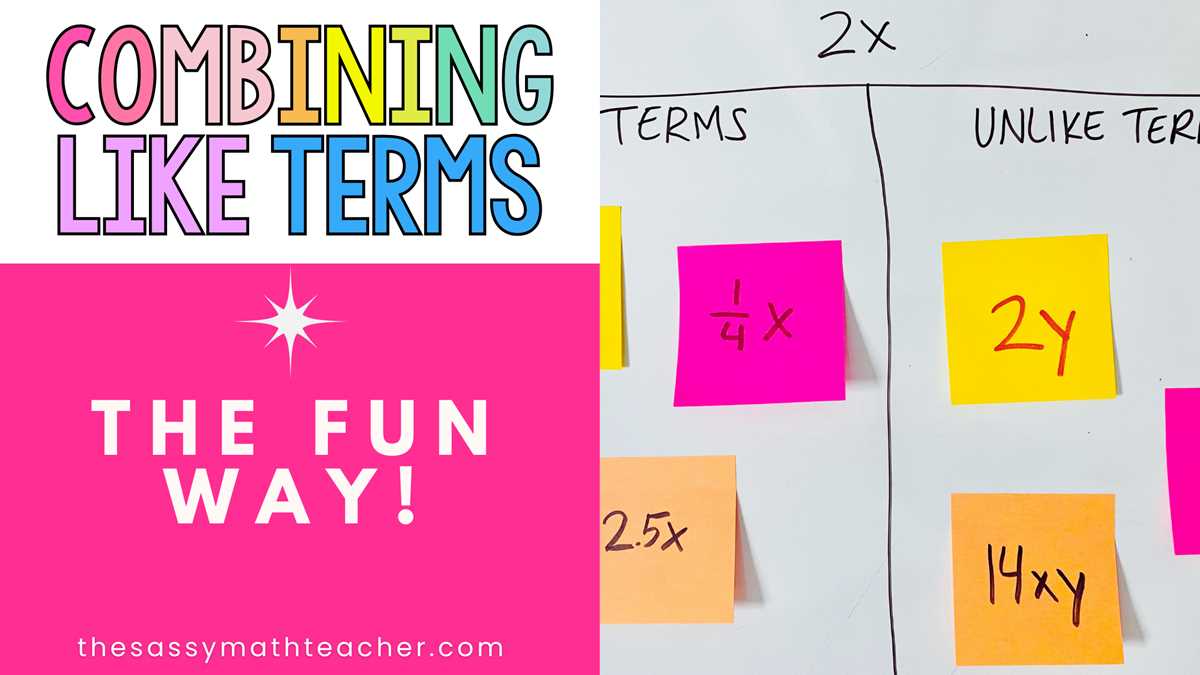
To simplify algebraic expressions, start by grouping similar elements. This process reduces complexity, allowing you to focus on the key components of the equation. Begin by identifying terms with the same variable, ensuring that only identical parts are combined. This step is vital in streamlining any expression.
Next, apply the appropriate mathematical techniques to handle coefficients and constants. Look for factors that can be factored out, or recognize patterns that allow you to condense the equation into a simpler form. Use grouping methods to bring similar components together, making calculations more manageable and straightforward.
After simplifying the terms, verify your results by working backward. This helps catch errors that may have been overlooked in earlier steps. Following a structured approach ensures accuracy, ultimately helping to achieve the correct outcome in any algebraic problem.
Combining Like Expressions and Applying the Distributive Law Practice with Solutions
Here are a few exercises to practice simplifying algebraic expressions. Focus on identifying matching components and applying the appropriate rules for grouping and expanding terms. Each example is followed by a step-by-step solution.
| Exercise | Solution |
|---|---|
| 3x + 4x | Combine the coefficients of x: 3x + 4x = 7x |
| 2(3x + 5) | Apply the distributive rule: 2 * 3x + 2 * 5 = 6x + 10 |
| 5x + 2x + 3x | Combine like components: 5x + 2x + 3x = 10x |
| 4(2x – 3) + 5x | Distribute: 4 * 2x – 4 * 3 + 5x = 8x – 12 + 5x = 13x – 12 |
| 3a + 2b + 4a | Combine a terms: 3a + 4a = 7a, leaving 7a + 2b |
These exercises help you reinforce the understanding of simplifying expressions by grouping identical elements and using the expansion method when necessary. Keep practicing with variations to gain confidence in solving similar problems.
How to Identify Similar Components in Algebraic Expressions
To identify matching components in algebraic expressions, focus on the variables and their exponents. Terms with identical variables and powers are considered to be the same, and can be grouped together for simplification.
For example, in the expression 3x + 5x + 2y, the terms 3x and 5x are similar because they both contain the variable x> with no exponents other than 1. These two can be combined, resulting in 8x + 2y.
Keep in mind the following key points:
- Only terms with the same variable raised to the same exponent can be grouped together.
- Numbers without variables, such as 7 or -3, are considered constants and can be grouped with other constants.
- If a term contains multiple variables (e.g., 2xy), it can only be grouped with other terms containing xy, not just x or y individually.
By following these guidelines, you can successfully identify matching components in any algebraic expression, simplifying the equation for easier calculation or further manipulation.
Step-by-Step Guide for Simplifying Algebraic Expressions
1. Identify matching variables: Look for terms that have the same variable raised to the same power. For example, 3x and 5x can be simplified together.
2. Combine the coefficients: Add or subtract the numerical values in front of the variables. In the example 3x + 5x, you would add the coefficients to get 8x.
3. Leave non-matching components as is: Terms with different variables or exponents cannot be combined. For example, 3x + 2y stays as 3x + 2y.
4. Rearrange the expression: After simplifying, rewrite the expression to ensure it is clear. Place like components together, such as 8x + 2y.
5. Double-check your work: Verify that you’ve only combined terms with the same variable and exponent. If unsure, separate out the terms again and check for any inconsistencies.
Understanding the Distributive Rule in Algebra
The distributive rule states that when a number or variable is multiplied by a sum or difference, you must multiply each term inside the parentheses by the factor outside. This is expressed as:
a(b + c) = ab + ac
Here’s how to apply it:
- Step 1: Identify the number or variable outside the parentheses.
- Step 2: Multiply this factor by each term inside the parentheses separately.
- Step 3: Combine the results to get the simplified expression.
Example: Simplify 2(x + 3).
- Multiply 2 by x: 2 * x = 2x
- Multiply 2 by 3: 2 * 3 = 6
The final simplified expression is: 2x + 6.
It is important to apply the rule carefully, ensuring that every term inside the parentheses is correctly multiplied. Missing a term or incorrectly applying multiplication can lead to errors in your algebraic expressions.
Solving Problems with the Distributive Rule
Follow these steps to solve problems using the distributive rule:
- Step 1: Identify the number or variable outside the parentheses that needs to be distributed.
- Step 2: Multiply this factor by each term inside the parentheses.
- Step 3: Combine the results into a simplified expression.
- Step 4: If possible, further simplify the expression by combining any like terms.
Example: Solve 3(x + 5).
- Multiply 3 by x: 3 * x = 3x
- Multiply 3 by 5: 3 * 5 = 15
The simplified expression is: 3x + 15.
For problems with more terms inside the parentheses, continue to apply the rule to each term. Ensure that every term inside the parentheses is multiplied by the factor outside.
Another Example: Solve 2(x + 4) – 3(x – 2).
- First, distribute the 2: 2 * x = 2x and 2 * 4 = 8.
- Then, distribute the -3: -3 * x = -3x and -3 * -2 = 6.
The expression becomes: 2x + 8 – 3x + 6. Combine like terms: -x + 14.
Keep practicing with different expressions to build your confidence in applying the rule correctly.
Common Mistakes to Avoid in Combining Like Factors
1. Misidentifying terms with different exponents. Always check that the exponents of variables match before grouping them. For instance, 3x and 3x² cannot be combined because their exponents are different.
2. Mixing up signs during simplification. When dealing with negative signs, be extra cautious. For example, in -2x + 3x, the result is x, not -x. Negative signs can easily cause errors in combining expressions.
3. Ignoring constants. Don’t forget to treat constants as their own group. In the expression 5 + 3x – 2, the constants 5 and -2 should be combined first, resulting in 3 + 3x.
4. Treating terms with different variables as similar. Only terms with the same variable and exponent can be combined. For example, 4a + 5b cannot be simplified further because a and b are different variables.
5. Forgetting to apply the distributive rule. Always remember to distribute a factor across all terms inside parentheses. For example, 2(x + 3) should be written as 2x + 6, not just 2x + 3.
6. Failing to double-check your final result. After simplifying, always review your work to ensure that all terms have been combined correctly and no steps have been skipped. Double-checking can help catch small mistakes.
Applying the Distributive Rule to Simplify Expressions
1. Identify the common factor. Begin by recognizing the common multiplier in the expression. For example, in 3(x + 4), the common factor is 3.
2. Multiply each term inside the parentheses. Distribute the factor to every term. For example, in 3(x + 4), multiply 3 by both x and 4 to get 3x + 12.
3. Simplify the result. After distribution, simplify the expression. In 5(2y – 3), distribute to get 10y – 15.
4. Apply multiple distributions when necessary. In cases where there are multiple sets of parentheses, distribute each factor separately. For example, in 2(3x + 4) – 5(2x – 1), distribute both 2 and -5 to get 6x + 8 – 10x + 5.
5. Combine like terms. Once you’ve distributed, combine any similar terms. For instance, 6x + 8 – 10x + 5 simplifies to -4x + 13.
6. Check for common factors after simplification. In some cases, you may be able to factor out a common factor from the entire expression once it’s simplified. For example, 2x + 4y can be simplified further to 2(x + 2y).
Practical Examples of Combining Like Expressions and Applying the Rule
Example 1: Simplify 5x + 3x. Both terms include the variable x, so add the coefficients. The result is 8x.
Example 2: Simplify 7y + 4 – 3y + 2. First, combine 7y and -3y to get 4y. Then combine the constants, 4 + 2, which gives 6. The simplified expression is 4y + 6.
Example 3: Apply the rule to 3(2x + 5). Distribute 3 to both 2x and 5, which gives 6x + 15.
Example 4: Simplify 4(3x – 2) + 2x. Distribute 4 to 3x and -2, resulting in 12x – 8 + 2x. Combine 12x and 2x to get 14x – 8.
Example 5: Simplify 2(4x – 3) + 3(2x + 1). Distribute 2 to 4x and -3, resulting in 8x – 6. Then distribute 3 to 2x and 1, giving 6x + 3. Combine 8x and 6x to get 14x, and combine -6 and 3 to get -3. The simplified result is 14x – 3.
Checking Your Work: Verifying Correctness in Simplified Expressions
To ensure your simplified expressions are correct, follow these steps:
- Recheck Each Step: Review every part of your process. Verify that you added or subtracted coefficients correctly and applied the rule to all terms.
- Substitute Values: Substitute a value for the variable and check if both the original and simplified expressions yield the same result. This will help confirm if your simplification was done correctly.
- Use a Calculator: Use a graphing calculator or an online tool to evaluate both the original and simplified expressions. Compare the results to spot any inconsistencies.
- Ask for Peer Review: If possible, have someone else check your work. A fresh set of eyes may catch errors you’ve overlooked.
- Practice with Examples: Revisit examples from trusted math resources to see how similar problems are simplified.
For more details on algebraic simplifications and checking correctness, refer to educational websites like Khan Academy.