Step-by-Step Solutions for Calculating Molarity in Chemistry
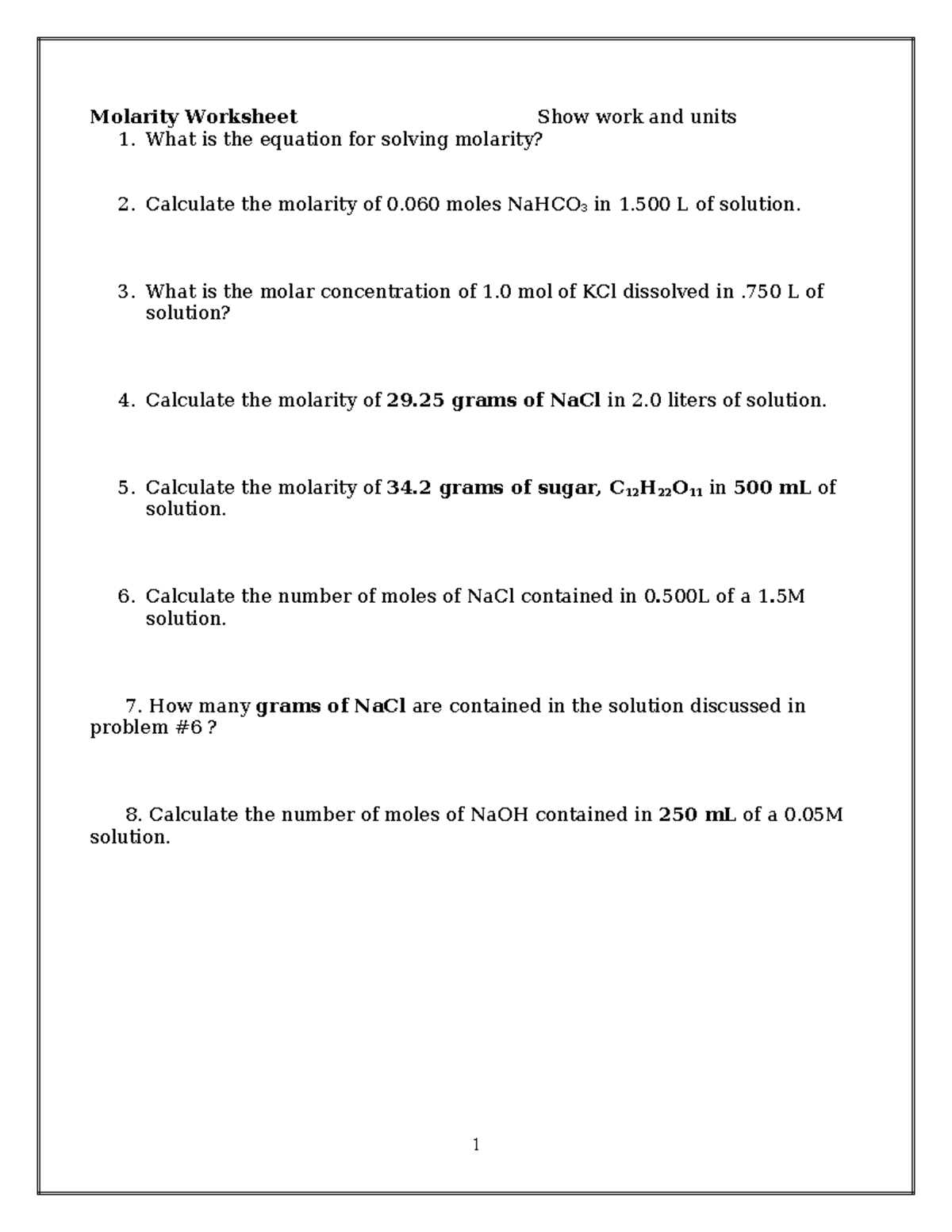
The concentration of a solution is determined by the amount of solute dissolved in a given volume of solvent. To determine this concentration, you can use the formula:
Concentration = Moles of solute / Volume of solution
When solving concentration problems, it’s crucial to convert the mass of solute into moles using the molar mass. This step is necessary to ensure the units of measurement align correctly. Once you have the moles of solute, you can divide by the volume of the solution (in liters) to find the concentration.
Pay attention to unit conversions, particularly converting from milliliters to liters, as this is a common error in many problems. Additionally, be mindful of the molar mass of the solute when performing these calculations. Knowing how to properly approach these steps will significantly improve your accuracy in solving concentration problems.
Throughout this guide, you will find example problems and step-by-step solutions to help reinforce these calculations and ensure you are well-prepared for any related tasks.
Solving Concentration Problems Step-by-Step
To find the concentration of a solution, follow these steps:
- Step 1: Convert the mass of solute into moles using the molar mass of the substance. Use the formula: moles = mass (g) / molar mass (g/mol).
- Step 2: Convert the volume of the solution from milliliters to liters by dividing the volume by 1000 (1 liter = 1000 milliliters).
- Step 3: Apply the concentration formula: Concentration (mol/L) = moles of solute / volume of solution (L).
- Step 4: Ensure the units are consistent (moles and liters) and double-check the calculations for accuracy.
For example, if you have 10 grams of sodium chloride (NaCl) dissolved in 500 milliliters of solution, the steps would be:
- Calculate moles: 10 g / 58.44 g/mol = 0.171 moles.
- Convert volume: 500 mL = 0.5 L.
- Find concentration: 0.171 moles / 0.5 L = 0.342 mol/L.
After performing the calculations, check if the results make sense based on the problem. For more practice, work through additional problems to strengthen your understanding of these steps.
Understanding Concentration and Its Formula
The concentration of a solution is the amount of solute dissolved in a given volume of solvent. It is commonly expressed in moles per liter, which is known as molar concentration. The formula to calculate concentration is:
Concentration (mol/L) = moles of solute / volume of solution (L)
To calculate the concentration, follow these steps:
- First, determine the amount of solute in moles. This can be done by dividing the mass of the solute (in grams) by its molar mass (g/mol).
- Next, convert the volume of the solution from milliliters (mL) to liters (L) by dividing by 1000.
- Finally, divide the number of moles by the volume of the solution in liters to find the concentration in moles per liter (mol/L).
For example, if 5 grams of NaCl (sodium chloride) is dissolved in 250 mL of solution, first calculate the moles of NaCl:
- 5 g ÷ 58.44 g/mol = 0.0855 moles
- Convert volume: 250 mL = 0.25 L
- Concentration = 0.0855 moles ÷ 0.25 L = 0.342 mol/L
This method can be applied to any solution to determine its concentration. Understanding this calculation is critical for preparing solutions with precise concentrations in chemical experiments.
Step-by-Step Guide to Determining Concentration
Follow these steps to determine the concentration of a solution in moles per liter (mol/L):
- Step 1: Calculate the number of moles of solute
Divide the mass of the solute (in grams) by its molar mass (in grams per mole). This gives the number of moles.
- Formula: moles = mass (g) ÷ molar mass (g/mol)
If the volume is given in milliliters, divide by 1000 to convert to liters.
- Formula: volume (L) = volume (mL) ÷ 1000
Now divide the number of moles by the volume of the solution in liters. This gives the concentration of the solution.
- Formula: concentration (mol/L) = moles ÷ volume (L)
Example: If you have 4.5 grams of NaCl (molar mass = 58.44 g/mol) and dissolve it in 200 mL of solution:
- Calculate moles: 4.5 g ÷ 58.44 g/mol = 0.077 moles
- Convert volume: 200 mL ÷ 1000 = 0.2 L
- Calculate concentration: 0.077 moles ÷ 0.2 L = 0.385 mol/L
By following these steps, you can accurately determine the concentration of any solution given the mass of solute and the volume of solvent.
How to Convert Grams of Solute to Moles
To convert grams of a solute to moles, follow these steps:
- Step 1: Determine the molar mass of the solute
- Step 2: Divide the mass of the solute by its molar mass
Find the molar mass of the solute from the periodic table or a reliable source. The molar mass is expressed in grams per mole (g/mol).
Use the following formula to convert grams to moles:
- moles = mass (grams) ÷ molar mass (g/mol)
Perform the division to find the number of moles of the solute.
Example: If you have 20 grams of sodium chloride (NaCl), with a molar mass of 58.44 g/mol:
- moles = 20 g ÷ 58.44 g/mol = 0.342 moles
Thus, 20 grams of sodium chloride is equal to 0.342 moles.
For further reference, you can consult the following reliable source on chemical calculations: ChemBlink.
Using Volume to Determine Molarity
To determine concentration using volume, apply the formula:
concentration (mol/L) = moles of solute / volume of solution (L)
Follow these steps:
- Step 1: Identify the number of moles of solute
- Step 2: Convert volume to liters
- Step 3: Apply the formula
Ensure you have the number of moles of the solute. If not, you can calculate it from the mass of the solute and its molar mass as discussed earlier.
If the volume is provided in milliliters (mL), convert it to liters (L) by dividing by 1000. For example, 500 mL equals 0.5 L.
Insert the number of moles of solute and the volume in liters into the formula:
- Example: For 0.5 moles of solute and 2 L of solution, the concentration is 0.5 mol / 2 L = 0.25 mol/L.
Thus, the concentration of the solution is 0.25 mol/L.
Common Mistakes When Calculating Concentration and How to Avoid Them
1. Forgetting to Convert Volume to Liters
One of the most common mistakes is not converting the volume from milliliters (mL) to liters (L). Always remember that 1000 mL equals 1 L. If the volume is not in liters, the result will be incorrect.
2. Using Incorrect Units for Moles
Ensure that the number of moles of solute is correctly determined. If you use the mass of the solute, convert it to moles by dividing by its molar mass. Not converting mass to moles will lead to inaccurate results.
3. Misunderstanding the Formula
The formula for concentration is moles of solute / volume of solution in liters. Avoid rearranging the formula incorrectly. Keep the units consistent to ensure accurate calculations.
4. Confusing Solute and Solvent
Sometimes, people confuse the solute (the substance being dissolved) with the solvent (the substance doing the dissolving). Always ensure that you’re using the correct substance in your calculations.
5. Incorrectly Rounding Numbers
When performing calculations, round the answer only after completing the entire process. Rounding intermediate values can cause significant errors, especially in long calculations.
To avoid these errors, double-check each step of your work. Verifying units and conversions is key to achieving accurate results.
Examples of Concentration Problems with Solutions
Example 1: Determine the concentration of a solution when 10 grams of NaCl (sodium chloride) is dissolved in 500 mL of water.
Solution: First, convert the mass of NaCl to moles. The molar mass of NaCl is 58.44 g/mol.
10 g NaCl × (1 mol / 58.44 g) = 0.171 mol NaCl
Next, convert 500 mL to liters: 500 mL = 0.500 L.
The concentration is given by the formula: Concentration = moles of solute / volume of solution in liters.
Concentration = 0.171 mol / 0.500 L = 0.342 mol/L
The concentration of the NaCl solution is 0.342 mol/L.
Example 2: Find the volume of 2.5 M HCl solution required to obtain 0.75 moles of HCl.
Solution: Use the formula Concentration = moles / volume, rearranged to Volume = moles / concentration.
Volume = 0.75 mol / 2.5 M = 0.30 L
The required volume is 0.30 L or 300 mL.
Example 3: A student mixes 250 mL of a 3.0 M NaOH solution with 500 mL of water. What is the final concentration of NaOH?
Solution: The total volume of the solution is 250 mL + 500 mL = 750 mL = 0.750 L.
Use the dilution formula: C1V1 = C2V2, where C1 is the initial concentration, V1 is the initial volume, C2 is the final concentration, and V2 is the final volume.
Substitute the known values: 3.0 M × 0.250 L = C2 × 0.750 L
C2 = (3.0 M × 0.250 L) / 0.750 L = 1.0 M
The final concentration of NaOH is 1.0 M.
How to Verify Your Concentration Calculations
Double-check the units: Ensure that all measurements, including mass, volume, and concentration, are in the correct units. For example, convert milliliters to liters or grams to moles as necessary.
Recheck the formula: Make sure that the formula used to calculate the concentration is applied correctly. For concentration, the standard formula is C = n / V, where C is concentration, n is moles of solute, and V is the volume of solution in liters.
Verify the calculation of moles: Confirm that the number of moles of solute is calculated correctly by using the molar mass and the given mass. Moles = mass (g) / molar mass (g/mol).
Perform reverse calculation: To validate your concentration, use the calculated value to find the mass or volume of the solute and check if it matches the initial data given in the problem.
Compare with known values: If possible, compare the result with known standards or reference solutions to ensure the calculation aligns with expected values.
| Step | Action | Example |
|---|---|---|
| 1 | Convert mass to moles | 10 g NaCl × (1 mol / 58.44 g) = 0.171 mol |
| 2 | Convert volume to liters | 500 mL = 0.500 L |
| 3 | Calculate concentration | Concentration = 0.171 mol / 0.500 L = 0.342 mol/L |
Applications of Concentration in Real-World Chemistry Problems
The concept of concentration is critical in various real-life chemical processes. Here are some practical applications:
- Pharmaceuticals: Drug formulation requires precise knowledge of solution concentration to ensure proper dosing and effectiveness. For example, intravenous solutions often have specific molar concentrations for optimal performance.
- Environmental Chemistry: In water treatment, knowing the concentration of contaminants allows for the proper use of chemicals like chlorine or fluoride to purify drinking water.
- Food Industry: Concentration is important for food preservation, such as determining the correct concentration of salt or sugar in brines, syrups, or jams to ensure quality and longevity.
- Chemical Engineering: In industrial processes like polymer production, precise control over reactant concentrations is necessary to maintain reaction rates and product quality.
- Education: Laboratory experiments in schools and universities often rely on accurately prepared solutions. Knowledge of concentration allows students to conduct experiments and understand chemical reactions at a molecular level.
Each of these examples demonstrates how a deep understanding of concentration aids in making precise adjustments and ensuring quality outcomes in various chemical-related fields.