Gummy Bear Osmosis Lab Worksheet Solutions and Explanations
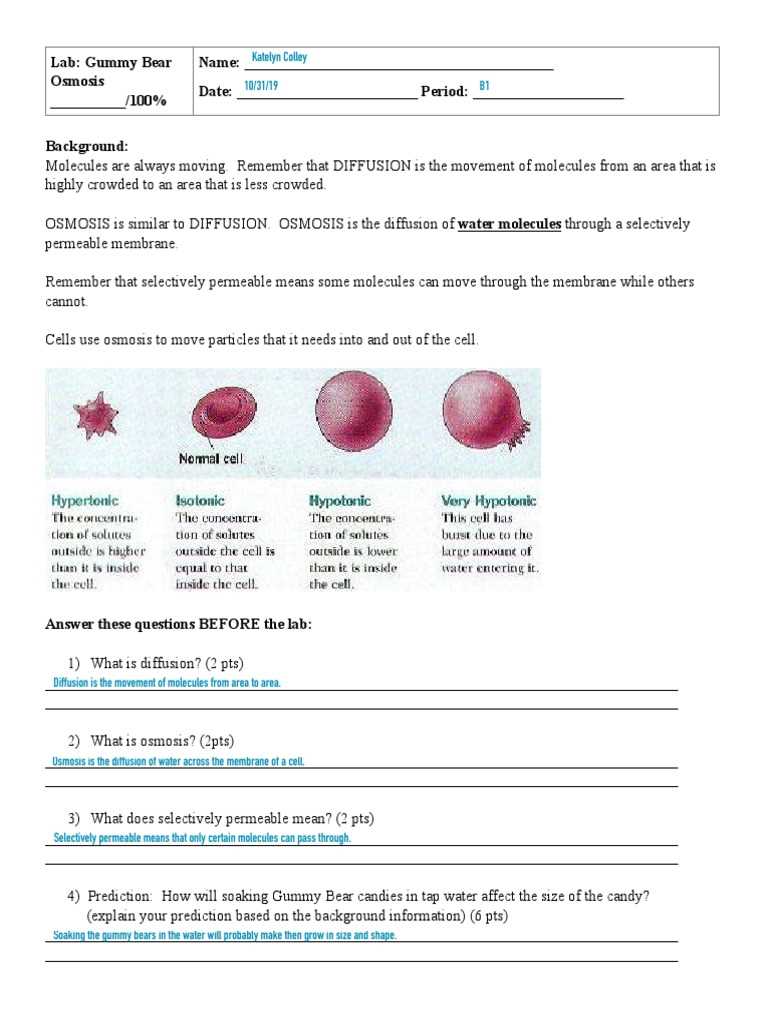
To understand the changes observed in the experiment, start by recognizing that the key factor at play is the movement of water into or out of objects. When conducting the experiment with candy, this principle can be visualized as the absorption of water by the candy. During this process, the candy expands or shrinks based on the surrounding solution’s concentration.
After completing the procedure, focus on analyzing the data you’ve collected. This involves comparing the size changes of the candy before and after immersion in various solutions. Take note of the differences in volume and draw conclusions based on the types of liquids used in the experiment. The changes you observe are a direct reflection of the principles behind the water’s movement across barriers, such as the candy’s gelatin structure.
By following this approach, you can gain a clearer understanding of how solutions with varying concentrations affect the behavior of materials in similar experiments. This will also help in refining your grasp of core concepts related to cell behavior and environmental influences. Keep in mind that accurate data recording is essential for drawing valid conclusions from the experiment.
Gummy Bear Osmosis Experiment Solutions and Explanations
Start by analyzing the changes in size of the candy after immersion in different solutions. If the candy increased in size, this indicates that the surrounding solution had a lower concentration than the candy itself, causing water to move into the candy. Conversely, if the candy shrank, the solution was more concentrated, and water moved out of the candy.
Here are the expected outcomes for different scenarios:
- In a solution with a lower concentration of solutes than the candy, water will enter the candy, making it swell. This happens because water moves from areas of lower solute concentration to higher concentration.
- In a concentrated solution, the candy will lose water and shrink. The higher concentration of solutes outside the candy causes water to leave the candy to balance the solute levels.
- In a solution with the same concentration of solutes as the candy, there should be little to no size change, as the water will move equally in and out of the candy.
To confirm your findings, always measure the candy’s size before and after the experiment. Record these changes in a table format to better visualize how different liquids influence the candy’s size. This step will provide clear evidence of the movement of water and solutes.
For accurate results, ensure that the candy pieces are of uniform size before starting the experiment. Additionally, be sure to use the same volume of solution for each trial to eliminate inconsistencies that may affect your data.
Step-by-Step Guide to Completing the Osmosis Experiment
Begin by preparing your materials. You will need pieces of candy, different concentrations of solutions (such as salt or sugar water), a ruler, and a timer. Measure the initial size of each candy piece before immersion in any solution.
Next, place the candy pieces into separate containers, each filled with a different solution. Make sure the candy is completely submerged in the liquid. Record the exact volume of solution in each container for consistency across trials.
Let the candy sit in the solution for a set period, typically 24-48 hours. During this time, water will either move into or out of the candy depending on the concentration of the surrounding liquid.
After the set time, remove the candy from each solution. Carefully blot away any excess liquid and measure the final size of the candy. Record the measurements in a table for comparison.
Now, calculate the difference in size for each candy. If the candy has increased in size, it absorbed water. If it has decreased, it lost water. Note these results and identify any patterns, such as which solution caused the most swelling or shrinkage.
Finally, analyze the results to understand the movement of water relative to the concentration of the solution. This data will help you interpret how different solute concentrations affect the flow of water across semipermeable membranes.
Understanding the Concept of Osmosis in Sweets
When a piece of candy is placed in a solution, water molecules move in or out of the candy due to differences in the concentration of solutes (like sugar or salt) inside the candy and in the surrounding solution. This process, known as osmosis, is a type of passive transport where water moves from an area of lower solute concentration to an area of higher solute concentration. The candy’s gelatin structure acts as a semipermeable membrane, allowing water to flow in or out based on the surrounding solution’s concentration.
If the candy is placed in a solution with a higher concentration of solutes than the candy itself (hypertonic solution), water will leave the candy, causing it to shrink. If the candy is placed in a solution with a lower concentration of solutes (hypotonic solution), water will enter the candy, causing it to swell. In isotonic solutions, where the concentration of solutes is similar inside the candy and in the solution, there is little to no change in size.
To see this in action, compare the size of the candy before and after immersion in different solutions. The degree of swelling or shrinking can be measured and analyzed to understand how osmosis works in a simple, hands-on way. This experiment provides a clear visual example of how water movement across cell membranes functions in biological systems.
For more detailed information on osmosis and its biological significance, check resources like Khan Academy’s Osmosis Article.
How to Record and Analyze Changes in Candy Size
To accurately track and analyze changes in the size of the candy, follow these steps:
- Measure Initial Size: Before placing the candy in a solution, use a ruler to measure its length, width, and height. Record these dimensions in a table.
- Submerge the Candy: Place the candy in the solution and ensure it is fully submerged. Leave it for the designated period (typically 24-48 hours).
- Measure Final Size: After the immersion time, carefully remove the candy from the solution, pat it dry gently, and measure its dimensions again using the same method.
- Record Data: Write down the final measurements in the same table used for the initial measurements. Make sure to note any changes in shape as well, such as swelling or shrinking.
- Calculate the Change: Subtract the initial measurements from the final measurements to calculate the change in size. Record this in your table, indicating whether the candy increased or decreased in size.
Once you have all your data, analyze the results. If the candy expanded, the solution it was placed in had a lower concentration of solutes (hypotonic), causing water to move into the candy. If the candy shrank, the solution was more concentrated, drawing water out of the candy. This comparison will help you understand the relationship between solute concentration and water movement.
| Solution Type | Initial Size (cm) | Final Size (cm) | Change in Size (cm) |
|---|---|---|---|
| Hypotonic | 2.5 x 2.5 x 2.5 | 3.0 x 3.0 x 3.0 | +0.5 |
| Hypertonic | 2.5 x 2.5 x 2.5 | 2.0 x 2.0 x 2.0 | -0.5 |
| Isotonic | 2.5 x 2.5 x 2.5 | 2.5 x 2.5 x 2.5 | 0 |
By following these steps, you’ll be able to analyze how the candy reacts in different solutions and understand the role of concentration gradients in water movement.
Common Mistakes to Avoid When Completing the Experiment
Ensure consistent measurements by using the same tool for size recording at both the start and end of the process. A different ruler or method can introduce discrepancies.
Avoid incomplete immersion of the item in the solution. If it is not fully submerged, the experiment will yield inaccurate results, as the water will not have consistent access to all parts of the item.
Be cautious with timing. Leaving the item in the solution for too short or too long a period can distort results. Stick to the recommended time and ensure it is the same for each trial.
Do not forget to properly record the initial and final sizes. Failing to document measurements as soon as they are taken can lead to confusion and affect the analysis.
Avoid handling the item roughly. Gently pat it dry before measuring to prevent changes to its size caused by water absorption or loss during handling.
Do not assume that all items behave the same way. Different substances can react differently in the solution, so ensure to account for any variations between different tests or substances.
Ensure your solution concentrations are accurate. Inconsistent or incorrect preparation of the solutions can lead to misleading outcomes and undermine the validity of your results.
Interpretation of Results in the Experiment
If the item increased in size, it indicates that it absorbed liquid from the surrounding environment. This suggests that the concentration of the surrounding solution was lower than the concentration inside the object, causing water to move into it.
If the item decreased in size, it indicates that the liquid inside the object was drawn out into the surrounding solution. This happens when the surrounding solution has a higher concentration than the inside of the object.
In cases where there is no noticeable change in size, it suggests that the concentration of the liquid inside and outside the object was similar, resulting in no movement of liquid into or out of the substance.
Consider how the rate of change in size might vary across different solutions. Stronger or weaker concentrations of solutions will affect the rate at which liquid moves, which can be seen in more rapid or minimal changes in size.
When interpreting the results, take note of the amount of time the item spent in the solution. A longer exposure time can result in greater changes, as the process of liquid movement continues to occur over time.
Be aware of any anomalies or unexpected outcomes. If the results deviate from expected patterns, double-check the experiment’s conditions, such as concentration, timing, and the size of the item to ensure accurate conclusions.
Calculating the Osmotic Pressure in the Experiment
To calculate the osmotic pressure in this experiment, you’ll need to apply the formula for osmotic pressure:
Π = i × M × R × T
Where:
- Π is the osmotic pressure (in atm).
- i is the ionization constant, representing the number of particles into which a solute dissociates in solution. For non-electrolytes like sugar, i is 1.
- M is the molarity of the solution (mol/L).
- R is the ideal gas constant (0.0821 L·atm/(mol·K)).
- T is the temperature in Kelvin (K), which can be found by adding 273.15 to the Celsius temperature.
To calculate osmotic pressure, start by determining the molarity of the solution. This can be done by dividing the number of moles of solute by the volume of the solution in liters. Once you have the molarity, you can substitute the values into the equation to find the osmotic pressure.
In the case of the experiment, you may need to account for the changes in volume and mass of the item. The osmotic pressure will be influenced by the concentration gradient, which is determined by comparing the concentration inside the substance and the surrounding solution. The greater the difference in concentration, the higher the osmotic pressure.
Once osmotic pressure is calculated, you can analyze how the changes in size or mass correlate with the osmotic pressure values. This will help you better understand the relationship between concentration, liquid movement, and osmotic pressure during the experiment.
Visualizing Osmosis Using Gummy Bears: A Practical Approach
To visualize the process of diffusion and water movement, use a simple, hands-on experiment. The procedure outlined below helps demonstrate how substances move through semi-permeable membranes, using items of various sizes as a model. Follow these steps carefully for accurate results.
1. Select the correct size items: Use soft, colorful gelatin-based items. Their size, texture, and ability to absorb liquids mimic the process of diffusion across a membrane.
2. Prepare the solutions: Use different solutions (water, salt, sugar) to create varying concentration gradients. You’ll need to measure each solution’s concentration carefully.
3. Track initial measurements: Measure the initial size and mass of the item. Record these values in a table to compare with the final measurements after the experiment.
4. Submerge the items in the solutions: Place the items into their respective solutions. Let them sit for a specified period, ensuring you allow enough time for the process to take place (usually 24-48 hours).
5. Measure changes: After the time has passed, remove the items from the solution. Re-measure their size and mass. Record the changes. Note how the different solutions affected the item differently.
6. Analyze the results: The change in size indicates how water molecules moved into or out of the items. Compare the item’s final size with the concentration gradient. Items placed in higher concentration solutions will typically shrink, while those in lower concentrations will expand.
7. Interpret the findings: The results will show how substances move across barriers. Higher concentrations cause shrinkage due to water loss, while lower concentrations cause expansion as the items absorb water.
This visual demonstration can help you better understand key concepts related to the movement of molecules, and it can be a fun way to engage with science while reinforcing basic principles.
Cross-Referencing Lab Results with Theoretical Osmosis Concepts
To validate your results, compare the changes in size and mass of the items with the principles of water movement through semi-permeable membranes. Theoretical concepts, such as diffusion and concentration gradients, can be used as benchmarks for analysis.
1. Compare the observed data with diffusion principles: As per diffusion theory, water will move from areas of lower solute concentration to higher solute concentration. If the experiment shows that items in higher concentration solutions shrink, it aligns with this principle.
2. Analyze concentration gradient effects: Items placed in solutions with higher solute concentration will lose water, which matches the prediction that water moves to areas of greater solute concentration. Conversely, those in lower concentration solutions will gain water and expand, confirming the expected behavior of molecules moving toward areas of lower solute concentration.
3. Consider water potential: The concept of water potential can be applied to explain why the results differ depending on the solution. Items placed in solutions with higher osmotic pressure (due to solutes) should shrink, whereas those in lower pressure areas (pure water or lower solute concentrations) will expand.
4. Evaluate changes over time: Osmosis is a gradual process. If the experiment results show a continuous change in size or mass over the course of the experiment, this supports the theoretical model where water moves slowly until equilibrium is reached. Ensure that the measurements are taken at consistent intervals to track this process.
5. Confirm consistency with theoretical models: After completing the experiment, review your results in relation to the expected outcomes of theoretical models. If results do not align, reconsider factors such as the concentration levels used or the size of the items being tested. Understanding these factors will help refine the experimental setup for future trials.
By cross-referencing experimental data with theoretical knowledge, you can strengthen the conclusions drawn and better understand the movement of water across membranes.