Review of Transcription and Translation Processes and Answers
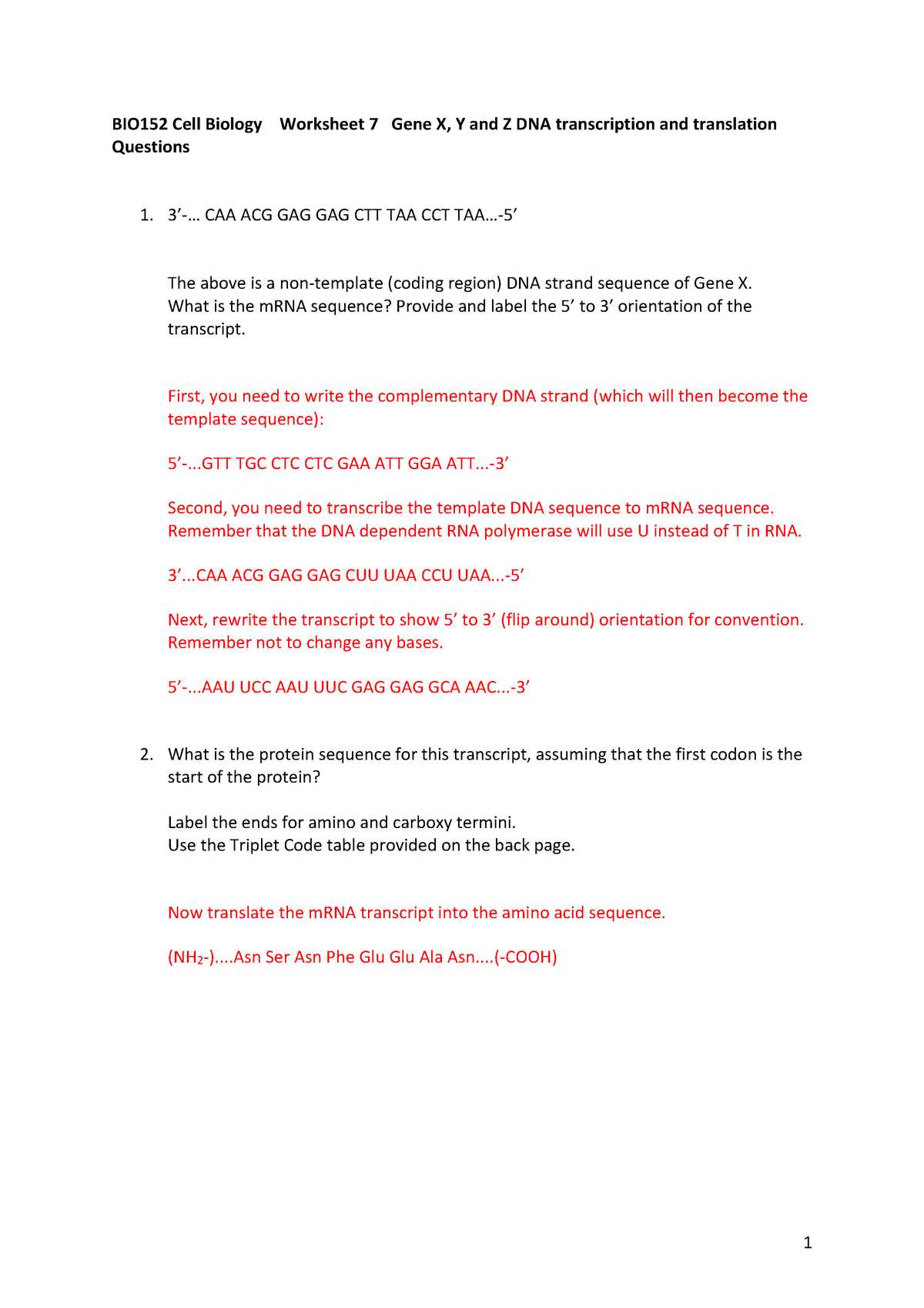
For a clear grasp of gene expression, focus on the sequence of events where DNA is transcribed into RNA and then translated into proteins. The first crucial step involves the conversion of genetic information from DNA to messenger RNA (mRNA), which then carries this information to the ribosomes for protein synthesis.
The process begins with the synthesis of mRNA, which is the template for building proteins. Key enzymes, like RNA polymerase, play a vital role in this process by unwinding the DNA and creating an RNA copy. Once the mRNA is created, it undergoes several modifications before it is ready to be translated.
Next, the mRNA is read by the ribosomes, which act as molecular machines to assemble amino acids into polypeptide chains based on the code carried by the mRNA. The ribosomes interpret the mRNA codons using transfer RNA (tRNA), which matches each codon with the correct amino acid.
Understanding these steps is crucial for recognizing how cells build proteins and regulate functions. A breakdown in any part of this process can lead to various diseases or disorders, highlighting the importance of these molecular mechanisms in both normal cellular function and in the development of biotechnological applications.
Overview of Gene Expression Mechanisms and Their Processes
The process of gene expression begins with the creation of messenger RNA (mRNA) from a DNA template. RNA polymerase binds to the promoter region of a gene and synthesizes an RNA strand that is complementary to the DNA sequence. Once transcription is complete, the newly formed mRNA undergoes modifications such as capping, splicing, and polyadenylation before being transported out of the nucleus.
After the mRNA is processed, it enters the cytoplasm where the next stage, protein synthesis, begins. Ribosomes attach to the mRNA and read its codons, each of which corresponds to a specific amino acid. Transfer RNA (tRNA) molecules bring the appropriate amino acids to the ribosome, where they are added to a growing polypeptide chain, following the sequence dictated by the mRNA.
Understanding this process requires recognizing the critical enzymes involved, such as RNA polymerase during the initial phase and the ribosomes and tRNA during the synthesis phase. Any malfunction in this process can lead to errors in protein production, contributing to diseases such as cancer or genetic disorders.
| Step | Process | Key Components |
|---|---|---|
| Step 1 | DNA to mRNA Synthesis | RNA Polymerase, DNA template |
| Step 2 | mRNA Processing | Capping, Splicing, Polyadenylation |
| Step 3 | mRNA Translation | Ribosome, tRNA, Amino Acids |
| Step 4 | Protein Folding | Polypeptide Chain |
This process is vital for cellular function, as it dictates the synthesis of proteins that perform most of the cellular functions, from structural support to enzyme catalysis. Understanding the stages and their molecular players allows researchers and biologists to manipulate gene expression for therapeutic purposes and scientific advancements.
Understanding the Basics of Gene Expression in Molecular Biology
During gene expression, the first step involves creating a complementary RNA strand from a DNA template. This process is carried out by an enzyme known as RNA polymerase, which binds to a specific region on the DNA known as the promoter. As RNA polymerase moves along the DNA, it synthesizes a pre-messenger RNA (pre-mRNA) molecule, which mirrors the gene’s DNA sequence but with uracil (U) replacing thymine (T).
Once the RNA is synthesized, it undergoes several modifications. These include the addition of a 5′ cap, which helps the RNA molecule to exit the nucleus, and a poly-A tail at the 3′ end, which stabilizes the RNA. Additionally, non-coding regions (introns) are removed, and the remaining coding regions (exons) are spliced together to form the mature mRNA that is ready for translation.
This process is highly regulated to ensure accurate gene expression. Key regulatory elements in the promoter region control the rate of RNA synthesis, while enhancers and silencers in other regions of the genome can influence transcription levels. Understanding these steps provides insight into how cells produce proteins, regulate their function, and maintain cellular processes.
Step-by-Step Guide to the Gene Expression Process
1. Initiation: The process begins when RNA polymerase attaches to a specific region on the DNA called the promoter. This enzyme unwinds the DNA strands to expose the template strand, which will be used for RNA production.
2. Elongation: RNA polymerase proceeds along the DNA template strand, adding complementary RNA nucleotides. The bases on the RNA strand pair with those on the DNA template: adenine (A) pairs with uracil (U), and cytosine (C) pairs with guanine (G). This results in the formation of an RNA chain.
3. Termination: Upon reaching a termination sequence, RNA polymerase detaches from the DNA, and the newly synthesized RNA molecule is released. The DNA strands then reattach to reform the double helix structure.
4. Post-Production Modifications: After the RNA molecule is synthesized, it undergoes several changes. A 5′ cap is added to the beginning of the RNA, and a poly-A tail is added to the 3′ end. These modifications help protect the RNA from degradation and assist with its transport out of the nucleus.
5. Splicing: Introns, or non-coding regions, are removed from the RNA sequence. The remaining exons are joined together to form the final mRNA, which carries the instructions for protein synthesis.
6. Transport to the Cytoplasm: The mature mRNA molecule is then exported from the nucleus to the cytoplasm, where it will be used as a template for protein assembly in the next stage of gene expression.
Key Enzymes Involved in Gene Expression Processes and Their Functions
RNA Polymerase: This enzyme is central to the process. It binds to the promoter region of the DNA and catalyzes the formation of RNA from ribonucleotides, using one strand of DNA as a template. It unwinds the DNA, adding nucleotides to form a complementary RNA strand during elongation.
Helicase: Helicase is responsible for unwinding the DNA double helix ahead of RNA polymerase. This step is vital for exposing the DNA template strand, allowing it to be accessed for the synthesis of RNA.
Topoisomerase: Topoisomerase helps prevent DNA tangling and supercoiling during the process. It alleviates the torsional strain caused by the unwinding of the DNA by making temporary cuts in the DNA molecule, which are later resealed.
Single-Strand Binding Proteins (SSBPs): These proteins bind to the single-stranded DNA as it is unwound by helicase, preventing the DNA from reannealing and ensuring the template strand stays available for RNA synthesis.
Ribonuclease H: This enzyme plays a crucial role in the degradation of the RNA strand in RNA-DNA hybrid regions, particularly in the termination phase of gene expression. It ensures that RNA is correctly separated from the template DNA.
TFIIH: A multi-subunit protein complex, TFIIH is involved in both the unwinding of the DNA and the phosphorylation of the RNA polymerase, which helps to initiate transcription and release it from the promoter.
How mRNA is Processed After Gene Synthesis
5′ Capping: Shortly after the synthesis of the messenger RNA, a cap structure is added to the 5′ end. This 7-methylguanosine cap protects the mRNA from degradation, assists in ribosome recognition during protein synthesis, and facilitates the export of mRNA from the nucleus to the cytoplasm.
Splicing: Non-coding regions called introns are removed from the pre-mRNA, while the coding regions, or exons, are joined together. This process is carried out by the spliceosome, a complex of proteins and RNA molecules. Splicing ensures that the final mRNA sequence contains only the instructions needed for protein production.
3′ Polyadenylation: A poly-A tail, consisting of adenine nucleotides, is added to the 3′ end of the mRNA. This tail increases the stability of the mRNA, facilitates its export from the nucleus, and plays a role in the initiation of translation in the cytoplasm.
Transport to the Cytoplasm: Once processed, the mature mRNA is transported from the nucleus to the cytoplasm through nuclear pores. The cap and poly-A tail are crucial for this transport, as they help the mRNA recognize the nuclear export machinery.
Quality Control: Before leaving the nucleus, the processed mRNA undergoes quality control to ensure that it is properly spliced and fully intact. Only correctly processed mRNA is exported, ensuring the accuracy of protein synthesis in the cytoplasm.
Overview of Protein Synthesis and Its Role in Cellular Function
The process of protein creation begins in the cytoplasm where messenger RNA (mRNA) is used as a template. Ribosomes, the cellular machines responsible for protein production, read the sequence of nucleotides in the mRNA in sets of three, known as codons. Each codon corresponds to a specific amino acid.
Transfer RNA (tRNA) molecules act as adapters, bringing the correct amino acids to the ribosome based on the codons in the mRNA. Each tRNA has an anticodon, a three-nucleotide sequence that pairs with the codon on the mRNA, ensuring the accurate incorporation of amino acids into the growing protein chain.
The ribosome facilitates the formation of peptide bonds between adjacent amino acids, linking them into a polypeptide chain. As the ribosome moves along the mRNA, this chain elongates until a stop codon is reached, signaling the end of protein synthesis.
Once synthesized, the polypeptide chain undergoes folding and modifications, such as phosphorylation or glycosylation, which are critical for the protein’s final structure and function. Proper protein folding is essential for maintaining the protein’s activity and stability within the cell.
This entire process plays a fundamental role in cellular function, as proteins are involved in virtually every cellular activity, from catalyzing biochemical reactions to providing structural support and regulating gene expression.
The Machinery Behind Protein Synthesis: Ribosomes, tRNA, and Codons
The ribosome is the central component in protein creation, serving as the molecular machine that reads messenger RNA (mRNA) sequences and assembles amino acids into a polypeptide chain. It consists of two subunits, a large subunit and a small subunit, each responsible for different aspects of protein synthesis. The small subunit binds to the mRNA, while the large subunit facilitates the formation of peptide bonds between amino acids.
Transfer RNA (tRNA) acts as a bridge between the mRNA sequence and the corresponding amino acids. Each tRNA molecule has a specific anticodon that pairs with a codon on the mRNA, ensuring that the correct amino acid is incorporated into the growing protein chain. The tRNA also carries the amino acid that matches the codon it recognizes, playing a key role in translating genetic information into a functional protein.
Codons are the fundamental units of the genetic code. A codon is a sequence of three nucleotides in mRNA, each corresponding to one specific amino acid. For example, the codon “AUG” codes for methionine, the first amino acid in many proteins. The ribosome reads these codons sequentially, directing the tRNA molecules to deliver the appropriate amino acids, ensuring the correct sequence of amino acids for the protein.
As the ribosome moves along the mRNA, the tRNAs continuously deliver amino acids, and peptide bonds form between them. This process continues until a stop codon is encountered, signaling the end of the protein synthesis. The protein chain then detaches, and the newly synthesized protein undergoes further modifications to reach its final, functional state.
Common Errors in Molecular Processes and How to Address Them
One common issue during the gene expression process is mismatched nucleotides. This can occur when RNA polymerase mistakenly adds the wrong nucleotide, resulting in an incorrect mRNA sequence. To minimize errors, careful proofreading mechanisms such as RNA editing exist. Using highly accurate enzymes for transcription also reduces the likelihood of mismatches. Regular monitoring of these processes is key in ensuring high fidelity in gene expression.
Another frequent issue is premature termination. This happens when the process is stopped before the full mRNA sequence is transcribed, which can occur due to faulty signals or interference with transcription machinery. Preventing this requires accurate signaling systems and the involvement of regulatory proteins that ensure proper initiation and elongation of the mRNA strand. Regular checks of promoter regions and terminator sequences can also help address this issue.
Errors during the protein synthesis phase, such as incorrect amino acid incorporation or skipping codons, can arise if tRNA mismatches occur. This may lead to malfunctioning proteins that do not perform their biological roles effectively. To reduce these errors, accurate matching of tRNA anticodons to mRNA codons is critical. Additionally, using high-fidelity ribosomes and minimizing the occurrence of faulty tRNA or mRNA will ensure more accurate protein production.
Gene mutations, such as point mutations or deletions, can also lead to incorrect protein synthesis, which can have severe biological consequences. Regular sequencing and monitoring of genetic material can help in identifying and correcting these mutations before they lead to significant issues. Utilizing gene-editing technologies like CRISPR is a promising solution for addressing such problems at their source.
For further details on common errors and their impact on molecular processes, you can refer to trusted sources such as NCBI (National Center for Biotechnology Information).
Practical Applications of Gene Expression in Biotechnology
In biotechnology, understanding the molecular processes that convert genetic information into functional proteins has numerous practical applications, from producing therapeutic proteins to developing genetically modified organisms (GMOs). One key use is in the production of recombinant proteins, such as insulin or growth factors, for medical treatments. By inserting a gene of interest into a host organism’s genome, these proteins can be produced in large quantities for therapeutic purposes.
Genetic engineering is another area where these processes are widely applied. For example, plants and animals can be modified to express specific proteins, enhancing their resistance to disease or improving crop yields. In genetically modified crops, genes responsible for beneficial traits are transferred into the plant’s DNA, allowing for traits like drought resistance or improved nutritional content.
In the field of synthetic biology, researchers can design custom biological systems that mimic natural processes. This includes the creation of synthetic gene networks that produce valuable compounds like biofuels or pharmaceuticals. By understanding how cells read and process genetic information, scientists can engineer microorganisms to produce these compounds efficiently, reducing the reliance on traditional chemical synthesis methods.
Gene expression technologies are also used in diagnostics, where detection of specific biomarkers can lead to the identification of diseases at early stages. By designing probes that target mRNA from a specific gene, diagnostic tests can be developed to detect cancer, viral infections, or genetic disorders.
Furthermore, CRISPR-Cas9 technology has revolutionized gene editing. By harnessing the cell’s natural repair mechanisms, CRISPR allows precise modifications to DNA, enabling corrections to genetic mutations that cause diseases. This gene-editing tool has immense potential for treating genetic disorders by directly repairing the faulty genes responsible for these conditions.
For more information on these applications, refer to reliable resources like GenomeWeb.