Directional Terms Review Worksheet Solutions and Explanations
To accurately describe the location of structures within the human body, it’s critical to use standardized language that conveys position, orientation, and relationship to other parts. Familiarity with these anatomical concepts allows for precise communication in both medical and educational settings.
The most common approach involves using specific reference points and terminology that clearly indicate the location or direction of one body part relative to another. Whether you’re working in a clinical environment or studying human anatomy, mastering this vocabulary is fundamental for describing spatial relationships effectively.
As you work through exercises and examples, focus on understanding how these reference points–such as superior, inferior, anterior, and posterior–are applied in different scenarios. Recognizing the importance of these terms will allow you to interpret anatomical descriptions and communicate more clearly in both practical and theoretical contexts.
Solutions and Explanations for Anatomical Position Exercises
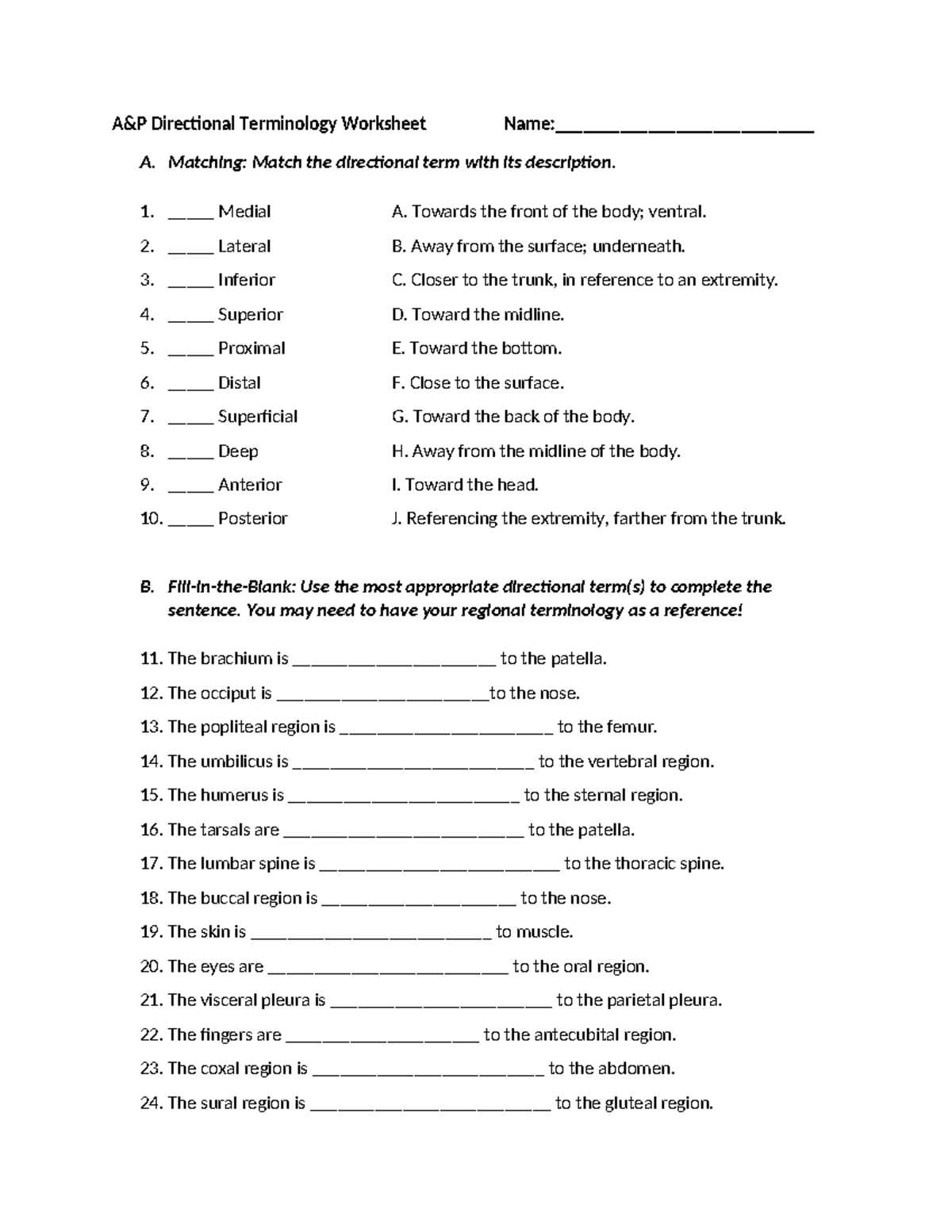
When identifying the correct orientation of the body or its parts, it is key to associate each reference with a corresponding directional term. Below is a detailed breakdown of how to approach each exercise correctly, with explanations for the correct responses.
| Exercise | Correct Response | Explanation |
|---|---|---|
| 1. The heart is ___ to the lungs. | Medial | The heart is located towards the midline of the body, while the lungs are on either side, making the heart medial to the lungs. |
| 2. The toes are ___ to the knee. | Distal | Distal refers to being farther from the body’s midline or point of attachment. The toes are farther from the knee, making them distal. |
| 3. The nose is ___ to the eyes. | Medial | The nose is positioned closer to the midline of the body, whereas the eyes are lateral to it, making the nose medial to the eyes. |
| 4. The ears are ___ to the nose. | Lateral | The ears are positioned on the sides of the head, which makes them lateral to the nose, which is at the center. |
| 5. The spine is ___ to the stomach. | Posterior | The spine is located on the back of the body, while the stomach is in the front, making the spine posterior to the stomach. |
Each of these terms helps clarify the relative position of structures in the body, providing a clearer understanding of spatial relationships between body parts. As you practice, pay attention to the orientation of each part and its proximity to other structures to strengthen your knowledge of anatomical terminology.
Understanding the Purpose of Anatomical Orientation in Body Positioning
In anatomy, clear communication is key to describing the position of body parts. These reference points are used to describe where one structure is in relation to another, ensuring accuracy in both verbal and written descriptions. The primary function of these references is to provide clarity, especially when discussing complex interactions between organs and tissues.
Without consistent terminology, understanding the relationship between different structures would become challenging. These references allow healthcare professionals, scientists, and students to precisely locate anatomical structures, both in the living body and in anatomical diagrams. For instance, using words like “superior” or “proximal” ensures that both the person describing and the listener have a shared understanding of the location being discussed.
Additionally, these references help in identifying abnormal conditions or injuries. If a doctor needs to communicate the location of a wound, a tumor, or an infection, these terms allow for a quick and accurate description. For example, stating that a wound is “distal to the elbow” gives clear information about its position relative to the joint, avoiding confusion.
Understanding these references not only aids in communication but also improves your ability to visualize how body systems are interconnected. Mastering these basic concepts will strengthen your knowledge of anatomy and enhance your ability to describe anatomical positions with confidence.
Common Anatomical Positioning References and Their Definitions
Understanding the following positioning references is crucial for accurately describing locations and relationships between structures in the body:
- Superior: Refers to a structure that is closer to the head or higher than another part. For example, the head is superior to the neck.
- Inferior: Describes a structure that is closer to the feet or lower than another part. The stomach is inferior to the chest.
- Anterior (Ventral): Refers to the front of the body or towards the belly side. The sternum is anterior to the heart.
- Posterior (Dorsal): Refers to the back of the body or towards the back side. The spine is posterior to the heart.
- Medial: Describes a structure that is closer to the midline of the body. The nose is medial to the eyes.
- Lateral: Refers to a structure that is farther away from the midline. The arms are lateral to the chest.
- Proximal: Used to describe a structure that is closer to the trunk of the body or point of attachment. The elbow is proximal to the wrist.
- Distal: Refers to a structure that is farther from the trunk or point of attachment. The fingers are distal to the wrist.
These references help establish clear and consistent communication, particularly when describing the relative positions of body parts. Mastery of these concepts is key to understanding anatomy and effectively communicating in a clinical or educational setting.
How to Apply Anatomical Positioning References in Different Body Positions
To accurately describe the location of body structures, it is crucial to adjust the usage of positioning references based on the subject’s body posture. Here’s how these references apply in different body positions:
- Supine Position (Lying on the back): In this position, the body is lying flat with the face and chest upward. Terms like superior and inferior describe vertical relationships, such as the head being superior to the feet. The anterior side is the chest, while the posterior side is the back.
- Prone Position (Lying on the stomach): In this posture, the body is flat with the face downward. The posterior side becomes the surface facing upwards, while the anterior side is facing downward. The superior and inferior terms remain based on the head and feet.
- Standing Position: When standing, the body is in an upright position. The anterior side is the front of the body, and the posterior is the back. Medial and lateral are used to describe parts closer to or further from the midline, such as the arms being lateral to the chest.
- Fetal Position: In this curled posture, the body is bent with the knees drawn to the chest. The superior and inferior terms are still used to describe vertical relationships, but this position affects how other references are applied due to the compact positioning of the body.
By adjusting the anatomical positioning references according to the body posture, accurate descriptions of structures and their relationships can be made in various physical states.
Understanding Anatomical Planes and Their Relation to Directional References
Anatomical planes divide the body into sections that help describe locations and movements in relation to other structures. These planes are fundamental for understanding the relationship between different body parts. Each plane corresponds to specific directional references used to describe positions and movements.
- Sagittal Plane: This plane divides the body into left and right sections. It is used in conjunction with medial and lateral references. The medial describes structures closer to the midline, while lateral refers to parts further away from it.
- Coronal (Frontal) Plane: The coronal plane divides the body into anterior (front) and posterior (back) parts. This plane is helpful when using references such as anterior and posterior to describe the position of organs or structures.
- Transverse (Horizontal) Plane: This plane divides the body into superior (upper) and inferior (lower) sections. It is particularly useful when discussing superior and inferior relationships between different body parts.
By understanding how the body is divided into these planes, the application of references like medial, lateral, anterior, posterior, superior, and inferior becomes clearer. This knowledge is key for precise anatomical descriptions and clinical observations.
Examples of Correct Usage of Anatomical References in Medical Contexts
In clinical practice, precise use of anatomical references is critical for accurate communication. Below are some examples of correct applications:
- Medial: “The heart is medial to the lungs,” indicating that the heart is closer to the midline of the body than the lungs.
- Lateral: “The kidneys are lateral to the spine,” meaning the kidneys are positioned on either side of the spine.
- Anterior: “The sternum is anterior to the heart,” referring to the sternum being in front of the heart.
- Posterior: “The spinal cord is posterior to the digestive tract,” meaning the spinal cord lies behind the digestive organs.
- Superior: “The brain is superior to the spinal cord,” indicating the brain is above the spinal cord.
- Inferior: “The stomach is inferior to the lungs,” signifying that the stomach is located below the lungs.
These references help professionals describe the relative position of anatomical structures, allowing for clear and accurate descriptions during medical assessments and procedures.
How to Avoid Confusion Between Similar Anatomical References
To prevent confusion between similar anatomical references, it’s important to focus on their specific meanings and relative positioning. Here are some tips:
- Medial vs. Lateral: The key difference lies in proximity to the body’s midline. “Medial” refers to structures closer to the midline, while “lateral” refers to structures farther from it. For example, the nose is medial to the eyes, while the ears are lateral to the nose.
- Anterior vs. Posterior: These terms describe the front and back positions. “Anterior” indicates something towards the front of the body, while “posterior” means towards the back. For instance, the sternum is anterior to the heart, and the spine is posterior to the heart.
- Superior vs. Inferior: “Superior” refers to structures positioned higher up in the body, while “inferior” refers to structures located lower. The brain is superior to the spinal cord, and the stomach is inferior to the lungs.
To avoid mix-ups, it’s helpful to visualize the body in standard anatomical positions and think in terms of relative positioning. Practicing these terms in different contexts can reinforce their proper use and ensure clarity in communication.
Practical Exercises for Mastering Anatomical Positioning
To master anatomical positioning, it’s important to engage in exercises that reinforce the use of each term. Here are some practical activities:
- Labeling Diagrams: Practice labeling body diagrams with anatomical references. Focus on placing labels like “medial,” “lateral,” “superior,” and “inferior” correctly. This will help you visualize the body’s structure and reinforce terms in context.
- Positioning Exercises: Stand or lie in standard anatomical position. Practice using the references to describe the location of different body parts, such as “the elbow is proximal to the wrist” or “the head is superior to the chest.”
- Flashcards: Create flashcards with different body parts or organs on one side, and use the appropriate anatomical term to describe their relative position on the other side. This helps reinforce the terms through repetition and active recall.
- Group Activities: Work with a study group to quiz each other on anatomical references. Have one person describe a body part’s position, and others must identify and label the correct term.
Incorporating these exercises into your study routine will help solidify your understanding of anatomical positioning and improve your ability to apply these terms accurately in medical contexts.
Common Mistakes to Avoid When Using Anatomical Positioning References
Avoid these common errors when using anatomical positioning language:
- Confusing “Superior” and “Inferior”: “Superior” refers to something higher, while “Inferior” indicates something lower. Misusing these can lead to incorrect descriptions, especially when talking about body parts in relation to one another.
- Mixing up “Medial” and “Lateral”: “Medial” refers to being closer to the midline of the body, and “Lateral” means further away. It’s easy to confuse these terms when describing the positions of structures on the body.
- Using “Proximal” and “Distal” Incorrectly: These terms are relative to a point of reference, often the trunk of the body. “Proximal” means closer to the reference point, while “Distal” means farther. A common mistake is using these terms for structures not connected to the body trunk.
- Confusing “Anterior” and “Posterior”: “Anterior” is towards the front of the body, and “Posterior” is towards the back. This mix-up can cause confusion, especially when referring to structures like the chest and the back.
- Incorrect Use of “Superficial” and “Deep”: “Superficial” refers to something closer to the surface of the body, while “Deep” refers to something further away. These terms are often misunderstood, especially when describing muscle layers or organs.
For more in-depth understanding and practical examples, refer to reputable anatomy resources, such as those provided by educational institutions like NCBI Bookshelf.