Solutions to Practice Problems on Sex Linked Genes and Inheritance

To solve inheritance questions related to sex chromosomes, begin by carefully analyzing the distribution of traits linked to X and Y chromosomes. These traits often exhibit unique inheritance patterns that differ from autosomal traits. Start by reviewing basic Mendelian inheritance and move on to how these genes are transmitted through generations via the X or Y chromosomes.
In many cases, it’s important to recognize the difference between dominant and recessive traits on the sex chromosomes. For example, X-linked recessive disorders like color blindness often affect males more frequently than females because males have only one X chromosome. Understanding this concept is key to accurately solving problems related to these types of traits.
When solving problems, use Punnett squares to predict the likelihood of offspring inheriting specific traits. For X-linked traits, remember that females carry two X chromosomes, while males carry one X and one Y. Pay close attention to the specific genotypes of the parents to determine how traits will be passed down, especially in cases where one or both parents are carriers.
Ensure that you consider all possible outcomes, including those involving carriers–particularly female carriers of X-linked recessive traits. These carriers often do not show the trait themselves but can pass it on to their children. By methodically working through these steps, you can increase accuracy when solving genetic inheritance problems involving the sex chromosomes.
Solutions for Inheritance Questions on X and Y Chromosomes
For accurate solutions to inheritance problems involving X and Y chromosomes, follow these key steps:
- Identify whether the trait in question is dominant or recessive, and whether it is carried on the X or Y chromosome.
- Use Punnett squares to predict the genetic combinations between parents and offspring. Remember that males have only one X chromosome, while females have two.
- For X-linked recessive traits, such as color blindness, males (XY) are more likely to express the trait because they lack a second X chromosome that could carry the dominant normal allele.
- For females (XX), if one X chromosome carries the recessive allele, the female is a carrier but typically does not express the trait unless both X chromosomes carry the recessive allele.
- Pay close attention to whether the mother or father carries the gene, as this affects the inheritance pattern of the trait in their children.
For more detailed information, refer to reputable genetic resources such as the GenomeWeb, which provides extensive research and updates on genetic inheritance patterns.
Understanding the Basics of Inheritance Through X and Y Chromosomes
Inheritance of traits carried on the X and Y chromosomes follows specific rules that differ from autosomal inheritance. Here’s what to remember:
- The X chromosome carries many genes, including those responsible for traits like color blindness and hemophilia. These traits are often more common in males because they only have one X chromosome (XY).
- Females, with two X chromosomes (XX), are typically carriers if only one X carries the recessive allele for a trait. A female will show the trait only if both X chromosomes carry the recessive gene.
- Y-linked traits are passed directly from father to son, as only males carry a Y chromosome. These traits are inherited in a straightforward father-to-son manner.
- When solving inheritance questions, use a Punnett square to determine the likelihood of offspring inheriting specific traits, remembering that males cannot be carriers for X-linked traits–they either express them or don’t.
For deeper insights and more examples of X and Y chromosome inheritance, visit NCBI Genetics, which offers detailed explanations and current research.
How to Set Up a Punnett Square for Inheritance of Traits on X and Y Chromosomes
To solve inheritance problems for traits carried on the X and Y chromosomes, follow these steps:
- Identify the alleles for each parent. For males, use XY or XY to represent their X and Y chromosomes. For females, use XX to indicate two X chromosomes.
- Determine whether the trait is dominant or recessive. Typically, the allele for a recessive trait will be represented by a lowercase letter (e.g., x), and the dominant allele will be uppercase (e.g., X).
- Set up the Punnett square with the parent’s alleles. For a male, use only the X or Y from his set, while for a female, place both X alleles across the top.
- Fill in the squares based on possible combinations of the parent’s alleles. The vertical and horizontal axes represent the alleles of the mother and father, respectively.
- Analyze the results. The Punnett square will show the probability of offspring inheriting a specific trait from each parent. For males, you only have the chance of inheriting the X-linked traits from the mother, as they inherit their Y chromosome from the father.
Use the square to determine the likelihood of a male or female inheriting the trait, keeping in mind that the inheritance pattern will differ depending on whether the trait is X-linked or Y-linked.
Interpreting X and Y Chromosome Inheritance Patterns
Inheritance patterns for traits carried on the X and Y chromosomes follow distinct rules. Here’s how to interpret these patterns:
- Inheritance of X-linked traits: Females have two X chromosomes, so they can inherit one X-linked allele from each parent. Males only have one X chromosome, inherited from the mother. A male will express an X-linked trait if the allele on his X chromosome is dominant or recessive, depending on the gene.
- Inheritance of Y-linked traits: Only males can inherit Y-linked traits, as they inherit the Y chromosome from their father. These traits are passed directly from father to son and are not expressed in females, since they lack a Y chromosome.
- Carrier status in females: Females can be carriers of X-linked recessive traits, meaning they carry one allele for the trait but do not express it. This is common with disorders like hemophilia or color blindness. Males, however, cannot be carriers for X-linked recessive traits as they have only one X chromosome.
- Pedigree analysis: In a pedigree, X-linked recessive traits often appear more frequently in males than in females. Affected males will pass the allele to all of their daughters, but none of their sons. Affected females will pass the allele to both sons and daughters.
By understanding the rules for X and Y chromosome inheritance, it’s possible to predict how traits will be passed down across generations. Use pedigree charts and Punnett squares to visualize these patterns and assess probabilities of inheritance.
Examples of Common Sex Linked Disorders and Their Inheritance
Hemophilia: A disorder where blood does not clot properly, leading to excessive bleeding. It is caused by a recessive allele on the X chromosome. Males with the allele on their single X chromosome will show symptoms, while females need two copies of the recessive allele to express the disorder. Females with one copy are carriers.
Color Blindness: An inherited inability to perceive certain colors, typically red and green. This condition is X-linked and is more common in males due to their single X chromosome. Females must inherit two copies of the recessive allele to express the condition, while males only need one copy.
Duchenne Muscular Dystrophy: A severe form of muscular dystrophy caused by a mutation in the dystrophin gene on the X chromosome. It affects males almost exclusively, as females with one affected X chromosome are typically carriers. Symptoms usually begin in early childhood, and the condition leads to progressive muscle weakness.
Red-Green Color Vision Deficiency: The most common type of color vision deficiency, where individuals cannot distinguish between red and green. It is passed through the X chromosome, and males are more likely to be affected. Females would need both X chromosomes to carry the defect to express the condition.
Lesch-Nyhan Syndrome: A rare disorder characterized by self-mutilating behaviors, gout, and neurological issues. It is X-linked recessive and typically affects males. Females with one affected X chromosome are carriers but rarely show symptoms.
Understanding how these disorders are inherited helps in predicting the likelihood of passing them on to offspring, especially in families with a history of X-linked conditions.
How to Solve Problems Involving Carrier Females
To solve problems involving carrier females, start by understanding that females have two X chromosomes. If a female carries a recessive allele for a disorder on one X chromosome, she will not express the condition but can pass the allele to her offspring. This makes her a carrier.
1. Identify the Female Carrier: A carrier female has one normal X chromosome and one with the recessive allele. The notation for a carrier is often XHXh, where H represents the dominant, normal allele, and h represents the recessive allele associated with the condition.
2. Understand the Inheritance Pattern: In X-linked recessive inheritance, the male offspring inherit one X chromosome from their mother. If the mother is a carrier (XHXh), there is a 50% chance that the son will inherit the Xh chromosome and express the condition. Female offspring can inherit either the XH or Xh chromosome from their carrier mother, making them carriers themselves if they inherit the Xh chromosome.
3. Construct a Punnett Square: Set up a Punnett square with the mother’s two X chromosomes and the father’s one X or Y chromosome. For example, if the father has a normal X chromosome (XH) and the mother is a carrier (XH Xh), the possible offspring combinations will be:
| Mother XH | Mother Xh |
| Father XH (Daughter XHXH) | Father XH (Daughter XHXh) |
| Father Y (Son XHY) | Father Y (Son XhY) |
4. Interpret the Results: In this case, daughters could either be carriers or unaffected, and sons may inherit the condition if they inherit the Xh chromosome from the mother.
By understanding the principles of inheritance and constructing Punnett squares, you can predict the likelihood of offspring being affected or carrying X-linked conditions.
Explaining the Difference Between X-Linked and Y-Linked Traits

The main difference between X-linked and Y-linked traits lies in the chromosomes that carry the associated alleles. X-linked traits are located on the X chromosome, while Y-linked traits are carried on the Y chromosome.
X-Linked Traits: These traits are controlled by alleles on the X chromosome. Since females have two X chromosomes and males have one X and one Y chromosome, males are more likely to express X-linked recessive conditions. Females may be carriers if they inherit one affected X chromosome but will not express the trait unless both X chromosomes carry the recessive allele.
Y-Linked Traits: Y-linked traits are only found on the Y chromosome. Only males can inherit and express these traits, as females do not possess a Y chromosome. These traits are passed from father to son, since only males carry a Y chromosome.
Key points of differentiation:
- Inheritance Pattern: X-linked traits can be passed from mother to both sons and daughters, whereas Y-linked traits are strictly passed from father to son.
- Gender Affected: Males are more frequently affected by X-linked traits due to their single X chromosome, while Y-linked traits affect only males.
- Carrier Status: Females can be carriers for X-linked recessive traits, but they cannot carry Y-linked traits because they lack a Y chromosome.
Understanding these differences helps in predicting inheritance patterns and determining the likelihood of offspring inheriting specific traits.
Common Mistakes in Solving Sex Linked Gene Problems
One common mistake is neglecting to properly account for the different inheritance patterns in males and females. Males have only one X chromosome, while females have two, which impacts the way traits are passed down. Always ensure you are correctly assigning the X and Y chromosomes to males and females, and don’t confuse them.
Another frequent error is not recognizing when a trait is recessive. In X-linked recessive inheritance, males will always express the trait if they inherit the affected X chromosome. Females, on the other hand, must inherit two copies of the recessive allele–one from each parent–to express the trait. Make sure you check if the trait is recessive or dominant when solving these scenarios.
Forgetting to account for carriers in females can lead to incorrect results. In many cases, females are carriers for X-linked recessive traits but do not express the trait themselves. Ensure that when females are carriers, you represent them with a heterozygous genotype (XHXh) instead of assuming they are affected.
Another mistake is misplacing or incorrectly labeling the alleles on the Punnett square. When using Punnett squares, make sure you are correctly labeling the X and Y chromosomes for males and females. This is crucial for calculating probabilities accurately.
Finally, do not forget that Y-linked traits are only passed from father to son. Since females do not have a Y chromosome, they cannot inherit or pass on Y-linked traits. If you are solving a problem involving Y-linked inheritance, ensure you recognize that only males are affected and that the trait will be inherited by male offspring only.
Step-by-Step Guide to Verifying Your Solutions
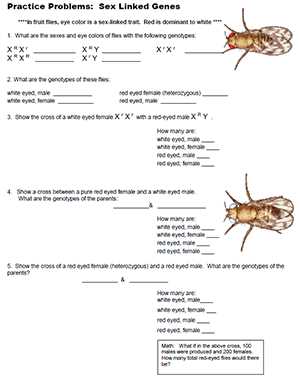
1. Begin by reviewing the problem setup. Double-check that you have correctly identified the inheritance patterns, whether it’s X-linked or Y-linked, and whether the traits are dominant or recessive. Confirm that you have assigned the proper alleles to both parents based on their gender and genetic information.
2. Next, use a Punnett square to map out all possible genetic combinations. Ensure that you label the chromosomes accurately: X and Y for males, X and X for females. This will help you track how traits are inherited from one generation to the next.
3. After completing the Punnett square, calculate the probability of each possible outcome. For example, if you are dealing with a recessive trait, calculate how likely it is for the offspring to inherit two copies of the recessive allele, particularly for females who may be carriers.
4. Check if you have accounted for carriers. In females, carriers of X-linked recessive traits will not show symptoms but can pass on the allele. Be sure to represent them with a heterozygous genotype and verify your interpretation of this in your solution.
5. Reassess the final genotypes and phenotypes you’ve assigned to each offspring. Ensure that all males are properly assigned a Y chromosome and that females have two X chromosomes. Cross-check this with the problem requirements to verify accuracy.
6. Finally, review the inheritance pattern of the trait. If the problem involves a Y-linked trait, confirm that the trait can only be passed from father to son, with no females affected. For X-linked traits, ensure that males will always express the condition if they inherit the affected X chromosome.