Skills Practice for Graphing Quadratic Functions with Solutions
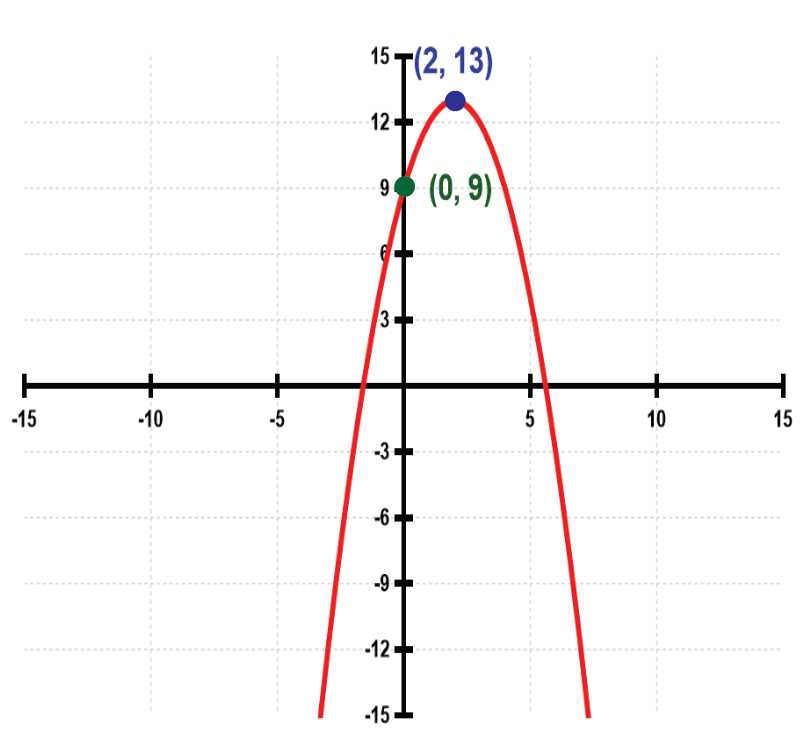
Start by identifying the equation in the form of y = ax² + bx + c. This is the standard form for any parabola. Recognizing the structure of this equation allows you to determine the key points needed for plotting the curve.
The vertex is one of the most important features. Use the formula x = -b / 2a to find the axis of symmetry, which will help you pinpoint the vertex. Once you know the vertex, you can plot it on the graph and proceed to sketch the curve from that central point.
Additionally, remember to calculate the intercepts. The y-intercept is found by setting x = 0 in the equation, and the x-intercepts are located by solving the equation ax² + bx + c = 0. This process gives you critical points for creating an accurate graph of the parabola.
By following these steps, you can ensure that your parabolic graph is accurate, giving you a solid understanding of how to transform and analyze quadratic equations effectively.
Practice Exercises for Plotting Parabolic Curves with Solutions
Begin by solving the equation y = 2x² – 4x – 6. First, find the vertex using the formula x = -b / 2a. For this equation, a = 2, b = -4, so x = -(-4) / (2 * 2) = 1. Substitute x = 1 into the equation to find the corresponding y-coordinate: y = 2(1)² – 4(1) – 6 = -8. Therefore, the vertex is at (1, -8).
Next, determine the y-intercept by setting x = 0: y = 2(0)² – 4(0) – 6 = -6. The y-intercept is (0, -6).
For the x-intercepts, solve the equation 2x² – 4x – 6 = 0 using the quadratic formula: x = (-b ± √(b² – 4ac)) / 2a. With a = 2, b = -4, and c = -6, the discriminant is b² – 4ac = (-4)² – 4(2)(-6) = 16 + 48 = 64. Thus, x = (4 ± √64) / 4 = (4 ± 8) / 4, giving the solutions x = 3 and x = -1. The x-intercepts are at (3, 0) and (-1, 0).
Now plot these points on the graph: the vertex at (1, -8), the y-intercept at (0, -6), and the x-intercepts at (3, 0) and (-1, 0). Connect the points to form the parabola.
For additional practice problems, visit Khan Academy Algebra.
Understanding the Standard Form of a Parabolic Equation
The standard form of a parabolic equation is written as y = ax² + bx + c, where a, b, and c are constants. The coefficient a determines the direction and width of the parabola. If a is positive, the parabola opens upward, and if a is negative, it opens downward.
The value of c represents the y-intercept, the point where the curve crosses the y-axis. To find the x-intercepts, set y = 0 and solve the resulting quadratic equation ax² + bx + c = 0.
The vertex of the parabola can be found using the formula x = -b / 2a. This gives the x-coordinate of the vertex, and you can substitute this value into the equation to find the corresponding y-coordinate.
For example, consider the equation y = 2x² – 4x – 6. The vertex can be calculated by first finding x = -(-4) / (2 * 2) = 1, and then substituting x = 1 into the equation to find y = -8. The vertex is at (1, -8).
How to Identify Key Features of a Parabola
To identify key features of a parabolic curve, focus on three main components: the vertex, axis of symmetry, and direction of opening.
The vertex is the point where the parabola reaches its maximum or minimum value. It can be calculated using the formula x = -b / 2a for an equation in the form y = ax² + bx + c. Substituting this value of x back into the equation gives the y-coordinate of the vertex.
The axis of symmetry is a vertical line that passes through the vertex. Its equation is x = -b / 2a, which is the same as the x-coordinate of the vertex. This line divides the parabola into two symmetrical halves.
The direction of opening is determined by the coefficient a. If a is positive, the parabola opens upward, and if a is negative, it opens downward. The width of the parabola is also influenced by a; a larger value of a makes the parabola narrower, while a smaller value makes it wider.
Finally, identify the y-intercept, which is the point where the curve crosses the y-axis. This occurs when x = 0. Substitute x = 0 into the equation to find the y-coordinate of the intercept.
Steps to Graph Equations by Plotting Points
To graph an equation by plotting points, follow these steps:
- Write the equation in standard form: Ensure the equation is in the form y = ax² + bx + c.
- Find the vertex: Use the formula x = -b / 2a to find the x-coordinate of the vertex. Substitute this value into the equation to get the corresponding y-coordinate.
- Plot the vertex: Plot the vertex on the coordinate plane. This is the point (x, y).
- Choose additional x-values: Select a few x-values around the vertex. These can be negative and positive values, ensuring that you get points both to the left and right of the vertex.
- Substitute x-values into the equation: For each selected x-value, substitute it into the equation to find the corresponding y-value. This gives you additional points to plot.
- Plot the points: Plot each of the points on the coordinate plane, ensuring they align with the curve of the graph.
- Draw the parabola: Connect the plotted points with a smooth, U-shaped curve. The curve should be symmetric about the vertex.
- Check the axis of symmetry: The parabola should be symmetric on both sides of the axis of symmetry, which is the vertical line passing through the vertex.
By plotting multiple points and connecting them smoothly, you can accurately graph any parabolic equation.
Using the Vertex Formula to Find Key Points
To determine the key points of a parabola, start by using the vertex formula. For an equation in the form y = ax² + bx + c, the x-coordinate of the vertex is found using the formula:
x = -b / 2a
After calculating the x-coordinate, substitute this value back into the original equation to find the corresponding y-coordinate. This gives you the vertex, the most important point on the graph.
Once the vertex is identified, you can calculate additional points by choosing x-values on either side of the vertex, substituting these values into the equation, and plotting the resulting points. These points will help shape the curve of the parabola.
Finally, check the symmetry of the graph. The parabola will be symmetrical with respect to the axis passing through the vertex, so plotting points on both sides should yield identical results.
Common Mistakes When Graphing Quadratic Functions
A common mistake is misidentifying the vertex’s location. Ensure the vertex is found using the formula x = -b / 2a, and avoid assuming it is always at (0, 0) or another default position.
Another frequent error is incorrectly plotting points. Always substitute values into the equation carefully and double-check each calculation to ensure accuracy when determining the corresponding y-values for chosen x-values.
Mixing up the direction of the parabola’s opening is also a mistake. If a is positive, the graph opens upwards. If a is negative, the graph opens downwards. Always check the sign of a before drawing the curve.
Failing to account for symmetry is another issue. The parabola is symmetrical around the vertical line through the vertex, so make sure the points on both sides of the vertex mirror each other.
Lastly, neglecting to plot the axis of symmetry is an oversight. Draw this line through the vertex, as it helps to guide the accurate shape of the parabola. This line can also assist in checking for symmetry when verifying the graph.
How to Use the Axis of Symmetry in Graphing
The axis of symmetry is a vertical line that divides the parabola into two symmetrical halves. To graph it correctly, first find its equation using the formula x = -b / 2a, where a and b are the coefficients from the equation.
Once you’ve determined the axis of symmetry, plot it as a dashed vertical line through the x-coordinate of the vertex. This line will guide the graph, ensuring that points on both sides of the vertex mirror each other.
The axis of symmetry also helps verify the accuracy of your plot. After placing the vertex and plotting a few points, check if the points on both sides of the axis are equidistant from it. If they are not, adjust the graph accordingly.
Additionally, when using the axis of symmetry, remember it passes through the vertex. This means that the vertex is always located on this line, which makes it easier to spot potential errors in your graph.
Lastly, use the axis of symmetry to reflect points. If you plot a point to the left of the axis, simply reflect it over to the right side to plot the corresponding point. This symmetry speeds up the process of drawing an accurate curve.
Interpreting the Effects of Coefficients on the Parabola’s Shape
The coefficients in a quadratic equation significantly influence the shape and orientation of the graph. Here’s how:
- Effect of ‘a’ (Leading Coefficient): The value of a determines the width and direction of the parabola. If a is positive, the parabola opens upwards. If a is negative, the parabola opens downwards. A larger absolute value of a makes the parabola narrower, while a smaller value makes it wider.
- Effect of ‘b’ (Linear Coefficient): The value of b affects the horizontal position of the vertex. It influences how the graph shifts left or right but does not change the direction (up or down) of the parabola. Adjusting b will move the vertex along the axis of symmetry.
- Effect of ‘c’ (Constant Term): The constant c moves the graph vertically. A positive value shifts the graph upwards, while a negative value shifts it downwards. The value of c represents the y-intercept, where the parabola crosses the y-axis.
By understanding how each coefficient impacts the graph, you can quickly sketch the shape of a parabola and predict its key features, such as its direction, width, and vertex location.
Practice Problems and Solutions for Graphing Quadratics
Problem 1: Graph the equation y = 2x² – 4x + 1
Solution: Start by identifying the coefficients: a = 2, b = -4, and c = 1.
- Determine the vertex using the formula: x = -b / 2a = -(-4) / (2 * 2) = 1. The vertex is at (1, y).
- Find y by substituting x = 1 into the original equation: y = 2(1)² – 4(1) + 1 = -1.
- The vertex is (1, -1).
- Since a = 2 is positive, the parabola opens upwards. Plot the vertex and two additional points by substituting x = 0 and x = 2 into the equation, yielding (0, 1) and (2, 1).
The graph is a parabola with vertex at (1, -1), opening upwards.
Problem 2: Graph the equation y = -x² + 6x – 5
Solution: Identify the coefficients: a = -1, b = 6, and c = -5.
- Use the vertex formula: x = -b / 2a = -6 / (2 * -1) = 3. The vertex is at (3, y).
- Substitute x = 3 into the equation: y = -(3)² + 6(3) – 5 = 4.
- The vertex is (3, 4).
- Since a = -1 is negative, the parabola opens downwards. Plot the vertex and two additional points by substituting x = 2 and x = 4 into the equation, yielding (2, -3) and (4, -3).
The graph is a parabola with vertex at (3, 4), opening downwards.
These examples show how to find the vertex and plot points to accurately graph a parabola. Understanding the role of coefficients in shaping the curve is key to mastering graphing parabolas.