Complete Guide to Moles Gizmo Activity and Solutions
The first step in accurately determining the number of particles in a given substance is grasping the concept of the mole. This measurement links the macroscopic world to the atomic and molecular scale, providing a straightforward method for calculating quantities like atoms, molecules, or ions in a sample. By using a set of tools and calculations, you can easily convert between grams and moles, a crucial step in understanding chemical reactions.
One of the most helpful activities involves using virtual tools to simulate real-world reactions and calculate molar relationships. These tools allow for direct input and manipulation of variables, which makes solving problems more intuitive. Mastering how to calculate the number of particles from a known quantity of a substance is key to applying this knowledge in practical chemistry.
In this guide, you will learn how to calculate moles from various data inputs, troubleshoot common mistakes in molar calculations, and interpret your results accurately. Whether you’re just starting to learn about chemical calculations or need to refine your skills, understanding how to apply these methods will enhance your understanding of stoichiometry and chemical behavior.
Mole Calculation Techniques and Common Mistakes
When tackling mole-related calculations, it’s crucial to focus on understanding the relationship between moles, mass, and volume. Start by accurately converting between grams and moles using the molar mass of the substance involved. To avoid errors, always double-check the molar mass and ensure the correct units are used in each calculation step. Make sure to follow the correct stoichiometric ratios when balancing equations and applying them to real-world scenarios.
Another key aspect is practicing the conversion between moles and molecules or atoms. For example, knowing that one mole of any substance contains approximately 6.022 x 10^23 particles (Avogadro’s number) will help you easily scale up or down between macroscopic and microscopic quantities. Remember, these conversions are fundamental to understanding chemical reactions and their outcomes in the lab.
The table below outlines the common calculations you’ll encounter while working with moles and substances. This visual aid provides a clear breakdown of how to convert from mass to moles and vice versa, ensuring accuracy and preventing common mistakes.
| Calculation | Formula | Example |
|---|---|---|
| Grams to Moles | Moles = Mass (grams) ÷ Molar Mass (g/mol) | If mass = 12g and molar mass = 12g/mol, then moles = 12g ÷ 12g/mol = 1 mole |
| Moles to Grams | Mass (grams) = Moles × Molar Mass (g/mol) | If moles = 2 and molar mass = 18g/mol, then mass = 2 × 18g/mol = 36g |
| Moles to Particles | Particles = Moles × Avogadro’s Number (6.022 x 10^23) | If moles = 3, then particles = 3 × 6.022 x 10^23 = 1.807 x 10^24 particles |
| Particles to Moles | Moles = Particles ÷ Avogadro’s Number | If particles = 1.807 x 10^24, then moles = 1.807 x 10^24 ÷ 6.022 x 10^23 = 3 moles |
By applying these techniques and checking for unit consistency, you can successfully navigate through mole-related problems and improve your overall accuracy in chemical calculations.
Understanding the Mole Concept in the Activity
To fully grasp the concept of moles in this activity, start by familiarizing yourself with how a mole relates to particles. A mole represents 6.022 x 10^23 particles, which could be atoms, molecules, or ions, depending on the substance. In this activity, you will observe the conversion between a macroscopic amount of material (grams) and its microscopic count (molecules or atoms) by using the molar mass of a substance.
Begin by using the molar mass of a substance to convert between the mass of a sample and the number of particles it contains. This will help you visualize the connection between the observable and the atomic level. For example, if you are given the mass of a substance, you can use its molar mass to find how many moles are present, and then use Avogadro’s number to determine the total number of particles.
Throughout the activity, pay close attention to how changes in the amount of material affect the number of particles. The visual aids in the activity will help you connect theoretical concepts with practical examples. By practicing these conversions, you will better understand how large-scale chemical reactions occur at the atomic level.
How to Use the Tool to Calculate Amounts
Begin by selecting the substance you are working with and entering its molar mass into the tool. The molar mass is the weight of one mole of the substance and is typically provided on the periodic table for elements or can be calculated for compounds by summing the atomic masses of each element in the formula.
Once the molar mass is inputted, the next step is to input the sample’s mass. This is the amount of substance you are working with, and it can be measured directly or estimated. The tool will then automatically calculate how many moles of the substance are present by dividing the mass by the molar mass.
For more complex calculations, you can adjust the amount of substance or switch between units. The tool allows you to see how different amounts of material influence the number of particles present, giving you a clear understanding of how macroscopic quantities translate into atomic-level measurements.
Interpreting the Results from the Simulation
After completing the calculation, review the total number of particles displayed by the tool. This result reflects the amount of substance you are working with, based on the input mass and molar mass.
If the simulation shows a smaller or larger value than expected, check the mass and molar mass entries for accuracy. A discrepancy can arise from rounding errors or incorrect values entered into the system.
Pay attention to the unit conversion. If the calculation involves different units, ensure that all measurements are consistent. For example, converting from grams to milligrams may lead to a significant difference in the results.
Examine the comparison of experimental and theoretical values, if available. This helps in assessing how close your results are to what is predicted based on standard chemical theory.
Common Mistakes in Calculations and How to Avoid Them
A frequent mistake is entering incorrect molar masses. Ensure the molar mass for each substance is correctly selected or calculated based on its atomic or molecular formula.
Another common error is misinterpreting units. Always check that the units of mass, volume, or other measurements are consistent throughout the calculation process. Convert units where necessary to maintain uniformity.
Forgetting to balance chemical equations before starting calculations can lead to incorrect results. Double-check that the equation is properly balanced, as this ensures the correct stoichiometric ratios are applied.
Rounding errors can accumulate, especially when working with large numbers or small decimals. Avoid rounding intermediate results during calculations until the final step to preserve accuracy.
Finally, be cautious with significant figures. Ensure the number of significant figures in your final result matches the precision of the given data, avoiding over- or under-reporting accuracy.
How to Apply Avogadro’s Number in Activities
To accurately calculate the number of particles in a sample, multiply the amount of substance (in moles) by Avogadro’s number (6.022 × 10²³). This step converts moles to the actual number of atoms, molecules, or ions.
For example, if you have 0.5 moles of a substance, multiply 0.5 by Avogadro’s number to find the total number of particles:
- 0.5 moles × 6.022 × 10²³ = 3.011 × 10²³ particles.
Ensure the correct unit conversion when working with different amounts, such as mass or volume, by first converting these quantities into moles before applying Avogadro’s number. Always verify the units align with the desired outcome.
In activities, Avogadro’s number helps establish relationships between the microscopic and macroscopic scales, offering insight into how many individual particles are present in a given amount of substance.
Understanding the Relationship Between Moles and Molecules
The number of particles (atoms, molecules, etc.) in a sample is directly linked to the number of moles present. One mole corresponds to exactly 6.022 × 10²³ particles, a quantity known as Avogadro’s number.
To calculate the number of particles from the number of moles, use the following formula:
- Number of particles = Moles × 6.022 × 10²³
For example, 3 moles of a substance contains:
- 3 moles × 6.022 × 10²³ = 1.8066 × 10²⁴ particles.
Similarly, to find the number of moles from a given number of particles, divide the number of particles by Avogadro’s number:
- Moles = Number of particles ÷ 6.022 × 10²³
This relationship is fundamental in stoichiometry and is used to convert between mass, volume, and the number of molecules in a sample.
How to Use the Moles Gizmo for Stoichiometry Problems
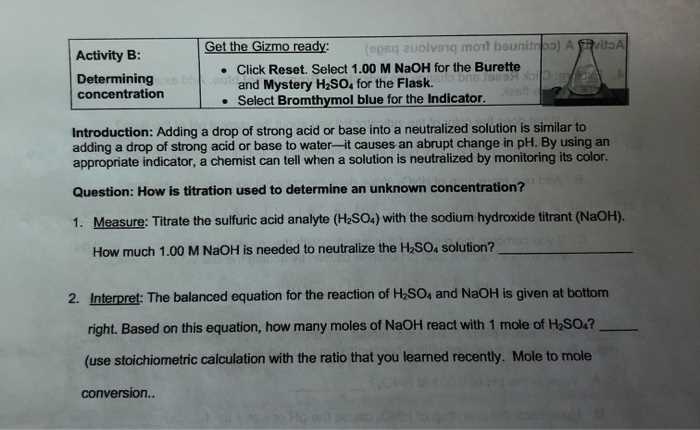
To solve stoichiometry problems using the simulation, start by identifying the reactants and products in the given chemical reaction. You will then input the number of moles for the known substances and use the simulation’s tools to find the amounts of other substances.
Follow these steps:
- Set up the reaction: Input the balanced chemical equation. Ensure that all coefficients are correct and that the equation represents the reaction accurately.
- Input known values: Enter the number of moles for the substance that is given in the problem. This will serve as your starting point for the calculation.
- Use mole ratios: The tool will automatically calculate the mole ratios based on the coefficients in the balanced equation. These ratios will help you determine the amounts of other substances involved in the reaction.
- Calculate unknown values: By using the mole ratios, you can calculate the number of moles for the other reactants or products, depending on the problem. For example, if the problem asks for the amount of a product, the simulation will calculate this based on the initial number of moles of the reactants.
- Verify results: Cross-check the calculations with the stoichiometric principles and ensure that the units match the required answer.
For more detailed instructions and resources, refer to the official site for simulations and support tools: ExploreLearning.
Practical Tips for Verifying Your Moles Gizmo Answers
Double-check all values and units before finalizing your results. Ensure that the input values for substances are correct and correspond to the given problem. Verify the coefficients in the balanced equation and confirm that they are accurately entered.
Cross-reference calculations with stoichiometric principles. If the simulation provides results, manually calculate a sample problem using the same method to ensure consistency. Use the mole ratios derived from the equation to confirm that the results align with expected theoretical values.
Pay attention to significant figures. Check that your answer includes the appropriate number of significant figures based on the precision of the data provided in the problem. Inconsistent or incorrect rounding can lead to inaccuracies.
Take advantage of the built-in features of the simulation. Use the tool’s option to visualize the reaction and examine the amounts of substances before and after the reaction. This can help identify any discrepancies in the calculated values.
Consult reliable sources for confirmation. Compare the simulation results with those found in textbooks or trusted academic websites. If there are any discrepancies, review your input values and make sure the correct methodology was followed.