Kinematics Projectile Motion Answer Key and Solutions Guide
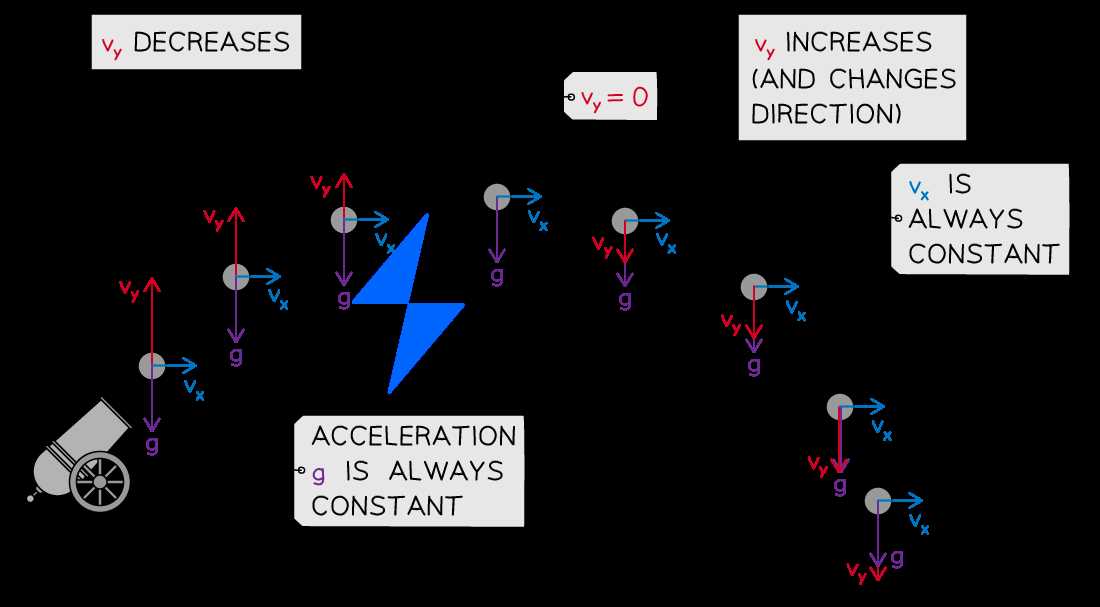
For solving projectile motion problems, begin by identifying the key variables: initial velocity, launch angle, time of flight, and range. Use these to break down the motion into horizontal and vertical components. The horizontal motion follows uniform velocity, while vertical motion is influenced by gravity, creating a constant acceleration.
Use the following formulas for horizontal and vertical displacements:
Horizontal distance: x = v₀ * cos(θ) * t
Vertical distance: y = v₀ * sin(θ) * t – 0.5 * g * t²
where v₀ is the initial velocity, θ is the launch angle, g is the acceleration due to gravity, and t is time. Time can be found by solving the vertical motion equation for t.
Once you have time, calculate the maximum height and range of the projectile. Remember that the time of flight is the total time the object is in the air, and range is the horizontal distance it covers before hitting the ground.
Always double-check your units, ensuring they are consistent throughout the calculations, and use the appropriate trigonometric functions for angle-based problems.