Solutions for Gravity and Orbits PHET Simulation
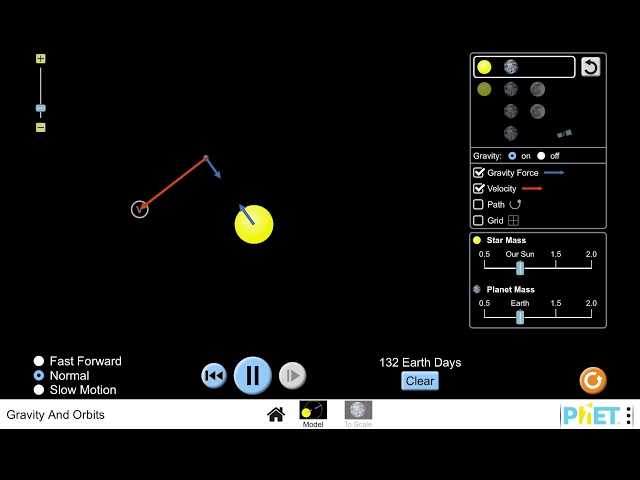
To solve problems involving the interaction between two celestial bodies, begin by calculating the gravitational force acting between them. Use Newton’s law of universal attraction, F = G * (m1 * m2) / r², where “G” is the gravitational constant, “m1” and “m2” are the masses of the two bodies, and “r” is the distance between their centers. This equation is critical for determining the strength of the pull that keeps objects in motion around each other.
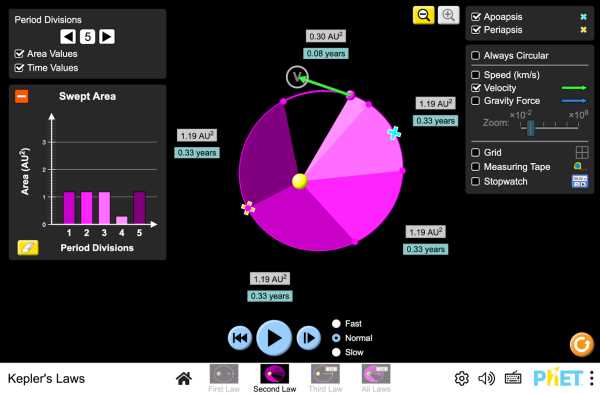
Next, analyze the velocity and trajectory of the smaller object. Objects in motion along a curved path, such as planets or satellites, maintain their velocity through a balance between the inward gravitational force and the outward inertial force. Adjust the mass of the central object or the initial speed of the orbiting body to observe how these factors impact the object’s orbit.

Recommendation: Pay close attention to the role of distance in gravitational attraction. A small change in the distance between the two objects can result in a significant change in the force exerted. Use this information to adjust parameters and understand the behavior of different celestial systems. Calculating these forces accurately will provide a clearer view of orbital mechanics.