Step by Step Guide to FOIL Method and Factoring Trinomials
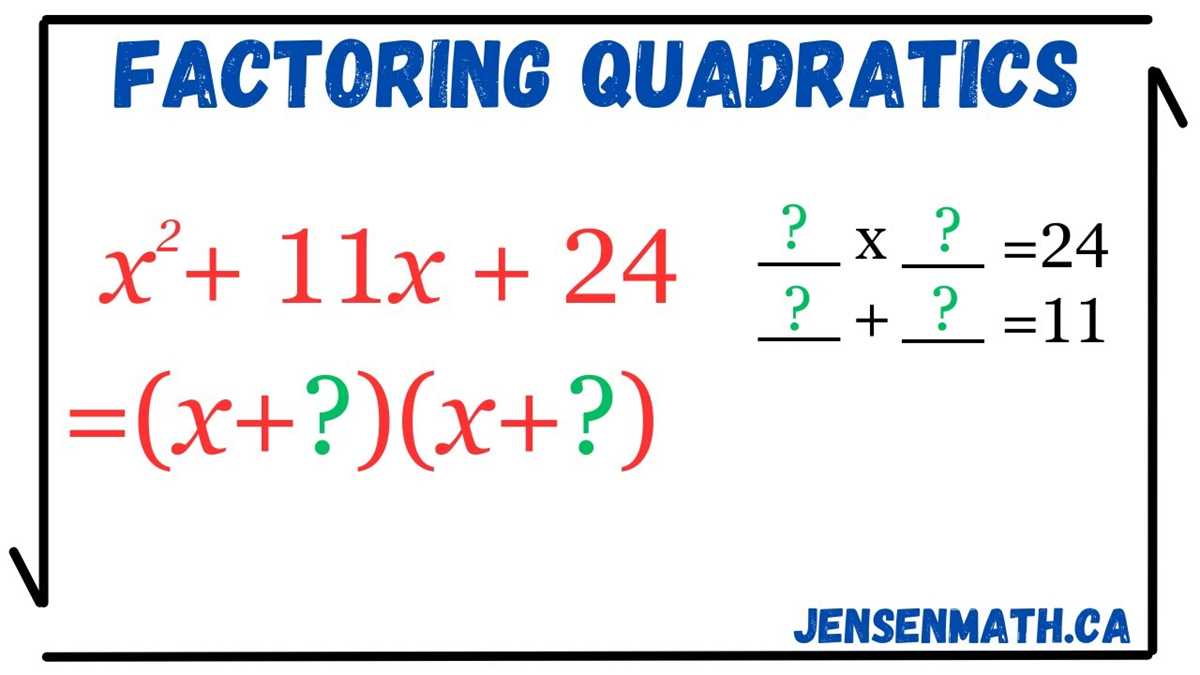
When working with binomials or polynomials, the process of multiplying two binomials and simplifying the expression is key to solving many algebraic problems. Start by multiplying each term in the first binomial with each term in the second binomial. This method ensures that no terms are overlooked and that the result is simplified correctly.
For polynomial expressions with three terms, use a systematic approach to identify common factors or use grouping to break the expression into smaller, manageable parts. This helps in finding the correct factors more easily. By practicing with various examples, you’ll develop the ability to identify and factor expressions quickly and accurately.
Checking your results is as important as getting the correct solution. After multiplying or factoring, it’s always a good idea to verify your results by expanding the factored form or simplifying the expanded form. This ensures that no mistakes were made during the calculation process and that your final answer is correct.
Expanding and Simplifying Polynomials: A Guide
To multiply two binomials, multiply each term in the first binomial by each term in the second. For example, if you have (x + 3)(x + 2), perform the following steps:
- Multiply the first terms: x * x = x²
- Multiply the outer terms: x * 2 = 2x
- Multiply the inner terms: 3 * x = 3x
- Multiply the last terms: 3 * 2 = 6
Now, combine like terms: x² + 2x + 3x + 6 = x² + 5x + 6. This is the expanded form.
For simplifying a polynomial like x² + 5x + 6, you look for two numbers that multiply to give you 6 and add up to 5. These numbers are 2 and 3, so the factored form is (x + 2)(x + 3).
Always verify the factorization by multiplying the factors back out to ensure you get the original polynomial. For example, (x + 2)(x + 3) = x² + 5x + 6. This confirms that the factorization is correct.
Understanding the Method for Multiplying Binomials
When multiplying two binomials, break the process down into four steps. For example, consider the expression (a + b)(c + d). Follow these steps:
- Multiply the first terms: a * c
- Multiply the outer terms: a * d
- Multiply the inner terms: b * c
- Multiply the last terms: b * d
Now, combine all the results. For instance, (a + b)(c + d) becomes ac + ad + bc + bd. This is the expanded form of the product.
If you’re given a specific problem, such as (x + 5)(x + 3), apply the same steps:
- First terms: x * x = x²
- Outer terms: x * 3 = 3x
- Inner terms: 5 * x = 5x
- Last terms: 5 * 3 = 15
Combine like terms: x² + 3x + 5x + 15 = x² + 8x + 15. This is the expanded form of (x + 5)(x + 3).
Step-by-Step Process of Simplifying Quadratic Expressions
To simplify an expression like ax² + bx + c, follow these steps:
- Identify the coefficients: Look at the expression and identify a, b, and c. For example, in x² + 5x + 6, a = 1, b = 5, and c = 6.
- Find two numbers: Search for two numbers that multiply to give you the product of a * c (in this case, 1 * 6 = 6) and add up to b (5 in this example).
- Split the middle term: Rewrite the expression by splitting the middle term (5x) into two terms using the numbers found. For x² + 5x + 6, we split 5x into 2x and 3x, so the expression becomes x² + 2x + 3x + 6.
- Factor by grouping: Group the terms in pairs: (x² + 2x) and (3x + 6). Now, factor out the greatest common factor (GCF) from each group. The first group gives x(x + 2), and the second group gives 3(x + 2).
- Final factorization: Now, factor out the common binomial factor (x + 2), so the expression becomes (x + 2)(x + 3).
Thus, the factored form of x² + 5x + 6 is (x + 2)(x + 3).
Identifying Common Mistakes in Expanding Binomials and Simplifying Expressions
One common mistake is missing a sign when multiplying the terms. For example, in the expression (x + 3)(x – 4), multiplying the outer terms incorrectly as -12 instead of -4x is a frequent error.
Another mistake occurs when forgetting to include all terms during the expansion. For example, expanding (x + 2)(x + 5) and only writing x² + 10 instead of x² + 7x + 10 omits the necessary middle term.
Watch out for incorrectly factoring out the greatest common factor (GCF) when simplifying expressions. For example, simplifying 2x² + 4x by factoring out 2 is often misdone as 2(x² + 2x) instead of 2x(x + 2), which alters the result.
Finally, mistakes can happen when factoring incorrectly or assuming that all quadratics can be factored easily. A common error is trying to factor a quadratic expression like x² + x + 1, which doesn’t have integer factors. Always check if factoring is possible.
How to Use the FOIL Method for Polynomials
The FOIL method can be applied to expand expressions involving binomials, but it can also extend to polynomials. Here’s how to do it step by step:
- First: Multiply the first terms in each polynomial. For example, with (x + 3)(x + 5), you multiply x * x to get x².
- Outer: Multiply the outer terms. In the example, 3 * x gives 3x.
- Inner: Multiply the inner terms. Here, x * 5 results in 5x.
- Last: Finally, multiply the last terms. In the case of (x + 3)(x + 5), 3 * 5 equals 15.
Now, combine all the products: x² + 3x + 5x + 15. Combine like terms (3x + 5x) to simplify the expression to x² + 8x + 15.
For larger polynomials, apply the same process. Multiply each term in the first polynomial by each term in the second polynomial. This will involve more steps but follows the same principle of multiplying corresponding terms.
For a more detailed explanation, visit Khan Academy’s Algebra Section.
Recognizing Special Patterns in Factoring Trinomials
To efficiently simplify expressions, recognize common patterns in polynomials. Some special cases arise frequently, making them easier to handle:
- Perfect Square Trinomial: If the first and last terms are perfect squares and the middle term is twice the product of the square roots of these terms, the expression can be factored as the square of a binomial. For example, x² + 6x + 9 factors as (x + 3)².
- Difference of Squares: If the polynomial consists of a subtraction between two squares, it can be factored as (a + b)(a – b). Example: x² – 16 factors as (x + 4)(x – 4).
- Sum of Squares: Unlike the difference of squares, the sum of squares (e.g., x² + 9) does not factor into real-number binomials. However, it can often appear as part of a larger expression.
- Sum or Difference of Cubes: If you see the form x³ ± y³, it can be factored using the formulas (x ± y)(x² ∓ xy + y²). For instance, x³ – 8 factors as (x – 2)(x² + 2x + 4).
By recognizing these patterns, factoring becomes quicker and more straightforward. Practice with these patterns and apply them to more complex expressions to build fluency in simplifying polynomials.
Checking Your Work: Verifying FOIL and Factoring Results
To confirm your results, reverse the process. After multiplying binomials or simplifying an expression, check by re-expanding or re-expanding the factored form.
- Re-expand: If you’ve multiplied two binomials, multiply them again to see if you get the original expression. For example, (x + 3)(x + 2) = x² + 5x + 6. Confirm that the expanded form matches the terms in your equation.
- Use the distributive property: For binomials, multiply each term in the first binomial by each term in the second. This should give you the same result as expanding the product of the binomials.
- Check for correct signs: Pay close attention to positive and negative signs when expanding or simplifying. Mistakes with signs are common and can lead to incorrect answers.
- Substitute values: After factoring, substitute a value for the variable to ensure the factored expression gives the same result as the original. This is a quick way to verify the correctness of your factoring work.
By applying these checks, you can confidently verify your work and correct any potential errors.
Solving Complex Trinomials with Grouping Technique
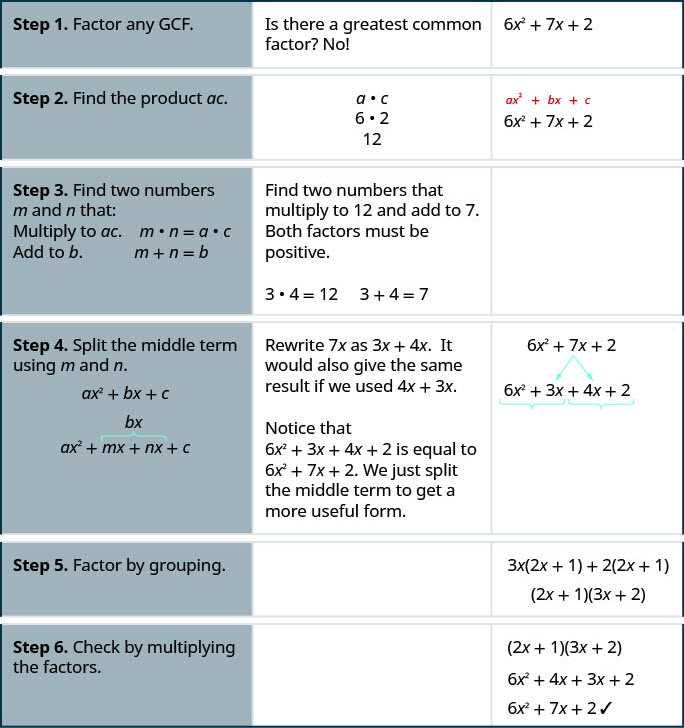
To solve complex expressions, break the middle term into two terms that can be grouped for easier factoring. Follow these steps:
- Identify the coefficient of the middle term: Look at the expression and identify the coefficient of the linear term (the middle term). This coefficient will be split into two terms that will help with grouping.
- Multiply the leading coefficient by the constant term: Multiply the first coefficient (from the x² term) and the constant at the end of the trinomial. This will give you the product that helps to break up the middle term.
- Find two numbers: Look for two numbers that multiply to the product from the previous step and add up to the middle term’s coefficient. These two numbers will be used to split the middle term into two parts.
- Split the middle term: Break the middle term into two parts based on the two numbers you found. For example, if the numbers were 4 and 6, split the term as x² + 4x + 6x + 9.
- Group terms: Group the terms in pairs to factor each pair separately. For example, (x² + 4x) + (6x + 9).
- Factor each group: Factor out the greatest common factor (GCF) from each pair of terms. For example, x(x + 4) + 3(x + 4).
- Factor the common binomial: After factoring each group, you should be left with a common binomial factor. Factor this out to get the final factored expression. For example, (x + 4)(x + 3).
This technique simplifies the process of solving complex expressions, making it easier to find the factors.
Practical Tips for Mastering Factoring and FOIL Techniques
When simplifying expressions, break down each step systematically to reduce mistakes. Start by carefully identifying the terms involved, then focus on the following:
- Practice with simple examples: Begin with smaller expressions to build confidence. As you get more comfortable, move on to more complex ones.
- Double-check your signs: Pay close attention to positive and negative signs, as they can drastically change the result. Make sure each term is correctly placed before proceeding.
- Use the distributive property: Always apply the distributive property step by step. For example, when multiplying two binomials, ensure that each term in the first binomial is multiplied by each term in the second binomial.
- Look for common factors: Before simplifying, always check if there are common factors in the terms. This can often simplify the process significantly.
- Check your work: After factoring or multiplying, always recheck the result by expanding or substituting values to confirm accuracy.
- Memorize patterns: Certain patterns, like the difference of squares or perfect square trinomials, make the process quicker. Recognizing these early on saves time.
- Use trial and error for tougher cases: If you find yourself stuck, test possible factor pairs using trial and error to find the correct match.
- Stay consistent with notation: Clear and consistent notation helps avoid confusion. Always write terms and factors carefully to ensure proper calculations.
By consistently applying these tips, you will gain efficiency and accuracy with these techniques over time.