Step by Step Guide to Finding Factors and Solving Related Problems
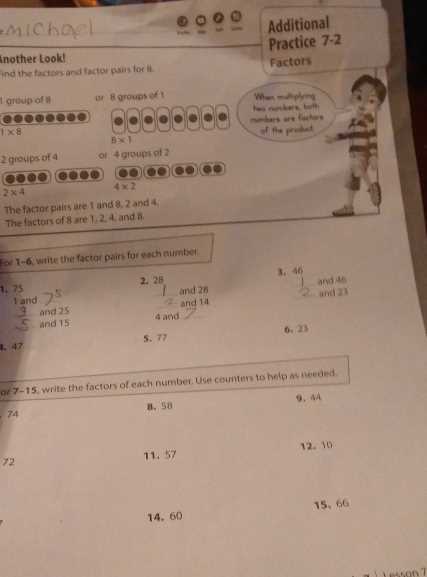
To break down a number into its divisors, start by testing smaller integers. Begin with 1, since all integers are divisible by 1, and proceed by checking each consecutive number for divisibility. For example, to find the divisors of 12, check the division: 12 ÷ 1 = 12, 12 ÷ 2 = 6, 12 ÷ 3 = 4, and 12 ÷ 4 = 3. This method will uncover all numbers that divide evenly into the target value.
One efficient approach is to test numbers up to the square root of the given number. This reduces the amount of calculations needed. For instance, to find divisors of 36, check numbers from 1 to 6, since √36 = 6. After discovering divisors below the square root, you can pair them with corresponding values above the square root, ensuring no potential divisor is missed.
Additionally, always check for prime numbers as divisors. These are numbers that are divisible only by 1 and themselves. Identifying these helps in understanding whether the number in question is prime or composite, which can influence how you solve related problems or factorize larger expressions.
Detailed Guide on Identifying Divisors and Solving Problems
To determine all integers that divide a given number without leaving a remainder, start by testing integers from 1 to the square root of the number. For example, to find all divisors of 28, begin with 1 and continue up to √28, which is approximately 5.3. Check divisibility for each number in this range and pair any valid divisors with their complements.
For 28, you test: 28 ÷ 1 = 28, 28 ÷ 2 = 14, 28 ÷ 4 = 7. The divisors are 1, 2, 4, 7, 14, and 28. You can pair each divisor less than √28 with its corresponding larger divisor (for example, 1 pairs with 28, 2 pairs with 14, and 4 pairs with 7). This approach ensures that you cover all possibilities efficiently.
In some problems, it’s important to find divisors that meet certain conditions, such as only even numbers or prime numbers. For example, identifying all even divisors of 36 requires checking divisibility by 2, 4, 6, and other even numbers up to √36. Similarly, identifying prime divisors involves testing only prime candidates like 2, 3, 5, and so on, while eliminating non-prime numbers like 4 or 6.
When working with larger numbers or solving more complex problems, remember to apply this method step by step. Breaking down the problem by testing smaller numbers first and pairing them with their complements will streamline the process and help avoid mistakes.
How to Identify Divisors of a Given Number
To identify all integers that divide a given number evenly, follow these steps:
- Start by testing all integers from 1 up to the square root of the number. If a number divides evenly, both the divisor and its complement (the quotient) are factors.
- For example, to identify the divisors of 36, check divisibility from 1 through 6 (since √36 = 6). The valid divisors are 1, 2, 3, 4, 6, 9, 12, 18, and 36.
- Once you find a divisor, pair it with the result of the division. For instance, 36 ÷ 2 = 18, so both 2 and 18 are divisors.
- Make sure to check for both smaller and larger divisors. For example, divisors of 36 include both 2 and 18, 3 and 12, and so on.
For more detailed steps and explanations, visit the official Khan Academy, which provides in-depth lessons on the subject.
Step-by-Step Process for Factorizing Numbers
To break down a number into its prime components, follow these simple steps:
- Start with the smallest prime number: Begin with 2, the smallest prime. If the number is divisible by 2, divide it by 2. If not, move to the next prime (3, 5, 7, etc.).
- Continue dividing: Keep dividing the quotient by the same prime number until it no longer divides evenly. When that happens, move on to the next prime number and repeat the process.
- Repeat the division process: For example, for 36, divide by 2 to get 18, then divide 18 by 2 to get 9. Since 9 is not divisible by 2, move on to 3, and divide 9 by 3 to get 3, and again divide 3 by 3 to get 1.
- Write down the prime numbers: The result will be a list of prime numbers that, when multiplied together, give you the original number. In the case of 36, the prime factorization is 2 × 2 × 3 × 3.
Remember, the goal is to break the number down to the smallest possible prime factors. This process is especially useful in algebra and other areas of mathematics.
Understanding Prime and Composite Numbers in Factorization
A prime number is a whole number greater than 1 that has no divisors other than 1 and itself. For example, 2, 3, 5, 7, and 11 are prime numbers. These numbers can only be divided by 1 and the number itself, making them fundamental building blocks in breaking down other numbers.
In contrast, a composite number has divisors other than 1 and itself. These numbers can be broken down into smaller whole numbers. For example, 4, 6, 8, and 9 are composite numbers because they have divisors other than 1 and themselves (e.g., 4 can be divided by 2, 6 can be divided by 2 and 3).
When breaking down a composite number into its prime components, you start by dividing it by the smallest prime numbers. This helps you identify the prime numbers that make up the original number, a process known as prime factorization.
Understanding the distinction between prime and composite numbers is crucial for correctly applying factorization methods and simplifying expressions in mathematics.
Common Methods for Finding All Divisors
To determine all divisors of a number, several approaches can be used. One common method involves dividing the number by each whole number up to its square root. Here’s how it works:
- Start by dividing the number by 1. This will always be a divisor.
- Then, continue dividing the number by integers sequentially, from 2 up to the square root of the number. Each time the number divides evenly, you have found a divisor.
- For every divisor found, also include the corresponding co-divisor by dividing the number by the divisor you just found. For example, if 12 is divisible by 3, then both 3 and 4 (12 ÷ 3 = 4) are divisors of 12.
Another method is to list multiples of the number, starting from 1, and check which ones divide the number evenly. This approach is straightforward but works best for smaller numbers.
Example:
For the number 36:
| Divisor | Co-Divisor |
|---|---|
| 1 | 36 |
| 2 | 18 |
| 3 | 12 |
| 4 | 9 |
| 6 | 6 |
By using these methods, you can find all divisors of any number, ensuring you cover every possible factor.
How to Use Divisibility Rules for Quick Factorization
Use divisibility rules to quickly identify possible divisors of a number. These rules help you eliminate candidates and focus on the remaining ones, speeding up the process.
- Divisibility by 2: A number is divisible by 2 if its last digit is even (0, 2, 4, 6, or 8). This allows for the immediate identification of all even divisors.
- Divisibility by 3: A number is divisible by 3 if the sum of its digits is divisible by 3. For instance, 123 (1 + 2 + 3 = 6) is divisible by 3 because 6 is divisible by 3.
- Divisibility by 5: A number is divisible by 5 if its last digit is either 0 or 5. This simplifies checking for divisibility by 5.
- Divisibility by 6: A number is divisible by 6 if it satisfies both the divisibility rules for 2 and 3. Check for both conditions to determine divisibility by 6.
- Divisibility by 9: A number is divisible by 9 if the sum of its digits is divisible by 9. For example, 567 (5 + 6 + 7 = 18) is divisible by 9 since 18 is divisible by 9.
- Divisibility by 10: A number is divisible by 10 if its last digit is 0. This rule makes identifying multiples of 10 quick and easy.
By using these rules, you can quickly identify which numbers divide evenly into the given number, allowing you to focus on finding all divisors faster.
Examples of Factorizing Small and Large Numbers
To illustrate the process of breaking down numbers, here are examples of how to determine divisors for both small and large values.
Example 1: Small Number – 36
Start by checking divisibility with small primes.
- 36 is divisible by 2 (even number): 36 ÷ 2 = 18
- 18 is divisible by 2 again: 18 ÷ 2 = 9
- 9 is divisible by 3 (sum of digits 9): 9 ÷ 3 = 3
- 3 is divisible by 3: 3 ÷ 3 = 1
The prime factorization of 36 is: 2 × 2 × 3 × 3.
Example 2: Large Number – 210
Begin with small divisors, progressing step by step.
- 210 is divisible by 2 (even number): 210 ÷ 2 = 105
- 105 is divisible by 3 (sum of digits 6): 105 ÷ 3 = 35
- 35 is divisible by 5 (last digit is 5): 35 ÷ 5 = 7
- 7 is a prime number and cannot be divided further.
The prime factorization of 210 is: 2 × 3 × 5 × 7.
Example 3: Large Number – 360
Apply divisibility rules to break it down efficiently.
- 360 is divisible by 2: 360 ÷ 2 = 180
- 180 is divisible by 2: 180 ÷ 2 = 90
- 90 is divisible by 2: 90 ÷ 2 = 45
- 45 is divisible by 3: 45 ÷ 3 = 15
- 15 is divisible by 3: 15 ÷ 3 = 5
- 5 is a prime number.
The prime factorization of 360 is: 2 × 2 × 2 × 3 × 3 × 5.
These examples demonstrate how to break down both small and large numbers by using division with prime numbers. The process remains consistent regardless of the size of the number.
Common Mistakes in Factorizing and How to Avoid Them
When breaking down numbers into their components, certain errors often occur. Here’s how to prevent them:
- Skipping Prime Numbers: Always start with the smallest prime numbers (2, 3, 5, etc.). Avoid missing smaller divisors before moving on to larger ones.
- Incorrect Division: Double-check each division step. Incorrectly dividing by a non-divisor or skipping a number can lead to errors in the process.
- Not Repeating the Process: After dividing by a prime number, repeat the process for the quotient. Ensure every number is broken down completely.
- Overlooking Larger Divisors: If a smaller number doesn’t divide evenly, try the next larger divisor. For example, if 7 doesn’t divide, check 11, 13, and so on.
- Forgetting to Check for Prime Status: After reducing a number, always verify if the result is prime. Do not attempt to divide further if the number is prime.
By following these guidelines, you can avoid common mistakes and ensure accurate breakdowns of numbers.
Practical Applications of Factorization in Real Life Problems
Understanding how to break down numbers is useful in various real-world scenarios. Here are some practical examples:
- Optimizing Resources: When planning for construction projects, you may need to divide materials (e.g., tiles, bricks) into smaller sections. Knowing how to break down numbers helps determine the right quantities to avoid waste.
- Cryptography: Secure communication relies on prime number factorization. In encryption algorithms, such as RSA, large numbers are factored to secure data transmissions.
- Designing Efficient Storage Solutions: Factorization helps in designing layouts for storage spaces, ensuring that items are grouped optimally, reducing unused space in warehouses and storage units.
- Scheduling Events: If you’re organizing events and need to divide people into equal groups, understanding number breakdowns helps in calculating the optimal division.
- Financial Analysis: Factorization is used in risk assessments and financial planning to analyze the stability of investments by breaking down large data sets into more manageable components.
These applications show that the ability to break numbers down into smaller parts plays a significant role in problem-solving across industries.