Understanding Floating and Sinking Concepts with Detailed Solutions
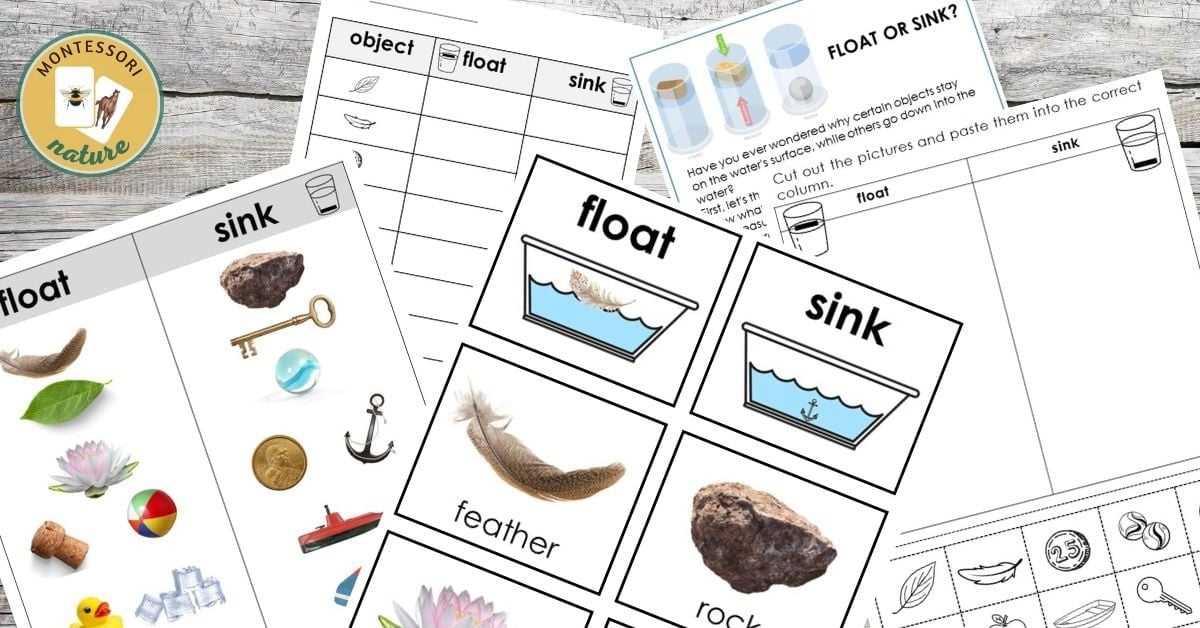
Start by assessing the relationship between an object’s density and its ability to remain on the surface or sink. Density, the measure of mass per unit volume, is the key factor in determining whether something will stay afloat or descend. Objects denser than water will sink, while those less dense will float. Understanding this concept is crucial for solving related problems and interpreting results accurately.
Next, evaluate the materials you’re working with. Some common materials, like wood, are less dense than water and naturally stay afloat, while metals like iron or lead are denser and sink. Always remember that even objects that appear similar may behave differently based on their structure and material composition.
As you work through problems, focus on comparing the density of various objects and their interaction with water. For accurate results, always verify your calculations and conclusions using reliable resources and problem-solving guides. This approach will help you confidently analyze and understand the principles behind buoyancy.
Understanding Buoyancy with Detailed Solutions
To determine if an object will remain on the surface or submerge, calculate its density by dividing its mass by its volume. This will indicate whether the object is denser or less dense than water, which has a density of 1 g/cm³.
Example 1: A metal cube with a mass of 20 grams and a volume of 10 cm³ has a density of:
- Density = Mass / Volume = 20 g / 10 cm³ = 2 g/cm³
- Since 2 g/cm³ is greater than the density of water, the metal cube will sink.
Example 2: A wooden block with a mass of 10 grams and a volume of 20 cm³ has a density of:
- Density = Mass / Volume = 10 g / 20 cm³ = 0.5 g/cm³
- Since 0.5 g/cm³ is less than the density of water, the block will stay afloat.
For accuracy, always ensure that your units are consistent when performing calculations. The mass should be in grams, and the volume in cubic centimeters. Additionally, consider the shape and material of the object to predict its behavior accurately in different environments.
When solving more complex problems, break the task into smaller steps. Calculate the density first, then compare it with water’s density to predict the outcome. Use diagrams if necessary to visualize the problem and verify your results by checking against known principles of buoyancy.
Understanding the Basics of Buoyancy and Submersion
The behavior of objects in liquids is determined by their density relative to the liquid’s density. If an object’s density is less than the liquid, it will remain on the surface; if it is greater, it will submerge.
Density is calculated by dividing mass by volume. An object with a higher mass-to-volume ratio will have a greater density, causing it to sink. Conversely, objects with a lower mass-to-volume ratio will float because they displace more water than their weight.
For example, a lead ball has a much higher density than water, meaning it sinks. A rubber ball, however, has a lower density, causing it to stay afloat on the water’s surface. The key concept is comparing the object’s density with that of the liquid–water has a density of 1 g/cm³.
To test whether an object will sink or float, measure its mass and volume, then compute the density. If the calculated density is less than 1 g/cm³, the object will float. If it exceeds 1 g/cm³, it will sink.
How Density Affects Objects’ Buoyancy
The buoyancy of an object is directly influenced by its density. An object’s density is defined as its mass per unit volume. Objects with a lower density than the liquid in which they are placed will float, while those with a higher density will sink.
When an object is placed in a liquid, it displaces a certain amount of liquid based on its volume. If the object’s density is less than that of the liquid, it will displace enough liquid to support its weight and stay afloat. If the density is greater, the object will not displace enough liquid to support itself and will sink.
For instance, a block of wood has a density lower than water, allowing it to stay on the surface. A piece of iron, on the other hand, has a higher density, which causes it to sink. The difference in density between the object and the surrounding liquid determines how much of the object will be submerged and whether it will float or sink.
To predict whether an object will float or sink, calculate its density. If the object’s density is greater than the liquid’s, it will sink. If it’s less, it will float. For liquids like water, objects with a density less than 1 g/cm³ will float, while objects with a density greater than 1 g/cm³ will sink.
Identifying Materials That Float and Sink in Water
To determine which materials stay on the surface and which submerge, understanding their density in comparison to water is key. Objects with a density less than water (1 g/cm³) will stay afloat, while those with a greater density will sink. Here’s a breakdown of common materials and their behaviors in water:
- Wood: Typically floats due to its lower density compared to water. The type of wood can affect its buoyancy, but most varieties remain afloat.
- Iron: Sinks because its density (7.9 g/cm³) is much higher than that of water.
- Plastic: Many types of plastic, such as polyethylene, float due to their relatively low density, but denser plastics like PVC can sink.
- Stone: Generally sinks due to its high density. However, porous stones, such as pumice, may float because they trap air within their structure.
- Rubber: Most rubber materials float because their density is lower than that of water.
- Glass: Typically sinks due to its density being higher than water’s, though small, hollow glass objects might float.
For further exploration on material properties and their behavior in water, you can refer to trusted scientific resources such as National Geographic Science.
Step-by-Step Guide to Solving Floating and Sinking Problems
Start by identifying the material of the object. Determine its density by checking the object’s mass and volume. If the object’s density is less than the fluid’s, it will remain on the surface. If the density is higher, it will submerge.
Next, calculate the volume of the object. For irregularly shaped objects, use water displacement to determine the volume. Fill a container with water, note the water level, and then submerge the object, measuring how much the water level rises.
Once you have the density and volume, apply the buoyant force equation: Buoyant Force = Volume of displaced water × Density of water × Gravitational acceleration. If the buoyant force is greater than or equal to the weight of the object, it will float.
Check the weight of the object using the formula: Weight = Mass × Gravitational acceleration. Compare the weight with the buoyant force to predict whether the object will float or sink.
If the object has a hollow structure or is porous, take into account the air trapped inside, which can alter its overall density and affect whether it will float.
Common Misconceptions About Floating and Sinking
One common misconception is that heavier objects always sink. In reality, an object’s buoyancy depends on its density, not just its weight. A large, heavy object may float if its overall density is lower than the fluid’s density.
Another misconception is that objects with a larger surface area will always float. While a larger surface area can help distribute weight, it doesn’t guarantee buoyancy. The object’s material properties and density play a larger role in determining if it will stay on the surface.
Some believe that an object will sink if it is submerged in water. However, whether an object stays submerged or rises depends on the relationship between the object’s density and the fluid’s density. If the object’s density is higher, it will sink; if lower, it will float back up.
It is also often thought that density alone determines buoyancy, but the shape and structure of the object are just as important. An object with a porous or hollow structure may float despite being made of a dense material, as the trapped air decreases its overall density.
Lastly, many assume that temperature does not affect buoyancy. In reality, as the temperature of the liquid increases, its density decreases, which can change how objects behave in it. A material that floats in colder water may sink in warmer water due to the change in fluid density.
Practical Experiments to Test Floating and Sinking Concepts
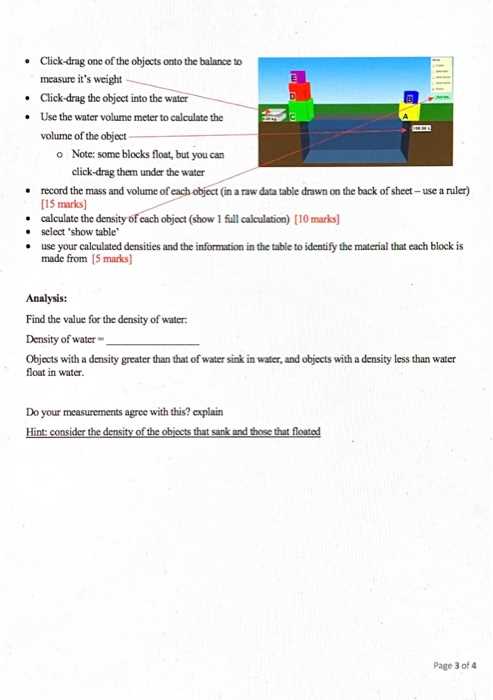
Start with a simple test using common objects. Gather items with varying densities, such as a rock, a plastic ball, and a piece of wood. Place each object in water and observe whether it stays on the surface or sinks. This will help demonstrate how different densities affect buoyancy.
Try modifying the shape of an object to see how it impacts buoyancy. For example, flatten a piece of clay into a thin sheet and place it in water. Then, roll the clay into a ball and test it again. Note the differences in behavior when the shape changes while the material remains the same.
Another experiment involves changing the water’s temperature. Heat the water in a pot and slowly pour it into a container with objects placed inside. Observe how the change in temperature affects the buoyancy of different materials. You may notice that warmer water allows some objects to sink that previously floated in cooler water.
Use different liquids to compare their densities. Fill two containers with different liquids, such as water and oil, and place the same objects in each. Record whether the objects float or sink in both liquids, and note any differences in behavior due to the density of the liquids.
A more advanced experiment can involve measuring the mass and volume of an object to calculate its density. Use a balance scale to measure the object’s mass, then use a measuring cup of water to determine its volume by displacement. Compare the calculated density to that of the liquid, and predict whether the object will float or sink based on the results.
Real-Life Applications of Floating and Sinking Principles
The design of ships and submarines relies on understanding how objects interact with water. Engineers calculate the mass and volume of materials to ensure ships float by balancing the forces of buoyancy and gravity. Submarines, on the other hand, adjust their buoyancy by controlling the amount of water in their ballast tanks, allowing them to sink or rise as needed.
In the construction of oil rigs, buoyancy principles determine the design and positioning of floating platforms. These platforms are constructed to float on the surface of the ocean while supporting large structures, such as drilling equipment. The materials used are chosen for their ability to displace enough water to keep the rig stable and above the surface.
In the food industry, floating and sinking concepts are applied to the design of flotation tanks used in sorting food products. For instance, fruits and vegetables are sorted by density, with items that are less dense floating to the surface, while denser ones sink to the bottom. This method is often used in sorting potatoes, tomatoes, and other produce.
In environmental science, flotation principles help in the treatment of wastewater. Certain materials in the water are separated using flotation tanks that introduce air bubbles to lift impurities to the surface. This process is used in sewage treatment plants to remove oils, greases, and other contaminants before water is released back into the environment.
In recreational activities, such as swimming, knowing the balance between the weight of an object and the amount of water it displaces can affect buoyancy. For example, life jackets are designed to float by using materials that are less dense than water. These products are tested for their ability to keep people above water by considering the volume of displaced water versus the weight of the person wearing the jacket.
How to Use the Answer Key for Verifying Your Results
To verify your results, start by comparing your calculations and outcomes with the provided solutions. Cross-check each step of your process against the corresponding explanation to identify any discrepancies.
Ensure that you have correctly interpreted the problem statement before matching your answers. Sometimes errors arise from misreading the problem or overlooking specific details.
Next, carefully review each solution step-by-step. If the solution provided includes reasoning, compare it with your own logic and calculations. This can help identify where mistakes were made, whether in the setup, calculations, or assumptions.
If any part of your solution differs from the answer guide, double-check your work, particularly the operations or conversions performed. Mistakes often happen in simple arithmetic or when transitioning between different units.
In case of complex calculations, revisit key formulas or concepts that you applied. The answer key may also include hints on simplifying the process or alternative approaches you could have used.
Using the answer key is a valuable tool for learning and improving. If your results do not match, take the time to understand the discrepancy and use the correct approach in future problems.