Understanding Analytical Solutions for Limits in 1.2
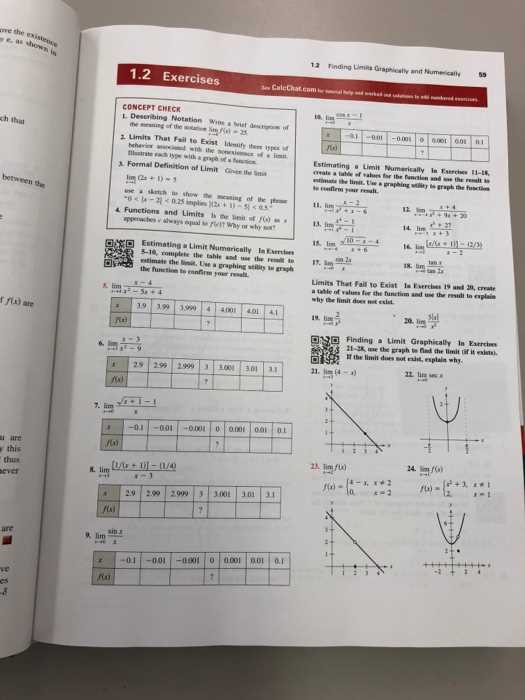
To evaluate expressions that involve approaching a value, begin by attempting direct substitution. If the result yields a determinate value, your work is done. However, if you encounter an indeterminate form such as 0/0, use algebraic techniques to simplify the expression. Factorizing, rationalizing, or applying specific limits rules can often resolve the issue.
For complex problems, especially those that involve functions with square roots or rational expressions, always check for simplifications before applying further methods. Using factorization or rationalization can transform the expression into a form that allows easy substitution of values.
When you face expressions that tend toward infinity, be sure to differentiate between vertical asymptotes and horizontal asymptotes. These cases require separate strategies, with horizontal asymptotes often determined by analyzing behavior as the variable grows without bound.
Finally, practice is key. Solve multiple examples to familiarize yourself with each type of scenario. With repeated exposure to different methods, you’ll develop a quicker and more intuitive approach to solving limit problems.
Limits Calculations and Solutions
To evaluate expressions involving an approach to a certain value, begin by testing for direct substitution. If the result is finite, the problem is solved. However, if you encounter an indeterminate form like 0/0, apply algebraic manipulation to simplify the expression. Use factoring or canceling terms where possible.
For example, if the expression is:
| lim (x → 2) (x² – 4) / (x – 2) |
Factor the numerator:
| lim (x → 2) (x – 2)(x + 2) / (x – 2) |
Cancel the common (x – 2) terms:
| lim (x → 2) (x + 2) |
Now substitute x = 2:
| 2 + 2 = 4 |
For more complex functions involving square roots, rationalizing the numerator or denominator may be necessary. For example, if the expression is:
| lim (x → 0) (√(x + 1) – 1) / x |
Multiply both the numerator and denominator by the conjugate of the numerator:
| lim (x → 0) (√(x + 1) – 1)(√(x + 1) + 1) / x(√(x + 1) + 1) |
This will eliminate the square root, simplifying the expression for direct substitution.
Always check for horizontal or vertical asymptotes in cases where the variable tends to infinity or approaches a value that causes division by zero. If the numerator grows without bound and the denominator does not, the result may approach infinity.
Understanding the Concept of Limits in Calculus
The concept of approaching a value is fundamental in calculus. When working with functions, the limit represents the value that a function approaches as the input variable gets arbitrarily close to a certain point. This idea allows you to handle functions that don’t necessarily reach a defined value at a point but approach it as the input gets closer to that point.
To calculate limits, follow these steps:
- Direct Substitution: Begin by substituting the value of the variable into the function. If the result is a finite number, the limit is that number.
- Indeterminate Forms: If direct substitution results in an indeterminate form like 0/0, further analysis is required. This can involve factoring, simplifying, or rationalizing the expression.
- Check for Asymptotes: For functions approaching infinity or negative infinity, check for vertical asymptotes, which occur when the denominator approaches zero but the numerator does not approach zero.
- Use of Special Limits: Certain standard limits, such as the limit of sin(x)/x as x approaches 0, can simplify complex calculations.
Example: For the function f(x) = (x² – 4)/(x – 2), direct substitution of x = 2 results in 0/0, so factoring is required:
(x² - 4) = (x - 2)(x + 2)
Now, cancel the common factor (x – 2) and substitute x = 2 into the simplified expression:
lim (x → 2) (x + 2) = 4
Understanding this approach allows you to solve limits in a wide variety of scenarios, including continuous and discontinuous functions. It is a core concept for working with derivatives and integrals, as limits lay the foundation for understanding instantaneous rates of change and areas under curves.
How to Compute Limits Using Direct Substitution
To compute a limit using direct substitution, simply substitute the value of the variable into the function. If the result is a finite number, that is the limit. This method works for most functions that are continuous at the point of interest.
Follow these steps:
- Identify the value: Determine the value to which the variable approaches in the limit expression.
- Substitute the value: Plug the value of the variable directly into the function. If the result is a valid number, that is the limit.
- Check for indeterminate forms: If the result is 0/0 or ∞/∞, direct substitution fails, and you will need to use other methods such as factoring or L’Hopital’s Rule.
Example:
Find the limit of f(x) = 3x + 4 as x approaches 2.
Substitute x = 2 into the function:
f(2) = 3(2) + 4 = 6 + 4 = 10
Therefore, the limit as x approaches 2 is 10.
Direct substitution is a simple and efficient method, but it only works when the function is continuous at the point you’re evaluating. If the function has a discontinuity or results in an indeterminate form, other techniques are required.
Identifying Indeterminate Forms and L’Hopital’s Rule
An indeterminate form occurs when direct substitution in a limit expression leads to an undefined result such as 0/0 or ∞/∞. These forms indicate that further manipulation is required to evaluate the limit.
Common indeterminate forms include:
- 0/0 – Occurs when both the numerator and denominator approach zero.
- ∞/∞ – Occurs when both the numerator and denominator approach infinity.
- 0 × ∞ – A product that results in an indeterminate form.
- ∞ – ∞ – The difference of two infinite values.
- 0^0 – The base and exponent both approach zero.
- ∞^0 – The base approaches infinity, and the exponent approaches zero.
To resolve indeterminate forms, apply L’Hopital’s Rule. This rule is used when the limit expression results in 0/0 or ∞/∞ after direct substitution. L’Hopital’s Rule states:
If lim f(x) / g(x) = 0/0 or ∞/∞, then lim f(x) / g(x) = lim f'(x) / g'(x), provided the limit on the right-hand side exists.
Steps for applying L’Hopital’s Rule:
- Check if the limit leads to 0/0 or ∞/∞.
- If it does, differentiate the numerator and denominator separately.
- Reevaluate the limit with the new derivatives.
- If the result is still an indeterminate form, apply L’Hopital’s Rule again.
Example:
Find the limit of (x^2 - 4) / (x - 2) as x approaches 2.
Substitute x = 2 into the function:
(2^2 - 4) / (2 - 2) = 0 / 0, an indeterminate form.
Apply L'Hopital’s Rule:
Differentiate the numerator: 2x
Differentiate the denominator: 1
Now evaluate the new limit:
lim (2x) / 1 = 2(2) / 1 = 4.
Thus, the limit is 4.
L’Hopital’s Rule is a powerful technique for resolving indeterminate forms, but it only applies to the specific cases of 0/0 or ∞/∞. For other forms, additional methods such as algebraic manipulation or series expansions may be required.
Using Factorization to Evaluate Limits
When direct substitution results in an indeterminate form, factorization is a useful technique for simplifying the expression and evaluating the limit. The process involves factoring the numerator and/or denominator to cancel out common terms, enabling the limit to be computed without the indeterminate form.
Follow these steps to apply factorization effectively:
- Start by attempting direct substitution to check if the expression leads to 0/0 or another indeterminate form.
- If 0/0 occurs, factor the numerator and denominator separately.
- Cancel out any common factors between the numerator and denominator.
- Re-evaluate the limit with the simplified expression. If the limit is no longer indeterminate, substitute the value of the variable.
Example:
Find the limit of (x^2 - 4) / (x - 2) as x approaches 2.
Direct substitution gives:
(2^2 - 4) / (2 - 2) = 0 / 0.
Now, factor the numerator:
(x^2 - 4) = (x - 2)(x + 2).
The expression becomes:
(x - 2)(x + 2) / (x - 2).
Cancel the common (x - 2) factor:
(x + 2) / 1.
Substitute x = 2:
2 + 2 = 4.
Thus, the limit is 4.
Factorization is particularly effective when dealing with quadratic expressions or any situation where the numerator and denominator share common factors. After canceling common terms, direct substitution can usually be applied, yielding a determinate result.
Applying Rationalization for Limits Involving Square Roots
When faced with expressions containing square roots that result in indeterminate forms, rationalization is an effective technique to simplify the limit calculation. This method involves multiplying the numerator and denominator by the conjugate of the expression containing the square root.
Follow these steps to apply rationalization:
- Identify if the expression results in an indeterminate form such as 0/0 when you attempt direct substitution.
- If the expression involves square roots, multiply both the numerator and denominator by the conjugate of the expression that contains the square root. The conjugate is obtained by changing the sign between the terms under the square root.
- Simplify the resulting expression after multiplication, often eliminating the square root from the denominator or numerator.
- Substitute the value of the variable into the simplified expression to evaluate the limit.
Example:
Find the limit of (sqrt(x) - 2) / (x - 4) as x approaches 4.
Direct substitution gives:
(sqrt(4) - 2) / (4 - 4) = (2 - 2) / 0 = 0 / 0.
Now, multiply both the numerator and denominator by the conjugate (sqrt(x) + 2):
[(sqrt(x) - 2)(sqrt(x) + 2)] / [(x - 4)(sqrt(x) + 2)].
Simplify the numerator using the difference of squares:
(x - 4) / [(x - 4)(sqrt(x) + 2)].
Cancel the common (x - 4) factor:
1 / (sqrt(x) + 2).
Now, substitute x = 4:
1 / (sqrt(4) + 2) = 1 / (2 + 2) = 1 / 4.
Thus, the limit is 1/4.
Rationalization is particularly useful when dealing with square roots in both the numerator and denominator. It eliminates the square roots, allowing for easier calculation of the limit using substitution.
Handling Infinite Limits and Vertical Asymptotes
When an expression approaches infinity or negative infinity as the variable approaches a specific value, you are dealing with an infinite limit. This often occurs when the denominator of a rational function approaches zero while the numerator does not. The presence of an infinite limit typically indicates a vertical asymptote at the point where the function tends to infinity.
To handle infinite limits and vertical asymptotes, follow these steps:
- Check for a denominator approaching zero. If the numerator is non-zero at that point, an infinite limit is likely.
- Perform direct substitution to confirm the form of the expression. If direct substitution results in a division by zero (with a non-zero numerator), the function is approaching infinity or negative infinity.
- If necessary, factor the expression to identify and cancel out any common factors, simplifying the expression.
- Determine the sign of the limit by testing values approaching the point from both the left and right. If the limit tends to positive infinity from one side and negative infinity from the other, a vertical asymptote exists at that point.
- If the expression still tends to infinity, the function has a vertical asymptote at the point of the limit.
Example:
Find the limit of (1 / (x - 2)) as x approaches 2.
Direct substitution gives:
1 / (2 - 2) = 1 / 0.
This results in a division by zero. To determine whether the limit tends to infinity, check the behavior from the left and right of x = 2.
As x approaches 2 from the right, (x - 2) becomes positive, and the function tends to positive infinity.
As x approaches 2 from the left, (x - 2) becomes negative, and the function tends to negative infinity.
Therefore, the limit is infinite, and there is a vertical asymptote at x = 2.
For further reading on vertical asymptotes and infinite limits, visit Khan Academy’s explanation of vertical asymptotes and infinite limits.
Limits at Infinity and Horizontal Asymptotes
To evaluate the behavior of a function as the variable approaches positive or negative infinity, focus on determining the horizontal asymptote of the function. A horizontal asymptote represents a value that the function approaches as the independent variable grows larger in magnitude.
Follow these steps to assess horizontal asymptotes:
- If the function is a rational function, compare the degrees of the numerator and denominator.
- If the degree of the numerator is less than the degree of the denominator, the horizontal asymptote is at y = 0.
- If the degree of the numerator equals the degree of the denominator, divide the leading coefficients of the numerator and denominator to determine the horizontal asymptote.
- If the degree of the numerator is greater than the degree of the denominator, the function has no horizontal asymptote, and instead, it tends to infinity or negative infinity as the variable approaches infinity.
Example:
Find the horizontal asymptote of f(x) = (3x^2 + 2) / (4x^2 + 5).
Both the numerator and denominator have the degree of 2. So, the horizontal asymptote is given by the ratio of the leading coefficients:
y = 3/4.
Thus, the horizontal asymptote is y = 3/4.
For functions involving higher-degree polynomials or more complex expressions, applying limits to infinity helps clarify the behavior and confirm the presence of horizontal asymptotes.
Practice Problems and Solutions for Mastering Limits
Here are some practice problems designed to sharpen your understanding of evaluating functions as variables approach certain values. Apply the appropriate methods such as direct substitution, factorization, and rationalization for each problem.
Problem 1: Evaluate the following:
lim x→2 (x² – 4) / (x – 2)
Solution: Factor the numerator:
(x² - 4) = (x - 2)(x + 2)
Now the expression becomes:
lim x→2 (x - 2)(x + 2) / (x - 2)
Cancel the common factor (x – 2) and substitute x = 2:
lim x→2 (x + 2) = 2 + 2 = 4
Problem 2: Evaluate the following:
lim x→∞ (3x² – 2) / (x² + 5x)
Solution: Divide both the numerator and denominator by x²:
lim x→∞ (3 - 2/x²) / (1 + 5/x)
As x approaches infinity, the terms with x in the denominator go to 0:
lim x→∞ (3 - 0) / (1 + 0) = 3
Problem 3: Evaluate the following:
lim x→0 (sin(x)) / x
Solution: This is a standard limit that equals 1. Use the well-known limit:
lim x→0 (sin(x)) / x = 1
Problem 4: Evaluate the following using rationalization:
lim x→0 (√(x + 1) – 1) / x
Solution: Multiply the numerator and denominator by the conjugate (√(x + 1) + 1):
lim x→0 (√(x + 1) - 1)(√(x + 1) + 1) / x(√(x + 1) + 1)
Using the difference of squares formula:
lim x→0 (x) / x(√(x + 1) + 1)
Cancel the x terms and substitute x = 0:
lim x→0 1 / (√1 + 1) = 1 / 2
Continue practicing with various functions and apply the techniques you’ve learned to develop confidence in evaluating functions and solving limits.