Complete Solutions for Boyle’s Law Problems Worksheet
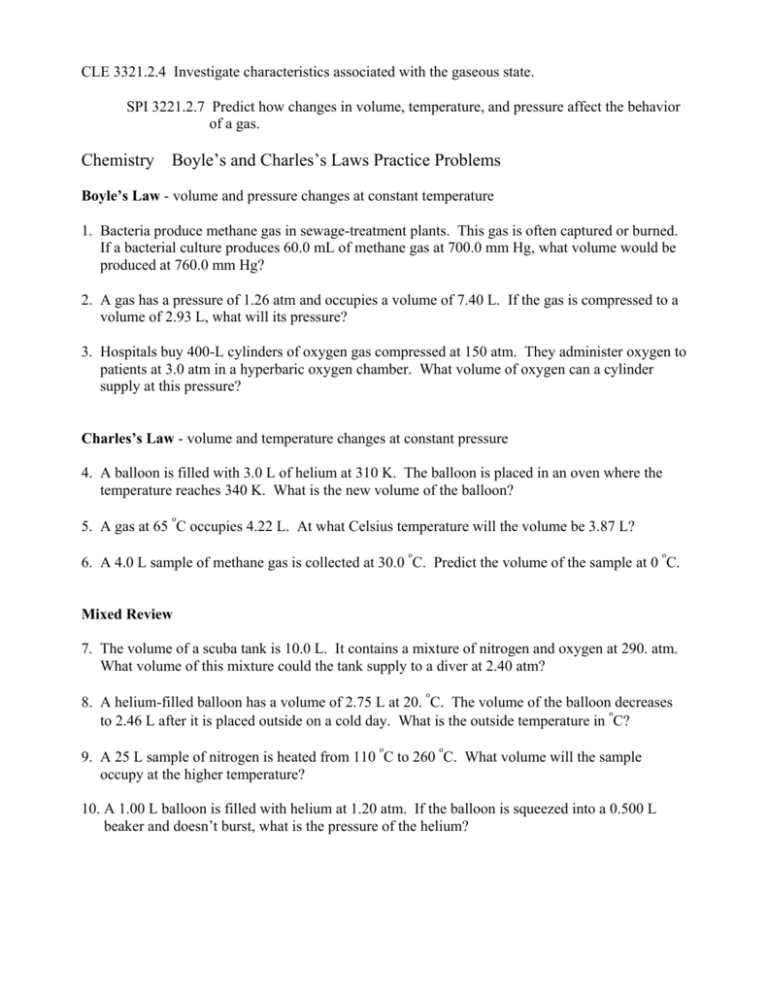
To accurately solve questions related to gas compression and expansion, you need to understand the relationship between pressure and volume. Start by using the formula P1 × V1 = P2 × V2, where P represents pressure and V represents volume. Make sure to use consistent units throughout the calculations to avoid errors.
If the pressure increases, the volume will decrease, and vice versa, as long as the temperature remains constant. This inverse relationship is key to solving these types of exercises. For each scenario, identify the initial and final conditions of the gas and apply the formula correctly. Be sure to convert units where necessary, for instance, if pressure is given in atmospheres and volume in liters, use consistent units throughout the calculation.
Another critical step is double-checking your work. After solving for the unknown variable, verify if the result makes logical sense in the context of the question. For example, if the volume decreases, the pressure should increase, assuming the temperature does not change. Understanding the physical concepts behind the formula will make it easier to identify and correct mistakes if your solution does not align with the expected results.
Solving Gas Pressure and Volume Questions
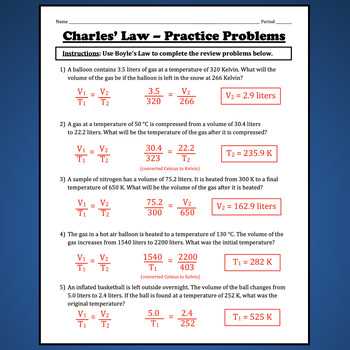
To solve for the missing variable in questions involving pressure and volume, use the formula P1 × V1 = P2 × V2. Begin by identifying the known values for pressure and volume at the initial and final conditions. Always ensure that the units are consistent throughout the calculation–pressure in atmospheres (atm), volume in liters (L), and temperature in kelvins (K) if applicable.
For instance, if the initial pressure is 2 atm and the initial volume is 3 L, and you are given the final pressure of 1 atm, you can solve for the new volume using the equation. Simply rearrange the formula to solve for V2:
V2 = (P1 × V1) / P2
In this case, V2 = (2 atm × 3 L) / 1 atm = 6 L. This method can be applied to any problem where you are asked to find the new volume or pressure of a gas when the other variable changes.
Always check that the results make physical sense. If the pressure decreases, the volume should increase, as per the inverse relationship between these two variables. If your calculated result doesn’t align with this logic, recheck your units or calculations.
Understanding the Basics of Boyle’s Law and its Formula
The relationship between the pressure and volume of a gas is inversely proportional. As the pressure on a gas increases, the volume decreases, and vice versa. This is captured by the equation:
P1 × V1 = P2 × V2
In this formula, P1 and V1 represent the pressure and volume of a gas at the initial state, while P2 and V2 represent the pressure and volume after a change. The temperature is assumed to remain constant throughout the process. This relationship only holds true under isothermal conditions (constant temperature).
To apply the formula, simply rearrange it to solve for the unknown variable. For example, if you’re given the initial and final pressure and volume, you can easily calculate the missing variable by rearranging the formula as:
V2 = (P1 × V1) / P2
It’s important to ensure that the units of pressure and volume are consistent, typically using atmospheres (atm) for pressure and liters (L) for volume. Double-check the units before performing any calculation to avoid errors.
How to Set Up Boyle’s Law Problems Step by Step
Follow these steps to solve gas pressure and volume relationships using the formula:
- Identify the given values: Determine which values are provided for pressure (P) and volume (V) at different stages. Label these values as P1, V1, P2, and V2. Ensure that pressure and volume are measured in consistent units, such as atmospheres (atm) for pressure and liters (L) for volume.
- Write down the formula: Use the equation P1 × V1 = P2 × V2. This expresses the inverse relationship between pressure and volume at constant temperature.
- Rearrange the formula: If you’re solving for a missing variable, rearrange the formula. For example, to solve for V2, use V2 = (P1 × V1) / P2. To solve for P2, use P2 = (P1 × V1) / V2.
- Substitute known values: Plug the given numbers into the equation. Double-check your units to avoid errors. For example, if you know P1 = 2 atm, V1 = 3 L, and P2 = 1 atm, substitute them into the formula to find V2.
- Calculate: Perform the arithmetic operations as required. Ensure that your calculator is set to the appropriate number of decimal places, based on the precision of the given values.
- Interpret the result: The result will give you the new volume or pressure after the change. Ensure the answer makes sense based on the problem’s context – for example, volume should decrease as pressure increases, if all conditions are correct.
By following these steps and ensuring unit consistency, you can solve for any missing variable in Boyle’s gas equation with confidence.
Key Units and Conversions in Boyle’s Law Calculations
Understanding the correct units and conversions is crucial for accurate calculations involving pressure and volume relationships. Below are the key units and their conversions:
- Pressure (P): Commonly measured in atmospheres (atm), pascals (Pa), or millimeters of mercury (mmHg).
- 1 atm = 101,325 Pa
- 1 atm = 760 mmHg
- Volume (V): Typically measured in liters (L), but it may also be expressed in milliliters (mL) or cubic mete
Common Mistakes in Boyle’s Law Problems and How to Avoid Them
One of the most common mistakes in solving gas-related calculations is failing to properly convert units. Ensure that pressure, volume, and temperature are expressed in consistent units throughout the calculation.
- Unit Inconsistencies: Mixing units like liters with milliliters or atmospheres with pascals can cause errors. Always convert units before applying the formula.
- Temperature in Celsius: The gas laws require temperature in Kelvin, not Celsius. If the temperature is given in Celsius, convert it by adding 273.15.
- Forgetting to apply the inverse relationship: Boyle’s formula involves an inverse relationship between pressure and volume. Be cautious when interpreting changes in either value; as one increases, the other must decrease.
Double-check your calculations by verifying that the pressure and volume changes are indeed inversely proportional. If your results don’t align with expectations, it’s a sign that one or more steps need to be reviewed.
Common Mistake How to Avoid It Incorrect unit conversions Ensure all units are consistent before calculations Using Celsius instead of Kelvin Convert temperature to Kelvin before applying the equation Misinterpreting the inverse relationship Remember that when pressure increases, volume must decrease, and vice versa For a deeper understanding of unit conversions and proper handling of the formula, check reliable references such as Celsius to Fahrenheit conversion site.
Interpreting Results from Boyle’s Law Calculations
When interpreting the results from gas calculations, check if the pressure and volume follow the expected inverse relationship. As the pressure increases, the volume should decrease proportionally.
- Consistent Results: Ensure that the calculated values make sense. For example, if the pressure is doubled, the volume should be halved, assuming the temperature remains constant.
- Units Check: Double-check that your final units match the expected ones. For example, pressure should be in pascals or atmospheres, and volume in liters or milliliters.
- Correct Interpretation of Variables: Ensure that the initial and final conditions correspond correctly. For example, a decrease in pressure should correlate with an increase in volume.
Compare your results with expectations from the formula. If your calculated value is not in line with predictions, verify each step for errors, especially in unit conversions or formula application.
Possible Issue Recommendation Pressure and volume not inversely proportional Recheck unit conversions and the correct application of the formula Unexpected results for pressure or volume Verify if initial and final conditions are set correctly Incorrect units Confirm all units are compatible (e.g., liters, atmospheres) How to Check Your Answers for Boyle’s Law Calculations
To verify the accuracy of your results, start by ensuring that the pressure and volume are inversely proportional. If you increase the pressure, the volume should decrease, and vice versa.
- Unit Consistency: Make sure all units are consistent and correctly converted. For example, use liters for volume and atmospheres or pascals for pressure. Double-check the conversion between units if necessary.
- Correct Formula Application: Reconfirm that you’ve used the correct formula and plugged the right values into the corresponding variables. Cross-check initial and final conditions of pressure and volume.
- Order of Operations: Ensure you’ve followed the correct sequence of operations when calculating. Parentheses, multiplication, and division should be handled according to the proper order.
If your results deviate from expectations, check for common mistakes such as incorrect unit conversions, misapplied formulas, or errors in arithmetic. Cross-check your calculations with other examples to confirm consistency.
Potential Issue Solution Inconsistent results between pressure and volume Revisit the formula and check unit conversions Incorrect units used for volume or pressure Ensure all units match the correct system (liters, atmospheres, etc.) Calculation error Double-check each step and consider recalculating with a different method Applying Boyle’s Law to Real-World Scenarios
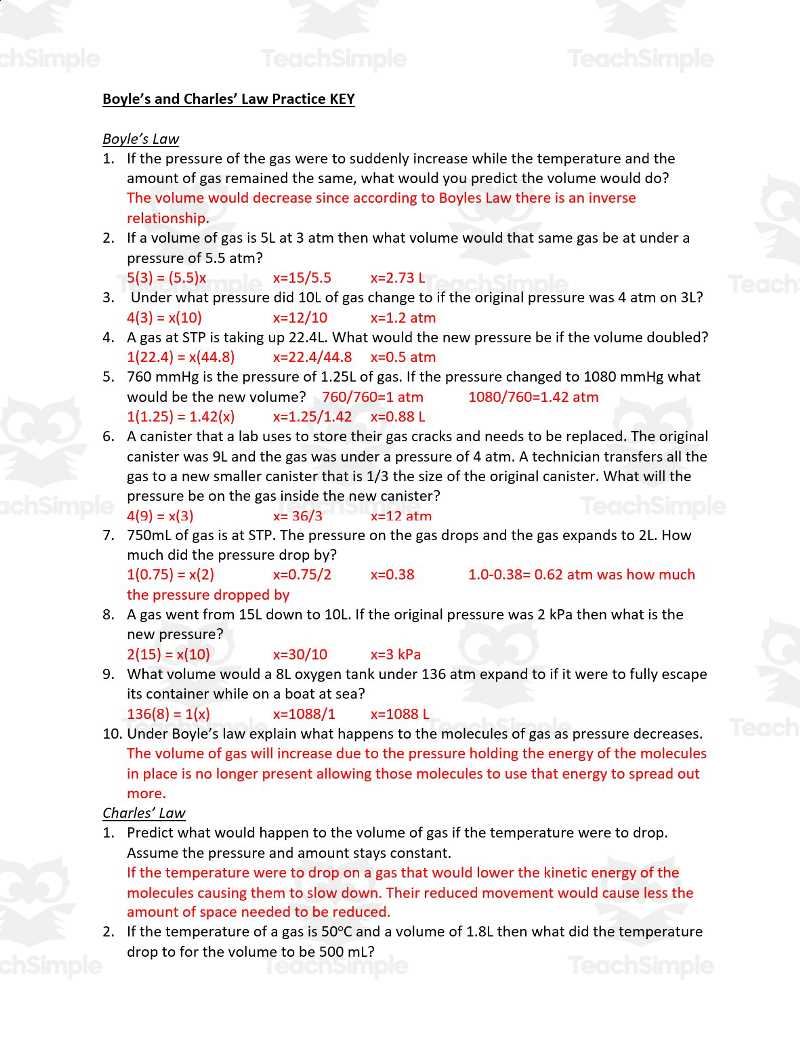
To apply this principle in real-world situations, recognize how pressure and volume behave in enclosed spaces. For example, in a syringe, pushing the plunger decreases the volume, which increases the pressure of the gas inside.
- Scuba Diving: As a diver descends, the pressure increases, causing the air in the lungs to compress. Understanding how volume changes with pressure is crucial for safe diving practices.
- Air Compression: In air compressors, reducing the volume of air inside the tank increases the pressure, which is then released for various industrial uses.
- Breathing: When you inhale, your diaphragm moves downward, increasing the volume of the lungs and decreasing the pressure inside. This allows air to flow in. Conversely, exhalation reduces lung volume and increases pressure, pushing air out.
By applying this principle to such scenarios, you can predict how gases behave under different pressures and volumes, aiding in the design of equipment and ensuring safety in practices involving gases.
Additional Practice Problems for Mastering Boyle’s Law
Use the following practice scenarios to reinforce your understanding of how pressure and volume interact in closed systems. These exercises will help you gain confidence in applying the principle to different contexts.
Problem Given Information Required Calculation 1. A gas occupies 3.0 L at 2.0 atm. What is the new volume if the pressure increases to 6.0 atm? Initial volume: 3.0 L, Initial pressure: 2.0 atm, Final pressure: 6.0 atm Calculate the final volume 2. A balloon has a volume of 5.0 L at 1.0 atm. What will its volume be if the pressure drops to 0.5 atm? Initial volume: 5.0 L, Initial pressure: 1.0 atm, Final pressure: 0.5 atm Calculate the final volume 3. A gas is stored in a container at 4.0 atm and 2.5 L. What will its pressure be if the volume is reduced to 1.5 L? Initial pressure: 4.0 atm, Initial volume: 2.5 L, Final volume: 1.5 L Calculate the final pressure 4. A syringe contains 100 mL of gas at 1.2 atm. If the gas is compressed to 50 mL, what will the new pressure be? Initial volume: 100 mL, Initial pressure: 1.2 atm, Final volume: 50 mL Calculate the final pressure For each exercise, apply the formula P₁V₁ = P₂V₂. Double-check your calculations by comparing initial and final conditions. Ensure the units are consistent throughout the problem and remember that temperature must remain constant for this principle to apply.