Unit 3 Test Study Guide for Relations and Functions with Answer Key
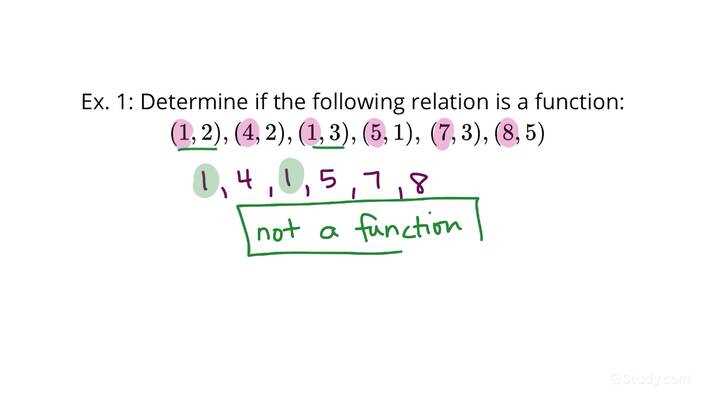
Begin by focusing on the core elements such as identifying inputs and outputs, and understanding how they relate. Recognizing the different ways to represent these relationships, such as through equations or graphs, will form the foundation of more advanced topics. Practice solving for unknown values by applying both algebraic and graphical methods.
Next, familiarize yourself with the distinctions between different types of relations, such as those that can be described by straight lines versus curves. Knowing how to manipulate equations for different scenarios, like transforming a basic function into its inverse or adjusting its shape, will enhance your problem-solving skills. Start with simple examples and gradually increase the complexity as you gain confidence.
Finally, ensure you are comfortable with the concepts of domain and range. This will allow you to recognize valid inputs and corresponding outputs for each situation, and help you avoid errors while solving problems. Take time to review each example thoroughly, as repetition is key to mastering these topics.
Review and Practice for Key Concepts in Algebra
Start by revisiting how to define inputs and outputs for a given equation. Ensure you can identify whether a set of points or a graph represents a valid scenario, keeping in mind that each input should have one corresponding output. Practice using tables, graphs, and equations to express these relationships.
Next, focus on how to solve for unknowns in both algebraic and graphical formats. For example, solve equations where one variable is given, and practice plotting linear and nonlinear models. Ensure you can identify the slope, intercepts, and behavior of different curves, such as parabolas or exponential functions.
Additionally, familiarize yourself with the concept of domain and range. For each equation, determine the possible inputs and the corresponding outputs. Know how to exclude values that would lead to undefined results, such as division by zero or square roots of negative numbers.
Sample Question 1: Given the equation y = 2x + 3, determine the output for x = 4.
Solution: Substitute x = 4 into the equation: y = 2(4) + 3 = 8 + 3 = 11.
Sample Question 2: Find the domain of the equation y = 1/(x – 2).
Solution: The domain is all real numbers except x = 2, as this would result in division by zero.
Work through several examples of equations and graphs to ensure you can apply these concepts effectively. Practice problems that require solving for x or y in different types of equations and graphing their results.
Understanding Functions and Their Notations
Begin by reviewing the definition of a function. A function is a relationship where each input corresponds to exactly one output. The notation f(x) is commonly used to represent a function, where “f” is the name of the function and “x” is the input value. When you see f(3), for example, it means you are plugging 3 into the function and solving for the output.
Next, practice recognizing different ways functions are expressed. For example, you might encounter a function written as y = 2x + 1. In this case, y represents the output and x the input, with the function showing how to find the output for any given x.
When working with function notation, remember that the function’s name (such as f, g, or h) can vary, but the format f(x) remains the same. This notation is used to simplify expressions and make it clear that each input has one specific output.
Example 1: Given the function f(x) = 3x + 4, find the output when x = 2.
Solution: Substitute x = 2 into the function: f(2) = 3(2) + 4 = 6 + 4 = 10.
Example 2: For the function g(x) = x² – 1, what is g(5)?
Solution: Substitute x = 5 into the function: g(5) = 5² – 1 = 25 – 1 = 24.
To further your understanding, practice writing equations in function notation and solving for different values. Ensure you can identify when a relationship is a function and how to express it using notation.
Identifying Domain and Range in Functions
The domain of a function consists of all possible input values (x-values) that the function can accept. The range refers to the set of possible output values (y-values) generated by the function. To identify the domain and range, consider the function’s equation or graph.
1. Identifying the Domain:
- Examine the function for restrictions on x-values. For example, if a function has a denominator, ensure that the denominator never equals zero, as division by zero is undefined.
- If the function contains a square root, the radicand (the expression inside the square root) must be non-negative, as negative values would result in complex numbers.
- For a function represented by a graph, observe where the graph starts and ends along the x-axis. The domain is the horizontal spread of the graph.
Example: For the function f(x) = √(x – 2), the domain is x ≥ 2 because the expression inside the square root must be greater than or equal to zero.
2. Identifying the Range:
- Examine the possible y-values produced by the function. For polynomial functions, the range is usually all real numbers, but this can vary for rational or piecewise functions.
- For square root functions, the range is typically non-negative (y ≥ 0), since square roots cannot yield negative numbers.
- For a function represented by a graph, look at the vertical extent of the graph. The range is the vertical spread of the graph.
Example: For the function f(x) = x², the range is y ≥ 0 because the square of any real number is non-negative.
To practice identifying the domain and range, examine various functions both algebraically and graphically. Recognize any restrictions and understand how they affect the set of valid input and output values.
Types of Functions: Linear, Quadratic, and Exponential
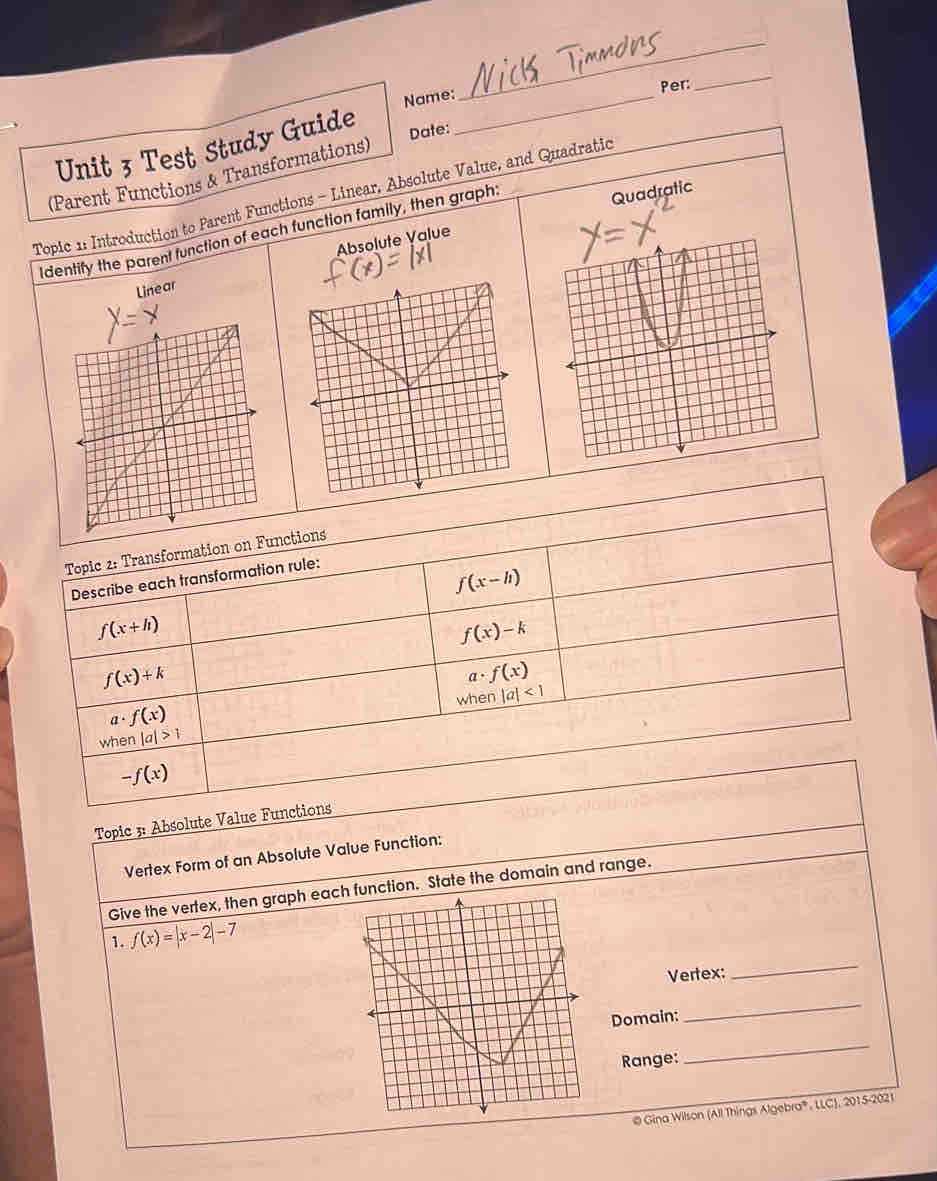
Linear Functions: A linear function is a polynomial function of degree 1. It has the general form f(x) = mx + b, where m is the slope and b is the y-intercept. The graph of a linear function is a straight line. These functions represent constant rates of change.
- Example: f(x) = 2x + 3
- Key characteristic: The slope (m) determines the steepness of the line. If m is positive, the line rises; if negative, the line falls.
- Real-world applications: Linear functions model situations with constant growth or decay, such as distance over time at a constant speed.
Quadratic Functions: A quadratic function is a polynomial function of degree 2. It has the general form f(x) = ax² + bx + c, where a, b, and c are constants. The graph of a quadratic function is a parabola, which can either open upward or downward depending on the value of a.
- Example: f(x) = x² – 4x + 3
- Key characteristic: The vertex of the parabola is the highest or lowest point, depending on the direction of the opening.
- Real-world applications: Quadratic functions model projectile motion, such as the path of a ball thrown into the air.
Exponential Functions: An exponential function has the form f(x) = a * b^x, where a is a constant, b is the base, and x is the exponent. Exponential functions grow or decay at a constant percentage rate, making them useful for modeling population growth, radioactive decay, and compound interest.
- Example: f(x) = 3 * 2^x
- Key characteristic: The base (b) determines the rate of growth or decay. If b > 1, the function grows; if 0
- Real-world applications: Exponential functions are used in finance, biology, and physics, where quantities change at an increasing or decreasing rate over time.
For more in-depth explanations and examples, visit resources like Khan Academy’s Algebra section for further study.
Graphing Relations and Functions on a Coordinate Plane
To graph a relationship or mathematical expression on a coordinate plane, start by plotting points based on given values. For equations or expressions, determine pairs of x and y values (or other variables) that satisfy the equation.
Steps for Graphing:
- Identify the type of equation: For linear equations, the graph will be a straight line. For quadratic equations, expect a parabola, and for exponential equations, a curve with rapid growth or decay.
- Create a table of values: Select values for x (or the independent variable) and compute the corresponding y (or dependent variable) using the given equation.
- Plot points: Plot each point on the coordinate plane using the x and y values obtained from the table.
- Draw the graph: Connect the points smoothly. For linear equations, draw a straight line; for curves, sketch the appropriate shape based on the equation type.
Example: For the linear equation f(x) = 2x + 1, choose values for x (e.g., -2, -1, 0, 1, 2) and calculate corresponding y values:
| x | f(x) = 2x + 1 |
|---|---|
| -2 | -3 |
| -1 | -1 |
| 0 | 1 |
| 1 | 3 |
| 2 | 5 |
After plotting these points, connect them with a straight line, which is the graph of the equation f(x) = 2x + 1. Repeat this process for other types of expressions to visualize their graphs.
Solving Function Equations and Systems of Equations
To solve function equations, isolate the dependent variable by performing inverse operations. For example, given an equation like f(x) = 2x + 3, solve for x by subtracting 3 from both sides and then dividing by 2.
Steps for Solving a Single Equation:
- Isolate the function expression: Rearrange the equation so that the variable is isolated on one side.
- Perform operations: Apply algebraic operations (addition, subtraction, multiplication, division) to simplify the equation and solve for the unknown variable.
- Check the solution: Substitute the value back into the original equation to verify that both sides are equal.
Example: Solve the equation f(x) = 2x + 3 for x.
| Step | Action | Result |
|---|---|---|
| 1 | Start with f(x) = 2x + 3 | f(x) = 2x + 3 |
| 2 | Subtract 3 from both sides | f(x) – 3 = 2x |
| 3 | Divide by 2 | (f(x) – 3) / 2 = x |
| 4 | Final answer: x = (f(x) – 3) / 2 | x = (f(x) – 3) / 2 |
For solving systems of equations, use substitution or elimination methods. Substitution involves solving one equation for a variable and substituting it into another equation. Elimination involves adding or subtracting equations to eliminate one variable, making it easier to solve for the others.
Steps for Solving a System of Equations:
- Choose a method: Select substitution or elimination based on which variable is easiest to isolate or eliminate.
- Substitute or eliminate: Use the chosen method to simplify the system into one equation with one variable.
- Solve for the variable: Once one variable is isolated, solve for it and substitute the value into the other equation to solve for the remaining variable.
- Check your solution: Verify the solution by substituting the values into the original equations.
Example: Solve the system of equations:
2x + 3y = 12
4x – y = 7
| Step | Action | Result |
|---|---|---|
| 1 | Use substitution or elimination method | Choose substitution to solve for x or y |
| 2 | Substitute x = 2 into the second equation | 4(2) – y = 7 |
| 3 | Solve for y | 8 – y = 7 → y = 1 |
| 4 | Substitute y = 1 into the first equation | 2x + 3(1) = 12 → 2x + 3 = 12 → 2x = 9 → x = 4.5 |
| 5 | Final solution: | x = 4.5, y = 1 |
This method ensures that the system is solved correctly by determining values for both variables. Be sure to double-check by substituting back into both original equations.
Understanding and Applying Function Transformations
To apply transformations to functions, it is important to understand how changes to the function’s equation affect its graph. These transformations include translations, reflections, stretching, and compressions. Each transformation can be represented algebraically, and understanding the effect on the graph is key to accurately visualizing and applying these changes.
Translations: A translation shifts the graph horizontally or vertically. For example, the equation f(x) + 3 shifts the graph of f(x) upwards by 3 units, while f(x – 2) shifts the graph to the right by 2 units.
- Vertical translation: If the equation is f(x) + k, the graph moves vertically by k units (positive k moves up, negative k moves down).
- Horizontal translation: If the equation is f(x – h), the graph moves horizontally by h units (positive h moves right, negative h moves left).
Reflections: A reflection flips the graph across a line. A reflection over the x-axis can be represented by -f(x), while a reflection over the y-axis is f(-x). The negative sign in front of the function reflects the graph over the respective axis.
- Reflection over the x-axis: The equation -f(x) reflects the graph over the x-axis.
- Reflection over the y-axis: The equation f(-x) reflects the graph over the y-axis.
Stretching and Compressions: A vertical stretch or compression occurs when the function is multiplied by a constant. The equation a * f(x) applies a vertical stretch by a factor of |a| if |a| > 1, or a vertical compression if 0
- Vertical stretch: If the equation is 2 * f(x), the graph stretches vertically by a factor of 2.
- Vertical compression: If the equation is 0.5 * f(x), the graph compresses vertically by a factor of 0.5.
A horizontal stretch or compression occurs when the input variable x is multiplied by a constant. The equation f(bx) compresses the graph horizontally by a factor of |b| if |b| > 1, or stretches the graph horizontally if 0
- Horizontal stretch: If the equation is f(0.5x), the graph stretches horizontally by a factor of 2.
- Horizontal compression: If the equation is f(2x), the graph compresses horizontally by a factor of 2.
Example: For the equation f(x) = |x – 3| + 4, the graph is translated 3 units to the right and 4 units up. The function shifts accordingly on the coordinate plane.
Understanding these transformations allows for greater flexibility in graphing functions and solving related problems. Practice with different transformations will lead to a better grasp of their effects on the graph and their practical applications.
Inverse Functions and Their Properties
Inverse functions are functions that reverse the effect of the original function. To find the inverse of a function, the roles of the input and output are switched. If a function is denoted by f(x), its inverse is written as f-1(x). The inverse of a function undoes what the original function does to a given value.
Steps to Find the Inverse:
- Replace the function notation f(x) with y.
- Switch the x and y variables.
- Solve the equation for y.
- Replace y with f-1(x) to express the inverse function.
Example: If f(x) = 2x + 3, to find the inverse:
- Replace f(x) with y: y = 2x + 3.
- Switch x and y: x = 2y + 3.
- Solve for y: y = (x – 3)/2.
- The inverse is f-1(x) = (x – 3)/2.
Properties of Inverse Functions:
- Reflection: The graph of an inverse function is the reflection of the original graph over the line y = x.
- One-to-One: Only one-to-one functions have an inverse. A function is one-to-one if every output corresponds to exactly one input.
- Composition: If f(x) is a function and f-1(x) is its inverse, then:
- f(f-1(x)) = x for all x in the domain of f-1(x).
- f-1(f(x)) = x for all x in the domain of f(x).
- Domain and Range: The domain of the original function becomes the range of its inverse, and the range of the original function becomes the domain of its inverse.
Example: For f(x) = 2x + 3, the domain is all real numbers, and the range is also all real numbers. The inverse, f-1(x) = (x – 3)/2, has the same domain and range.
Inverse functions are useful for solving equations and understanding the behavior of functions. By practicing these concepts, you can quickly identify and apply inverse functions in different contexts.
Practice Problems with Solutions for Functions and Relations
Problem 1: Given the equation y = 3x – 5, find the value of y when x = 4.
Solution: Substitute x = 4 into the equation:
y = 3(4) - 5
y = 12 - 5
y = 7
The value of y is 7 when x = 4.
Problem 2: Determine if the following set of points represents a function: {(2, 3), (4, 5), (2, 6), (7, 8)}.
Solution: A set of points represents a function if each input (x-value) corresponds to exactly one output (y-value). Here, the point (2, 3) and (2, 6) share the same x-value (2) but have different y-values. Therefore, this set does not represent a function.
Problem 3: Find the inverse of the function f(x) = (x – 2)/4.
Solution: To find the inverse, swap x and y and solve for y:
x = (y - 2)/4
Multiply both sides by 4:
4x = y - 2
Add 2 to both sides:
4x + 2 = y
The inverse is f-1(x) = 4x + 2.
Problem 4: Graph the linear equation y = 2x + 1.
Solution: To graph the equation y = 2x + 1, identify the y-intercept (1) and the slope (2). Start at the point (0, 1) on the y-axis. Then, use the slope of 2 to rise 2 units and run 1 unit to the right to plot the next point. Continue this process to plot more points and draw a straight line through them.
Problem 5: For the quadratic function f(x) = x2 – 4x + 3, find the vertex.
Solution: The vertex of a quadratic function can be found using the formula x = -b/2a, where the function is in the form f(x) = ax2 + bx + c. For f(x) = x2 – 4x + 3, a = 1 and b = -4. Substituting into the formula:
x = -(-4)/2(1) = 4/2 = 2
Substitute x = 2 into the original function:
f(2) = (2)2 - 4(2) + 3 = 4 - 8 + 3 = -1
The vertex is (2, -1).
Problem 6: Solve the system of equations:
x + y = 7
2x - y = 4
Solution: Add the two equations to eliminate y:
(x + y) + (2x - y) = 7 + 4
3x = 11
x = 11/3
Substitute x = 11/3 into x + y = 7:
(11/3) + y = 7
y = 7 - 11/3 = 21/3 - 11/3 = 10/3
The solution is x = 11/3 and y = 10/3.