Genetics Matching Worksheet Solutions and Explanations
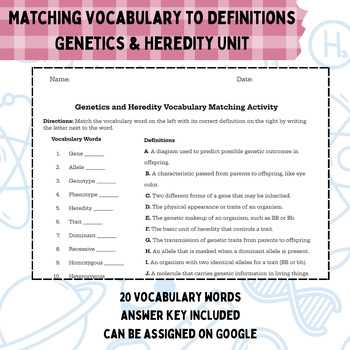
To approach exercises that focus on genetic traits and inheritance, break down each term and concept to its core. Start by identifying dominant and recessive characteristics, and then move on to understanding how these traits are passed down through generations. Focus on mastering Punnett squares, which are crucial tools for predicting offspring outcomes.
When reviewing exercises, pay special attention to the relationships between genotypes and phenotypes. It’s important to recognize the difference between homozygous and heterozygous gene pairs, as these distinctions form the basis for solving many problems. Ensure that you also grasp how various alleles interact to produce specific traits in an organism.
Finally, practicing how to correlate specific terms with the correct definitions or examples is key. This approach will help solidify your grasp of the material and improve your performance when analyzing genetic inheritance scenarios. Review each concept thoroughly, and don’t rush through exercises, as a clear understanding is crucial for accurately solving related problems.
Genetics Matching Worksheet Solutions
To correctly match alleles with their corresponding traits, start by identifying the dominant and recessive alleles. Dominant alleles should be represented with a capital letter (e.g., A), while recessive alleles are represented with lowercase letters (e.g., a). For each genetic trait, assign the proper allele pair according to the phenotype described in the problem.
For example, when tasked with determining the genotype of an organism with a dominant phenotype, assume the organism could be either homozygous dominant (AA) or heterozygous (Aa). If the organism’s offspring exhibit a recessive phenotype, the parent must be heterozygous (Aa). In contrast, a homozygous recessive individual (aa) can only pass on the recessive allele.
After assigning genotypes to phenotypes, make sure to check for consistency. If a cross between two individuals results in offspring with a 3:1 ratio of phenotypes, the parents must be heterozygous for the trait. A 1:1 ratio indicates that one parent is homozygous recessive, and the other is heterozygous. Always double-check your calculations by using Punnett squares to visualize allele combinations and predict offspring traits.
Understanding the Basics of Genetic Inheritance
Genetic traits are inherited based on the combination of alleles passed from both parents to their offspring. Each parent contributes one allele for every gene, which can be dominant or recessive. The genotype of an organism, which consists of two alleles, determines the phenotype, or observable trait.
To understand inheritance patterns, it’s important to know how alleles interact. Dominant alleles will always express their traits, even if only one copy is inherited. Recessive alleles, on the other hand, only manifest when two copies are present (homozygous recessive). A heterozygous genotype, containing one dominant and one recessive allele, will express the dominant trait.
For example, if a child inherits a dominant allele for a trait (e.g., “A”) from one parent and a recessive allele (e.g., “a”) from the other, the child’s genotype will be heterozygous (Aa) and the dominant trait will be expressed. However, if the child inherits two recessive alleles (aa), the recessive trait will be expressed.
- Homozygous dominant: two copies of the dominant allele (AA).
- Heterozygous: one dominant allele and one recessive allele (Aa).
- Homozygous recessive: two copies of the recessive allele (aa).
Using Punnett squares can help visualize the probability of offspring inheriting certain alleles. This tool helps predict the outcome of genetic crosses, illustrating the chances of different genotypes in the next generation.
How to Approach Matching Genetic Terms and Concepts
When working with terminology related to inheritance and biological traits, it’s important to break down complex ideas into simpler components. Start by familiarizing yourself with basic terms like allele, genotype, phenotype, dominant, and recessive. Understanding these core concepts will make it easier to match them with other terms.
Focus on the relationships between the concepts. For example, if you’re asked to match a genotype with its possible phenotype, remember that a homozygous dominant genotype (e.g., AA) will always express the dominant trait. A heterozygous genotype (e.g., Aa) will express the dominant trait as well, while a homozygous recessive genotype (aa) will express the recessive trait.
Consider the different inheritance patterns such as Mendelian dominance, incomplete dominance, and codominance. In Mendelian inheritance, the dominant allele overshadows the recessive allele, while in incomplete dominance, the heterozygous genotype results in an intermediate phenotype. In codominance, both alleles are equally expressed.
| Term | Definition |
|---|---|
| Allele | An alternative form of a gene, one of the factors that determine a trait. |
| Genotype | The genetic makeup of an organism, represented by the alleles inherited from both parents. |
| Phenotype | The observable traits of an organism, influenced by its genotype and environmental factors. |
| Dominant Allele | An allele that expresses its trait even when only one copy is present. |
| Recessive Allele | An allele that expresses its trait only when two copies are present. |
In matching exercises, link terms with their definitions based on these characteristics. Practice by testing different combinations to solidify your understanding of how genetic information is inherited and expressed.
Analyzing Mendelian Inheritance Patterns in Worksheets
To effectively analyze inheritance patterns in exercises, focus on identifying dominant and recessive traits. Begin by noting whether the condition is controlled by a single gene with clear dominant and recessive alleles. In many problems, a dominant allele is represented by a capital letter (e.g., A), while a recessive allele is shown with a lowercase letter (e.g., a).
Examine the provided genotypes for each individual. For example, a homozygous dominant genotype (AA) will always show the dominant trait, while a homozygous recessive genotype (aa) will express the recessive trait only in the absence of a dominant allele. A heterozygous genotype (Aa) will exhibit the dominant trait as well, due to the presence of the dominant allele.
Look for key patterns such as the phenotypic ratio of offspring in monohybrid crosses. Typically, a cross between two heterozygous parents (Aa x Aa) will produce a 3:1 ratio of dominant to recessive phenotypes. Understanding these ratios helps identify the genetic inheritance pattern at play.
In addition, note whether the cross involves a test cross, where a homozygous recessive individual (aa) is crossed with an individual of unknown genotype. This can help determine if the individual with the dominant phenotype is homozygous or heterozygous.
| Genotype | Phenotype |
|---|---|
| AA | Dominant trait expressed |
| Aa | Dominant trait expressed |
| aa | Recessive trait expressed |
By identifying these elements in the problems, you can effectively determine inheritance patterns, predict offspring ratios, and accurately match individuals to their respective genotypes.
Identifying Dominant and Recessive Traits in Genetics
To identify dominant and recessive traits, start by understanding how alleles interact. Dominant traits are expressed even if only one dominant allele is present, while recessive traits are only visible when both alleles are recessive.
Examine the genotype of each individual. If an individual has at least one dominant allele (e.g., Aa or AA), the dominant trait will be expressed. For example, a capital “A” represents the dominant allele for a trait like flower color. On the other hand, a lowercase “a” indicates the recessive allele, and the recessive trait will only show if the genotype is homozygous recessive (aa).
Next, check family pedigrees or genetic crosses. If two individuals with a dominant trait produce offspring with a recessive trait, then both parents must be carriers of the recessive allele. For example, if two parents with a dominant phenotype (e.g., Aa) have a child with a recessive phenotype (aa), both parents must have one copy of the recessive allele.
Use Punnett squares to predict the inheritance of traits. A Punnett square helps determine the possible genotypes and phenotypes of offspring. For example, a cross between two heterozygous individuals (Aa x Aa) results in a 75% chance of offspring showing the dominant trait and a 25% chance of showing the recessive trait.
| Genotype | Phenotype |
|---|---|
| AA | Dominant trait expressed |
| Aa | Dominant trait expressed |
| aa | Recessive trait expressed |
Understanding dominant and recessive allele relationships is key to predicting inheritance patterns and determining the traits that will appear in future generations.
Utilizing Punnett Squares for Genetic Predictions
To predict the inheritance of traits, create a Punnett square by placing the alleles of both parents along the top and left side of a grid. Each box in the grid represents a potential genotype of the offspring.
Begin by identifying the alleles for each parent. For example, if one parent has a genotype of Aa and the other also has Aa, each parent can contribute either an “A” (dominant) or an “a” (recessive) allele. The combination of these alleles is placed in the Punnett square grid.
The Punnett square allows you to visualize all possible combinations of alleles in the offspring. For example, with two heterozygous parents (Aa x Aa), the possible offspring genotypes are: AA, Aa, Aa, and aa. This results in a 3:1 ratio of dominant to recessive phenotypes in the offspring.
| Parent 1 | Parent 2 | Offspring Genotypes |
|---|---|---|
| Aa | Aa | AA, Aa, Aa, aa |
Analyze the results by looking at the proportion of genotypes and phenotypes. In the example above, 75% of the offspring would display the dominant trait, while 25% would display the recessive trait.
Punnett squares are a valuable tool for predicting the likelihood of different traits appearing in offspring, whether dealing with simple Mendelian inheritance or more complex cases.
Decoding Genetic Terminology in Worksheets
Start by familiarizing yourself with common terms such as “allele”, “genotype”, “phenotype”, and “homozygous”. These terms form the foundation of the tasks presented in any genetic-related exercises.
When you encounter “alleles”, these refer to different versions of a gene. For example, an allele for eye color can be “B” for brown or “b” for blue. Understanding how these alleles combine to form a genotype is key to solving related problems.
“Genotype” refers to the genetic makeup of an individual, expressed as combinations of alleles, like “BB” or “Bb”. The “phenotype” is the physical expression of the genotype, such as having brown or blue eyes.
Pay close attention to terms like “dominant” and “recessive”. Dominant traits are expressed when at least one dominant allele is present (e.g., “B” for brown eyes), while recessive traits only appear if both alleles are recessive (e.g., “bb” for blue eyes).
Understanding these terms helps you break down the genetic problems and correctly match the alleles and traits described in the exercise.
Common Mistakes to Avoid in Genetics Matching Exercises
One common mistake is confusing “dominant” and “recessive” alleles. Always ensure that you identify dominant traits correctly, as they mask the expression of recessive traits. For example, “A” is dominant over “a”, meaning that having one “A” allele will express the dominant trait, even if the second allele is recessive.
Another error is mixing up “genotype” and “phenotype”. Genotype refers to the genetic code, while phenotype refers to the physical traits observed. Be cautious when identifying which is being asked for in the exercise.
Be aware of the inheritance patterns. Many people forget that certain traits follow patterns such as autosomal dominant or autosomal recessive. For example, in a cross between two heterozygotes, the expected ratio of offspring genotypes may differ depending on the dominance of the traits.
Also, avoid assuming that traits with more complex genetic patterns (like incomplete dominance or co-dominance) follow simple Mendelian ratios. These patterns require more nuanced interpretation.
For further guidance and resources, refer to authoritative sources such as the Khan Academy on inheritance and genetic disorders.
Using Genetics Matching Answers for Study and Review
Use the provided solutions to check your responses after completing exercises. This helps identify areas where understanding may be lacking. Pay close attention to how traits are classified and how the correct answers relate to the concepts.
When reviewing, focus on understanding why certain answers are correct, rather than just memorizing them. Break down the reasoning behind each solution to reinforce your grasp of inheritance patterns, allele interactions, and genotypic expressions.
In addition, attempt to recreate the exercises without referring to the solutions. Afterward, compare your responses with the correct answers to spot any errors. This process improves retention and helps clarify complex topics.
Consider using the solutions to reinforce specific concepts like dominant versus recessive traits, genetic crosses, and Mendelian ratios. By revisiting these topics with the correct answers in mind, you can identify any misconceptions and correct them during study sessions.