Step-by-Step Guide to Balancing Chemical Equations with Solutions
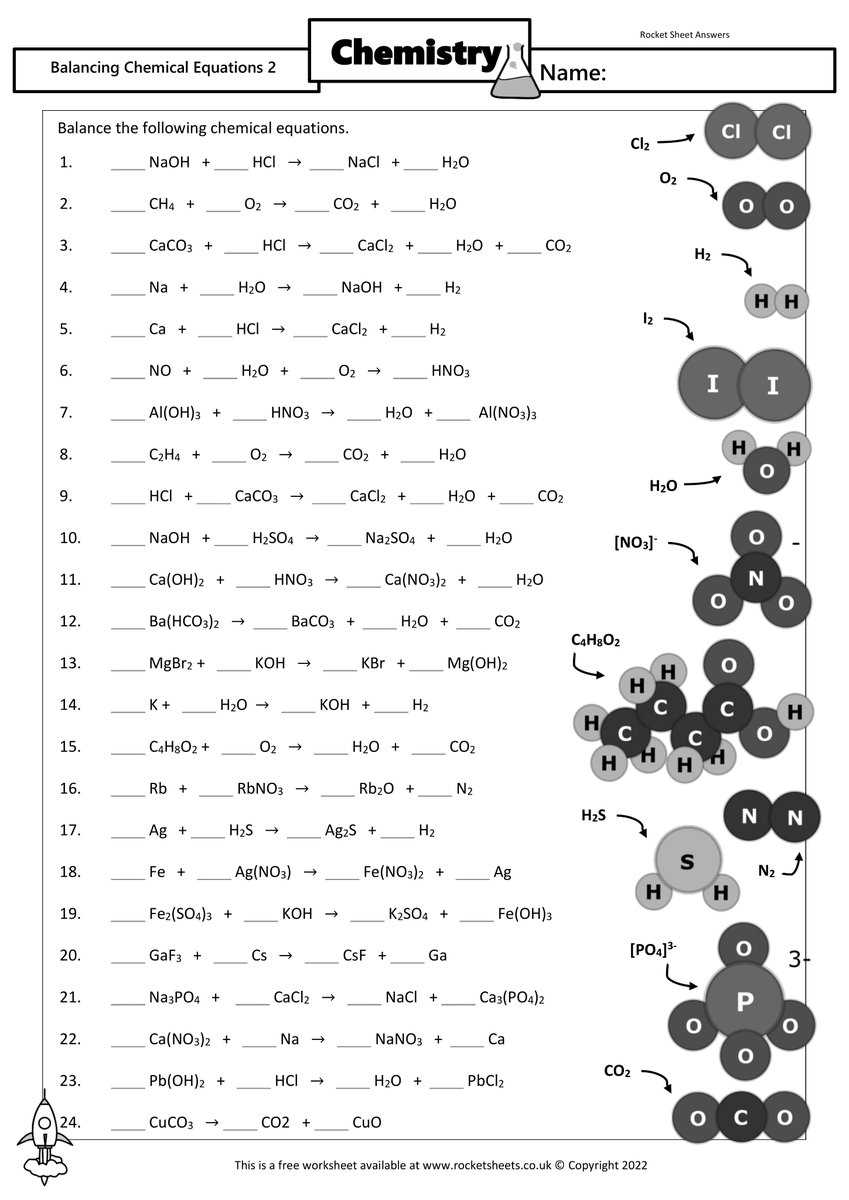
Begin by ensuring that each reactant and product has the same number of atoms on both sides of the reaction. This principle, known as the conservation of mass, is the foundation of any reaction balance. To achieve this, use coefficients to adjust the number of molecules involved while maintaining their identity and properties.
Start by identifying simple reactions where the coefficients can be adjusted directly. For example, in the reaction between hydrogen and oxygen to form water, begin by placing a coefficient of 2 in front of H2 to balance the hydrogen atoms. Then, adjust the oxygen to maintain equality on both sides. The process becomes progressively more complex as you deal with reactions involving multiple reactants and products.
For more complicated reactions, focus on grouping elements that appear in multiple molecules and adjusting them systematically. This includes handling polyatomic ions or gases, where stoichiometric ratios are crucial for accuracy. Always check your work by verifying that the number of atoms of each element is the same on both sides.
Once you’ve practiced balancing basic reactions, tackle redox reactions by following the oxidation number method, which involves tracking electron transfer. This approach requires attention to detail, as changes in oxidation states must be mirrored on both sides of the reaction.
Lastly, refine your technique by reviewing balanced reactions from reliable sources. Practice repeatedly with different reaction types and complexity to master the process and reinforce your understanding of stoichiometry.
Step-by-Step Guide to Solving Reaction Models
1. Begin by writing the unbalanced reaction. Identify all reactants and products clearly, ensuring all components are listed with their correct formulas. For example, for a combustion reaction, write oxygen (O2) and methane (CH4) as reactants, with carbon dioxide (CO2) and water (H2O) as products.
2. Count the atoms of each element on both sides. This will help you identify which elements are unbalanced. If there is an uneven number of atoms for a specific element, that’s your cue to adjust coefficients.
3. Adjust the coefficients. Start with the elements that appear in the least number of compounds. Often, balancing the atoms of carbon and oxygen first is a good strategy. For example, if methane and oxygen are involved in the reaction, balance the carbon atoms first by placing a coefficient in front of CO2.
4. Balance the remaining atoms. After balancing the major elements, work on adjusting hydrogen and oxygen atoms. Pay attention to polyatomic ions, which can be treated as a single unit to simplify the balancing process.
5. Double-check each atom. Verify that the number of atoms for each element is equal on both sides of the equation. If any discrepancies remain, adjust the coefficients again until all elements are balanced.
6. Finally, ensure that all coefficients are in their simplest whole-number ratios. If necessary, divide the coefficients by the greatest common divisor to simplify the numbers.
By following these steps and practicing with different reaction types, you can consistently solve reaction models and ensure that the mass is conserved across both sides of the reaction.
Understanding the Law of Conservation of Mass
The Law of Conservation of Mass states that mass is neither created nor destroyed in a chemical reaction. The total mass of reactants is always equal to the total mass of products. This principle is fundamental for ensuring that chemical reactions are consistent with the laws of physics and chemistry.
To apply this law, begin by identifying the atoms involved in a reaction. For example, in a combustion reaction, if one molecule of methane (CH4) reacts with two molecules of oxygen (O2), the number of carbon, hydrogen, and oxygen atoms on the left side of the equation must equal the number on the right side.
The law ensures that atoms are rearranged, not lost or gained. By adjusting the coefficients in a reaction, you maintain the total number of atoms on both sides, adhering to this principle. This is a key concept when ensuring that a reaction is mathematically and chemically balanced.
Consider the following example:
| Reactants | Products |
|---|---|
| CH4 + 2O2 | CO2 + 2H2O |
In this example, the total number of atoms of each element (carbon, hydrogen, and oxygen) on the left side matches the number on the right, demonstrating the law in action. By following this principle, we ensure that no mass is lost or gained during the transformation from reactants to products.
How to Identify Reactants and Products in a Chemical Equation
To identify reactants and products in a reaction, start by recognizing the components on either side of the equation. The substances present before the reaction occurs are called reactants, and those formed as a result of the reaction are the products.
In a reaction written as A + B → C + D, A and B are the reactants, while C and D are the products. Reactants are typically listed on the left side of the equation, and products appear on the right side.
Look for the substances that undergo change in the reaction. For example, in the combustion of methane (CH4), the reactants are methane (CH4) and oxygen (O2), and the products are carbon dioxide (CO2) and water (H2O).
Reactants often interact or combine during the reaction, while products are the final substances that result from this interaction. Identifying these components accurately is critical for understanding the process and ensuring that the reaction is correctly represented.
Common Types of Chemical Reactions and Their Balancing Techniques
There are several key types of reactions that commonly occur in chemistry, each requiring different techniques for balancing the involved components.
Synthesis Reactions involve two or more reactants combining to form a single product. The simplest form is A + B → AB. To balance, ensure the number of atoms for each element is equal on both sides.
Decomposition Reactions involve a single compound breaking down into two or more simpler substances. For example, AB → A + B. Balancing this type typically requires checking that the elements split correctly across the equation.
Single Displacement Reactions occur when one element displaces another from a compound, forming a new compound and releasing the displaced element. An example is A + BC → AC + B. Ensure that the metals or nonmetals are properly accounted for when balancing.
Double Displacement Reactions involve two compounds exchanging ions to form two new compounds. For example, AB + CD → AD + CB. Balancing these reactions often requires identifying and swapping the ions between the reactants and products.
Combustion Reactions typically involve a hydrocarbon reacting with oxygen to produce carbon dioxide and water, like C4H10 + O2 → CO2 + H2O. To balance, start with carbon atoms, then balance hydrogen, and finally oxygen atoms.
Each type of reaction has unique characteristics that require different approaches to balancing. Understanding the specific pattern of the reaction helps in applying the correct method for achieving a balanced equation.
For more detailed information on balancing various types of reactions, refer to trusted chemistry resources such as Chemguide.
Step-by-Step Method to Balance Simple Equations
Follow these steps to correctly adjust the reactants and products in simple reactions:
- Write the unbalanced equation. Start by writing the basic form of the reaction with all reactants and products included.
- Count atoms of each element. Check the number of atoms for each element on both sides of the equation.
- Balance atoms one element at a time. Begin with the most complex molecule or the element that appears the least. Adjust coefficients to match the number of atoms on both sides.
- Adjust coefficients. Use whole number coefficients. Always check that the number of atoms for each element is equal on both sides after each adjustment.
- Balance hydrogen and oxygen last. These elements often appear in multiple compounds. It’s best to balance them after other elements are adjusted.
- Double-check the equation. Recount atoms for all elements. Ensure that the number of atoms on both sides is equal.
Following these steps ensures that the reaction adheres to the law of mass conservation, where the mass of reactants equals the mass of products.
Balancing Complex Reactions with Polyatomic Ions
When working with reactions that involve polyatomic ions, treat the ion as a unit to simplify the process. Follow these steps:
- Identify the polyatomic ions. In many cases, polyatomic ions like sulfate (SO42−) or nitrate (NO3−) remain unchanged during the reaction. Recognize these ions to simplify your equation.
- Balance polyatomic ions first. If a polyatomic ion appears on both sides of the reaction, balance it as a whole rather than balancing individual elements.
- Balance other elements. After adjusting polyatomic ions, move on to balance other individual elements in the reaction. Often, oxygen and hydrogen are the last to be balanced.
- Adjust coefficients as needed. Ensure that the coefficients are whole numbers and adjust them so the number of atoms of each element matches on both sides of the equation.
- Double-check polyatomic ions. Ensure that the polyatomic ions are still balanced after adjusting the rest of the equation. If needed, make further adjustments to the coefficients.
- Verify the final equation. Recap the atom count for each element and polyatomic ion to confirm both sides are balanced.
By focusing on polyatomic ions as single units, balancing these complex reactions becomes more manageable and accurate.
Using Coefficients vs. Subscripts in Reactions
In molecular reactions, coefficients and subscripts serve different purposes:
- Coefficients indicate the number of molecules or moles involved in a reaction. Adjusting these ensures that the number of atoms of each element is the same on both sides of the reaction.
- Subscripts refer to the number of atoms of an element within a molecule. These cannot be changed during the balancing process, as they represent the fixed chemical structure of a compound.
To balance a reaction:
- Modify coefficients to adjust the number of molecules or moles.
- Never change the subscripts, as this alters the identity of the compounds involved.
For example, in the reaction of oxygen and hydrogen to form water (H2 + O2 → H2O), you would adjust the coefficient of O2 and H2, but not the subscripts within H2O.
By using coefficients properly and leaving subscripts unchanged, you can maintain the integrity of the chemical compounds while ensuring mass is conserved across the reaction.
Handling Redox Reactions in Reaction Balancing
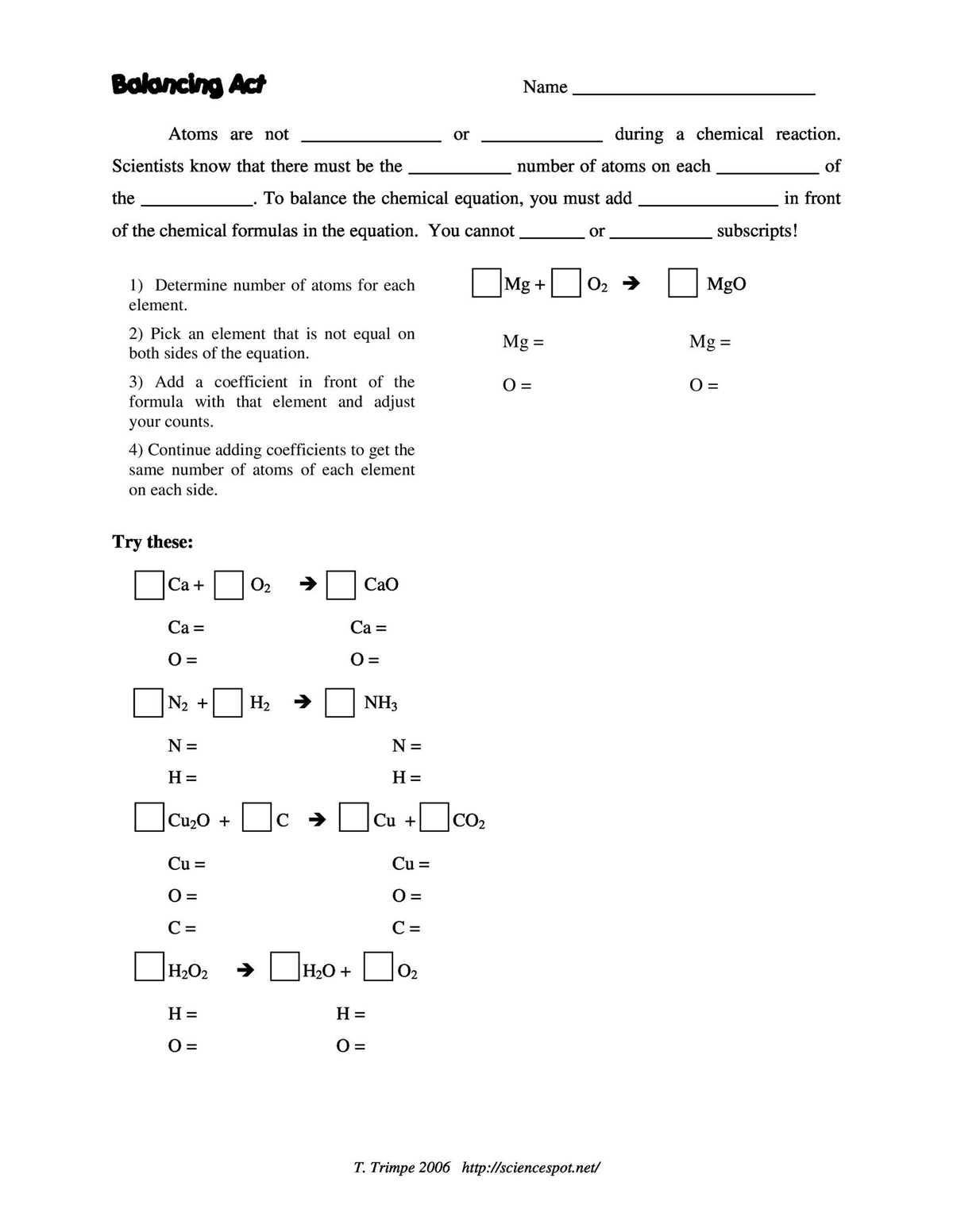
In redox reactions, one element undergoes reduction (gain of electrons), while another undergoes oxidation (loss of electrons). To balance such reactions:
- Identify the oxidation states of all elements in the reaction.
- Determine which elements are being oxidized and which are being reduced.
- Balance the electrons lost and gained by adjusting the coefficients of the reactants and products.
For example, consider the reaction between zinc and copper sulfate:
Zn + CuSO4 → ZnSO4 + Cu
1. Zinc (Zn) is oxidized from 0 to +2, while copper (Cu) is reduced from +2 to 0.
2. Balance the number of electrons: for each zinc atom losing two electrons, one copper ion must gain two electrons.
- Balance atoms, ensuring the number of atoms of each element on both sides are the same.
- Ensure that the total charge on both sides of the reaction is the same.
By carefully adjusting coefficients and ensuring that electron transfer is accounted for, you can correctly represent the redox process. Always check that mass and charge are conserved in the final reaction.
Practical Tips for Double-Checking Your Balanced Reactions
Before finalizing a reaction, make sure to follow these steps to ensure accuracy:
- Verify that the number of atoms for each element is the same on both sides of the reaction.
- Check the total charge on both sides. The charge must be balanced, especially in reactions involving ions.
- Double-check that the coefficients are in the smallest possible whole numbers. Avoid fractional coefficients.
Use the following additional strategies:
- Revisit the oxidation states of elements involved in redox reactions. Ensure electron loss and gain are properly accounted for.
- Consider using a systematic method, such as the algebraic method or half-reaction method, to double-check your results.
Finally, use your knowledge of the reaction’s context. If it’s a combustion or synthesis reaction, make sure products are reasonable based on standard chemical behavior. This practical approach will help you identify errors early and avoid common pitfalls.