Step-by-Step Guide to Balancing Chemical Equations with Solutions
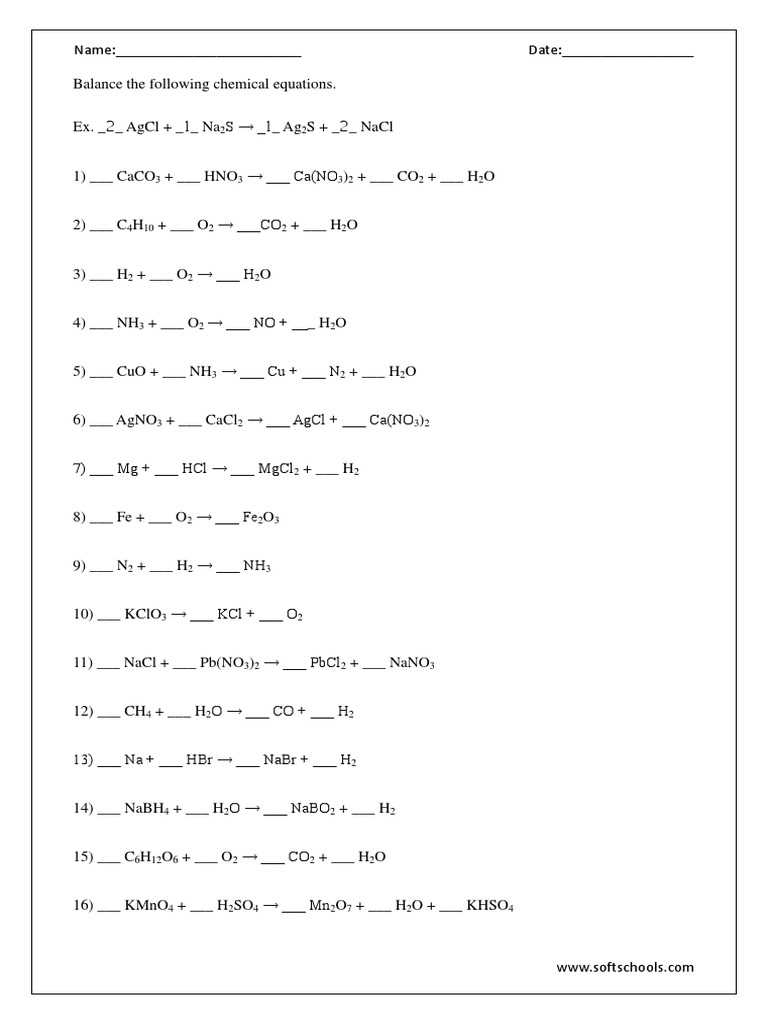
First, identify all elements in the reactants and products. Make sure you list their counts on both sides of the equation. For example, in a reaction between hydrogen and oxygen to form water, you should know the number of hydrogen and oxygen atoms on each side.
Next, adjust the coefficients in front of each substance to ensure the same number of atoms for each element on both sides. Start by balancing the more complex molecules or elements that appear in fewer compounds. For example, in a combustion reaction, balance carbon and oxygen atoms first before adjusting the hydrogen.
Check your work by confirming that the total number of atoms for each element is equal on both sides. If there is an imbalance, recheck the coefficients you used and ensure you haven’t overlooked any compounds.
Step-by-Step Guide to Solving Reaction Balancing Problems
Begin by writing out the unbalanced reaction. Identify all compounds involved, ensuring you list the correct chemical formulas for each reactant and product. For example, for a combustion reaction involving methane, write CH₄ + O₂ → CO₂ + H₂O.
Next, count the number of atoms for each element on both sides of the reaction. Check that each element is accounted for in both reactants and products. In this example, you have carbon, hydrogen, and oxygen atoms to account for.
Adjust the coefficients next to each compound to ensure the same number of atoms of each element on both sides. Start with elements that appear in fewer compounds. For instance, balance carbon first, then hydrogen, and finally oxygen. This process may require trial and error, so don’t hesitate to adjust as needed.
After adjusting the coefficients, verify that the total number of atoms for each element is equal on both sides of the reaction. If the numbers do not match, recheck your work and adjust the coefficients accordingly.
For a visual reference on balancing reactions, visit the resources provided by educational institutions like LibreTexts, which offer detailed explanations and examples.
Understanding the Basics of Balancing Reactions
Begin by ensuring that both sides of the reaction have the same number of atoms for each element. This process involves adjusting the coefficients in front of each compound to match the atom count between reactants and products.
Start with elements that appear in only one reactant and one product. This simplifies the process and avoids confusion. For example, balance metals first, followed by nonmetals like oxygen and hydrogen. Oxygen is often the last element to balance due to its presence in multiple compounds.
It’s crucial to remember that coefficients are the only numbers you should adjust. Do not change subscripts, as this alters the identity of the compound. For instance, altering the subscript in H₂O to H₄O changes the molecule entirely.
After adjusting the coefficients, count the atoms of each element again to ensure that both sides of the reaction are equal. If discrepancies remain, revise the coefficients accordingly until balance is achieved.
For more examples and practice, you can visit resources like LibreTexts for in-depth explanations and exercises.
Identifying Reactants and Products in a Reaction
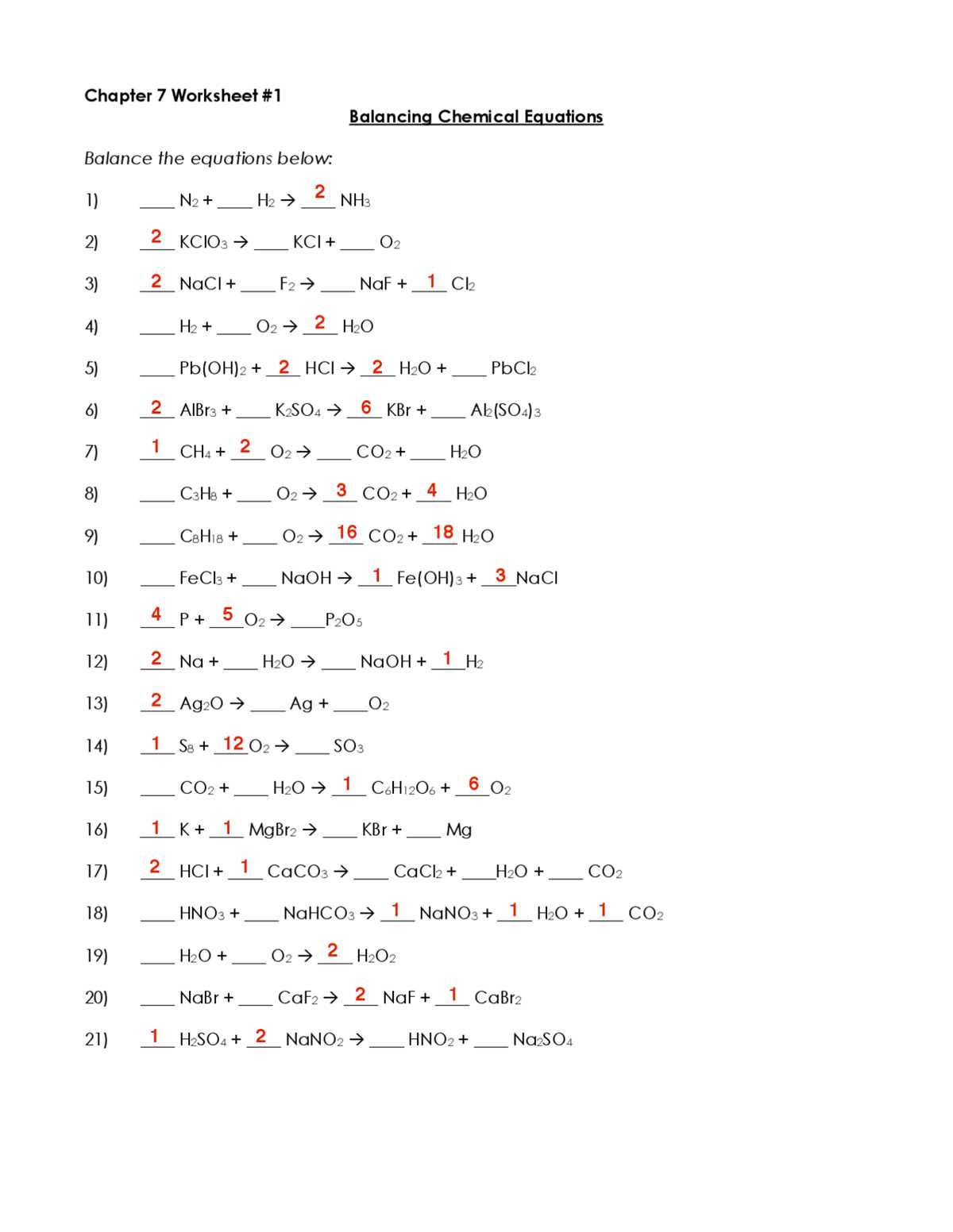
To correctly identify the components in a reaction, start by recognizing the reactants and products. Reactants are substances that undergo change, located on the left side of the reaction. Products are the substances formed after the reaction, shown on the right side.
Here’s how to differentiate between them:
- Reactants: These are the starting materials that will react to form new substances. They are always listed first in a reaction equation. For example, in the combustion of methane: CH₄ + 2O₂ → CO₂ + 2H₂O, methane (CH₄) and oxygen (O₂) are reactants.
- Products: The substances produced as a result of the chemical change. They are always placed on the right side of the equation. In the same reaction, carbon dioxide (CO₂) and water (H₂O) are the products.
To identify reactants and products effectively, focus on the structure of the reaction. Reactants are often elements or compounds that will undergo transformation, while products are the new substances formed after the rearrangement of atoms and bonds.
Be sure to carefully analyze each compound in a reaction to avoid confusion. Sometimes, intermediate compounds or by-products are involved, which may require further analysis to identify properly.
How to Use the Law of Conservation of Mass to Equalize Reactions
To ensure that a reaction adheres to the Law of Conservation of Mass, the number of atoms for each element must remain the same on both sides of the equation. This means that the mass of reactants should be equal to the mass of products.
Follow these steps to maintain this principle:
- Write the unbalanced equation: Start by listing all reactants and products. For example, for the reaction of hydrogen and oxygen to form water, write it as H₂ + O₂ → H₂O.
- Count atoms of each element: On both sides of the reaction, tally how many atoms of each element are present. In the example, there are 2 hydrogen (H) atoms on the left, but only 2 hydrogen atoms on the right. Oxygen (O) has 2 atoms on the left but only 1 on the right.
- Adjust coefficients: To ensure the number of atoms is the same on both sides, adjust the coefficients in front of the compounds. For the example, put a coefficient of 2 in front of H₂O to match the oxygen atoms: H₂ + O₂ → 2H₂O.
- Check the atom count: Now, check again. There are 2 oxygen atoms on both sides (O₂ on the left and 2 H₂O on the right). Hydrogen is also equal, with 2 H₂ on the left and 4 H on the right.
- Re-check coefficients: Adjust hydrogen again to match the atoms: 2H₂ + O₂ → 2H₂O. Now, hydrogen and oxygen atoms are balanced on both sides.
This method ensures that the mass is conserved in the reaction. Each atom involved in the process is accounted for before and after the transformation.
Step-by-Step Instructions for Equalizing Simple Reactions
Begin by writing out the unbalanced reaction. For example, consider the combination of hydrogen and oxygen to form water: H₂ + O₂ → H₂O.
1. Count atoms for each element: In the unbalanced equation, there are 2 hydrogen atoms on the left and 2 oxygen atoms. On the right, water has 2 hydrogen atoms but only 1 oxygen atom.
2. Adjust coefficients: To match the oxygen atoms, place a coefficient of 2 in front of H₂O: H₂ + O₂ → 2H₂O.
3. Recheck hydrogen atoms: Now there are 4 hydrogen atoms on the right side. To match this, place a coefficient of 2 in front of H₂ on the left: 2H₂ + O₂ → 2H₂O.
4. Verify atom balance: Ensure that the number of atoms for each element is the same on both sides. Hydrogen is now 4 on both sides, and oxygen is 2 on both sides.
5. Final check: After adjusting the coefficients, confirm that all elements are equal on both sides, completing the process.
Dealing with Complex Reactions: Tips for Multiple Elements
Focus on elements that appear in fewer compounds. Begin with the element that is easiest to adjust, such as one that only appears once on either side of the reaction.
1. Start with less frequent elements: When dealing with complex reactions, first adjust the coefficients for elements that are less common. This allows for a smoother process as you move through the equation.
2. Save oxygen for last: Oxygen is often present in more than one compound. Tackle this element last to avoid confusion and unnecessary adjustments across multiple terms.
3. Use fractions for intermediate steps: If atoms cannot be directly matched, introduce fractions (e.g., 1/2 or 3/2) to temporarily equalize atoms, and multiply through at the end to eliminate fractions.
4. Recheck the atom count: After modifying one element, reassess the count for all atoms. A minor adjustment can affect multiple elements, so consistent verification is key.
5. Finish with the simplest coefficients: Once all atoms are matched, adjust the coefficients to ensure they are the smallest whole numbers, typically by multiplying through by a common factor to eliminate fractions.
Common Pitfalls and Mistakes in Balancing Reactions
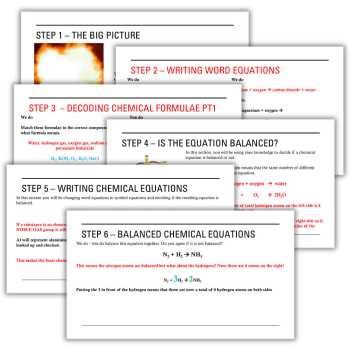
1. Overcomplicating adjustments: Avoid making changes to multiple elements at once. This often leads to errors. Focus on one element at a time, especially those appearing in fewer compounds.
2. Incorrectly adjusting coefficients: Ensure that you adjust the coefficients in whole numbers. Introducing fractions during intermediate steps can confuse the final result, so avoid this unless absolutely necessary.
3. Forgetting to check atom counts: Double-check atom counts after every adjustment. It’s easy to overlook discrepancies between the left and right sides, leading to unbalanced atoms.
4. Not addressing oxygen last: Oxygen atoms tend to appear in multiple compounds. If you adjust oxygen early in the process, it may require multiple revisions. Leave it until all other elements are balanced.
5. Not accounting for polyatomic ions: When dealing with compounds containing polyatomic ions, treat them as single units to simplify adjustments. Breaking down polyatomic ions unnecessarily complicates the process.
6. Not using the lowest whole numbers: After adjusting coefficients, always ensure they are in the simplest whole number ratio. Multiplying everything by a common factor can lead to larger numbers than necessary.
7. Ignoring conservation of mass: Each element must appear in equal amounts on both sides of the reaction. Double-check that all atoms are accounted for before finalizing.
Using Coefficients Correctly to Adjust Reactions
1. Start with elements appearing in fewer compounds: Begin by adjusting coefficients for elements that appear in only one reactant or product. This simplifies the process and reduces mistakes.
2. Do not change subscripts: Only change the coefficients, not the subscripts within chemical formulas. Subscripts represent the actual composition of a compound and should remain fixed.
3. Adjust coefficients in whole numbers: Always use whole numbers for coefficients. If a coefficient is fractional, multiply all coefficients by a common factor to convert them to whole numbers.
4. Ensure coefficients reflect atom conservation: After adjusting one element, recheck other elements. Ensure the total number of atoms on both sides of the reaction are equal.
5. Use coefficients to balance complex compounds: In reactions with polyatomic ions, treat the entire polyatomic ion as a unit. Adjust the coefficient of the polyatomic ion, not individual atoms within it.
6. Do not add extra elements: Coefficients should represent the existing elements in the reaction. Avoid introducing elements that do not appear in the original reaction.
7. Double-check all atoms: Once you adjust the coefficients, count each atom on both sides of the reaction. Ensure the same number of atoms of each element is present on both sides.
Verifying Your Balanced Equation for Accuracy
1. Check atom counts: Count each type of atom on both sides. Ensure that the number of atoms for every element is identical before and after the reaction.
2. Ensure mass conservation: Confirm that the total mass of the reactants is equal to the total mass of the products. This adheres to the law of mass conservation.
3. Review coefficients: Verify that all coefficients are in the smallest possible whole number ratio. Avoid fractional coefficients unless they are multiplied to become whole numbers.
4. Re-check polyatomic ions: For reactions involving polyatomic ions, ensure the ions are balanced as units, not by individual elements within them.
5. Verify charge balance (if applicable): In reactions involving ionic compounds, make sure that the total charge on both sides is the same. This is particularly important for reactions in solution.
6. Cross-reference with known patterns: Compare the reaction with known stoichiometric relationships or reference materials to spot any discrepancies or common mistakes.
7. Use a reaction calculator or tool: If available, use a reliable tool to cross-check your balanced equation. These tools can catch errors that are easy to overlook.