Complete Guide to AP Biology Chi Square Practice Problems Solutions
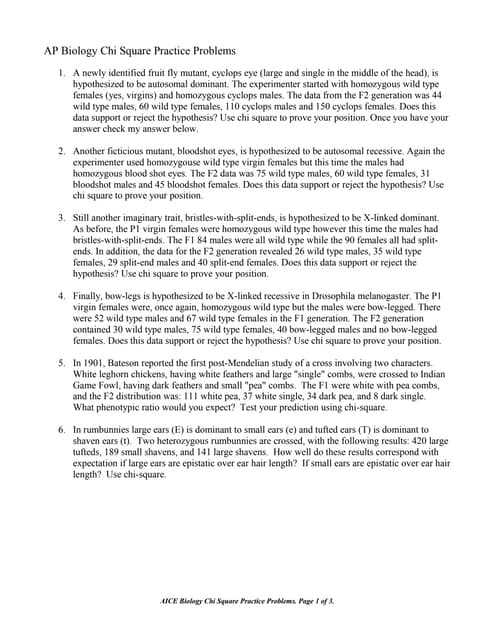
Focus on understanding the formula before applying it to data sets. The first step in any statistical test is to clearly identify the observed and expected values. Start by calculating the expected outcomes based on the hypothesis and compare them with the observed results. This is where many make mistakes–ensuring that each category’s expected value is accurate and reflects the correct assumptions is key to obtaining reliable results.
Don’t skip the calculations for degrees of freedom. The degrees of freedom are a critical component in determining whether the test result is statistically significant. Remember, for a goodness-of-fit test, the degrees of freedom are calculated by subtracting one from the number of categories. This value helps you locate the critical value from the chi-square distribution table and determine if your result falls within the acceptable range.
Interpret p-values correctly. Once you’ve completed your calculations, comparing the test statistic to the critical value will tell you if your result is significant. If the p-value is smaller than the significance level (usually 0.05), the null hypothesis is rejected. If the value is larger, there’s insufficient evidence to reject it. It’s crucial to understand that a significant result indicates a difference between observed and expected outcomes, but it doesn’t necessarily imply causation.
Practice is necessary to ensure accuracy. Repetition will help cement the process of running statistical tests and interpreting their outcomes. Using different datasets will also expose you to various ways the test might be applied, enhancing your overall understanding and boosting your confidence for the exam.
AP Biology Chi Square Practice Problems Answer Key
Step 1: Calculate the expected values based on the null hypothesis. The formula for expected values is simple: multiply the total number of observations by the expected proportion for each category. For example, if you expect a 1:1 ratio, divide the total observations equally between two categories.
Step 2: Compute the test statistic by using the formula: (observed – expected)² / expected for each category. Once you’ve calculated this for all categories, sum the values to get the total test statistic. This is where errors can occur if the expected values are inaccurate or the formula isn’t applied correctly to each group.
Step 3: Determine the degrees of freedom for the test. The degrees of freedom are calculated by subtracting one from the number of categories. For example, if you are working with four categories, the degrees of freedom would be 3. This number is needed to find the critical value in the chi-square distribution table.
Step 4: Compare the test statistic to the critical value from the chi-square distribution table. Find the critical value corresponding to your degrees of freedom and chosen significance level (usually 0.05). If the test statistic is greater than the critical value, reject the null hypothesis.
Step 5: Interpret the result. A p-value smaller than 0.05 indicates that the observed data significantly differ from the expected data, suggesting that the null hypothesis is false. If the p-value is larger than 0.05, there is not enough evidence to reject the null hypothesis, meaning the observed and expected data are not significantly different.
Example Problem: Assume you observe the following frequencies in two categories: observed values: 50 and 50, expected values: 60 and 40. To calculate the test statistic, first compute the differences: (50-60)²/60 = 1.67 and (50-40)²/40 = 2.5. Then sum these values to get the test statistic: 1.67 + 2.5 = 4.17. With 1 degree of freedom, the critical value at a 0.05 significance level is 3.84. Since 4.17 is greater than 3.84, you would reject the null hypothesis.
Understanding the Chi Square Test in AP Biology
Step 1: Formulating the Hypothesis is the starting point. The null hypothesis assumes no significant difference between observed and expected values. It states that any difference is due to random chance. The alternative hypothesis suggests that the difference is not due to random chance.
Step 2: Calculate Expected Values. Expected values are determined based on the hypothesis and the known proportions in the population. For example, if you expect a 1:1 ratio, the expected values are calculated by dividing the total number of observations equally between the two categories.
Step 3: Compute the Test Statistic. The formula is (observed – expected)² / expected for each category. This value is summed for all categories to get the total test statistic. The larger this value, the greater the discrepancy between observed and expected values.
Step 4: Degrees of Freedom are crucial in determining the critical value from a chi-square distribution table. The degrees of freedom are calculated by subtracting one from the number of categories. For example, with 4 categories, the degrees of freedom would be 3.
Step 5: Comparing to Critical Value. The critical value is found in a chi-square distribution table based on the degrees of freedom and the chosen significance level (typically 0.05). If the calculated test statistic exceeds the critical value, the null hypothesis is rejected.
Step 6: Interpreting Results. A p-value smaller than 0.05 indicates a significant difference, meaning the null hypothesis is likely false. A p-value greater than 0.05 suggests that the observed difference can be explained by random chance, and the null hypothesis stands.
Step-by-Step Guide to Solving Chi Square Problems
Step 1: State the Hypothesis
- Null Hypothesis: Assumes no significant difference between observed and expected data.
- Alternative Hypothesis: Suggests that any observed differences are not due to random chance.
Step 2: Calculate the Expected Values
- Expected values are based on the hypothesis and the expected distribution of categories.
- Use the total number of observations and the expected proportion to calculate expected frequencies.
Step 3: Compute the Test Statistic
- For each category, calculate the squared difference between observed and expected values.
- Use the formula: (observed – expected)² / expected.
- Sum the values from all categories to get the test statistic.
Step 4: Find the Degrees of Freedom
- Degrees of freedom = Number of categories – 1.
- For example, if there are 4 categories, degrees of freedom = 3.
Step 5: Determine the Critical Value
- Use a chi-square distribution table to find the critical value based on degrees of freedom and the significance level (usually 0.05).
- If the calculated statistic exceeds the critical value, reject the null hypothesis.
Step 6: Make the Decision
- Compare the test statistic with the critical value.
- If the test statistic is greater than the critical value, reject the null hypothesis.
- If the test statistic is less than or equal to the critical value, do not reject the null hypothesis.
Step 7: Interpret the Results
- A p-value less than 0.05 suggests a significant difference, meaning the null hypothesis is unlikely to be true.
- A p-value greater than 0.05 indicates no significant difference, so the null hypothesis holds.
Common Mistakes in Chi Square Calculations and How to Avoid Them
1. Incorrect Calculation of Expected Values
Ensure that the expected values are correctly calculated based on the hypothesis. The expected frequency for each category should be calculated by multiplying the total sample size by the proportion expected under the null hypothesis. Incorrect expected values lead to incorrect test statistics.
2. Forgetting to Use the Correct Formula
Always use the formula (observed – expected)² / expected for each category. Missing or misapplying this formula can lead to wrong conclusions. Double-check that each part of the formula is used correctly in your calculations.
3. Failing to Account for Small Expected Frequencies
When the expected frequency in any category is less than 5, it may violate the assumptions of the test. In such cases, consider combining categories or using an alternative statistical test, like Fisher’s exact test.
4. Misinterpreting Degrees of Freedom
The degrees of freedom are calculated as number of categories – 1. Forgetting to subtract 1 or miscounting categories can lead to an incorrect comparison with the critical value from the chi-square distribution table.
5. Confusing Critical Value and Test Statistic
Be clear on the difference between the critical value and the test statistic. The test statistic is the result of your chi-square calculation, while the critical value comes from the chi-square distribution table, depending on the degrees of freedom and significance level.
6. Misunderstanding P-Value Interpretation
Remember, a p-value less than the significance level (usually 0.05) indicates that the null hypothesis should be rejected. However, a p-value greater than 0.05 suggests there is no statistically significant difference. Misinterpreting the p-value can lead to incorrect conclusions about the data.
7. Not Double-Checking Your Data
Before calculating the test statistic, ensure that the observed data is accurate and corresponds correctly to the expected values. Simple data entry errors can lead to incorrect conclusions. Always verify the data set before performing calculations.
How to Interpret Chi Square Values and P-Values
1. Understanding the Test Statistic (Chi-Square Value)
The chi-square test statistic quantifies the discrepancy between the observed and expected frequencies. It is calculated by summing the squared differences between observed and expected values, divided by the expected values. A higher test statistic indicates a larger discrepancy and may suggest that the null hypothesis is not valid.
2. Comparing Test Statistic to Critical Value
Once the test statistic is calculated, compare it with the critical value from the chi-square distribution table. The critical value depends on the degrees of freedom and the significance level (commonly 0.05). If the calculated test statistic exceeds the critical value, the null hypothesis is rejected, suggesting a statistically significant difference.
3. Interpreting the P-Value
The p-value indicates the probability of obtaining a test statistic as extreme as the one observed, assuming the null hypothesis is true. A p-value less than 0.05 typically means the results are statistically significant, and the null hypothesis is rejected. A p-value greater than 0.05 suggests that the observed results could be due to random chance, and the null hypothesis cannot be rejected.
4. Degrees of Freedom and Their Role
The degrees of freedom (df) in a chi-square test are calculated as the number of categories minus one. The degrees of freedom are crucial for determining the critical value and interpreting the results. Incorrect degrees of freedom can lead to incorrect conclusions about the significance of the results.
5. When to Reject or Fail to Reject the Null Hypothesis
If the test statistic is greater than the critical value or if the p-value is less than the chosen significance level (usually 0.05), you reject the null hypothesis. This means that the differences between the observed and expected frequencies are too large to attribute to random chance. If the test statistic is lower than the critical value or the p-value is greater than 0.05, you fail to reject the null hypothesis.
6. Practical Considerations
Always ensure that the assumptions of the test are met. For example, expected frequencies should be sufficiently large (typically at least 5). If these assumptions are violated, consider using alternative statistical tests.
Learn more about interpreting chi-square values
Using Chi Square Test for Genetic Crosses and Inheritance Patterns
1. Identifying the Expected Ratios
To apply the test to genetic inheritance, first determine the expected phenotypic or genotypic ratios for a cross. For a simple Mendelian cross (e.g., a monohybrid cross), the expected ratio is typically 3:1 for dominant to recessive traits. For a dihybrid cross, it’s often 9:3:3:1. These ratios form the basis for comparison with observed data.
2. Collecting and Organizing Observed Data
Gather the observed frequency of each phenotype or genotype in the offspring. Ensure the data is clearly organized in a table, with each category representing a specific phenotype or genotype. This will make it easier to compare observed values with the expected values.
3. Calculating the Test Statistic
Calculate the test statistic by summing the squared differences between observed and expected values for each category, divided by the expected value for that category. The formula for the test statistic is:
(O - E)² / E
Where O is the observed value and E is the expected value. This calculation must be done for each phenotype or genotype, and then summed to get the total test statistic.
4. Determining Degrees of Freedom
Degrees of freedom (df) are determined by the number of categories minus one. For a simple monohybrid cross, there are two possible phenotypic categories, so df = 1. For more complex crosses (e.g., dihybrid crosses), the number of categories increases, and so does the degrees of freedom.
5. Comparing to the Critical Value
Using a chi-square distribution table, compare the calculated test statistic with the critical value based on your degrees of freedom and chosen significance level (usually 0.05). If the calculated value exceeds the critical value, reject the null hypothesis, indicating the observed and expected values differ significantly.
6. Interpreting the Results
If the test statistic is large enough to reject the null hypothesis, this suggests that the observed inheritance pattern does not align with the expected genetic ratios. This could be due to factors like genetic linkage, environmental influences, or experimental errors.
7. Addressing Potential Sources of Error
- Sample Size: A small sample size can lead to unreliable results. Larger sample sizes provide more accurate estimates of the true ratio.
- Assumptions of Independence: The test assumes that each data point is independent. Any dependence between data points could skew the results.
- Large Discrepancies: If observed values are very far from expected values, consider alternative explanations like incomplete dominance or co-dominance.
8. Practical Example: Mendelian Monohybrid Cross
For a monohybrid cross between two heterozygous pea plants (Tt x Tt), the expected ratio of offspring phenotypes is 3:1 (three dominant, one recessive). After conducting the cross and counting the number of each phenotype, apply the test to see if the results match the expected ratio.
What to Do When Chi Square Results Are Not Significant
If the calculated value does not exceed the critical value, and the p-value is greater than the chosen significance level (usually 0.05), it means the results are not statistically significant. Here are the next steps to take:
1. Double-check the Data Collection Process
Ensure that the observed data was correctly recorded and categorized. Errors in counting or categorizing the data can lead to inaccurate results. Verify that the sample size is sufficient and that all data points are independent.
2. Re-evaluate the Hypothesis
Consider if the hypothesis or model you are testing is valid. A non-significant result may indicate that the assumed genetic ratio or distribution does not accurately represent the underlying biological process. Revising the hypothesis could lead to new insights.
3. Review Assumptions
Review the assumptions of the test. Ensure that the categories being compared are mutually exclusive and exhaustive. If any assumptions are violated (e.g., small expected frequencies), consider adjusting the model or using a different statistical test.
4. Consider Increasing the Sample Size
A small sample size may lead to a lack of power, making it difficult to detect a significant difference even if one exists. Increasing the sample size can improve the reliability of the test and provide a clearer picture of the data.
5. Examine Alternative Explanations
If the results are still not significant, explore other factors that may influence the outcomes. For example, genetic linkage, environmental factors, or incomplete dominance could be altering the expected ratios. Consider incorporating these factors into your analysis.
6. Use a Different Statistical Test
If the assumptions of the chi-square test are not met (e.g., if expected frequencies are too low), consider using a different statistical test, such as Fisher’s Exact Test, which is more appropriate for small sample sizes or non-independent data.
| Observed | Expected | Difference | Squared Difference | Squared Difference / Expected |
|---|---|---|---|---|
| 50 | 45 | 5 | 25 | 0.56 |
| 45 | 50 | -5 | 25 | 0.50 |
In the example above, the calculation shows that the observed and expected values are fairly close, with the differences and squared differences calculated. If the total value remains small, this suggests no significant deviation from the expected outcomes.
Practice Problems with Detailed Solutions and Explanations
Problem 1: Plant Color Inheritance
In a genetic cross between two pea plants, 150 offspring were produced. Of these, 90 had green flowers and 60 had yellow flowers. The expected ratio is 3:1. Use the statistical test to determine if the observed data significantly deviates from the expected ratio.
Solution:
- Observed values: Green flowers = 90, Yellow flowers = 60
- Expected ratio: 3:1 (75 green, 50 yellow)
- Calculate the chi-square statistic:
| Observed | Expected | Difference | Squared Difference | Squared Difference / Expected |
|---|---|---|---|---|
| 90 | 75 | 15 | 225 | 3.00 |
| 60 | 50 | 10 | 100 | 2.00 |
Chi-Square Calculation:
The chi-square value is calculated by summing the values in the last column:
Chi-Square = (3.00 + 2.00) = 5.00
Interpretation:
Now, compare the calculated chi-square value (5.00) with the critical value from the chi-square distribution table for 1 degree of freedom (df = 1). For a significance level of 0.05, the critical value is 3.841. Since 5.00 > 3.841, the result is statistically significant, indicating a deviation from the expected ratio.
Problem 2: Dice Rolling Experiment
A group of students rolled a fair six-sided die 120 times and recorded the following results:
- 1: 18
- 2: 15
- 3: 22
- 4: 20
- 5: 25
- 6: 20
Check if the rolls follow the expected 1/6 ratio for each face.
Solution:
- Expected frequency: 120 rolls / 6 faces = 20 for each face
| Observed | Expected | Difference | Squared Difference | Squared Difference / Expected |
|---|---|---|---|---|
| 18 | 20 | -2 | 4 | 0.20 |
| 15 | 20 | -5 | 25 | 1.25 |
| 22 | 20 | 2 | 4 | 0.20 |
| 20 | 20 | 0 | 0 | 0 |
| 25 | 20 | 5 | 25 | 1.25 |
| 20 | 20 | 0 | 0 | 0 |
Chi-Square Calculation:
Chi-Square = (0.20 + 1.25 + 0.20 + 0 + 1.25 + 0) = 2.90
Interpretation:
For 5 degrees of freedom (df = 5) and a significance level of 0.05, the critical value is 11.070. Since 2.90
Additional Resources for Mastering Statistical Tests in AP Science
1. Khan Academy: Statistics and Probability – Offers in-depth video tutorials and exercises on hypothesis testing and statistical methods, which can help clarify concepts.
2. Coursera: Introduction to Statistics – Provides a structured course that covers a range of statistical techniques including hypothesis testing and data analysis, suitable for advanced placement courses.
3. Smith College: Online Statistics Resources – A valuable resource with access to online modules and practice questions on hypothesis testing and interpreting data.
4. YouTube Tutorials on Chi Square Test – A variety of channels offer step-by-step video guides for understanding how to perform the test and interpret results effectively.
5. StatTutorials – This website features detailed articles, explanations, and worked examples of common statistical tests, including step-by-step solutions to problems.
6. NCBI: Understanding Statistical Tests – Read research papers that provide insights into the theory and application of various statistical tests in scientific research.
7. R-bloggers – A blog dedicated to statistical programming using R. While focused on R, it provides excellent insights into data analysis, hypothesis testing, and statistical modeling.
8. Math is Fun: Chi Square Test – Offers clear explanations and interactive examples that walk you through the chi-square test step by step.