Algebra 1 Chapter 4 Solutions and Step-by-Step Explanation
To effectively solve linear equations, begin by isolating the variable on one side. Use inverse operations to eliminate constants and coefficients, simplifying the equation step by step. Pay attention to the signs–errors in handling negative numbers are common, so always double-check your work.
Next, practice applying the distributive property in expressions. Break down terms carefully and combine like terms to simplify. This will make solving more complex expressions easier and faster. It’s helpful to rewrite the equations in a form where each term is clearly visible and manageable.
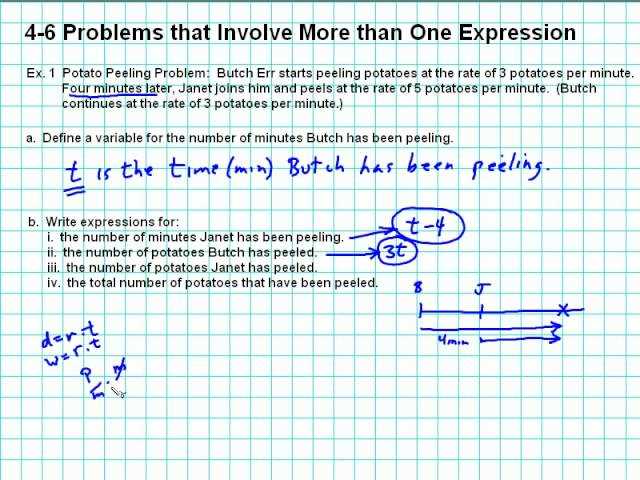
Word problems can be tricky, but the key is translating the text into an algebraic expression. Focus on identifying the unknowns and translating real-world scenarios into equations. Once you have your equation, solve it just as you would any other, checking for logical consistency in the results.
Graphing is another powerful tool for understanding linear relationships. Always identify the slope and y-intercept first, then plot the equation accurately. Practice graphing multiple equations to become comfortable with how each one behaves on the coordinate plane.
Step-by-Step Solutions for Key Problems in Section 4
For equations like 3x + 5 = 20, first subtract 5 from both sides to isolate the term with the variable: 3x = 15. Then, divide by 3: x = 5.
When dealing with systems of equations, such as x + y = 10 and 2x – y = 4, use the elimination method. Add the two equations together to eliminate y, resulting in 3x = 14. Solving for x gives x = 14/3. Substitute this value into one of the original equations to find y.
For factoring quadratics like x^2 + 5x + 6, look for two numbers that multiply to 6 and add to 5: 2 and 3. This allows you to factor the expression as (x + 2)(x + 3).
Graphing lines requires identifying the slope and y-intercept. For the equation y = 2x + 3, the slope is 2 and the y-intercept is 3. Plot the y-intercept on the graph and use the slope to find other points.
Always check your solutions. If you’re solving an inequality, make sure to reverse the inequality sign when multiplying or dividing by a negative number.
Solving Linear Equations Step by Step
To solve a linear equation like 3x + 4 = 19, follow these steps:
- Isolate the variable: Subtract 4 from both sides: 3x = 15.
- Simplify: Divide both sides by 3: x = 5.
- Check your solution: Substitute x = 5 into the original equation: 3(5) + 4 = 19, which simplifies to 15 + 4 = 19, confirming the solution is correct.
For equations like 2x – 7 = 13, first add 7 to both sides: 2x = 20. Then divide both sides by 2: x = 10.
When solving with fractions, clear the denominator first. For example, in 1/2 x + 3 = 7, subtract 3 from both sides: 1/2 x = 4. Multiply both sides by 2 to eliminate the fraction: x = 8.
Always double-check your work by substituting the solution back into the equation to ensure both sides are equal.
Understanding and Applying the Distributive Property
To simplify expressions using the distributive property, multiply each term inside the parentheses by the factor outside. For example:
3(x + 4) becomes:
- 3 * x = 3x
- 3 * 4 = 12
So, 3(x + 4) = 3x + 12.
In cases with negative numbers, distribute the negative sign properly. For example:
-2(4x – 3) becomes:
- -2 * 4x = -8x
- -2 * -3 = +6
So, -2(4x – 3) = -8x + 6.
When there are multiple terms inside parentheses, distribute to each term individually:
4(2x + 3y – 5) becomes:
- 4 * 2x = 8x
- 4 * 3y = 12y
- 4 * -5 = -20
So, 4(2x + 3y – 5) = 8x + 12y – 20.
Always remember to check if any like terms can be combined after applying the distributive property.
Solving Word Problems Involving Algebraic Expressions
To solve word problems with algebraic expressions, follow these steps:
- Identify Variables: Determine what each variable represents in the context of the problem. For example, if the problem involves finding the cost of items, let x represent the price of one item.
- Set Up the Equation: Translate the words into an algebraic expression. For example, “Five times a number plus 3” can be written as 5x + 3.
- Apply Operations: Use the appropriate mathematical operations (addition, subtraction, multiplication, division) to simplify or solve the equation.
- Solve the Equation: Isolate the variable by using inverse operations. For example, if you have 2x + 3 = 11, subtract 3 from both sides, then divide by 2.
- Check Your Work: Substitute your solution back into the original expression to make sure it satisfies the conditions of the problem.
For example, consider this problem:
Problem: A box contains 3 red balls and x green balls. The total number of balls in the box is 12. How many green balls are there?
Solution:
- Identify the variable: Let x represent the number of green balls.
- Set up the equation: 3 + x = 12.
- Solve the equation: Subtract 3 from both sides: x = 9.
- Check the solution: 3 + 9 = 12, so the solution is correct.
For more detailed explanations and examples, refer to trusted educational resources like Khan Academy.
Graphing Linear Equations and Interpreting the Results
To graph a linear equation, follow these steps:
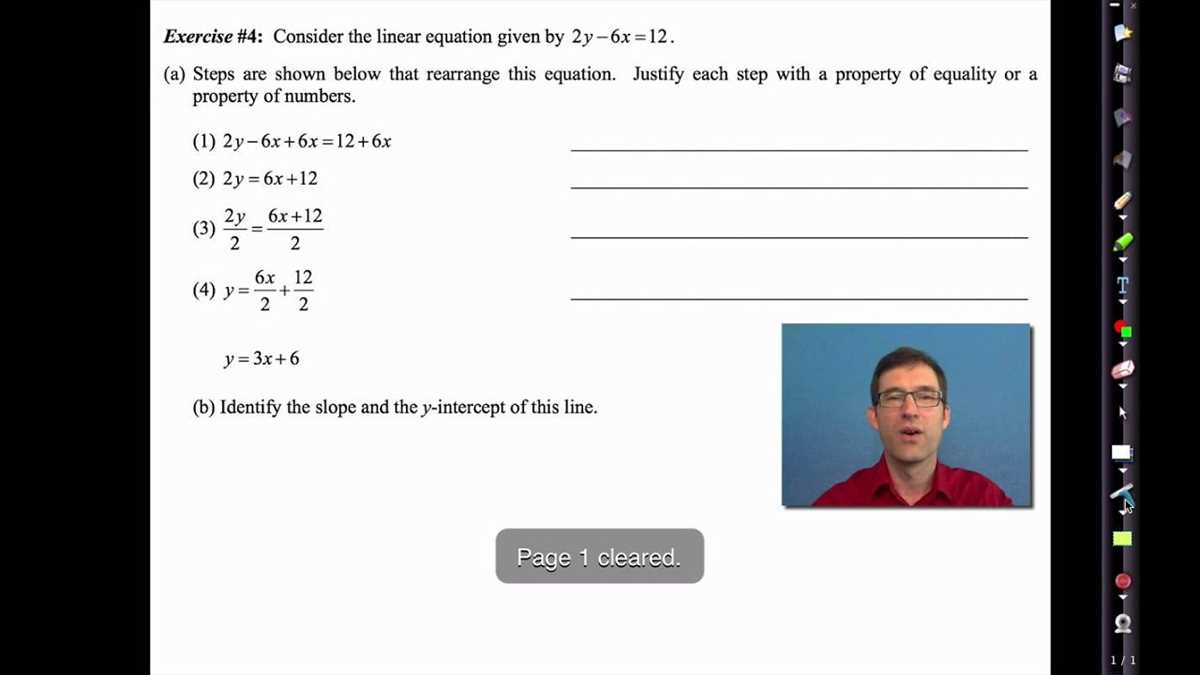
- Rewrite the equation in slope-intercept form: If necessary, rearrange the equation into the form y = mx + b, where m is the slope and b is the y-intercept.
- Plot the y-intercept: Locate b on the y-axis and plot the first point. This is where the line crosses the y-axis.
- Use the slope: From the y-intercept, use the slope m to determine the next points. For example, if the slope is 2/3, move up 2 units and right 3 units from the y-intercept.
- Plot additional points: Continue applying the slope to plot several points along the line.
- Draw the line: Connect the points with a straight line extending in both directions.
Example:
Given the equation y = 2x + 1, perform the following steps:
- Plot the y-intercept: The y-intercept is 1, so plot the point (0, 1) on the graph.
- Use the slope: The slope is 2, or 2/1, meaning for every 1 unit you move right, move up 2 units. Plot the next points (1, 3) and (2, 5).
- Draw the line: Connect the points and extend the line in both directions.
Interpreting the Graph:
- Slope: The slope m indicates the rate of change. In the example, a slope of 2 means that for each unit increase in x, y increases by 2 units.
- Y-intercept: The y-intercept b represents the value of y when x = 0. In this case, the line crosses the y-axis at 1.
By following these steps, you can accurately graph any linear equation and understand the relationship between the variables.
Factoring Quadratic Equations in Chapter 4
To factor quadratic equations, follow these steps:
- Identify the form: Ensure the equation is in standard form, ax² + bx + c = 0, where a, b, and c are constants.
- Find the product and sum: Multiply a and c, and find two numbers that multiply to ac and add to b.
- Split the middle term: Rewrite the middle term bx as the sum of two terms using the numbers found in the previous step.
- Factor by grouping: Group the terms in pairs, and factor each pair.
- Factor out the common binomial: Once grouped, factor out the common binomial factor.
Example: Factor the quadratic equation x² + 5x + 6 = 0.
- Step 1: Identify a = 1, b = 5, and c = 6.
- Step 2: Find two numbers that multiply to ac = 1 * 6 = 6 and add to b = 5. These numbers are 2 and 3.
- Step 3: Split the middle term: x² + 2x + 3x + 6 = 0.
- Step 4: Group terms: (x² + 2x) + (3x + 6) = 0.
- Step 5: Factor each pair: x(x + 2) + 3(x + 2) = 0.
- Step 6: Factor out the common binomial: (x + 2)(x + 3) = 0.
Thus, the factored form of x² + 5x + 6 = 0 is (x + 2)(x + 3) = 0.
Identifying and Working with Slope and Y-Intercept
To find the slope and y-intercept of a linear equation, follow these steps:
- Identify the slope: The slope is the ratio of vertical change to horizontal change between two points on the line. It is typically represented as m in the equation y = mx + b. Calculate the slope using the formula: m = (y2 – y1) / (x2 – x1).
- Identify the y-intercept: The y-intercept is the point where the line crosses the y-axis. In the equation y = mx + b, b is the y-intercept.
- Rewrite the equation: Express the equation in slope-intercept form y = mx + b, where m is the slope and b is the y-intercept. If the equation is not already in this form, rearrange it accordingly.
Example: Given the equation y = 2x + 5, the slope m = 2 and the y-intercept b = 5. This means that for every unit increase in x, y increases by 2, and the line crosses the y-axis at y = 5.
For another example, if given two points, (3, 4) and (7, 10), calculate the slope:
- Apply the formula: m = (y2 – y1) / (x2 – x1).
- m = (10 – 4) / (7 – 3) = 6 / 4 = 3 / 2.
Thus, the slope of the line is 3/2.
To find the y-intercept, use the point-slope form of the equation: y – y1 = m(x – x1). Plug in the slope m = 3/2 and one of the points (3, 4):
- y – 4 = 3/2(x – 3)
- Expand and solve for y: y – 4 = 3/2x – 9/2, so y = 3/2x + 1/2.
Thus, the equation of the line is y = 3/2x + 1/2, where the slope is 3/2 and the y-intercept is 1/2.
Using Substitution and Elimination Methods in Systems of Equations
The substitution method involves solving one equation for one variable and then substituting that expression into the other equation. Here’s how to use substitution:
- Choose one of the equations and solve for one variable, typically the one with the simplest coefficient.
- Substitute this expression into the second equation.
- Solve the resulting equation for the remaining variable.
- Substitute the value of the second variable back into the first equation to find the first variable.
Example: Solve the system:
- Equation 1: y = 2x + 3
- Equation 2: x + y = 7
Step 1: Substitute y = 2x + 3 into the second equation:
- x + (2x + 3) = 7
- Simplify: 3x + 3 = 7
- Subtract 3 from both sides: 3x = 4
- Divide by 3: x = 4/3
Step 2: Substitute x = 4/3 back into y = 2x + 3:
- y = 2(4/3) + 3 = 8/3 + 9/3 = 17/3
Thus, the solution is (4/3, 17/3).
The elimination method involves adding or subtracting equations to eliminate one of the variables. Here’s how to use elimination:
- Multiply both sides of one or both equations to align the coefficients of one variable.
- Add or subtract the equations to eliminate one variable.
- Solve for the remaining variable.
- Substitute the value into one of the original equations to solve for the second variable.
Example: Solve the system:
- Equation 1: 2x + 3y = 10
- Equation 2: x – y = 2
Step 1: Multiply Equation 2 by 3 to align the coefficients of y:
- 3(x – y) = 3(2)
- 3x – 3y = 6
Step 2: Subtract Equation 1 from the modified Equation 2:
- (3x – 3y) – (2x + 3y) = 6 – 10
- x – 6y = -4
- x = -4/3
Thus, the solution is (-4/3, 7/3).
Checking Your Work and Common Mistakes to Avoid
After solving equations or systems, always check your solutions by substituting the values back into the original equations. If the left-hand side equals the right-hand side, the solution is correct. If not, retrace your steps to find the error.
Common mistakes to watch out for:
- Sign errors: Be cautious when dealing with negative signs. Mistakes often occur when adding or subtracting negative numbers.
- Misplaced parentheses: Failing to distribute terms correctly or ignoring the order of operations can lead to incorrect solutions.
- Incorrectly isolating variables: Ensure that each step keeps the variable on one side of the equation and constants on the other. Double-check that you’ve divided or multiplied both sides of the equation equally.
- Forgetting to simplify: After solving, make sure you simplify the final expression. Sometimes, you might miss factoring or reducing terms.
- Rounding too early: In some cases, rounding off values too early in the process can lead to errors. It’s best to keep numbers in fraction form until the final step.
Example: When solving 2x + 3 = 9, many might incorrectly subtract 3 from both sides but forget to divide by 2 afterward. Double-check each operation for accuracy.
| Common Error | Correction |
|---|---|
| Misplacing signs (e.g., -6 becomes +6) | Carefully track signs, especially when multiplying or dividing negative numbers. |
| Skipping steps in the distributive property | Distribute each term and simplify carefully before proceeding. |
| Not checking solutions | Always substitute solutions back into the original equation to verify correctness. |
By regularly checking your work and staying mindful of common mistakes, the chances of making errors can be minimized, leading to more accurate results.