Comprehensive Guide to Earth’s Interior Worksheet Answers
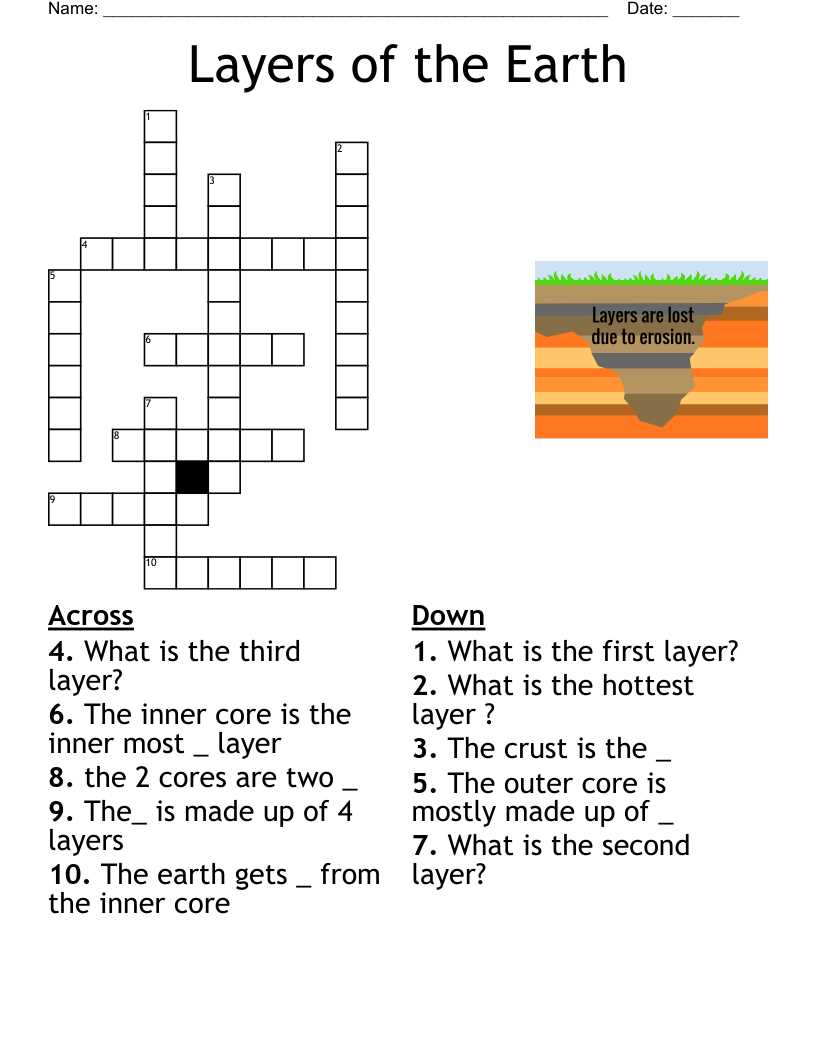
To understand the composition of our planet, focus on the three main layers: the crust, mantle, and core. Start by identifying key features of each layer, such as thickness, composition, and temperature. The crust is the outermost layer, composed mostly of rock, while the mantle is thicker and made of semi-solid material that moves slowly. The core, consisting of a liquid outer section and a solid inner core, plays a crucial role in generating Earth’s magnetic field.
Use diagrams to better visualize the relative sizes of each layer and the differences in materials found at different depths. Pay attention to the terms like lithosphere and asthenosphere, which describe specific parts of the crust and upper mantle. These layers are important for understanding plate tectonics and the movement of Earth’s plates.
Be sure to also consider the heat flow and convection currents within the mantle, as these processes drive much of Earth’s surface activity, including earthquakes and volcanic eruptions. Understanding how these currents work will give you a deeper insight into the dynamic nature of our planet’s interior.
Earth’s Structure and Composition Guide
Start by identifying the different layers of the planet: the crust, mantle, and core. Each of these layers has distinct properties that affect the behavior of the Earth as a whole. The crust is thin and composed mainly of rocks like granite and basalt, while the mantle, thicker and denser, is made up of silicate minerals. The core is divided into two sections: a solid inner core and a liquid outer core, both primarily made of iron and nickel.
Understanding the movements within these layers, such as convection currents in the mantle, helps explain geological phenomena like earthquakes and volcanic activity. In addition, heat flow from the core contributes to the tectonic movements of the lithosphere.
Refer to the following table for a quick overview of key characteristics of each layer:
| Layer | Composition | State | Thickness |
|---|---|---|---|
| Crust | Granite, basalt | Solid | 5-70 km |
| Mantle | Olivine, pyroxenes | Solid, semi-solid | 2,900 km |
| Outer Core | Iron, nickel | Liquid | 2,200 km |
| Inner Core | Iron, nickel | Solid | 1,200 km |
By referencing this table, you can easily compare the different layers and their attributes. This information is critical for understanding the role each layer plays in the overall dynamics of our planet. Remember to incorporate these details into your study of tectonic processes and the distribution of heat within the Earth.
Understanding the Layers of Earth’s Interior
To grasp how the planet operates, it’s crucial to understand its different layers: the crust, mantle, outer core, and inner core. These layers vary in composition, thickness, and physical state.
The crust is the outermost layer, composed mainly of rock. It is divided into two types: continental and oceanic. Continental crust is thicker and less dense, while oceanic crust is thinner and denser. This layer plays a key role in tectonic activity and is the site of earthquakes and volcanic eruptions.
Below the crust lies the mantle, which extends to a depth of about 2,900 kilometers. The mantle is semi-solid and made of silicate minerals rich in iron and magnesium. Convection currents within the mantle drive the movement of tectonic plates and contribute to the dynamic nature of the Earth’s surface.
At a depth of 2,900 kilometers, the outer core is liquid, primarily composed of iron and nickel. This layer generates the Earth’s magnetic field through the movement of molten metal. The outer core is responsible for the Earth’s magnetism and plays a vital role in protecting the surface from harmful solar radiation.
Finally, the inner core is a solid sphere primarily made of iron and nickel. Despite the high temperature, which exceeds 5,000°C, the immense pressure keeps this layer solid. The inner core is key in maintaining the Earth’s magnetic field and its overall stability.
Each of these layers contributes to the planet’s structure, energy systems, and geological processes. Understanding their properties is fundamental to studying natural phenomena like plate tectonics, earthquakes, and volcanoes.
How to Identify the Crust, Mantle, and Core
To identify the crust, mantle, and core, it is important to examine their characteristics, including composition, state of matter, and physical properties.
The crust is the outermost layer. It is a thin, solid shell made primarily of rock. You can identify it by its composition: it contains silicate minerals like feldspar and quartz. The crust is divided into two types: oceanic (thinner, denser) and continental (thicker, less dense).
Below the crust is the mantle, which extends to a depth of about 2,900 kilometers. The mantle is semi-solid, meaning it behaves like a solid but can flow slowly over time. It is rich in silicate minerals containing iron and magnesium. It can be identified by its higher density compared to the crust and its ability to undergo convection currents that drive tectonic plate movements.
The core is divided into two parts: the outer core and the inner core. The outer core is liquid and made mostly of iron and nickel. It generates the Earth’s magnetic field through convection of molten metals. The inner core, located at the center, is solid due to the immense pressure, despite the high temperatures. It is also composed mainly of iron and nickel.
Each layer can be distinguished by its distinct physical state: solid for the crust and inner core, semi-solid for the mantle, and liquid for the outer core. These layers also differ in their composition, density, and role in Earth’s geodynamics.
Common Misconceptions About Earth’s Structure
One common misconception is that the crust is uniformly thin across the globe. In reality, the thickness varies significantly. Continental crust is much thicker, reaching up to 70 km, while oceanic crust is much thinner, around 5 to 10 km thick.
Another misunderstanding is that the mantle is a solid, rigid layer. While it is mostly solid, it behaves like a very slow-flowing fluid due to heat and pressure, especially in the lower mantle. This fluid-like motion plays a key role in tectonic plate movement.
Many people also believe the core is made entirely of molten rock. In fact, the outer core is liquid and composed primarily of iron and nickel, but the inner core is solid due to the intense pressure, despite extremely high temperatures.
It is often thought that the layers of the planet are distinct, with clear boundaries. In reality, these layers transition gradually from one to another. For example, the boundary between the mantle and the outer core is not sharply defined but involves a gradual change in material properties.
Lastly, some assume that the core is the hottest part of the planet, but heat from the mantle also contributes to the surface temperature. The core’s heat primarily results from radioactive decay and the residual heat from Earth’s formation.
How to Use a Diagram for Earth’s Layers
Start by identifying each layer of the planet. Label the outermost layer as the crust, followed by the mantle, outer core, and inner core. Each layer should be clearly marked with its corresponding name and a brief description of its composition and characteristics.
Next, use color coding to differentiate the layers visually. For example, use shades of brown or grey for the crust, orange for the mantle, red for the outer core, and yellow for the inner core. This will make it easier to distinguish the various components.
To demonstrate the relative thickness and depth of each layer, add a scale or proportional diagram next to the labeled layers. Ensure that the crust is the thinnest layer, with the mantle and cores proportionally larger in the diagram.
Incorporate symbols or arrows to show movement or flow. For instance, use arrows to represent the convection currents in the mantle, which drive the movement of tectonic plates. These diagrams can help clarify how the layers interact with one another.
- Label the crust as solid rock, representing the thin outer layer.
- Indicate the mantle’s slow-moving solid state and the flow of heat within it.
- Mark the outer core as molten, while the inner core remains solid due to extreme pressure.
Finally, ensure that your diagram is labeled clearly with a title and includes a legend if necessary. This will make it easier to understand the diagram and apply it to further study or discussion on the topic.
Key Features of the Lithosphere and Asthenosphere
The lithosphere is the rigid, outermost layer of the planet, consisting of the crust and the uppermost part of the mantle. It is characterized by its solid and brittle nature, forming the tectonic plates that move over the more fluid layers beneath. It varies in thickness, being thinner under the oceans and thicker under continental landmasses.
The asthenosphere lies directly beneath the lithosphere and is a semi-fluid layer of the mantle. It behaves plastically, allowing the tectonic plates of the lithosphere to move over it. Unlike the lithosphere, the asthenosphere is not rigid and can deform over time under pressure and heat.
The lithosphere and asthenosphere are connected through the process of plate tectonics. As heat from the inner parts of the planet causes convection currents in the asthenosphere, it provides the movement needed for the tectonic plates in the lithosphere to shift. This interaction drives phenomena such as earthquakes, volcanic activity, and mountain formation.
- Lithosphere: Solid and rigid, it forms the outer shell of the planet.
- Asthenosphere: Semi-fluid and able to deform, allowing for tectonic movement.
- Tectonic Plates: The lithosphere is broken into pieces, called plates, that float on the asthenosphere.
- Plate Movement: Convection currents in the asthenosphere drive the motion of tectonic plates.
The interaction between these two layers is fundamental to understanding the dynamic nature of the planet’s surface and the processes that shape it over time.
What Causes Convection Currents in the Mantle?
Convection currents in the mantle are caused by temperature differences within the material. The mantle is made up of solid rock that behaves plastically over long periods, allowing for flow. Heat from the planet’s core heats the lower part of the mantle, causing it to become less dense. As the material rises, it cools and becomes denser, causing it to sink back down. This cycle of rising and sinking creates convection currents.
These currents are driven by the heat from the core, which generates thermal energy that moves through the mantle. As the mantle material heats up, it expands and becomes buoyant, rising toward the crust. When it reaches the upper mantle, it begins to cool and contracts, increasing its density and causing it to sink back down. This process forms a continuous loop, which is a key component in plate tectonics.
The convection currents are responsible for the movement of tectonic plates and phenomena such as earthquakes, volcanic activity, and mountain formation. They also influence the movement of the lithosphere, helping to explain how continents shift over time.
For more in-depth information, visit the National Geographic website.
How to Interpret Heat Flow in Earth’s Interior
To interpret heat flow within the planet, focus on the transfer of thermal energy from the deeper layers to the surface. Heat from the core rises through the mantle and reaches the crust. This movement occurs through conduction, where heat travels through solid material, and convection, where heated material circulates. The variation in heat flow across the surface provides insights into the geological activity occurring beneath.
Heat flow is highest in regions of tectonic plate movement, such as mid-ocean ridges, where new crust is formed, and volcanic areas where magma rises. These areas indicate active thermal processes, including the release of heat through volcanic eruptions and tectonic shifts. Conversely, lower heat flow is found in stable continental regions, indicating minimal geological activity beneath.
Geologists measure heat flow by analyzing temperature gradients at various depths. A higher temperature gradient suggests more active heat transfer, while a lower gradient indicates a more stable, less dynamic region. By mapping these gradients, scientists can deduce the locations of mantle plumes, hotspots, and plate boundaries.
For more details, refer to the USGS Heat Flow and Geothermal Energy page.
Important Terms and Concepts in Earth’s Internal Structure
Understanding the structure beneath the surface requires familiarity with several key terms and concepts that describe its layers and the processes occurring within them. These are essential for analyzing the planet’s composition and dynamics.
- Crust: The thin, outermost layer of the planet, composed of solid rock. It is divided into oceanic and continental sections.
- Mantle: A thick, semi-solid layer beneath the crust, responsible for convection currents that drive plate tectonics.
- Core: Divided into two parts–outer and inner. The outer core is liquid, while the inner core is solid, made mostly of iron and nickel.
- Convection Currents: The movement of material within the mantle due to temperature and density differences. These currents play a key role in plate movement.
- Lithosphere: The rigid outer layer of the Earth, including the crust and the uppermost part of the mantle, responsible for tectonic plate formation.
- Asthenosphere: A layer of the mantle below the lithosphere, characterized by a more fluid-like consistency, allowing for the movement of tectonic plates.
- Seismic Waves: Waves that travel through the Earth, providing insights into its internal structure. Primary (P) waves and secondary (S) waves help differentiate between solid and liquid layers.
- Heat Flow: The transfer of thermal energy from the core to the surface, driving convection currents and influencing geological activity.
Familiarizing yourself with these terms will allow you to better understand how each layer contributes to the planet’s behavior and geological processes.