Complete Guide to Solving Chemical Reactions with Solutions and Examples
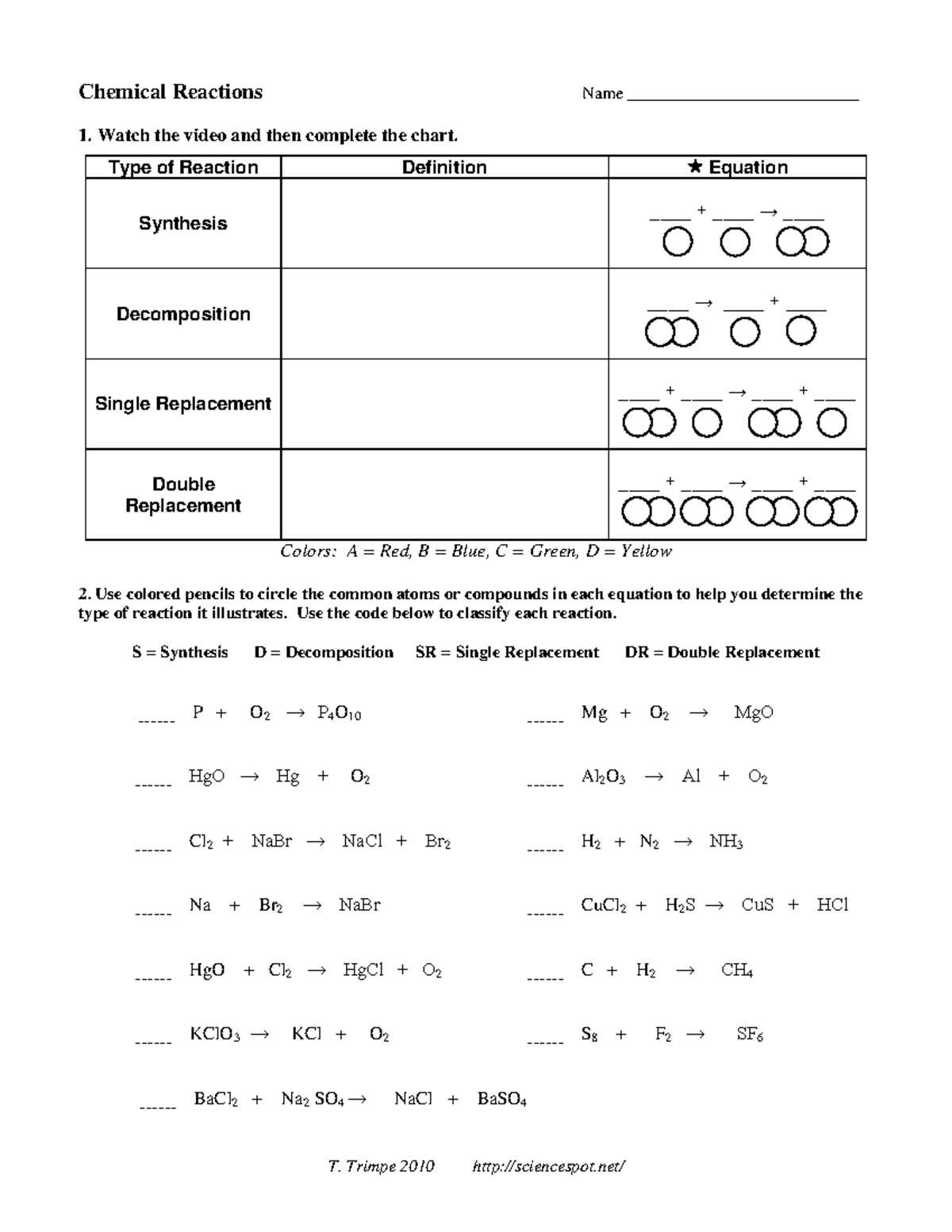
To balance a reaction, start by writing down the formulas of all reactants and products. Ensure that the number of atoms of each element is the same on both sides. This often involves adjusting coefficients in front of each molecule.
Use stoichiometric ratios to convert between the amounts of different substances involved. For example, if you know the moles of one substance, use the ratio from the balanced equation to calculate the moles of another substance.
When dealing with limiting reagents, first identify the substance that will be consumed first based on the amount of reactants. Once this is determined, calculate the theoretical yield of products and compare it to actual yields to find the efficiency of the process.
Finally, check for energy changes. Many reactions release or absorb energy, often in the form of heat. Understanding how energy flows during a process will help in predicting the feasibility and type of the reaction, whether exothermic or endothermic.
Chemical Reactions Answer Key
Start by balancing the equation. For example, in the reaction between hydrogen and oxygen to form water (2H₂ + O₂ → 2H₂O), check the number of atoms of each element on both sides. Adjust the coefficients to match them.
Next, use stoichiometric coefficients to convert between amounts of substances. If you know the amount of one reactant, use the ratio from the balanced equation to find how much of another substance is involved. For instance, if 2 moles of hydrogen react with 1 mole of oxygen, 2 moles of water will form.
If limiting reagents are involved, determine which reactant will be consumed first by comparing the mole ratio of the reactants. For example, if you have more hydrogen than oxygen, oxygen will be the limiting reagent, and the amount of water formed will be based on the available oxygen.
To calculate theoretical yield, use the limiting reagent’s mole amount to determine how much product can be formed. For example, with the oxygen limiting reagent, calculate the number of moles of water that can be formed from the available oxygen.
Finally, calculate percent yield by comparing the actual amount of product obtained to the theoretical yield. The formula for percent yield is: (Actual yield / Theoretical yield) × 100%.
Identifying Types of Chemical Reactions
To identify the type of interaction occurring, observe the behavior and products of the substances involved. Here’s a breakdown of common types:
| Type | Definition | Example |
|---|---|---|
| Synthesis | Two or more substances combine to form a single product. | 2H₂ + O₂ → 2H₂O |
| Decomposition | A single compound breaks down into two or more simpler substances. | 2H₂O₂ → 2H₂O + O₂ |
| Single Displacement | One element replaces another in a compound. | Zn + CuSO₄ → ZnSO₄ + Cu |
| Double Displacement | Two compounds exchange components to form new compounds. | AgNO₃ + NaCl → AgCl + NaNO₃ |
| Combustion | A substance reacts with oxygen to produce heat and light, typically forming CO₂ and H₂O. | CH₄ + 2O₂ → CO₂ + 2H₂O |
By examining the substances involved and their changes, you can identify which type of interaction occurs. Understanding these patterns helps predict products and balance equations effectively.
Balancing Chemical Equations Step by Step
To balance any equation, follow these steps systematically:
- Write the unbalanced equation: Start with the correct formulas of all reactants and products. For example: H₂ + O₂ → H₂O.
- Count the atoms: Count the number of atoms of each element on both sides of the equation.
- Balance one element at a time: Choose an element that is unbalanced. Adjust the coefficients (the numbers in front of each molecule) to balance the atoms of that element. Start with elements that appear only once on each side.
- Repeat for other elements: Move on to the next element, balancing one at a time. Make sure to check the previous adjustments to ensure no other element became unbalanced.
- Balance hydrogen and oxygen last: These elements often appear in multiple compounds. Adjust their coefficients at the end to ensure both sides are balanced.
- Check the final balance: Double-check that the number of atoms for each element is the same on both sides of the equation.
Example:
- Unbalanced: H₂ + O₂ → H₂O
- Balance hydrogen: 2H₂ + O₂ → 2H₂O
- Balance oxygen: 2H₂ + O₂ → 2H₂O (already balanced for oxygen)
- Final equation: 2H₂ + O₂ → 2H₂O
By following these steps, you can balance any equation correctly and efficiently.
Understanding Reactants and Products in Reactions
To identify reactants and products, focus on the substances involved in any transformation. Reactants are the starting materials that undergo change, while products are the new substances formed as a result of the process.
Reactants: These are substances present before a transformation begins. They appear on the left side of an equation. Reactants are usually in their original form, such as molecules, elements, or compounds. For example, in the reaction of hydrogen with oxygen to form water, hydrogen and oxygen are the reactants.
Products: These are the substances formed after the transformation. They are written on the right side of the equation. The products have different properties from the reactants due to the rearrangement of atoms during the process. In the example of hydrogen and oxygen, water is the product.
Key points:
- Reactants start the process and undergo chemical changes.
- Products are the end result of the transformation and have different chemical properties from the reactants.
- Both reactants and products must be accounted for in any balanced equation.
By recognizing the roles of reactants and products, you can better understand the changes occurring during a process and predict the outcomes based on the substances involved.
Applying Stoichiometry in Chemical Reactions
To solve problems involving substance conversion, begin by using stoichiometric relationships. Identify the molar ratios from the balanced equation to convert between reactants and products.
Step 1: Write the Balanced Equation
Ensure the reaction equation is balanced. This provides the necessary molar ratios between substances. For example, for the reaction:
2H₂ + O₂ → 2H₂O, the ratio is 2 moles of hydrogen react with 1 mole of oxygen to produce 2 moles of water.
Step 2: Identify Known and Unknown Quantities
Determine what is given and what needs to be calculated. For example, if you know the amount of one reactant, you can calculate how much product will form.
Step 3: Use Molar Ratios
Apply the stoichiometric coefficients from the balanced equation. Convert from moles of one substance to moles of another. For instance, if you have 4 moles of hydrogen, and the equation shows a 2:2 ratio between hydrogen and water, you would produce 4 moles of water.
Step 4: Convert to Desired Units
After finding the moles of the desired substance, convert to the required unit (grams, liters, molecules, etc.) using the molar mass or Avogadro’s number.
Example Problem:
If 10 grams of oxygen react with excess hydrogen, how many grams of water are produced?
1. Balance the equation: 2H₂ + O₂ → 2H₂O
2. Convert grams of oxygen to moles: 10g ÷ 32g/mol = 0.3125 moles O₂
3. Apply stoichiometric ratio: 0.3125 moles O₂ × (2 moles H₂O / 1 mole O₂) = 0.625 moles H₂O
4. Convert moles of water to grams: 0.625 moles × 18.015 g/mol = 11.25 grams of water.
By following these steps, you can use stoichiometry to determine the amounts of reactants and products in any given process.
How to Handle Limiting Reactants in Reactions
To identify and handle limiting reactants, follow these steps:
- Step 1: Write the Balanced Equation
Ensure the reaction is balanced to understand the molar ratios between reactants and products. - Step 2: Convert Known Quantities to Moles
Convert the mass or volume of each reactant to moles using molar mass or molar volume (for gases at standard conditions). - Step 3: Determine Molar Ratios
Use the coefficients from the balanced equation to determine how much of each reactant is required to produce the product. This will help you compare the amounts of each reactant. - Step 4: Compare Available Moles with Required Moles
Calculate the amount of product each reactant would produce based on the reaction. The reactant that produces the least product is the limiting reactant. - Step 5: Calculate Product from Limiting Reactant
Use the limiting reactant to calculate the amount of product formed. The excess reactant is left over and does not affect the amount of product formed.
Example Problem:
In the reaction: 2H₂ + O₂ → 2H₂O, if you have 4 moles of H₂ and 3 moles of O₂, determine the limiting reactant.
- Step 1: The equation is balanced (2H₂ + O₂ → 2H₂O).
- Step 2: You have 4 moles of H₂ and 3 moles of O₂.
- Step 3: According to the equation, 2 moles of H₂ react with 1 mole of O₂ to form 2 moles of H₂O.
- Step 4: From 4 moles of H₂, you would need 2 moles of O₂. Since you have 3 moles of O₂, there is excess O₂.
- Step 5: The limiting reactant is H₂, and you will produce 4 moles of H₂O (based on the 2:2 ratio).
By following these steps, you can determine which reactant is limiting and calculate the maximum amount of product that can be produced.
Predicting Products of Common Chemical Reactions
To predict products, apply the following principles based on the type of process:
- Synthesis (Combination) Reactions:
Two or more reactants combine to form a single product. Example: A + B → AB.
Example: 2H₂ + O₂ → 2H₂O.
- Decomposition Reactions:
A single reactant breaks down into two or more products. Example: AB → A + B.
Example: 2HgO → 2Hg + O₂.
- Single Displacement Reactions:
One element displaces another in a compound. Example: A + BC → AC + B.
Example: Zn + 2HCl → ZnCl₂ + H₂.
- Double Displacement Reactions:
Two compounds exchange ions to form new compounds. Example: AB + CD → AD + CB.
Example: AgNO₃ + NaCl → AgCl + NaNO₃.
- Combustion Reactions:
A substance reacts with oxygen to produce energy, carbon dioxide, and water. Example: CₓHᵧ + O₂ → CO₂ + H₂O.
Example: CH₄ + 2O₂ → CO₂ + 2H₂O.
For predicting products:
- Balance the Equation: Always ensure that the number of atoms of each element is the same on both sides of the equation.
- Identify the Type of Reaction: Recognize the pattern to determine what products are formed.
- Consider Solubility Rules (for double displacement): Use solubility charts to identify if a product is a precipitate or remains in solution.
- Check for Redox Changes (for single displacement): In cases involving metals and acids, consider oxidation and reduction processes.
Example: Predicting Products for a Double Displacement Reaction
| Reactant 1 | Reactant 2 | Predicted Products |
|---|---|---|
| NaCl | AgNO₃ | AgCl (precipitate) + NaNO₃ |
Following these guidelines will help you accurately predict the outcome of various common processes.
Calculating Reaction Yields and Percentages
To calculate the yield of a process, first determine the amount of product formed experimentally. Then compare it to the theoretical yield, which is the maximum possible product based on the limiting reactant.
- Theoretical Yield: Use stoichiometric calculations to determine the maximum amount of product that could be formed from the given quantities of reactants.
- Actual Yield: Measure the amount of product that is actually produced during the experiment.
- Percent Yield Formula: The formula to calculate percent yield is:
Percent Yield = (Actual Yield / Theoretical Yield) × 100
For example, if 50 g of product is expected, but only 45 g is obtained, the percent yield is:
- Percent Yield = (45 g / 50 g) × 100 = 90%
Steps to Calculate Yield:
- Write a balanced equation for the process.
- Identify the limiting reactant by comparing the mole ratio of reactants.
- Calculate the theoretical yield using stoichiometry and the limiting reactant’s amount.
- Measure the actual amount of product obtained from the experiment.
- Calculate the percent yield using the formula.
Example:
If the theoretical yield of a reaction is 80 g and the actual yield is 65 g, calculate the percent yield:
- Percent Yield = (65 g / 80 g) × 100 = 81.25%
Use these steps to evaluate the efficiency of any process and to identify areas where improvements can be made.
Interpreting Energy Changes in Chemical Reactions
Energy changes during a process are crucial for understanding whether a process is exothermic or endothermic. The key indicator is the heat flow in or out of the system.
Exothermic Processes: These processes release energy, typically in the form of heat or light. This happens when the total energy required to break bonds in reactants is less than the energy released when new bonds are formed in products. The system’s energy decreases, and the surroundings are heated.
Endothermic Processes: These processes absorb energy from the surroundings. This occurs when the energy needed to break bonds in reactants exceeds the energy released during product formation. The system gains energy, and the surroundings become cooler.
Enthalpy Change (ΔH): The enthalpy change is used to quantify energy changes. It is calculated as the difference between the total energy of products and reactants. If ΔH is negative, energy is released (exothermic). If ΔH is positive, energy is absorbed (endothermic).
To interpret energy changes, you must:
- Identify if the process absorbs or releases heat.
- Calculate or find the enthalpy change (ΔH) using bond energies or calorimetry data.
- Understand the impact of temperature and pressure on the system’s energy state.
Example: In the combustion of methane (CH4), energy is released, making it an exothermic process. The ΔH is negative, indicating a release of heat to the surroundings.
For more details on energy changes in reactions, refer to the LibreTexts Chemistry website.