Gravity and Orbits Lab Answer Key with Solutions and Explanations
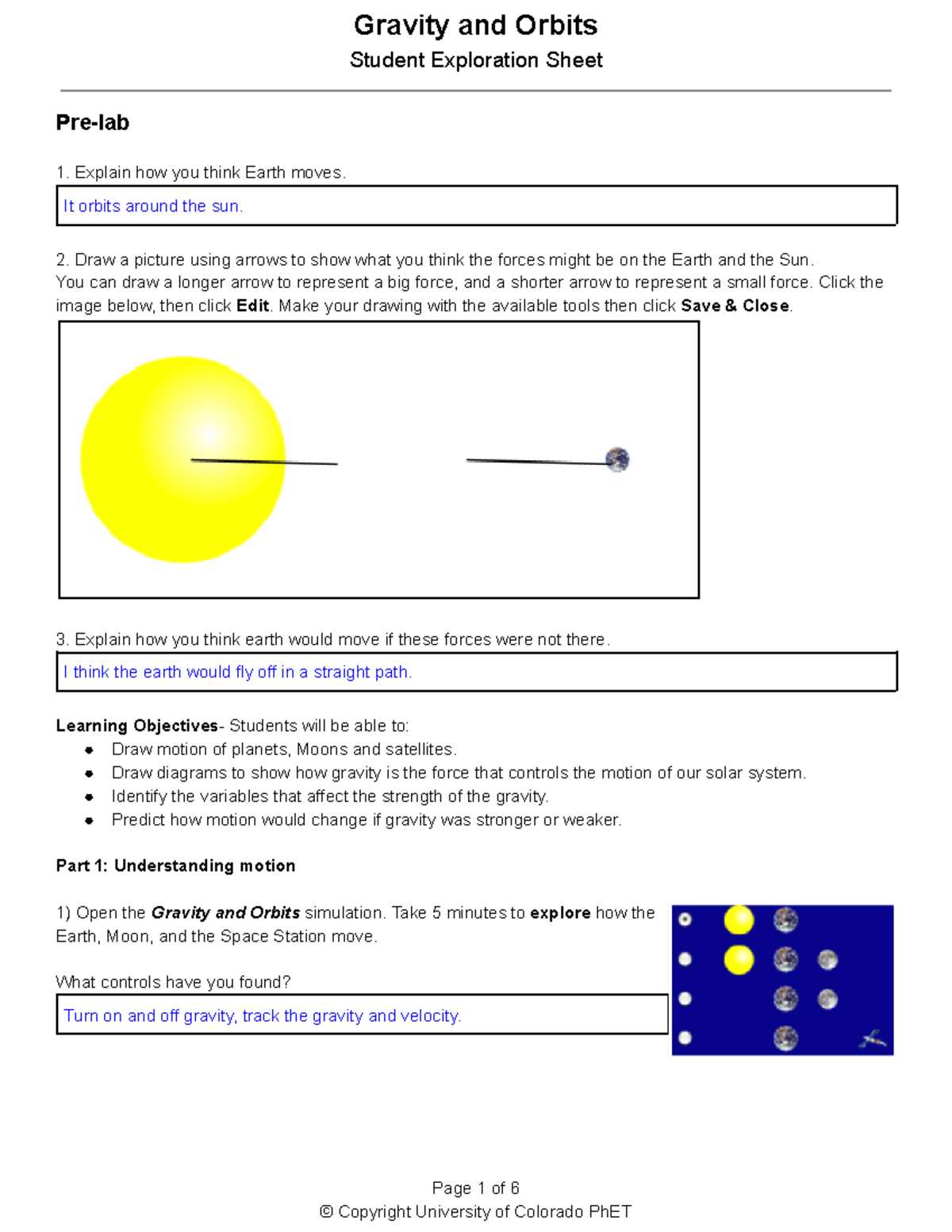
Focus on the first step: Calculate the gravitational force between two objects using the formula F = G(m1 * m2) / r², where G is the gravitational constant, m1 and m2 are the masses of the objects, and r is the distance between their centers. Ensure all units are consistent, typically using kilograms for mass and meters for distance, so that the force comes out in newtons.
For the second part: To understand how a body moves in orbit, apply the equation for centripetal force, F = m * v² / r, where v is the velocity of the orbiting body. In a stable orbit, gravitational force must equal the centripetal force. Set these two expressions equal to each other to find the orbital velocity.
Check the specific calculations: When solving for orbital periods or velocities, remember that the orbital velocity for circular motion depends on the mass of the central object, not the orbiting body. This relationship can help determine the speed needed for a stable orbit around planets or stars.
For complex orbits: If the orbit is elliptical, use Kepler’s laws of planetary motion to refine calculations. The semi-major axis of the orbit and the eccentricity are key factors in determining orbital period and speed at different points in the orbit.