Understanding Cross Sections of Three-Dimensional Figures
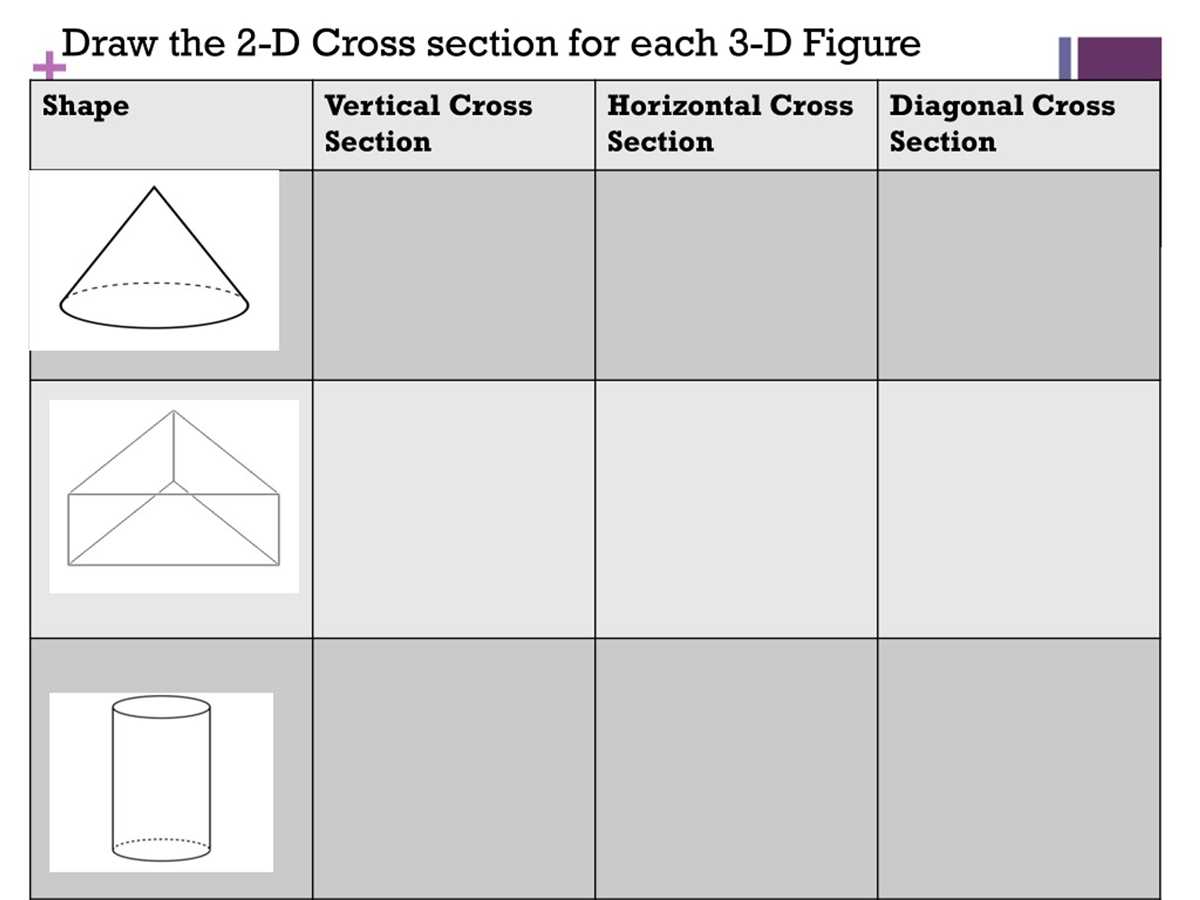
To fully grasp how a 3D object can be represented in 2D, it’s important to understand the results of slicing these objects. The method of cutting a solid can reveal its internal structure and produce various 2D shapes. Different angles and positions of cuts will result in distinct outlines, which provide valuable insights into the geometry of the solid.
When slicing a rectangular prism, for example, you may encounter shapes like rectangles or squares depending on the angle. Similarly, slicing a cylinder might yield circles or ellipses. Recognizing these patterns helps in visualizing how these solids look from different perspectives and is a critical skill in various mathematical and real-world applications.
Understanding how different solids react to slicing is an invaluable tool not only in geometry but also in fields like architecture, engineering, and design. By studying these 2D representations, you can gain a clearer understanding of a solid’s properties and make more informed decisions in practical scenarios.
Exploring Slices of Solids
Slicing a solid object through a specific plane results in a 2D shape. These slices reveal important information about the internal structure of the object. Understanding the resulting shapes helps in visualizing how 3D objects behave when cut at different angles.
For example, when a cube is sliced parallel to one of its faces, the result is a square. However, cutting it diagonally could produce a rectangle or other polygon. Likewise, a cone can be sliced in ways that yield circular, elliptical, or triangular shapes, depending on the angle of the cut.
- A cube sliced horizontally or vertically will create squares or rectangles.
- A cylinder sliced parallel to its base gives a circle, while a diagonal cut might produce an ellipse.
- A cone can create circles, ellipses, or triangles based on the cut’s orientation.
For more detailed explanations and examples, refer to reliable sources like the Khan Academy’s Geometry section, where you can explore visual representations and practice exercises on the topic.
How to Identify Slices in Geometric Solids
To identify the 2D shape formed when a solid is sliced, consider the orientation and position of the cut. Different angles create distinct shapes, revealing important features of the solid.
For a cube, a cut parallel to one of its faces results in a square, while a diagonal cut through the cube can produce a rectangle. For a cylinder, a horizontal cut parallel to the base creates a circle, and a vertical cut through the side will form a rectangle. Understanding these outcomes allows for precise identification of the resulting shape.
Similarly, in a cone, slicing parallel to the base yields a circle, while a cut perpendicular to the base can create a triangle. These geometric solids demonstrate how varying the angle of the cut leads to different 2D results.
To practice identifying these shapes, draw the solids and visualize how different cuts affect the outcome. With experience, you’ll be able to predict the resulting shapes without needing to physically slice the object.
Common Shapes Resulting from Slices of Prisms
When a prism is sliced parallel to its base, the resulting shape will match the base of the prism. For example, slicing a rectangular prism parallel to its base will produce a rectangle. Similarly, slicing a triangular prism parallel to its base will result in a triangle.
If the cut is made perpendicular to the base, the resulting shape depends on the orientation of the prism. For a rectangular prism, a perpendicular cut creates a rectangle, while for a triangular prism, it creates a parallelogram.
When slicing at an angle to the base, the resulting shape can vary. For a rectangular prism, this could result in a trapezoid. For prisms with more complex bases, such as hexagonal or octagonal prisms, the slice can result in polygons with more sides, depending on the angle of the cut.
Understanding the relationship between the orientation of the slice and the resulting shape helps in accurately identifying the shapes formed when slicing prisms. Practice with different prisms will improve your ability to predict the outcome of various cuts.
Understanding Slices of Cylinders and Cones
Slicing a cylinder at different angles results in distinct shapes. A horizontal cut through a cylinder, parallel to the base, will produce a circle. A vertical cut perpendicular to the base also produces a rectangle, depending on the height and angle of the slice. When cutting at an oblique angle, the resulting shape will be an ellipse.
For cones, a horizontal slice parallel to the base creates a circle, while a vertical slice perpendicular to the base forms a triangle. Similar to cylinders, an angled cut through a cone produces an elliptical shape. However, depending on the angle and position of the cut, the cone’s circular base may appear distorted in the resulting cross section.
Both cylinders and cones present a range of possibilities when cut at various angles, with the most common shapes being circles, ellipses, and triangles. Understanding these results is crucial for visualizing geometric shapes and solving related problems.
Analyzing Spheres and Their Cross Sections
When a sphere is sliced in various ways, the resulting shapes depend on the orientation of the cut. A cut through the center of the sphere, parallel to the base, will always produce a circle. The size of the circle is determined by the radius of the sphere.
If the sphere is sliced at any other angle that doesn’t pass through the center, the cross section will still form a circle, but the size of the circle will be smaller compared to one that passes through the sphere’s center.
Any cut through the sphere that does not pass through its center will produce a smaller, elliptical shape. The further away the slice is from the center, the more pronounced the ellipse becomes. Understanding these patterns is vital for solving geometry problems involving spheres.
Determining the Impact of Cutting Angles on Cross Sections
The angle at which an object is cut directly affects the shape and size of the resulting slice. When cutting a solid shape, if the cut is parallel to the base, the resulting shape will be consistent and predictable. For example, a cylinder cut parallel to its base will always produce a circle, and the size of the circle will correspond to the radius of the base.
If the cut is made at an angle that is not perpendicular to the surface, the shape of the slice changes. For example, when slicing a cone at an angle other than 90 degrees to the base, the resulting shape becomes an ellipse. The steeper the angle, the more elongated the ellipse will be.
In the case of spheres, any angle that does not pass through the center will produce a circular slice, but the size of the circle will depend on how far the cut is from the sphere’s center. The closer the cut is to the center, the larger the circle will be.
Understanding the relationship between cutting angles and resulting shapes is essential for solving geometry problems and for visualizing how solids will appear when sliced from different angles.
Cross Sections of Pyramids: Practical Examples
When slicing a pyramid horizontally, the shape of the resulting slice depends on the height and location of the cut. If the cut is made closer to the base, the shape will resemble the base of the pyramid. For a square-based pyramid, this slice will be a square; for a triangular base, the slice will be a triangle.
Making a vertical cut through a pyramid, aligned with the apex, will result in a triangular shape. This triangle’s size and proportions will vary based on the pyramid’s shape and angle of the cut. A vertical slice taken at an angle to the axis of symmetry of the pyramid creates a more complex shape, often a trapezoid or quadrilateral, depending on the slant of the sides.
For practical applications, such as architectural design or geometry studies, understanding how different slicing techniques impact the resulting shape is crucial. In construction, designers often consider these cross-sections when planning how to maximize space or aesthetics within a pyramid-shaped structure.
Visualizing Cross Sections Using 2D Diagrams
To effectively understand how slicing through a solid creates a specific shape, 2D diagrams are incredibly useful. These diagrams allow for a clear, visual representation of the resulting shape from a slice at various angles. For instance, when a sphere is cut through the center, the result is a perfect circle. By drawing this on a 2D plane, the process becomes easier to understand.
For cubes and rectangular prisms, slicing horizontally through the middle produces a rectangle, while a vertical slice aligned with the edges produces a square. Each diagram should clearly label the dimensions of the resulting shape to demonstrate how the slice relates to the original object. This helps build spatial awareness, essential for visualizing more complex shapes.
Using diagrams also aids in understanding the variations that arise when cutting solids at different angles. For example, a diagonal cut through a pyramid can result in a triangle or trapezoid, depending on the angle of the cut. By drawing these shapes, it becomes clear how different cutting planes affect the resulting two-dimensional shapes.
Applications of Cross Sections in Real-World Geometry
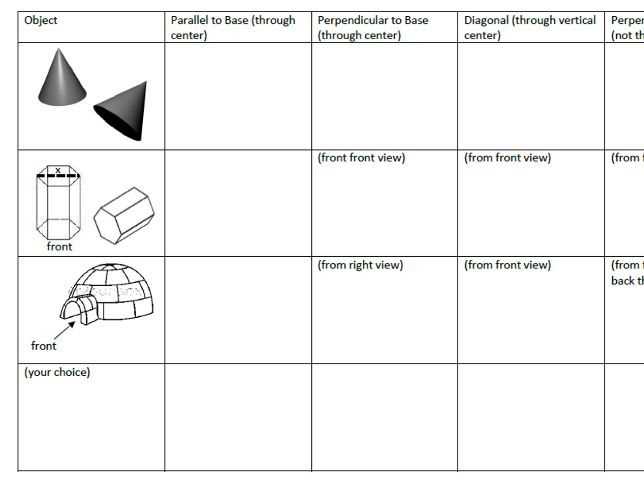
Understanding how slicing through an object can reveal different shapes has practical applications in various fields. Engineers, architects, and designers frequently use the concept of slicing to analyze and model complex structures. For example, in building design, the shape of windows and doorways is often derived by slicing through architectural models to create functional openings.
In medicine, especially in the field of radiology, slicing through the human body is essential for creating detailed images using CT scans or MRIs. These images provide doctors with valuable cross-sectional views of organs and tissues, helping in diagnosing illnesses and planning treatments.
In manufacturing, especially in materials science, the ability to slice through different materials allows engineers to examine the internal structure of a material, such as metals or composites, to check for uniformity, defects, or weaknesses. This helps improve the design and manufacturing of components in fields like aerospace and automotive engineering.
In the field of geology, slicing through rock formations enables scientists to study the layers of the Earth and understand the structure of minerals and fossils, which can provide important insights into natural resource distribution and environmental changes.
Overall, visualizing how cutting through solids can produce different shapes not only enhances understanding in academic contexts but also supports critical applications in various industries.