Review and Reteach Ionic and Covalent Bonding Concepts
Start by identifying the key differences between electrostatic attractions and shared electron pairs. The first type of interaction involves atoms gaining or losing electrons to form charged particles that attract one another. The second involves atoms sharing electrons to form a stable structure, typically between non-metals.
For clarity, focus on how the structure of a molecule influences its properties. In electrostatic attraction examples, such as salt, the resulting compound typically has high melting and boiling points due to the strong attraction between ions. On the other hand, compounds with shared electron pairs, like water, often have lower boiling points and distinct physical properties due to weaker intermolecular forces.
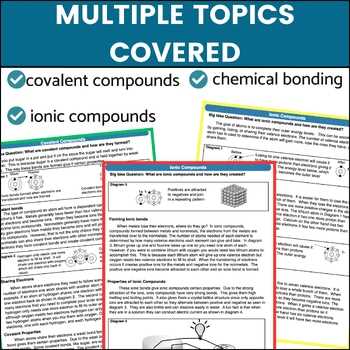
Next, practice identifying electron transfer versus electron sharing scenarios. Use specific examples to connect theory with real-world chemical behavior. These exercises will solidify understanding and improve problem-solving skills in identifying how atoms combine to form compounds.