Solutions and Explanations for Ionic Compound Formation Lab

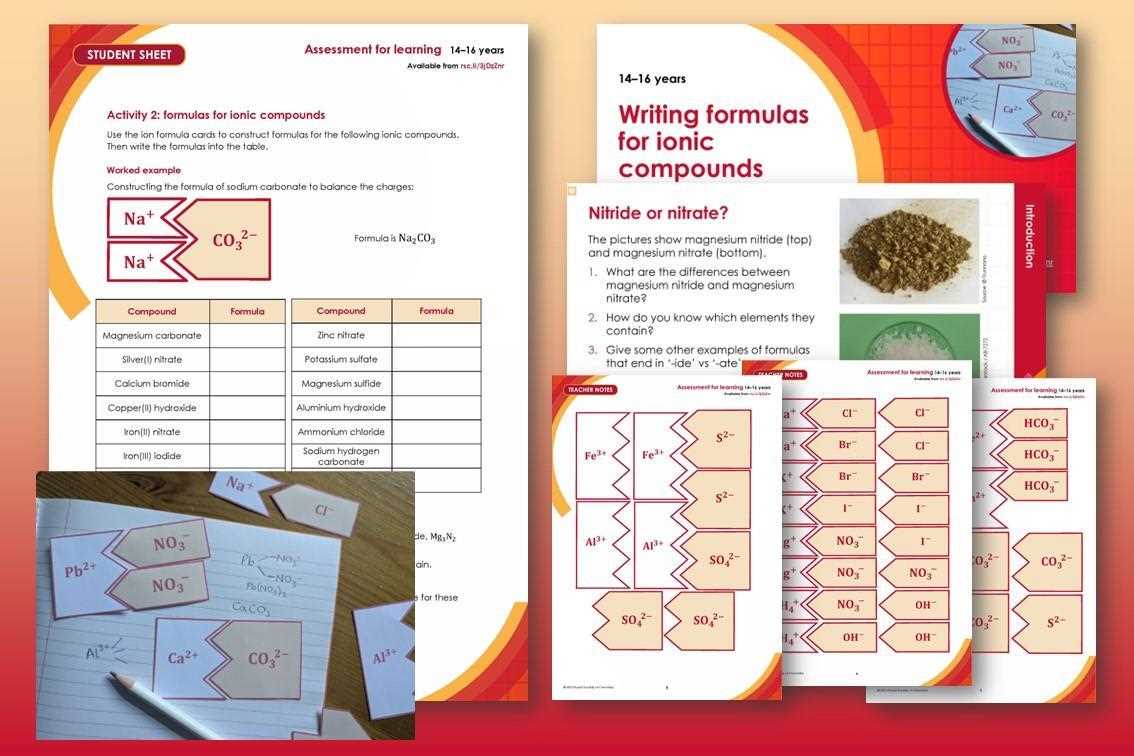
To correctly form a stable compound from two elements, ensure that their charges balance out. Begin by identifying the charges of the metal and non-metal components, as this will determine the number of atoms required from each element to achieve neutrality.
In the case of metal-nonmetal combinations, metals tend to lose electrons, forming positively charged ions, while nonmetals gain electrons to become negatively charged. The total positive charge must equal the total negative charge. Use this principle to write the correct chemical formula and predict the outcome of the reaction.
For example, in reactions involving sodium and chlorine, sodium (Na) loses one electron to form a Na+ ion, while chlorine (Cl) gains an electron to form a Cl- ion. The result is the ionic compound NaCl, where one Na+ ion pairs with one Cl- ion to form a neutral compound.
After conducting the experiment, verify your results by comparing the observed compounds to known ionic compounds. This allows you to ensure that you’ve applied the correct principles of charge balance and ionic bonding in your synthesis process.