Complete Answer Key for Model 1 Primary Succession
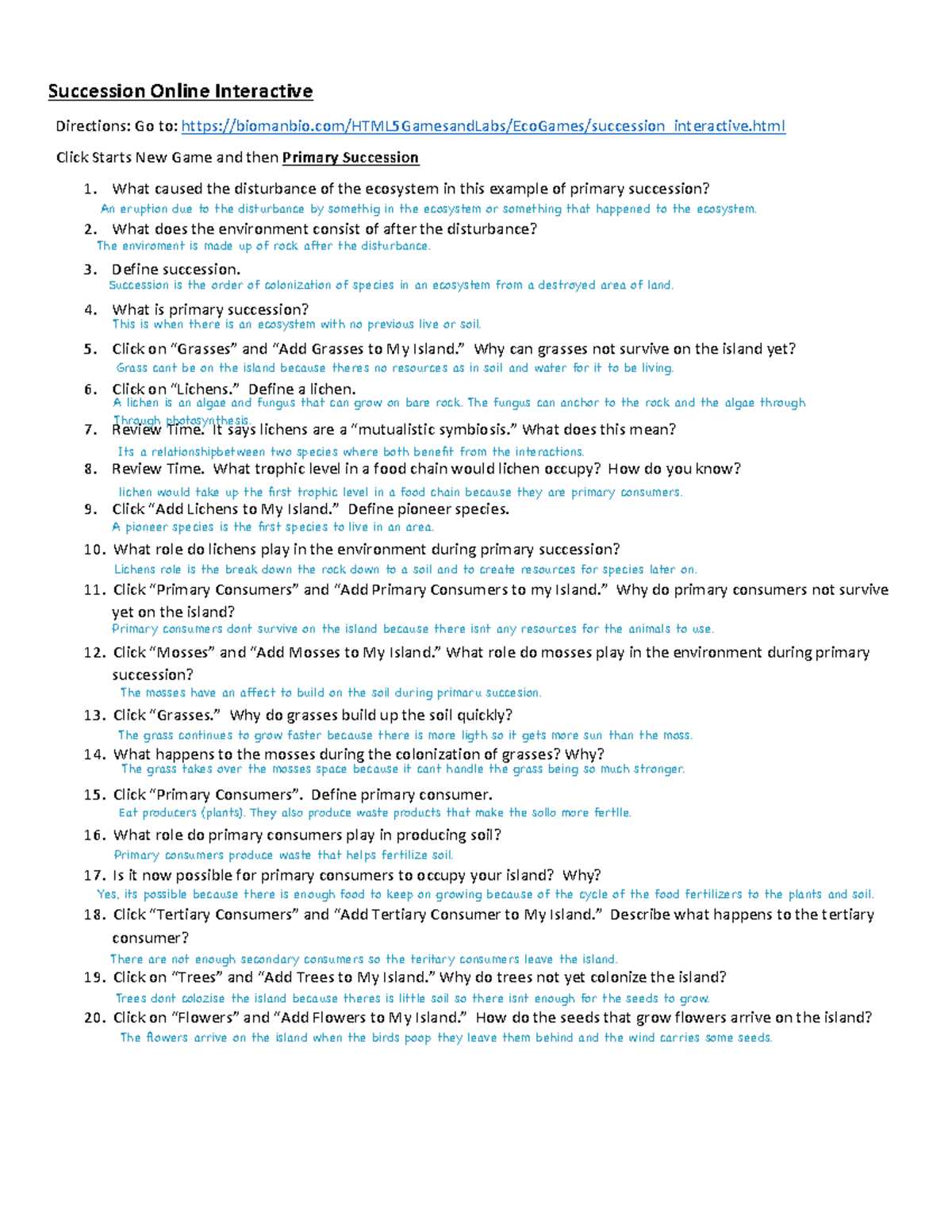
In the first phase, pioneer species such as mosses and lichens appear on bare rock or disturbed soil. These organisms are capable of surviving in harsh conditions and begin the process of soil formation. Over time, they break down rocks and contribute organic matter to the soil, creating conditions that allow for more complex life forms to establish themselves.
The second stage introduces grasses and small plants that thrive in the newly formed soil. These species further enrich the soil, making it suitable for shrubs and small trees to take root. During this stage, the ecosystem becomes more diverse, and the soil quality continues to improve with the presence of decomposers and nitrogen-fixing plants.
As the environment continues to evolve, larger shrubs and trees begin to dominate the area. The ecosystem’s complexity increases, with more species of plants, animals, and microorganisms establishing themselves. This phase results in a more stable environment that can support a variety of life forms.
The final stage involves the development of a mature ecosystem, where a stable community of organisms exists. The plant and animal species present are well adapted to the environment, and biodiversity reaches its peak. At this point, the area is capable of sustaining itself with minimal disturbance.