Complete Guide to Solving Practice Motion Graphs Problems
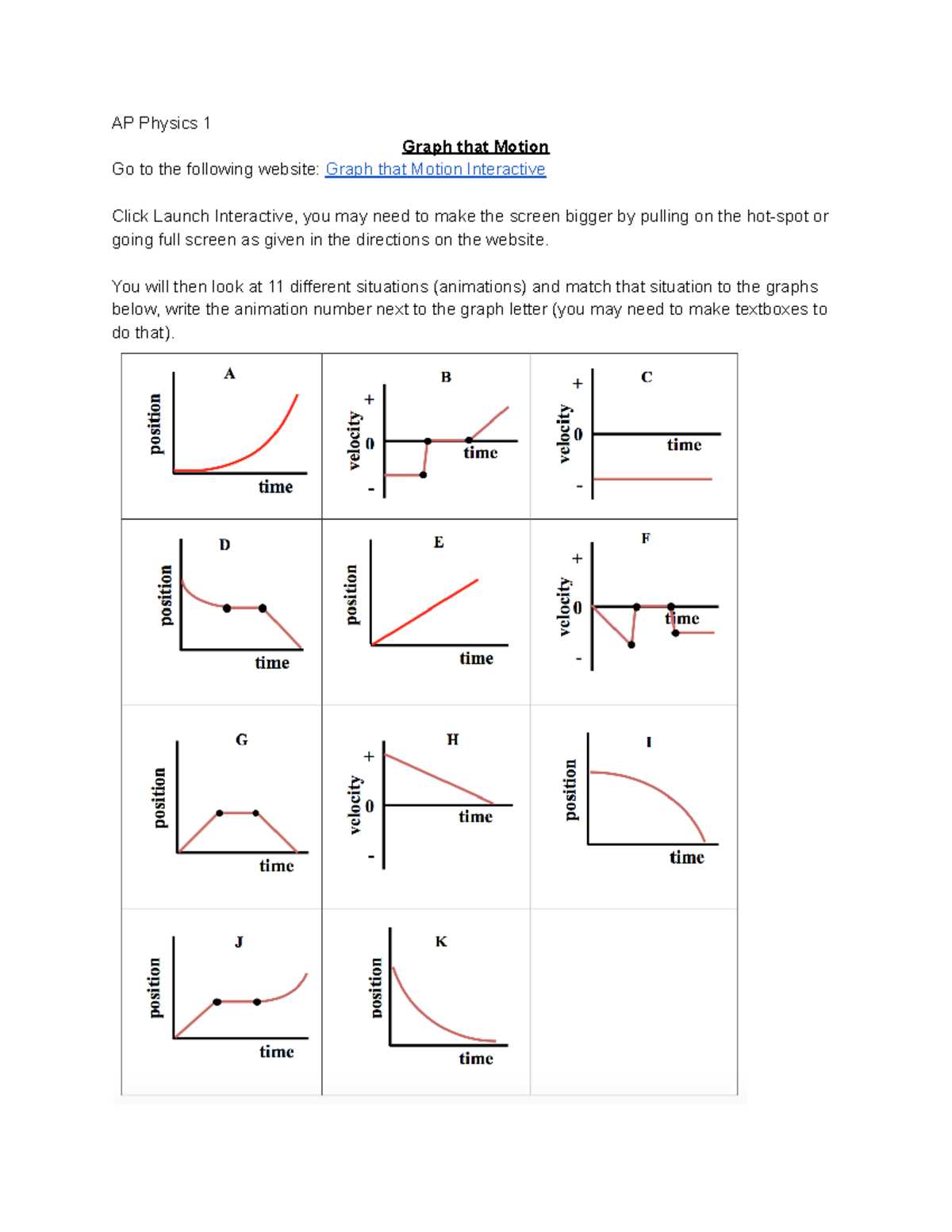
To accurately analyze motion, it’s critical to understand the key principles behind graphical representations of position, velocity, and acceleration over time. Start by focusing on how the slope of each line in these charts corresponds to physical quantities such as speed or change in velocity. Identifying these relationships is key to mastering this area of physics.
For each type of graph, whether it’s a position-time, velocity-time, or acceleration-time graph, knowing the mathematical relationships that govern their interpretation will help clarify the behavior of the object in question. Ensure that you can quickly determine how to read these graphs, what the slope represents, and how to calculate important quantities like displacement or velocity from them.
When solving problems, always break down the graph step by step. Look for patterns, check the units carefully, and verify your results using known equations. This method will help prevent errors and ensure a deeper understanding of how these graphs reflect real-world motion. Using a solution guide can provide insights into common mistakes and reinforce your ability to solve similar problems independently.
Solution Guide for Motion Graph Problems
Understanding the solutions to problems involving position-time, velocity-time, and acceleration-time charts is crucial for mastering motion analysis. Here’s a step-by-step approach to verifying your results:
- Position-Time Graphs: The slope of the line represents velocity. A horizontal line indicates no movement, while a diagonal line shows constant motion. A curve indicates changing velocity.
- Velocity-Time Graphs: The area under the curve gives displacement. A flat line means constant velocity, and the slope of the line indicates acceleration. Positive and negative values represent motion in opposite directions.
- Acceleration-Time Graphs: The area under the curve provides the change in velocity. A constant value indicates uniform acceleration or deceleration, while variations in the graph represent fluctuating forces acting on the object.
Always double-check your interpretation of the graph’s axes and units, and refer to reliable sources to ensure accuracy in your solutions. For further details and additional practice, refer to trusted educational websites such as Khan Academy.
Understanding Basic Concepts of Motion Graphs
When interpreting position-time, velocity-time, and acceleration-time charts, remember that each graph type represents a different aspect of an object’s movement.
Position-Time Charts: These graphs show how an object’s position changes over time. The slope of the line indicates the object’s velocity. A steeper slope means a faster speed, while a horizontal line indicates no movement.
Velocity-Time Charts: These graphs display how an object’s velocity changes with time. The slope represents acceleration, while the area under the curve gives the displacement. A flat line means constant velocity, while a positive or negative slope indicates acceleration or deceleration.
Acceleration-Time Charts: These graphs show how the acceleration of an object changes over time. A flat line indicates constant acceleration, while a changing curve shows varying acceleration. The area under the curve gives the change in velocity.
To interpret these graphs correctly, always focus on the axes and the units they represent, such as distance (m), velocity (m/s), and time (s). Check the slope and area of the graph for further details on the object’s movement.
How to Interpret Position-Time Graphs
To interpret a position-time chart accurately, focus on the following key elements:
- Axes: The x-axis represents time, typically in seconds, while the y-axis shows position, usually in meters. The units of each axis are crucial for accurate interpretation.
- Slope: The slope of the line on the chart indicates the object’s velocity. A steeper slope means a higher velocity, while a horizontal line means the object is at rest.
- Positive and Negative Slopes: A positive slope indicates motion in one direction, while a negative slope shows motion in the opposite direction.
- Curved Lines: If the line is curved, it indicates changing velocity, meaning the object is accelerating or decelerating. The steeper the curve, the greater the rate of change in velocity.
- Horizontal Lines: These indicate no change in position, meaning the object is stationary at that time.
By analyzing the slope and shape of the line, you can determine not only the object’s speed but also whether it is speeding up or slowing down over time. This helps in understanding its overall motion in a more detailed manner.
Analyzing Velocity-Time Graphs for Common Mistakes
When interpreting velocity-time charts, it’s important to avoid several common errors that can lead to incorrect conclusions:
- Misinterpreting Flat Sections: A horizontal line on a velocity-time graph indicates constant velocity, not acceleration. Be sure to differentiate between periods of constant motion and rest.
- Confusing Positive and Negative Velocities: A positive velocity indicates motion in one direction, while a negative velocity represents motion in the opposite direction. Ensure that you correctly identify the direction of travel.
- Incorrect Area Under the Curve: The area between the velocity curve and the time axis represents displacement. If the graph is not interpreted
Exploring Acceleration-Time Graphs
Acceleration-time charts reveal changes in the rate of velocity. When interpreting such diagrams, focus on the following key aspects:
- Flat Sections: A horizontal line indicates constant acceleration. Zero acceleration is represented by a line on the time axis, showing no change in velocity.
- Positive and Negative Acceleration: Positive acceleration reflects an increase in velocity, while negative acceleration (or deceleration) shows a decrease. Ensure you identify the direction of change accurately.
- Area Under the Curve: The area between the curve and the time axis represents the change in velocity. This area is crucial for calculating total velocity changes over time.
- Sharp Transitions: Sudden spikes or drops in the graph represent rapid changes in acceleration, which might indicate a forceful change in motion.
- Units and Scale: Ensure that the units for acceleration (e.g., m/s²) and time (e.g., seconds) are consistent throughout the graph. Misinterpreting scale can lead to incorrect calculations.
By examining these features, one can accurately interpret the acceleration profile and better understand how an object’s velocity is changing over time.
Key Steps to Solve Motion Graph Problems
Follow these steps to solve problems involving visual representations of an object’s movement:
- Identify the Variables: Determine what each axis represents (e.g., position, time, velocity, acceleration) and the corresponding units. This step ensures clarity throughout the problem-solving process.
- Examine the Shape of the Curve: Analyze the curve’s characteristics, such as its slope and concavity. For example, a straight line on a velocity-time diagram indicates constant velocity, while a curve suggests changing speed.
- Calculate Slope and Area: The slope of a position-time chart gives velocity, and the area under a velocity-time curve represents displacement. For acceleration-time graphs, the area gives the change in velocity.
- Check for Key Points: Identify important points like the starting position, maximum/minimum values, or intervals where motion changes direction or stops. This can help you identify specific motion events.
- Apply Equations of Motion: Use appropriate kinematic equations based on the graph type to find missing information, such as velocity or displacement, if needed.
- Double-Check Units: Always confirm that your calculations and interpretations are consistent with the correct units, especially when transitioning between graphs of different types (e.g., velocity and position).
By following these steps, you can break down complex motion problems into manageable tasks and arrive at accurate solutions.
How to Identify Slope and Area in Motion Graphs
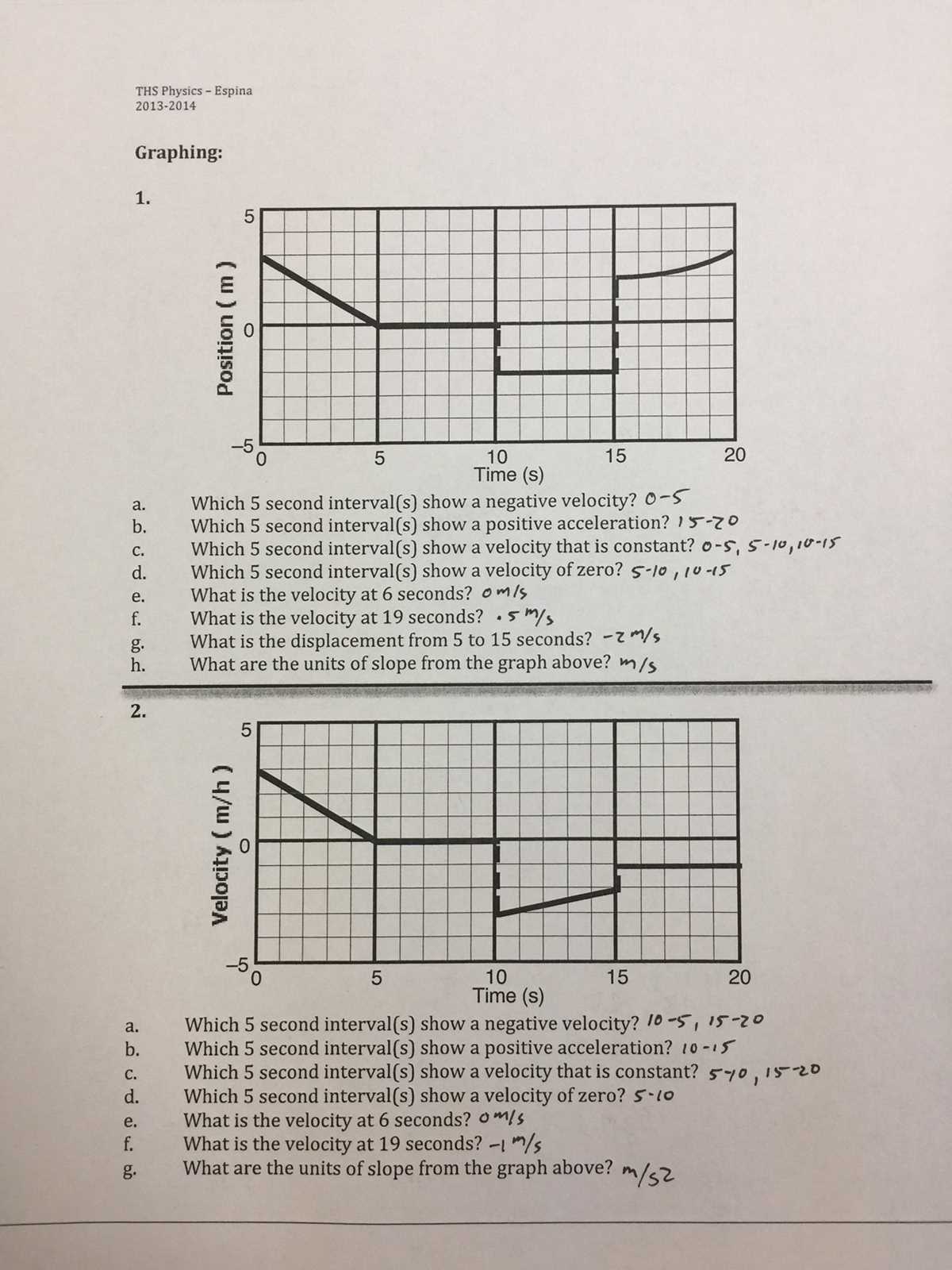
The slope and area in different types of graphs represent important aspects of an object’s movement. Understanding how to calculate and interpret these values is crucial.
- Slope in Position-Time Graphs: In a position-time graph, the slope indicates the object’s velocity. Calculate it by dividing the change in position by the change in time. A constant slope represents uniform motion, while a changing slope indicates acceleration or deceleration.
- Slope in Velocity-Time Graphs: The slope of a velocity-time graph shows the object’s acceleration. A positive slope indicates increasing velocity, while a negative slope shows decreasing velocity. The steeper the slope, the greater the acceleration or deceleration.
- Area under Velocity-Time Graphs: The area under a velocity-time graph represents the displacement of the object. To calculate it, multiply the velocity by the time interval. For non-linear graphs, break the area into simpler shapes (like rectangles or triangles) and sum the areas.
- Area under Acceleration-Time Graphs: The area under an acceleration-time graph gives the change in velocity. Multiply the acceleration by the time to get the total velocity change during that period. If the graph is divided into segments, calculate the area for each and then sum them.
By identifying the slope and calculating the area in these types of graphs, you can extract key details about the object’s speed, displacement, and acceleration.
Common Pitfalls in Motion Graph Interpretation
Interpreting graphical representations of an object’s movement can be tricky. Here are some frequent mistakes and how to avoid them:
- Confusing Slope with Area: In position-time graphs, the slope represents velocity, not displacement. Similarly, the area under a velocity-time graph gives displacement, not speed. Be sure to differentiate between these two concepts.
- Assuming Constant Velocity in a Curved Line: A curved line in a position-time graph indicates changing velocity (acceleration). Assuming constant velocity in such a graph will lead to incorrect conclusions about the object’s motion.
- Overlooking Units: Always check the units of measurement on both axes. A common mistake is assuming the time is in seconds while it may be in minutes or hours, leading to inaccurate calculations of velocity or acceleration.
- Ignoring Negative Values: A negative value on a velocity or acceleration graph indicates motion in the opposite direction or deceleration. Overlooking negative values can result in misinterpreting the direction of movement or the rate of change.
- Misinterpreting Flat Sections: A flat horizontal line on a velocity-time graph means zero velocity (the object is stationary). Similarly, a flat line on an acceleration-time graph indicates zero acceleration (constant velocity). Confusing these can lead to an incorrect understanding of the object’s behavior.
- Assuming Uniform Acceleration in All Cases: Not all motion involves uniform acceleration. Non-linear graphs can indicate changing acceleration, so be cautious when interpreting graphs with curves. Assuming constant acceleration without considering the graph’s shape can lead to errors.
By being aware of these common mistakes, you can avoid misinterpreting the data and gain a more accurate understanding of the object’s movement.
Applying Motion Graphs to Real-Life Scenarios
To understand how motion is represented in everyday situations, it’s important to analyze graphs in the context of real-world movements. Here are some practical applications:
- Car Acceleration: In a car’s velocity-time graph, a flat line indicates constant speed. A sloping line upwards indicates acceleration, and a downward slope shows deceleration. These patterns can help us understand how a car behaves under different conditions, such as speeding up or slowing down during a road trip.
- Elevator Movement: An elevator’s position-time graph typically starts with a steep slope as it accelerates upwards, followed by a flat line once it reaches a constant speed. The graph changes direction (negative slope) when the elevator starts to decelerate before stopping at a floor. This can be used to study the behavior of elevators in buildings.
- Jogging or Running: An athlete’s velocity-time graph can show periods of steady running (flat line), acceleration during sprinting (upward slope), and slowing down after the run (downward slope). These graphs are useful for understanding training routines and optimizing performance.
- Free Fall: In the case of an object in free fall, the velocity-time graph will show a constant upward slope (increasing speed) if air resistance is negligible. By studying this graph, you can determine how fast the object is falling at any point in time.
- Train or Subway Travel: A train’s journey often consists of phases of acceleration, cruising at a constant speed, and deceleration before stopping. These phases are clearly visible on a velocity-time graph and can be used for scheduling and safety analysis in public transportation systems.
By analyzing these real-life examples, it’s easier to relate the abstract concept of motion to everyday experiences. Using motion graphs allows for a more detailed understanding of various types of movement and can help improve processes in transportation, sports, and other industries.