Complete Guide to Balancing Chemical Equations Test Solutions
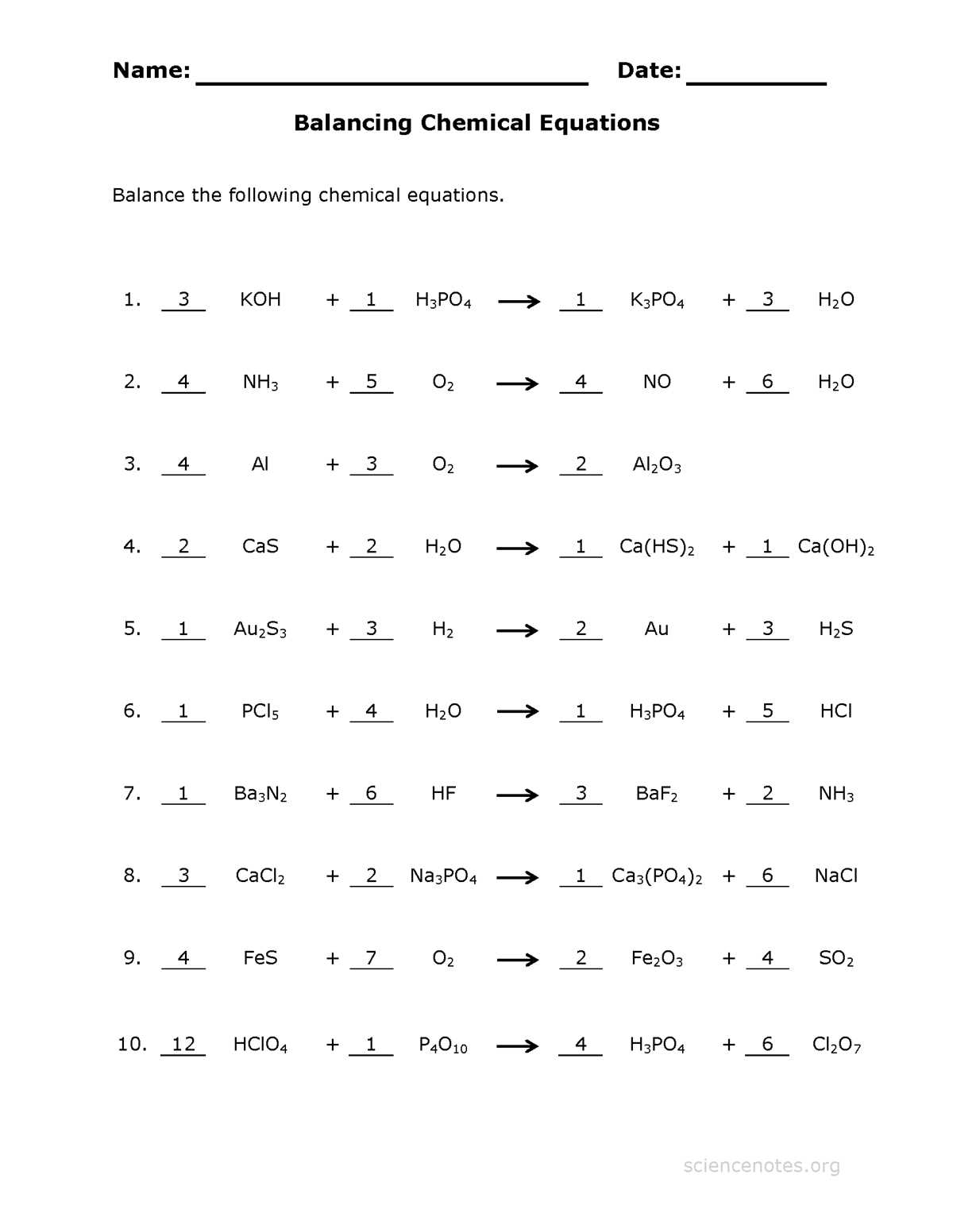
Focus on identifying the different types of reactions, such as synthesis, decomposition, and combustion. This will simplify the process of matching reactants and products.
Start by ensuring the number of atoms on both sides of the reaction are equal. Begin with the most complex molecule and move to the simpler ones. Adjust coefficients systematically to maintain balance.
In cases where polyatomic ions are present, treat them as a single unit to avoid unnecessary complications. This can streamline your approach, especially in reactions involving multiple elements.
If you encounter fractional coefficients, multiply the entire equation by a common denominator to eliminate fractions. This step ensures that the equation remains balanced without compromising accuracy.
Balancing Chemical Equations Test Answer Key
First, identify the compounds on both sides of the reaction. Ensure each molecule is properly represented by its correct formula. Double-check the number of atoms in each element on both sides to ensure they are equal.
Start with elements that appear in the most complex compounds. For example, if oxygen appears in multiple compounds, balance it after adjusting the other elements. This can help minimize back-and-forth adjustments.
If necessary, adjust the coefficients one by one. Begin with the highest coefficients and work downwards to smaller, simpler molecules. This method prevents overcomplicating the equation early on.
In reactions involving polyatomic ions, treat them as a single unit, especially if they remain unchanged throughout the process. This approach reduces the number of variables you need to track and simplifies the balancing process.
Always recheck your results by counting the atoms on both sides once you’ve made adjustments. Ensure that all elements are balanced before concluding the equation is correct.
Step-by-Step Process for Balancing Simple Reactions
To balance a simple reaction, follow these steps:
- Write the unbalanced equation: Begin by noting the reactants and products in their unbalanced form. For example, consider the reaction between hydrogen and oxygen to form water.
- Count atoms of each element: Count the number of atoms of each element on both sides of the reaction. For instance, in H2 + O2 → H2O, there are 2 hydrogen atoms on the left and 2 hydrogen atoms on the right, but oxygen is unbalanced.
- Balance the elements one at a time: Start with the elements that appear in the most complex molecules. In this example, balance oxygen by placing a coefficient of 1/2 in front of O2, giving 1 oxygen atom on both sides.
- Adjust coefficients for integer values: If you used fractions, multiply all coefficients by 2 to remove the fraction. This results in H2 + O2 → 2H2O.
- Check atom count again: Ensure that all elements are balanced by verifying the number of atoms for each element on both sides of the reaction. For example, now there are 4 hydrogen atoms on both sides and 2 oxygen atoms on both sides.
- Final review: Recheck the equation to confirm that both mass and charge are balanced. The final balanced equation should reflect the same number of atoms of each element on both sides.
Common Mistakes to Avoid When Balancing Reactions
Here are some frequent errors to avoid:
- Ignoring the Law of Conservation of Mass: Ensure that the number of atoms of each element is the same on both sides. This is a fundamental principle that must not be overlooked.
- Changing subscripts instead of coefficients: Subscripts indicate the composition of molecules and should never be altered when balancing. Only coefficients should be adjusted.
- Balancing oxygen and hydrogen last: Oxygen and hydrogen are often present in multiple compounds, making it easier to adjust them at the end. However, don’t neglect other elements when making adjustments for these two.
- Balancing one element at a time: While it may seem tempting, balancing each element individually can lead to incorrect results. Adjust coefficients for different elements simultaneously, ensuring the overall balance remains intact.
- Not checking the final equation: After adjusting coefficients, recheck the entire equation to ensure all elements are properly balanced. Double-check the atom count on both sides.
- Forgetting to adjust for whole numbers: After using fractional coefficients, always multiply all coefficients by the smallest possible factor to obtain whole numbers.
- Not considering the charge in ionic reactions: In reactions involving ionic compounds, make sure to balance both the atoms and the charges on each side of the equation.
How to Handle Fractional Coefficients in Reactions
When fractional coefficients appear in a reaction, it’s important to convert them into whole numbers. Here’s how to handle them:
- Multiply the entire equation by the denominator: If a fractional coefficient appears (for example, 1/2), multiply all the coefficients in the equation by the denominator (2 in this case) to eliminate the fraction.
- Adjust carefully: After multiplying, check that all the coefficients are whole numbers. Ensure that the balance of atoms is maintained throughout the process.
- Recheck the equation: After converting fractional coefficients, verify that the equation is still balanced. Ensure the atom count on both sides is equal.
- Apply to complex reactions: In reactions with multiple molecules or compounds, ensure that every fraction is addressed, adjusting each term as needed.
- Keep track of units and states: If the reaction includes states of matter (solid, liquid, gas, aqueous), ensure the units remain correct when multiplying coefficients.
Tips for Identifying Reaction Types in Balance Problems
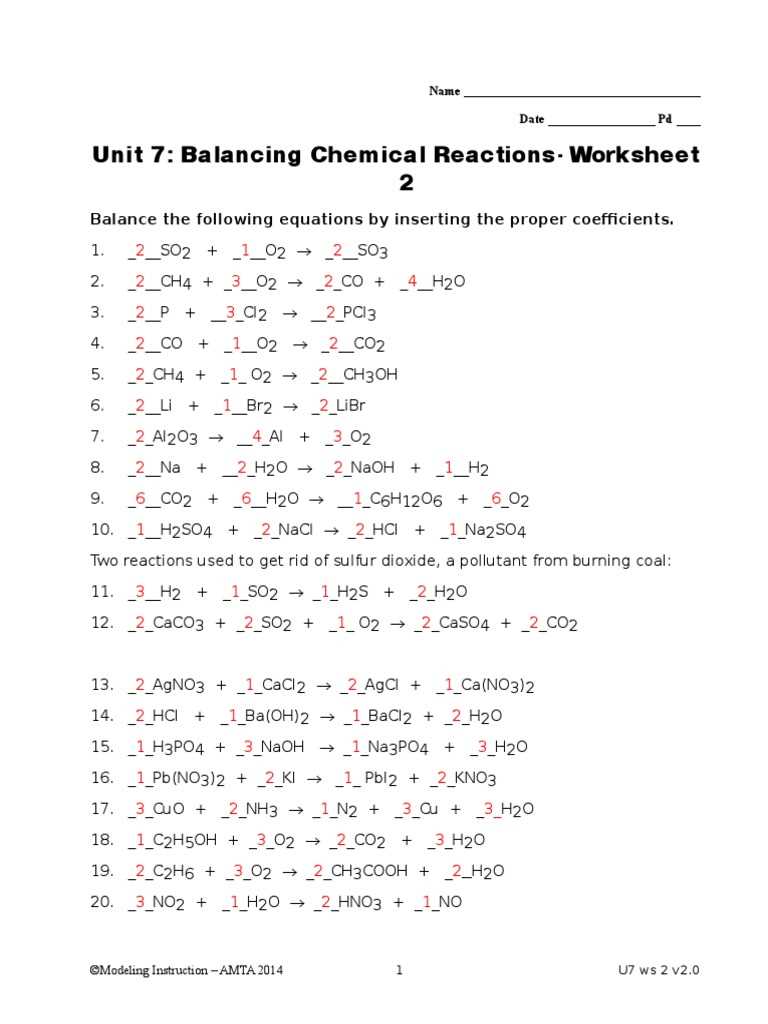
Identifying the type of reaction helps streamline the balancing process. Here’s how to approach different reaction types:
- Synthesis Reactions: Look for two or more reactants combining to form a single product. Example: A + B → AB.
- Decomposition Reactions: Identify when a compound breaks down into two or more products. Example: AB → A + B.
- Single Displacement Reactions: One element replaces another in a compound. Example: A + BC → AC + B.
- Double Displacement Reactions: Two compounds exchange ions. Example: AB + CD → AD + CB.
- Combustion Reactions: Oxygen reacts with a substance, typically a hydrocarbon, producing carbon dioxide and water. Example: CH₄ + O₂ → CO₂ + H₂O.
Recognizing these patterns will guide you in predicting product formation, making the balancing process faster and more accurate.
Understanding the Law of Conservation of Mass in Reactions
The Law of Conservation of Mass states that matter cannot be created or destroyed during a reaction. This principle ensures that the mass of reactants equals the mass of products in any reaction.
To apply this law, start by counting the atoms of each element in the reactants and products. Ensure that the number of atoms on both sides is the same, as no atoms are lost or gained during the process.
For example, in the reaction of hydrogen and oxygen to form water (2H₂ + O₂ → 2H₂O), there are four hydrogen atoms and two oxygen atoms on both sides of the equation, maintaining the mass balance.
By following this principle, you can accurately predict and verify the amounts of substances involved in any reaction.
Balancing Equations with Polyatomic Ions
When dealing with polyatomic ions in reactions, treat the entire ion as a single unit. This approach simplifies the process by preventing the need to balance individual atoms within the polyatomic ion.
First, identify the polyatomic ion on both sides of the reaction. If the ion remains unchanged during the reaction, you can balance it as a whole. For example, in the reaction between calcium nitrate and sodium carbonate: Ca(NO₃)₂ + Na₂CO₃ → CaCO₃ + 2NaNO₃, the nitrate ion (NO₃) appears on both sides and should be treated as a single entity.
Balance the ions first. Once the polyatomic ions are accounted for, proceed with balancing the remaining atoms in the equation. This method ensures that no ions are left unbalanced and that the reaction follows the law of mass conservation.
Check the final equation by counting atoms on both sides. If the polyatomic ion is balanced along with all other elements, the reaction is successfully balanced.
Using the Oxidation-Reduction Method for Balancing
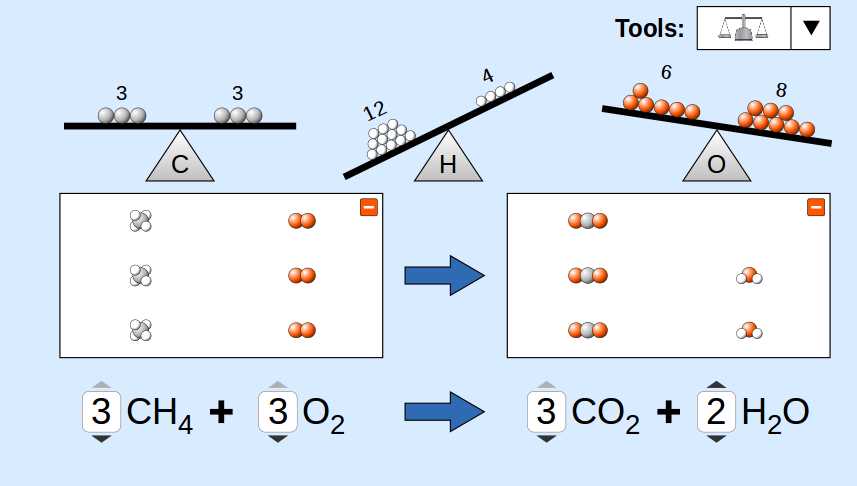
To balance reactions using the oxidation-reduction method, start by identifying the elements that undergo oxidation and reduction. These elements will experience changes in oxidation state during the reaction.
First, assign oxidation numbers to all elements in the reactants and products. The element that loses electrons undergoes oxidation, while the one that gains electrons is reduced. Track the changes in their oxidation states, which indicate the movement of electrons.
Next, balance the number of electrons lost and gained by adjusting the coefficients of the involved species. Ensure that the total number of electrons lost in oxidation equals the total number of electrons gained in reduction. This step might involve multiplying the half-reactions by appropriate factors.
Finally, balance all other atoms in the equation, ensuring that mass is conserved. After completing the balancing, verify that the equation adheres to the conservation of both mass and charge.
For more detailed examples and a thorough explanation of the oxidation-reduction method, visit LibreTexts.
Practice Problems with Solutions for Balancing Reactions
Here are some practice problems to help you master the process of balancing reactions. Follow the steps provided to ensure you achieve accurate results.
- Problem 1: Balance the following reaction:
H2 + O2 → H2O
Solution: Add a coefficient of 2 in front of H2 and O2 to balance hydrogen and oxygen atoms.
Correct balanced reaction: 2H2 + O2 → 2H2O
- Problem 2: Balance the following reaction:
C4H10 + O2 → CO2 + H2O
Solution: Start by balancing carbon atoms. Then, balance hydrogen and oxygen atoms. The balanced equation is:
2C4H10 + 13O2 → 8CO2 + 10H2O
- Problem 3: Balance the following reaction:
Na + Cl2 → NaCl
Solution: Balance sodium and chlorine atoms by adding a coefficient of 2 in front of NaCl.
Correct balanced reaction: 2Na + Cl2 → 2NaCl
Practice balancing more reactions to solidify your understanding. Always ensure that the number of atoms for each element is the same on both sides of the reaction.