Complete Guide to Solving Quadratic Equations Using the Formula
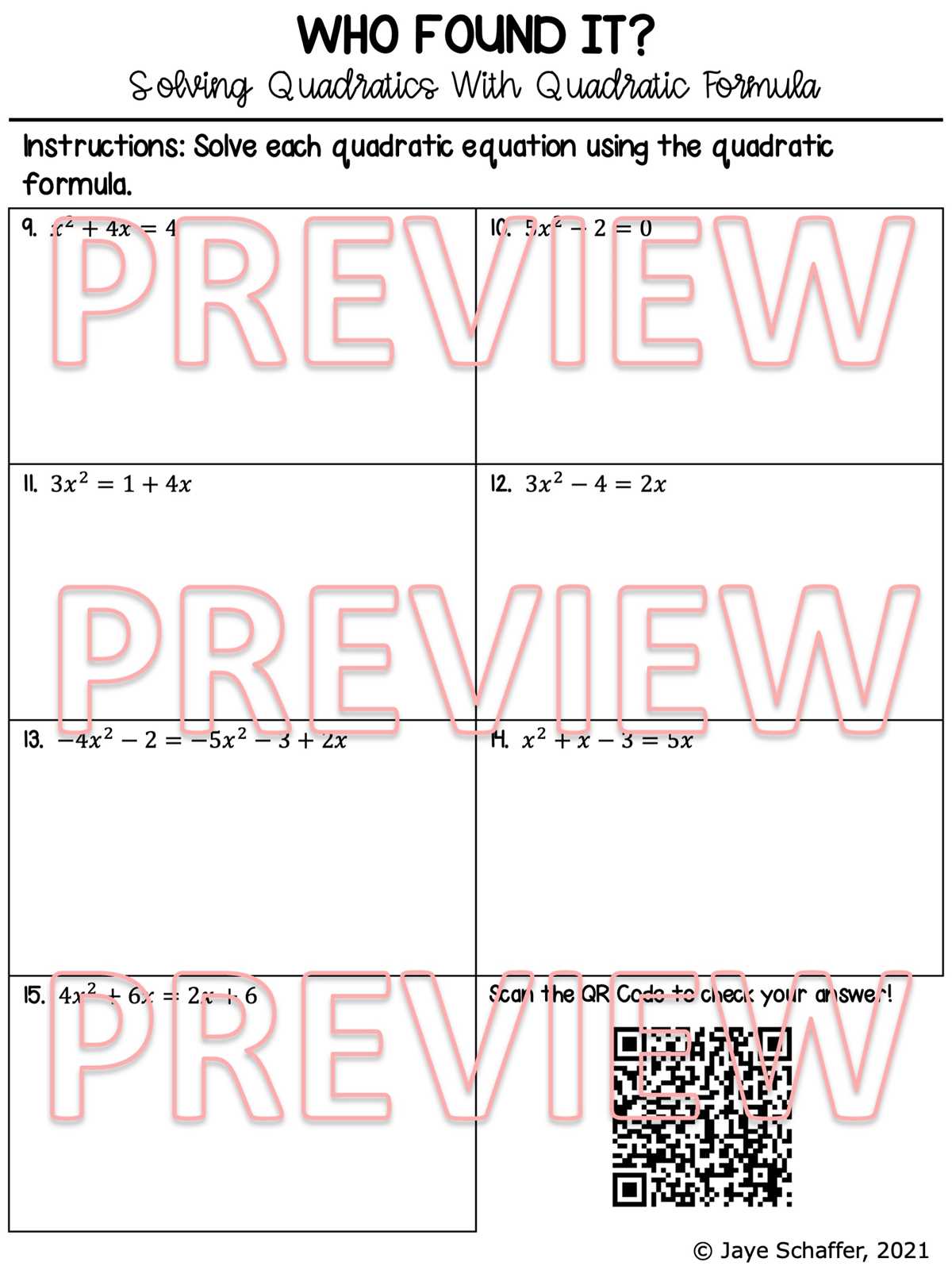
To solve quadratic equations with ease, follow the step-by-step process outlined below. This method breaks down the problem into manageable parts, helping you to quickly arrive at the correct roots. Begin by identifying the coefficients of the equation and applying the standard approach to find both possible solutions. Make sure to pay attention to whether the discriminant is positive, zero, or negative, as it will determine the type of solutions you get.
After completing the problem, cross-check your solutions using the provided solution set. This not only validates your work but also ensures you’ve correctly executed each step. Remember to simplify your answers wherever possible, ensuring they are in the most reduced form. Pay close attention to signs and square roots when calculating the final results.
To avoid common mistakes, carefully review the calculations for each step. Many students overlook the importance of the correct sign for the square root or misapply the formula when dealing with complex numbers. The answer set can serve as a valuable tool for recognizing patterns in your work and strengthening your understanding of the process.
Algebra 2 Quadratic Formula Worksheet Answer Key
For solving any equation of the form ax² + bx + c = 0, use the following method to determine the roots:
Step 1: Identify the coefficients: a, b, and c. These are the numbers in front of x², x, and the constant, respectively.
Step 2: Calculate the discriminant: Δ = b² – 4ac. This value helps determine the nature of the roots.
Step 3: Apply the solution formula: x = (-b ± √Δ) / 2a. This gives the two possible roots, one for the plus and one for the minus.
Step 4: Simplify the expression for x, ensuring to reduce the square roots and combine like terms when possible.
Step 5: Check the results using the given solution set to ensure that all steps have been performed correctly. If any errors are made, verify the discriminant and recalibrate the calculations accordingly.
Understanding the Quadratic Formula and Its Components
The equation to solve for x in a standard form equation ax² + bx + c = 0 is derived from completing the square. Here’s how each part functions:
- a: The coefficient of x². It determines the width and direction of the parabola.
- b: The coefficient of x. It influences the location of the vertex and the direction of the curve.
- c: The constant term. It shifts the entire parabola up or down along the y-axis.
The discriminant, represented as Δ (delta), is a critical part of the equation: Δ = b² – 4ac. It tells you how many solutions there are:
- If Δ > 0, there are two real and distinct solutions.
- If Δ = 0, there is one real solution (a repeated root).
- If Δ
By applying these components within the equation x = (-b ± √Δ) / 2a, you can solve for the values of x. The “±” indicates two possible solutions, which come from adding or subtracting the square root of the discriminant.
How to Use the Quadratic Formula to Solve Equations
To solve an equation of the form ax² + bx + c = 0, apply the following steps using the quadratic equation:
- Identify the coefficients: Extract the values of a, b, and c from the equation. For example, in 2x² + 3x – 5 = 0, a = 2, b = 3, and c = -5.
- Calculate the discriminant: Use the formula Δ = b² – 4ac to find the discriminant. For the example, Δ = 3² – 4(2)(-5) = 9 + 40 = 49.
- Apply the quadratic formula: Plug the values of a, b, and Δ into the equation x = (-b ± √Δ) / 2a. Using our example, x = (-3 ± √49) / 2(2).
- Evaluate the square root: Calculate the square root of the discriminant, √49 = 7. Now the equation becomes x = (-3 ± 7) / 4.
- Solve for the two possible values of x: There are two solutions:
- x₁ = (-3 + 7) / 4 = 4 / 4 = 1
- x₂ = (-3 – 7) / 4 = -10 / 4 = -2.5
The solutions are x = 1 and x = -2.5. These are the roots of the equation.
Step-by-Step Guide to Solving Quadratic Equations
Follow these precise steps to solve a quadratic equation of the form ax² + bx + c = 0.
- Identify coefficients: Extract the values of a, b, and c from the equation. For example, in 3x² + 5x – 2 = 0, a = 3, b = 5, and c = -2.
- Calculate the discriminant: Use the formula Δ = b² – 4ac. For the example, Δ = 5² – 4(3)(-2) = 25 + 24 = 49.
- Apply the solution formula: The general equation to find the roots is x = (-b ± √Δ) / 2a. In this case, x = (-5 ± √49) / 2(3).
- Simplify the square root: Calculate √49 = 7, so the equation becomes x = (-5 ± 7) / 6.
- Solve for the two roots:
- x₁ = (-5 + 7) / 6 = 2 / 6 = 1/3
- x₂ = (-5 – 7) / 6 = -12 / 6 = -2
- Conclusion: The two solutions are x = 1/3 and x = -2. These are the values where the equation equals zero.
Common Mistakes in Applying the Quadratic Formula
When solving equations using the general solution method, avoid these frequent errors:
- Misidentifying coefficients: Ensure that the values for a, b, and c are correctly extracted from the equation. Mistakes can occur if the terms are written incorrectly or if the signs are missed. Double-check for negative signs and constants.
- Incorrectly calculating the discriminant: The discriminant is Δ = b² – 4ac. A common mistake is to square the value of b or compute the product of a and c incorrectly. Ensure all operations are performed in the right order.
- Forgetting the ± symbol: When applying the formula, don’t overlook the ± symbol. This represents the two possible values of x derived from both positive and negative roots. Ignoring this step leads to only one solution.
- Mismanaging negative square roots: If the discriminant is negative, it indicates imaginary or complex solutions. Mistaking this for an error or using incorrect operations for negative square roots can result in inaccurate results.
- Incorrect simplification of the square root: Ensure you simplify square roots correctly. For example, √49 = 7, not √50 ≈ 7.07 unless the root is simplified correctly to the nearest decimal if necessary.
- Errors in dividing by 2a: When dividing by 2a, it’s crucial to use the exact value of a. Errors in this division often occur when simplifying fractions incorrectly or forgetting to divide by 2.
Avoid these errors by carefully reviewing each step and performing all calculations methodically. Double-check each operation before moving forward to ensure correct results.
How to Check Your Solutions Using the Discriminant
The discriminant, calculated as Δ = b² – 4ac, plays a crucial role in determining the nature of the solutions to a given equation. Here’s how you can use it to check your solutions:
- Calculate the Discriminant: Start by calculating the discriminant using the coefficients from your equation. Ensure that you correctly identify the values of a, b, and c from the standard form of the equation.
- Interpret the Result: The value of Δ tells you the nature of the roots:
- If Δ > 0, the equation has two distinct real solutions.
- If Δ = 0, the equation has exactly one real solution (a repeated root).
- If Δ
- Verify with the Solutions: After solving the equation using your method (e.g., applying the general solution), check the solutions:
- If the discriminant is positive, you should have two real solutions.
- If the discriminant is zero, your solutions should match the single repeated value.
- If the discriminant is negative, the solutions should be complex.
- Check for Consistency: Compare your solutions with the discriminant result. If they match the expected outcomes, your calculations are correct. If not, you may need to revisit your solution steps.
For more detailed guidance, visit Khan Academy for examples and exercises.
Real-Life Applications of the Quadratic Formula
The ability to solve for unknowns using a general equation is useful in many fields. Below are some practical uses:
- Projectile Motion: The path of an object thrown into the air follows a parabolic curve. Using the general equation, you can determine the time it takes for the object to reach the ground or the maximum height it will achieve.
- Engineering: Engineers use equations that model real-world systems, such as designing bridges or calculating the stress on materials. The solutions to these equations often require solving using a standard form that involves the square of a variable.
- Finance: In financial modeling, the general equation is used to calculate the break-even point or to solve for the future value of investments where time and interest rate variables are involved.
- Architecture: Architects use equations to model curves and angles when designing structures. For example, calculating the shape of arches or the height of a building given certain constraints often involves solving quadratic equations.
- Physics: In physics, many phenomena such as light refraction, heat conduction, and wave motion can be modeled using equations that require solving for roots using the standard method.
By mastering these calculations, you can solve real-world problems in various scientific and engineering contexts, where accuracy and precision are crucial.
Tips for Mastering Quadratic Equations in Algebra 2
To excel in solving second-degree equations, follow these practical strategies:
- Understand the Standard Form: Recognize the general structure: ax² + bx + c = 0. Knowing this form helps you easily identify the coefficients and apply them in various methods.
- Master the Discriminant: The discriminant (b² – 4ac) provides insight into the number and type of solutions. A positive discriminant means two real solutions, zero means one real solution, and a negative discriminant means complex solutions.
- Practice Completing the Square: This technique is key for transforming equations into perfect squares, making it easier to solve. It’s an essential step when solving manually without a calculator.
- Familiarize Yourself with Factoring: Before using advanced methods, always check if factoring the equation is possible. It’s the quickest approach for solving equations with integer coefficients.
- Use the Distributive Property Correctly: Be careful when expanding binomials or terms. Mistakes in multiplication can lead to incorrect solutions. Always double-check your steps.
- Break Problems into Smaller Parts: When dealing with complex equations, divide them into smaller, manageable components. Solve for one part, then move on to the next step.
- Check Solutions by Substituting Back: Once you find the roots, substitute them back into the original equation to verify their correctness. This will help catch errors early on.
- Practice Regularly: Consistent practice is key. The more you work through problems, the more intuitive the methods will become. Work with different sets of coefficients to gain confidence.
By incorporating these techniques into your study routine, you’ll build a strong foundation and improve your ability to solve complex problems quickly and accurately.
Where to Find Practice Problems for Quadratic Equations
To improve your skills in solving second-degree equations, use the following resources for practice:
- Textbook Exercises: Most textbooks offer a range of practice problems with varying levels of difficulty. Focus on sections that cover solving for roots and simplifying expressions.
- Online Math Websites: Websites like Khan Academy and Cymath provide interactive practice problems along with step-by-step solutions.
- Educational Apps: Apps like Photomath and Mathway let you solve equations and view solutions. Many apps also offer practice problems to test your understanding.
- Math Forums and Communities: Platforms like Math Stack Exchange provide real-world problems contributed by other learners and experts that you can solve and discuss.
- Online Math Generators: Use tools like Algebrator or Softmath to generate customized practice problems that focus on specific problem types, such as factoring or solving for x.
- Practice Books: Books specifically dedicated to solving second-degree equations offer worksheets with both answers and detailed explanations. These books can be found at most educational bookstores or online retailers.
- YouTube Channels: Many educators provide free tutorials and problem-solving sessions on YouTube. Channels like PatrickJMT offer guided practice on solving second-degree equations step by step.
Regularly working through these resources will help reinforce your understanding and ability to solve second-degree equations more effectively.