Chemistry Atomic Structure Worksheet Answer Key and Solutions
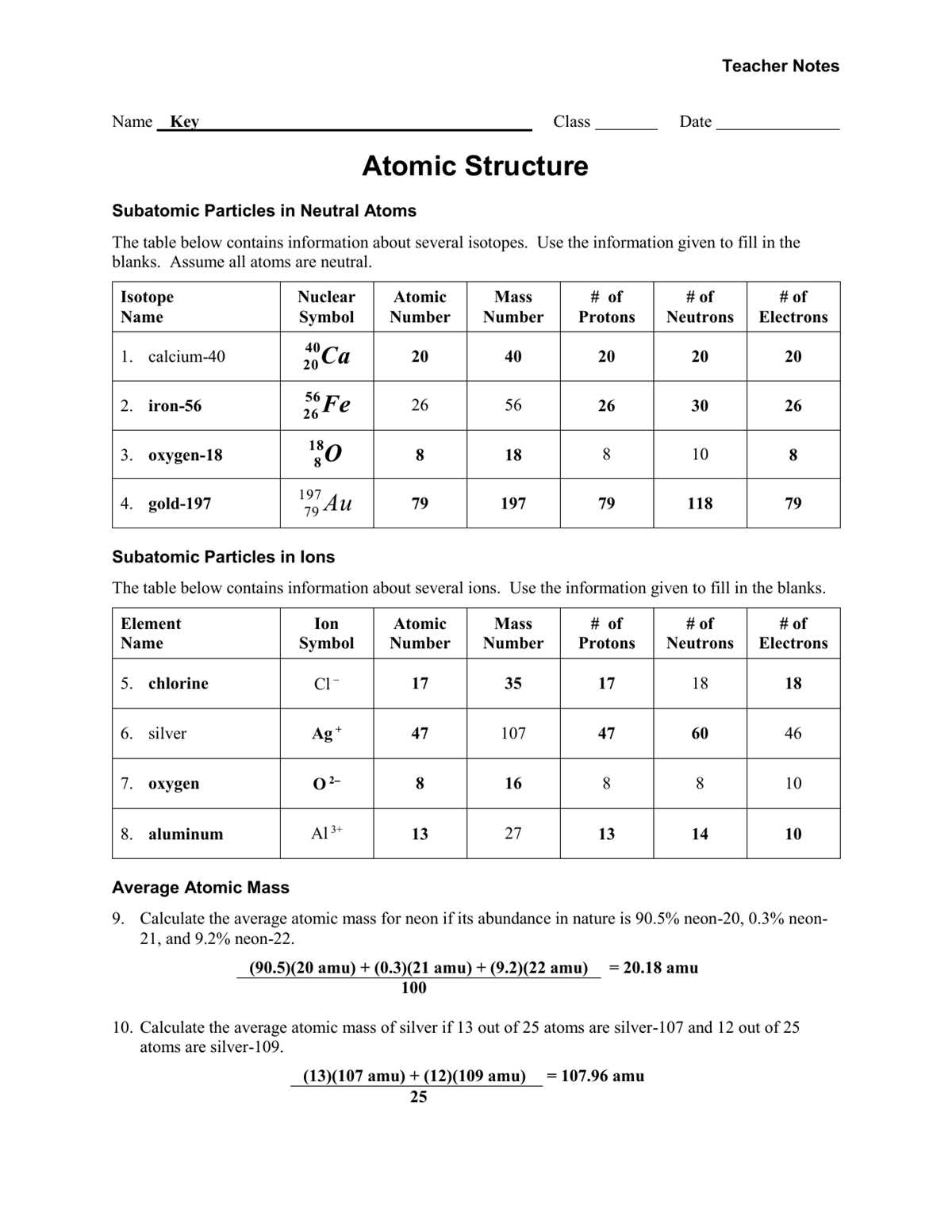
If you’re working through exercises involving subatomic particles, energy levels, and bonding, it’s crucial to focus on understanding how each component of an atom behaves and interacts. Start by reviewing how to identify protons, neutrons, and electrons in various models. This will give you a solid foundation for solving problems related to the periodic table and atomic mass.
Pay particular attention to electron configurations and how they relate to chemical properties. Use periodic trends to anticipate the behavior of elements in different bonding scenarios. Practice identifying the number of valence electrons and how this affects reactivity and molecular formation.
For problems involving isotopes, remember that the number of neutrons can vary while the number of protons stays the same. This will help you determine atomic mass and understand how isotopes influence the physical and chemical properties of elements.
Finally, check your work by verifying the consistency between your answers and the periodic table. Often, errors occur when attempting to balance atomic numbers, charge, or mass numbers. A quick cross-check can save time and prevent misunderstandings in more complex problems.
Chemistry Atomic Structure Worksheet Answer Key
To solve problems related to subatomic particles, begin by clearly identifying the number of protons, neutrons, and electrons in the given elements. Here’s how to approach specific exercises:
- Proton count: The atomic number directly corresponds to the number of protons in the nucleus. Verify this number by checking the element’s position on the periodic table.
- Neutron count: The number of neutrons can be calculated by subtracting the atomic number from the atomic mass. Round the atomic mass to the nearest whole number if necessary.
- Electron count: In a neutral atom, the number of electrons is equal to the number of protons. If the atom is ionized, check the charge and adjust accordingly.
When dealing with electron configurations, follow these steps:
- Start by filling the lowest energy orbitals first, following the Aufbau principle.
- Use Hund’s rule to distribute electrons across degenerate orbitals before pairing them.
- For elements in higher periods, be mindful of the transition between the 3d, 4s, and 4p orbitals, which often lead to exceptions in electron configuration.
For problems involving isotopes, always remember that isotopes of the same element have the same number of protons but a different number of neutrons. This results in different mass numbers. To calculate the mass number, simply add the protons and neutrons together.
- Example: Carbon-12 has 6 protons and 6 neutrons, while Carbon-14 has 6 protons and 8 neutrons.
Finally, check your work by verifying consistency with the periodic table. Ensure that all values match the known properties of the elements you are working with. Double-checking atomic numbers, electron configurations, and isotopic data can help avoid mistakes.
Understanding Atomic Models and Their Components
Begin by recognizing that the model of the atom has evolved significantly over time, each advancement providing greater clarity. Start with the basic concept: the atom consists of a central nucleus, containing positively charged protons and uncharged neutrons, surrounded by negatively charged electrons.
The earliest model, proposed by Dalton, viewed the atom as a solid sphere. Later, Thomson introduced the “plum pudding” model, where electrons were embedded in a positively charged mass. However, this model was soon replaced by Rutherford’s nuclear model, which identified a dense nucleus at the center of the atom, with electrons orbiting around it.
The Bohr model further refined this idea, suggesting that electrons move in fixed orbits or energy levels around the nucleus. These orbits correspond to specific energy levels, with each orbit able to hold a set number of electrons. This model explains how atoms absorb and emit light in discrete amounts, or quanta.
Today, the most widely accepted model is the quantum mechanical model, which treats electrons as existing within regions of probability rather than in fixed orbits. The locations of electrons are described by orbitals, which are areas where an electron is likely to be found. These orbitals are arranged in different energy levels and sublevels (s, p, d, f), each with distinct shapes and capacities.
Understanding the components of the atom–protons, neutrons, and electrons–is key for solving problems involving atomic number, mass number, and isotopes. Remember, the number of protons defines the element, while neutrons and electrons affect the atom’s stability and chemical behavior.
How to Interpret Electron Configurations in Worksheets
To correctly interpret electron configurations, start by understanding the notation used. The electron configuration of an element shows how electrons are distributed across various orbitals. The general format consists of energy levels (n), sublevels (s, p, d, f), and the number of electrons in each sublevel. Follow these steps to accurately analyze electron configurations:
1. Identify the element’s atomic number: This represents the number of electrons in a neutral atom. For example, for oxygen (atomic number 8), the electron configuration will have 8 electrons.
2. Fill orbitals according to energy levels: Electrons fill orbitals starting from the lowest energy level (1s), and follow the Aufbau principle. After the 1s orbital is filled, electrons move to 2s, then 2p, and so on.
3. Use Hund’s rule and Pauli Exclusion Principle: Hund’s rule states that electrons will occupy degenerate orbitals (orbitals of the same energy) singly before pairing up. The Pauli Exclusion Principle ensures no two electrons in the same orbital have the same spin.
Here is an example of electron configuration for elements in the first few periods:
| Element | Electron Configuration |
|---|---|
| Hydrogen (H) | 1s1 |
| Helium (He) | 1s2 |
| Lithium (Li) | 1s2 2s1 |
| Beryllium (Be) | 1s2 2s2 |
| Boron (B) | 1s2 2s2 2p1 |
For transition elements and elements beyond the first two periods, the configuration becomes more complex, requiring attention to the d and f orbitals. Always follow the energy order and note exceptions in the filling of 4s and 3d orbitals, as seen in elements like chromium and copper.
Identifying Key Concepts in Atomic Structure Problems
When working through problems related to subatomic particles, focus on the following core ideas:
- Atomic Number and Protons: The atomic number determines the number of protons in the nucleus. It also equals the number of electrons in a neutral atom. Always start by identifying this number to help you understand the element’s properties.
- Neutrons and Mass Number: The mass number is the sum of protons and neutrons. Subtract the atomic number from the mass number to find the number of neutrons. This is key when dealing with isotopes.
- Electron Configuration: Pay attention to how electrons fill orbitals. Follow the principles of Aufbau, Hund’s rule, and Pauli exclusion to properly distribute electrons across the available orbitals.
- Ions and Charges: For charged atoms, the number of electrons will differ from protons. A positively charged ion (cation) has fewer electrons, while a negatively charged ion (anion) has more. Recognize these differences when solving charge-related problems.
- Isotopes: These are atoms of the same element with different numbers of neutrons. When identifying isotopes, be sure to consider variations in mass number and their impact on chemical and physical properties.
By identifying these key concepts in each problem, you’ll be able to break down complex questions into manageable steps. Ensure you understand the relationships between protons, neutrons, and electrons, as well as how they influence the behavior of elements.
Common Mistakes in Atomic Structure Worksheets and How to Avoid Them
Many errors can occur when solving problems related to subatomic particles and electron configurations. Here are the most frequent mistakes and how to avoid them:
- Confusing Proton and Electron Count: The number of protons in a neutral atom is always equal to the number of electrons. Mistaking these numbers, especially in ions, is common. Double-check the charge to ensure correct electron count.
- Incorrect Neutron Calculation: Neutrons are found by subtracting the atomic number from the mass number. Skipping this step or miscalculating can lead to incorrect results, particularly when working with isotopes.
- Misunderstanding Electron Configuration Order: The order of electron filling can be confusing, especially when dealing with transition elements. Ensure you follow the correct order: 1s, 2s, 2p, 3s, 3p, 4s, 3d, 4p, etc. Double-check the periodic table for exceptions.
- Forgetting to Account for Ion Charges: When dealing with ions, always adjust the number of electrons based on the ion’s charge. A positive charge means the atom has lost electrons, while a negative charge means it has gained electrons.
- Ignoring Orbital Capacity Rules: Each orbital (s, p, d, f) has a specific electron capacity. The s orbital can hold 2 electrons, p can hold 6, d can hold 10, and f can hold 14. Misplacing electrons in orbitals can cause confusion in electron configurations.
By carefully reviewing these common mistakes and following these steps, you can avoid errors and ensure your calculations and reasoning are accurate.
Steps for Balancing Nuclear Equations in Exercises
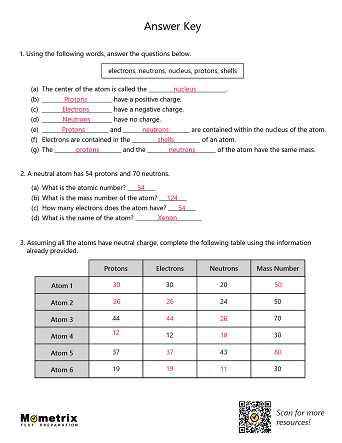
To balance nuclear equations, follow these steps carefully:
- Identify the particles involved: Begin by recognizing the type of radiation or particle emitted (alpha, beta, gamma, etc.) and the elements involved. For example, an alpha particle is denoted as 42He, and a beta particle as 0-1e.
- Check the mass number and atomic number: Ensure that both mass number (total number of protons and neutrons) and atomic number (number of protons) are conserved on both sides of the equation. The sum of mass numbers and atomic numbers must be equal on both sides.
- Balance the mass numbers: The sum of the mass numbers on the left side of the equation must equal the sum on the right side. For example, if an atom emits an alpha particle, subtract 4 from the mass number of the original atom.
- Balance the atomic numbers: The total atomic number must also remain the same. If an alpha particle is emitted (with an atomic number of 2), subtract 2 from the atomic number of the parent atom, resulting in a new element.
- Check for charge balance: Ensure that the charges on both sides of the equation are equal. If there is a positive charge on one side, make sure to account for it on the other side by balancing the emitted particles.
By following these steps, you can correctly balance nuclear reactions, ensuring that both mass and charge are conserved. Always double-check each component before finalizing your solution.
Using the Periodic Table to Solve Atomic Structure Questions
The periodic table is an invaluable tool for solving problems related to subatomic particles and electron configuration. To solve these questions, start by using the table to identify the element based on its atomic number. The atomic number tells you the number of protons in the nucleus and, in a neutral atom, the number of electrons surrounding the nucleus.
Next, determine the element’s position within a given period (row) and group (column). The period tells you the number of electron shells, while the group provides insight into the number of valence electrons, which are crucial for understanding reactivity and bonding behavior.
For example, elements in Group 1 (such as sodium) have one valence electron, while elements in Group 17 (like chlorine) have seven. This pattern helps predict how these elements will interact with others in chemical reactions.
Also, use the table to find the atomic mass. This is useful for calculating the number of neutrons by subtracting the atomic number from the atomic mass (rounded to the nearest whole number).
To understand electron configuration, note the filling order of orbitals. The table’s layout helps identify which orbitals are filled in each period and group, following the Aufbau principle and Hund’s rule.
For detailed information and to refer to an up-to-date version of the periodic table, visit Royal Society of Chemistry’s Periodic Table.
How to Calculate Atomic Mass and Isotopes Correctly
To calculate the atomic mass of an element, follow these steps:
- Find the Isotopes: Identify the isotopes of the element, which have the same number of protons but different numbers of neutrons. This will be key for the mass calculation.
- Note the Mass of Each Isotope: Each isotope has a specific mass, typically close to the number of protons and neutrons it contains. This is often provided in tables or can be calculated based on the isotope’s number of protons and neutrons.
- Use Abundance Percentages: The relative abundance of each isotope (how common it is in nature) must be considered. The percentage is usually given as a decimal (e.g., 75% = 0.75).
- Calculate the Weighted Average: Multiply the mass of each isotope by its relative abundance, then sum the values. This gives the weighted average mass, which is the atomic mass.
Example:
For an element with two isotopes, A and B, where isotope A has a mass of 10 amu and a relative abundance of 60%, and isotope B has a mass of 11 amu with a relative abundance of 40%, the atomic mass would be:
Atomic Mass = (10 amu × 0.60) + (11 amu × 0.40) = 6 amu + 4.4 amu = 10.4 amu
This gives the atomic mass of the element as 10.4 amu. Always check for the specific isotopes and their abundances in problem sets to ensure accurate calculations.
Tips for Reviewing and Double-Checking Worksheet Answers
Start by reviewing the basic details: check that the correct number of protons, neutrons, and electrons are accounted for, based on the element’s atomic number and mass. Miscounts in these basic components are common and often lead to errors in later steps.
Double-check calculations for electron configurations. Ensure that the orbitals are filled in the correct order, and verify that each energy level is properly populated according to the rules (e.g., Hund’s rule, the Aufbau principle).
For problems involving isotopes, ensure that you’ve correctly applied the mass numbers and accounted for relative abundance when calculating the average atomic mass.
Verify that charges on ions are properly handled. If working with ions, ensure the correct number of electrons is subtracted or added based on the ion’s charge. Recheck that the new element or compound makes sense based on the given information.
Finally, take a break before your final review. Coming back with fresh eyes will help spot mistakes that may have been missed during the first pass.