Step by Step Guide to Finding Quartiles with Examples
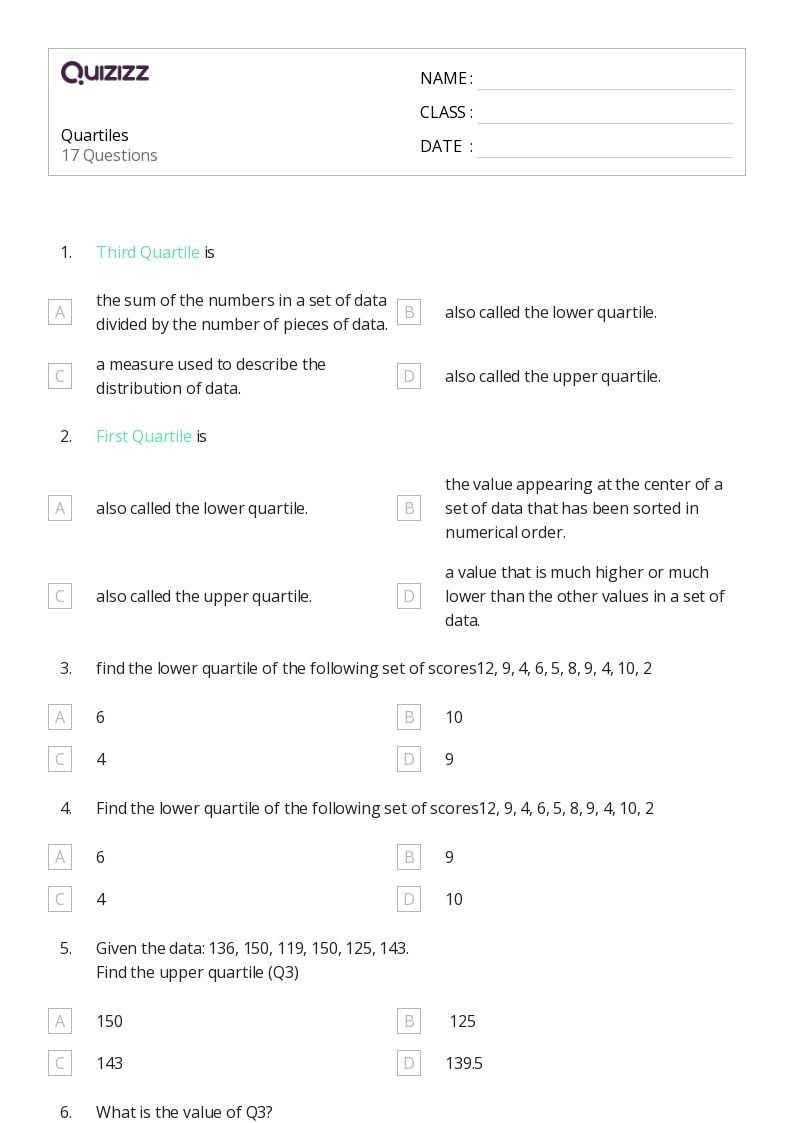
To calculate the divisions of a dataset, start by organizing the numbers in ascending order. This step is crucial because the central points, such as the median, and other group thresholds depend on how the data is sorted. Once sorted, you can easily identify the overall middle point and the other divisions that mark key thresholds of the dataset.
Next, calculate the median, which divides the dataset into two equal halves. For datasets with an odd number of values, the median is simply the middle value. For even-numbered datasets, the median is the average of the two central values. Once the median is found, the data is split into two groups: one below the median and one above it. These two sections will be used to calculate the lower and upper quartiles.
After identifying the median, focus on the two halves of the dataset. The lower half will give you the first division, and the upper half will provide the third division. These are calculated by finding the median of each half. The first division separates the lower 25% of the data, while the third division marks the 75% point, with the middle section of data between the first and third divisions.
Understanding these steps and calculations is crucial for interpreting data distributions. Use these divisions to assess spread, skew, and other important characteristics of a dataset, enabling a deeper analysis of the information.
Calculating Data Divisions Answer Key
To calculate the divisions of a dataset, follow these steps:
- Sort the data in ascending order.
- Find the median (the middle value) of the entire dataset. If there is an even number of data points, calculate the median by averaging the two middle numbers.
- Split the dataset into two halves–below and above the median. These halves are used to find the lower and upper quartiles.
- Find the median of the lower half (this is the first quartile, Q1) and the median of the upper half (this is the third quartile, Q3).
After calculating these values, use them to determine the spread and distribution of the data. The first quartile (Q1) represents the 25th percentile, the median represents the 50th percentile, and the third quartile (Q3) represents the 75th percentile.
To confirm the accuracy of your calculations, you can use resources such as the Khan Academy Statistics & Probability Course for further examples and explanations.
How to Identify Data Divisions in a Set
To identify the divisions in a dataset, first arrange the data in ascending order. Then, follow these steps:
- Find the median of the dataset. This is the middle value, which divides the data into two equal halves. If there is an even number of values, average the two middle values.
- Divide the dataset into two parts: one below the median and one above it. The lower half will be used to calculate the first quartile, and the upper half will be used to calculate the third quartile.
- Calculate the first quartile (Q1), which is the median of the lower half of the data. This value represents the 25th percentile.
- Calculate the third quartile (Q3), which is the median of the upper half of the data. This value represents the 75th percentile.
The quartiles divide the data into four equal parts: the first quartile (Q1), the median (Q2), and the third quartile (Q3). These values help in understanding the distribution of the data.
Step-by-Step Process for Finding Q1 Q2 and Q3
To calculate the values of Q1, Q2, and Q3, follow this method:
- Sort the Data: Arrange the dataset in ascending order. This step is crucial as quartiles are based on the ordered data.
- Find the Median (Q2): Identify the middle value of the dataset. If there is an odd number of values, the median is the middle number. If the dataset has an even number of values, average the two middle numbers.
- Split the Dataset: Divide the data into two halves: one below the median and one above it. If there is an odd number of data points, do not include the median in either half.
- Calculate the First Quartile (Q1): Find the median of the lower half of the dataset. This value represents the first quartile, or the 25th percentile.
- Calculate the Third Quartile (Q3): Find the median of the upper half of the dataset. This value represents the third quartile, or the 75th percentile.
Once you have Q1, Q2, and Q3, you can better understand the spread and distribution of the dataset. These three values help in summarizing the data and identifying outliers.
Understanding the Role of the Median in Quartile Calculation
The median is a key reference point in the process of calculating data spread. It serves as the dividing line that splits a dataset into two equal halves, crucial for determining the first and third percentiles. The median itself is also called Q2 and represents the 50th percentile of the dataset.
In a sorted dataset, the median separates the lower and upper halves. It is essential because:
- Defining the Middle: The median establishes the center of the dataset, from which other quartiles are measured. Without the median, it would be impossible to define Q1 and Q3 accurately.
- Dividing the Data: Once the median is identified, the data set is split into two groups, with the first quartile calculated from the lower half and the third quartile from the upper half.
- Ensuring Consistency: The median helps maintain consistency by ensuring that the distribution of data on either side is balanced, which is essential for accurate percentile calculations.
Without understanding the median’s position and role, quartile calculation would lose its effectiveness in analyzing the spread and identifying potential outliers. The median’s importance lies in its ability to represent the center of the dataset, forming the foundation for calculating the other percentiles.
How to Handle Even and Odd Number of Data Points
When working with a dataset, the method for calculating percentiles depends on whether the number of data points is odd or even.
For an odd number of data points: The median is the middle value in the sorted dataset. Since there is a single middle value, it serves as the central point for calculating the first and third percentiles. After identifying the median, divide the data into two equal halves: the lower half for Q1 and the upper half for Q3.
For an even number of data points: The median is found by averaging the two middle numbers. This results in a midpoint between the two central values, which is used as the reference for dividing the data into two halves. Just like in the case with an odd number of data points, Q1 and Q3 are calculated from the lower and upper halves, respectively.
For both cases, it is critical to accurately identify the median before proceeding with the calculation of the lower and upper quartiles. The difference in methodology for even and odd datasets ensures that the data is divided correctly and proportionally, which is crucial for consistent results.
Using the Interquartile Range (IQR) to Interpret Data
The Interquartile Range (IQR) is a measure of statistical dispersion, which represents the range within which the middle 50% of the data points lie. To calculate the IQR, subtract the first quartile (Q1) from the third quartile (Q3): IQR = Q3 – Q1.
The IQR is useful for understanding the spread of the central data and identifying potential outliers. Any data point that lies more than 1.5 times the IQR above Q3 or below Q1 is considered an outlier. This is calculated as follows:
- Lower bound for outliers: Q1 – 1.5 * IQR
- Upper bound for outliers: Q3 + 1.5 * IQR
By using the IQR, you can efficiently analyze the distribution of the data and determine whether there are extreme values that could skew the results. This helps in interpreting the data more accurately, particularly when dealing with large datasets where outliers may not be immediately obvious.
Common Mistakes When Calculating Quartiles and How to Avoid Them
One common mistake is misidentifying the middle value when the dataset has an odd number of points. This can lead to an incorrect value for the median, which impacts the calculation of both lower and upper quartiles. To avoid this, ensure that you correctly find the median by locating the central value of the ordered dataset, not just selecting a midpoint without considering the number of data points.
Another error occurs when calculating the position of quartiles. Quartiles are based on the ordered data, but people often confuse the method for calculating the exact position of Q1, Q2, and Q3. Remember, when the dataset is even, you need to compute the median of the lower and upper halves of the data separately. For odd datasets, the median should not be included in these halves.
Sometimes, there’s confusion about how to handle ties (identical data points). When multiple data points have the same value, it can affect the calculation of the median or quartiles. Ensure that when you encounter ties, you include them in the appropriate group (lower or upper half) and follow the standard approach for finding medians in each subset.
Another issue arises from improperly interpreting the formula for calculating quartile positions, especially when dealing with large datasets. Many mistake the quartile formula, which involves averaging values at certain positions, for a simple selection of a value in a set order. Double-check the methodology to ensure that the correct calculation method is followed for each quartile.
Using Online Tools to Check Your Quartile Calculations
To verify your calculations, use online calculators that are specifically designed for this purpose. These tools allow you to input your dataset and instantly get the results for all quartiles. Some of the most popular platforms include:
- Calculator.net: This website provides a reliable tool for calculating various statistical measures, including Q1, Q2, and Q3. Simply input your data, and it will display the quartiles and other relevant statistics.
- Desmos: Desmos offers an interactive graphing calculator that can be used to visually verify quartile values by plotting your data set and using their statistical functions.
- MathisFun: A user-friendly site that includes a quartile calculator. It also provides step-by-step instructions to help you better understand how the results are derived.
These tools ensure that you aren’t making errors in manual calculation, especially when working with large datasets. After entering your data, check the output against your own calculations to identify any discrepancies and ensure accuracy.
It’s also important to use multiple tools if needed. If the results from different calculators align, you can be confident that your values are correct. If discrepancies appear, review your manual steps or consult detailed guides for common errors in calculation.
Practical Examples of Quartile Calculation in Real-World Data
Here are a few practical examples of how to calculate the values that divide data into four equal parts:
- Example 1: Exam Scores
Consider the following set of 10 exam scores: 45, 55, 65, 70, 75, 80, 85, 90, 95, 100. To find the values that separate this data into four equal groups:
- Arrange the data in ascending order.
- Identify the median (Q2). In this case, it’s the average of 75 and 80, so Q2 = 77.5.
- Find the first quartile (Q1) by calculating the median of the lower half (45, 55, 65, 70, 75). Here, Q1 = 65.
- Find the third quartile (Q3) by calculating the median of the upper half (80, 85, 90, 95, 100). Here, Q3 = 90.
- Example 2: Monthly Income Data
Suppose you have the following monthly income data for 12 employees (in thousands): 24, 28, 32, 35, 37, 40, 43, 48, 50, 55, 58, 62.
- Arrange the data in ascending order.
- Find Q2 (the median) by averaging the 6th and 7th values: (40 + 43) / 2 = 41.5.
- To find Q1, calculate the median of the lower half (24, 28, 32, 35, 37, 40). Q1 = 33.5.
- To find Q3, calculate the median of the upper half (43, 48, 50, 55, 58, 62). Q3 = 51.5.
- Example 3: Age Data
In a group of 8 people, the following ages are recorded: 12, 18, 22, 26, 29, 31, 35, 40.
- Arrange the data in ascending order.
- Q2 (the median) is the average of 26 and 29: (26 + 29) / 2 = 27.5.
- Q1 is the median of the first half (12, 18, 22, 26), which is the average of 18 and 22: (18 + 22) / 2 = 20.
- Q3 is the median of the second half (29, 31, 35, 40), which is the average of 31 and 35: (31 + 35) / 2 = 33.
By following this method, you can calculate the division points for any dataset. The calculations allow for more accurate interpretation of data distributions and comparisons within datasets. It’s also important to ensure data is sorted before performing these calculations.