Complete Guide to Solving Fractions and Decimals Problems

To master number representation in both parts and whole forms, focus on converting between various forms and applying basic arithmetic operations. This skill is crucial for solving everyday problems and interpreting data accurately.
Begin by recognizing how different expressions can be simplified and manipulated. Knowing how to transform complex representations into simpler forms will save time and increase accuracy in calculations. Start with the basics of dividing a whole into equal portions or expressing parts as whole numbers and fractions.
Once these conversions are understood, practice with real-world scenarios such as budgeting, measurements, or percentages. These skills lay the foundation for more advanced topics like ratios, percentages, and statistical analysis.
Understanding Number Conversion and Simplification
To convert a number from a part-whole form into a decimal, divide the numerator by the denominator. For example, 3/4 becomes 0.75 when divided. Similarly, to convert a decimal into a part-whole form, consider the decimal places. For instance, 0.25 equals 1/4, as it is the same as one-quarter.
For more complex numbers, simplify by identifying the greatest common divisor (GCD) of the numerator and denominator. Reducing a fraction such as 12/16 involves dividing both numbers by 4, resulting in 3/4.
When performing arithmetic operations like addition or subtraction with fractions or decimals, ensure that the denominators match or that the decimal points align. For example, adding 0.5 and 1.25 requires converting 0.5 to 0.50, then performing the addition to get 1.75. For fractions, convert them to have a common denominator before adding or subtracting.
Multiplying fractions involves multiplying the numerators together and the denominators together. For decimals, shift the decimal point to remove the decimal places, perform the multiplication, and then adjust the decimal point in the result.
To divide fractions, multiply by the reciprocal of the divisor. For instance, dividing 1/2 by 1/3 is the same as multiplying 1/2 by 3/1, which results in 3/2. For decimals, convert both numbers to fractions or move the decimal point as needed to simplify the operation.
Converting a Number from Part-Whole Form to Decimal
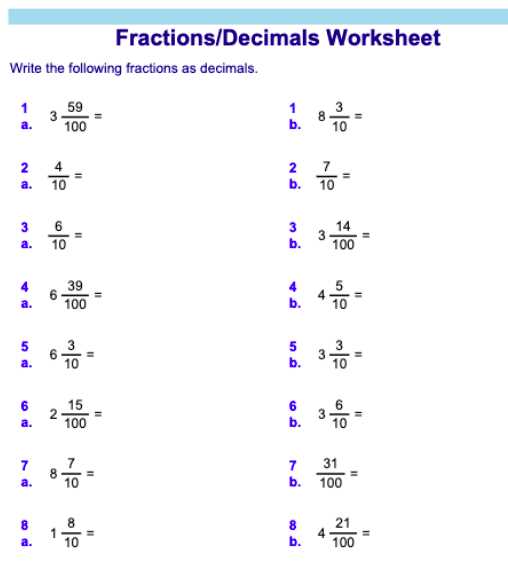
To convert a part-whole number to its decimal form, divide the numerator by the denominator. For instance, to convert 3/4, perform the division 3 ÷ 4, which results in 0.75.
In cases where the denominator is a power of 10 (such as 10, 100, 1000), the conversion is straightforward. For example, 3/100 becomes 0.03, and 25/1000 becomes 0.025.
If the division does not result in a terminating decimal, it may result in a repeating decimal. For instance, 1/3 equals 0.333…, with the digit 3 repeating indefinitely. This can be expressed as 0.3 or 0.(3).
For more complicated numbers, perform long division to determine the decimal. If the decimal doesn’t end, round it to a set number of places for practical use. For example, 22/7 equals 3.142857…, which can be rounded to 3.14 for simplicity in most applications.
In many cases, use a calculator or a software tool for precision when performing these conversions, especially for large numbers or those with long repeating decimals.
Converting a Decimal to Part-Whole Form
To convert a decimal to part-whole form, start by counting the number of decimal places. For example, for 0.75, there are two decimal places. This means you can express the number as 75/100.
Next, simplify the resulting fraction by dividing both the numerator and denominator by their greatest common divisor (GCD). For 75/100, the GCD is 25, so dividing both terms by 25 results in 3/4.
If the decimal has a repeating part, convert the repeating decimal to a fraction using the following method: Let x = the repeating decimal. Multiply both sides of the equation by 10, 100, or more, depending on how many digits repeat. Subtract the original equation from the new equation to eliminate the repeating part and solve for x. For example, for 0.333…:
- Let x = 0.333…
- Multiply by 10: 10x = 3.333…
- Subtract: 10x – x = 3.333… – 0.333… = 3
- Simplify: 9x = 3, so x = 3/9, which simplifies to 1/3.
For terminating decimals, you can easily convert them into a fraction by following the steps outlined. For repeating decimals, a more advanced method involving algebra will yield the correct part-whole form.
Adding and Subtracting Numbers with Different Denominators
To add or subtract numbers with different denominators, you must first find the least common denominator (LCD). The LCD is the smallest number that both denominators can divide into evenly.
Follow these steps:
- Identify the denominators of both numbers.
- Find the least common denominator by determining the least common multiple (LCM) of both denominators.
- Convert both numbers to equivalent values with the LCD as the new denominator. Multiply both the numerator and denominator of each number by the factor needed to get the LCD.
- Once the numbers have the same denominator, add or subtract the numerators. Keep the denominator the same.
- Simplify the result, if necessary, by dividing the numerator and denominator by their greatest common divisor (GCD).
Example 1: Adding 1/4 and 1/6:
- The denominators are 4 and 6. The LCM is 12.
- Convert 1/4 to 3/12 and 1/6 to 2/12.
- Now add the numerators: 3/12 + 2/12 = 5/12.
Example 2: Subtracting 3/8 from 5/6:
- The denominators are 8 and 6. The LCM is 24.
- Convert 5/6 to 20/24 and 3/8 to 9/24.
- Now subtract the numerators: 20/24 – 9/24 = 11/24.
After adding or subtracting, always check if you can simplify the result. This ensures that your final answer is in its simplest form.
Multiplying Numbers with Different Denominators
To multiply two numbers, simply multiply their numerators and denominators separately. For example, for the product of 2/3 and 4/5, multiply the numerators (2 * 4 = 8) and the denominators (3 * 5 = 15), resulting in 8/15.
For multiplying a number with a whole number, express the whole number as a fraction (e.g., 5 as 5/1), then multiply as usual. For instance, multiplying 2/3 by 5 gives (2 * 5 = 10) and (3 * 1 = 3), resulting in 10/3.
When multiplying with a number that includes a decimal point, remove the decimal point by converting the number into a fraction. For example, 0.5 can be written as 1/2. Then follow the multiplication process.
Example 1: Multiplying 3/4 by 5/6:
- Multiply numerators: 3 * 5 = 15
- Multiply denominators: 4 * 6 = 24
- The result is 15/24. Simplify by dividing by 3: 15 ÷ 3 = 5, 24 ÷ 3 = 8. Final result: 5/8.
Example 2: Multiplying 0.75 by 2:
- Write 0.75 as 3/4.
- Multiply: 3 * 2 = 6, 4 * 1 = 4.
- The result is 6/4, which simplifies to 3/2.
Always simplify the result, if possible, to express the number in its simplest form.
Dividing Numbers with Different Denominators
To divide one number by another, first flip (invert) the second number (the divisor) and then multiply. This is called “multiplying by the reciprocal.” For example, dividing 3/4 by 2/5 involves flipping 2/5 to 5/2, then multiplying:
- Multiply numerators: 3 * 5 = 15
- Multiply denominators: 4 * 2 = 8
- The result is 15/8.
If you’re dividing a whole number by a fraction, rewrite the whole number as a fraction with a denominator of 1. For instance, dividing 6 by 1/2 is the same as multiplying 6 by 2/1:
- Multiply: 6 * 2 = 12, 1 * 1 = 1
- The result is 12/1, which simplifies to 12.
For dividing a decimal by a whole number, simply move the decimal point and perform the division as usual. For example, 4.8 ÷ 2 is 2.4.
Example 1: Dividing 1/2 by 1/3:
- Flip 1/3 to 3/1.
- Multiply: 1 * 3 = 3, 2 * 1 = 2.
- The result is 3/2.
Example 2: Dividing 0.8 by 4:
- Convert 0.8 to a fraction: 8/10.
- Flip 4 to 1/4 and multiply: 8 * 1 = 8, 10 * 4 = 40.
- The result is 8/40, which simplifies to 1/5.
Always simplify the result, if possible, to its simplest form. For more detailed guidance on division with different types of numbers, refer to the Khan Academy for step-by-step tutorials.
Simplifying a Ratio to Its Lowest Terms
To reduce a ratio to its simplest form, divide both the numerator and the denominator by their greatest common divisor (GCD). Start by finding the largest number that divides evenly into both the top and bottom numbers. For example:
- If you have 8/12, first find the GCD of 8 and 12, which is 4.
- Divide both the numerator and the denominator by 4: 8 ÷ 4 = 2, 12 ÷ 4 = 3.
- The simplified ratio is 2/3.
For ratios where no common factors exist (such as 5/7), the ratio is already in its simplest form. In cases where the numerator and denominator are both even, you can divide by 2 as the first step, then check again for common factors.
Example 1: Simplifying 18/24:
- The GCD of 18 and 24 is 6.
- Divide both numbers by 6: 18 ÷ 6 = 3, 24 ÷ 6 = 4.
- The simplified ratio is 3/4.
Example 2: Simplifying 15/20:
- The GCD of 15 and 20 is 5.
- Divide both numbers by 5: 15 ÷ 5 = 3, 20 ÷ 5 = 4.
- The simplified ratio is 3/4.
Use prime factorization for larger numbers if necessary. This method involves breaking down each number into its prime factors and dividing out the common factors. Always check your result by multiplying the simplified terms to ensure they match the original ratio.
Understanding Repeating Periodic Values
A repeating value occurs when a particular digit or group of digits continues indefinitely after the decimal point. This happens when a number cannot be expressed exactly as a finite value. For example, 1/3 equals 0.333…, where “3” repeats infinitely.
To convert such a number into a fraction, identify the repeating part and use algebraic methods to solve. For example, consider the repeating value 0.666…. Let x = 0.666…, multiply both sides by 10 to shift the decimal: 10x = 6.666…. Subtract the original equation (x = 0.666…) from this new equation, and solve for x. This will give you x = 2/3.
Common repeating values include:
- 0.333… = 1/3
- 0.666… = 2/3
- 0.142857… = 1/7
For repeating decimals with a non-repeating part followed by a repeating section, such as 0.1(6), where the “6” repeats, treat the non-repeating and repeating parts separately to convert it into a fraction.
Example: Convert 0.1(6) to a fraction:
- Let x = 0.1(6), so x = 0.166666…
- Multiply by 10 to shift the decimal: 10x = 1.666666…
- Now subtract the original equation from this result: 10x – x = 1.666… – 0.166…
- 9x = 1.5, so x = 1.5/9 = 1/6.
Recognizing repeating values can help simplify calculations and provide a more accurate understanding of numbers that do not have a finite decimal representation. Practice recognizing and converting these values into fractions for better clarity.
Applications of Fractions and Decimals in Real-Life Problems
Understanding portions and numerical expressions is key to solving everyday problems, from budgeting to cooking. These concepts are used in a variety of real-life situations where precise calculations are necessary.
For example, when shopping with discounts, a price tag might show an item reduced by 25%. To calculate the sale price, convert 25% to a fraction (1/4), then subtract it from the original price. If the original price is $40, the sale price will be $40 – ($40 × 1/4) = $30.
In cooking, when adjusting recipe quantities, such as halving or doubling, portions are often represented as fractions. If a recipe calls for 3/4 cup of flour, to make half the recipe, you will use 1/4 cup. Similarly, converting units between fractions and decimals helps measure ingredients accurately.
Other practical examples include:
- Budgeting: When dividing a total amount of money into different categories (e.g., rent, groceries), using portions and percentages ensures proper allocation.
- Construction: Calculations for building dimensions, such as cutting a piece of wood to 3.5 feet, often involve decimal equivalents for fractions.
- Finance: Understanding interest rates, like 5% (0.05), and converting them into decimals helps in calculating interest amounts on loans or investments.
By mastering these calculations, you can approach daily tasks with greater confidence, whether determining sale prices, adjusting recipes, or managing financial goals.