Exponent Practice Solutions for Accurate Algebra Skill Building
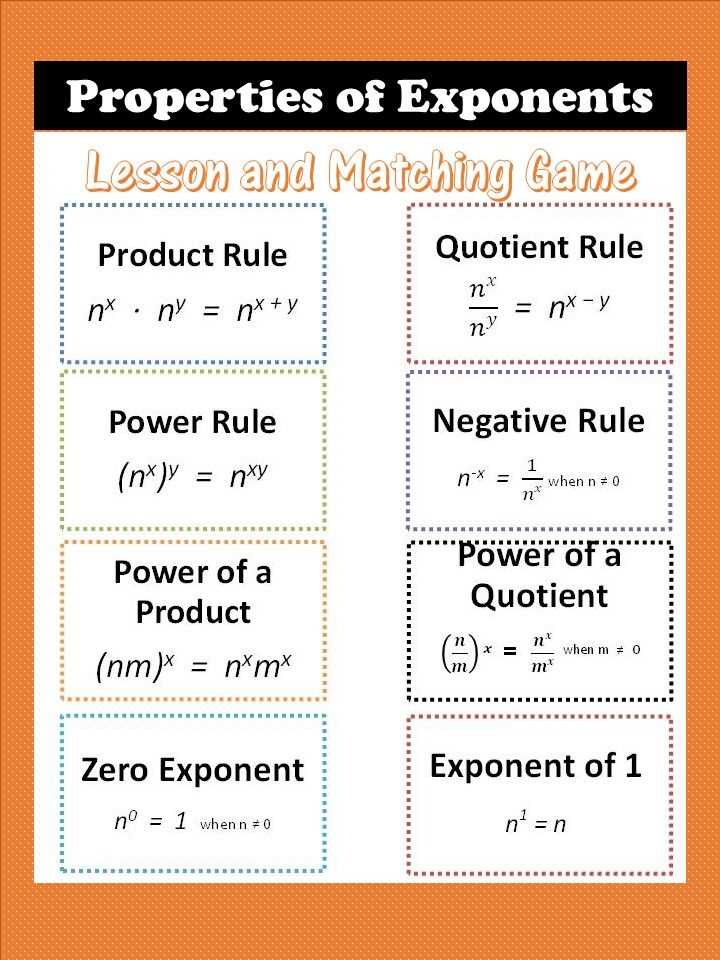
Apply rule-based steps immediately by isolating each power expression before combining terms; this prevents sign confusion and reduces repeated corrections later.
Check coefficients separately to avoid merging bases incorrectly. Treat numerical multipliers and powered variables as distinct elements until all transformations are complete.
Use written checkpoints such as recalculating negative powers, verifying placement of parentheses, and converting fractional powers into root forms to maintain accuracy across multi-step tasks.
Power-Rule Solution Methods and Real-World Use
Apply power rules by separating coefficients, bases, and signs before performing any transformation; this prevents merging unrelated components and reduces rework.
- Convert negative powers into reciprocal form only after confirming the original base is fully simplified.
- Use prime-factor breakdown when multiplying or dividing powered expressions with mismatched bases.
- Rewrite fractional powers as roots to verify whether simplification changes the domain of the expression.
Strengthen accuracy in applied tasks by pairing algebraic rules with contextual checks–such as verifying scale changes in growth models or compound-rate formulas–before finalizing any numeric output.
- Reassess exponent placement in scientific notation to confirm correct magnitude.
- Check unit consistency when powered variables interact with real measurements.
- Test simplified forms with sample values to ensure no sign shifts or structural errors were introduced.
Applying Product and Quotient Rules in Step-Based Problems
Combine matching bases only after confirming that no hidden factors remain; this prevents merging unrelated terms and maintains structural accuracy during transformations.
When using the product rule, check each base for nested powers before adding exponents, since expanded forms often expose simplifiable components that reduce later steps.
For quotient-focused tasks, verify that the numerator and denominator share identical bases before subtracting powers; if they differ, convert one expression through factoring or prime breakdown to align structures.
To avoid sign errors, reevaluate each subtraction step by rewriting the operation vertically–placing higher powers above lower ones–to visually confirm the resulting exponent’s direction.
In mixed problems combining multiplication and division, process multiplication segments first to consolidate like factors, then apply division rules to a minimized expression; this sequencing reduces algebraic clutter and limits misreads.
Correcting Misuse of Zero and Negative Power Rules
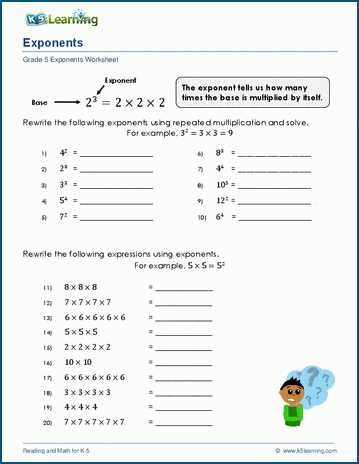
Convert any zero-power expression directly to 1 as long as the base is nonzero; this avoids accidental simplification into the base itself or dropping the term entirely.
For negative powers, move the base to the opposite side of the fraction bar rather than altering the sign of the base. For example, rewrite a⁻³ as 1/a³ without modifying the coefficient attached to the variable.
Before rearranging expressions with mixed signs, isolate numerical factors from variable parts; this separation prevents merging a negative sign with the power rule and creating false inverses.
To verify your steps, compare each transformation with a reliable algebra resource such as Khan Academy: https://www.khanacademy.org/math/algebra
Solving Multi-Step Expressions with Mixed Powers
Combine like bases only after confirming that each power has been simplified to its cleanest form; this prevents stacking operations that mask sign or coefficient errors.
Reorganize each term so that coefficients, bases, and powers are treated as separate units. Apply multiplication or division to coefficients first, then adjust powers using addition or subtraction rules tied to shared bases.
Convert negative powers into reciprocal form before merging terms; this step exposes hidden fractions that often become clearer once rewritten. Avoid rearranging anything until reciprocals are fully resolved.
Use a structured breakdown such as the table below to avoid skipping transformations:
| Step | Action | Example |
|---|---|---|
| 1 | Simplify each power independently | (2a³)(a⁻¹) → 2a³ × a⁻¹ |
| 2 | Convert negative powers to reciprocal form | a⁻¹ → 1/a |
| 3 | Merge powers of identical bases | a³ × a⁻¹ → a² |
| 4 | Combine numerical factors | 2 × a² → 2a² |
Recheck final output by confirming that all negative powers have been resolved, all like bases have been merged once, and no coefficient was altered during reciprocal conversion.
Identifying Errors in Simplification of Fractional Powers
Check whether the root step corresponds to the denominator of the rational index; reversing numerator and denominator produces outputs that deviate sharply from the intended form.
Convert each rational index into radical notation to reveal structural issues. For example, treat (a^{5/3}) as (sqrt[3]{a^5}) and confirm that the root degree matches the denominator.
Inspect base signs before applying roots. A negative value under an even root yields no real result, yet many algebra slips arise from ignoring this restriction.
Ensure that coefficients outside the power are not incorrectly absorbed into the root. A term such as (4x^{2/3}) must remain (4sqrt[3]{x^2}), not (sqrt[3]{4x^2}).
Test the transformed expression with a small numeric substitution. If the computed value differs from the original form’s output, the fractional manipulation was mishandled.
Using Parentheses to Prevent Operation Mistakes
Apply brackets around any base that includes subtraction or negative signs to avoid unintended transformations. Without enclosure, a form like -3^4 becomes -(3^4) instead of (-3)^4.
- Wrap multi-term bases, such as
(2x - 5)^3, to ensure the entire expression receives the power, not only the final term. - Place brackets around fractional bases before applying a power, e.g.,
(3/2)^5, preventing accidental distribution to only the numerator. - Surround polynomial groups before substitution to maintain consistent structure when rewriting or simplifying.
- Identify components that should act as a single unit.
- Add brackets around that unit before applying multiplication, division, or a power.
- Check the rewritten form by substituting a small numeric value to confirm that the output aligns with the intended transformation.
Use nested brackets only when an internal operation affects the outer structure, ensuring that each step preserves the correct hierarchy of operations.
Checking Work Through Equivalent Forms of Expressions
Compare the original form with a transformed version by substituting a small value such as x = 2 or x = -1; matching outputs confirm structural consistency. This approach exposes sign flips, misplaced brackets, or dropped factors.
Strengthen verification by rewriting the same structure in at least two alternative formats:
- Convert repeated multiplication into a condensed power form to verify coefficient accuracy.
- Rewrite roots as powers with fractional indices to confirm alignment between radical notation and symbolic notation.
- Expand grouped terms, then factor them again, checking that both routes return the same outcome.
For multi-variable expressions, test with distinct values such as (x, y) = (3, -2) to avoid false positives caused by zeros. If expressions differ only by a constant factor, adjust by dividing one form by the other; a quotient of 1 confirms equivalence.
Common Pitfalls in Power-of-a-Power Tasks
Multiply the outer and inner indices before altering any coefficients; skipping this step produces inflated or reduced results that look correct only superficially.
Avoid distributing the outer index across added or subtracted terms. The rule applies solely to grouped multiplication. For instance, applying an outer index to (a + b) without expanding first leads to structural errors.
Check for sign mistakes by isolating the base and rewriting the nested form twice: once as a condensed single index and once as repeated multiplication. If both forms disagree, revisit the multiplication of indices.
When negative bases appear, attach brackets deliberately. Without brackets, the sign changes unintentionally, especially with odd or even combined indices.
Verifying Final Results with Substitution Techniques
Insert a simple numerical value such as 2 into both the transformed expression and the original form to confirm that each produces the same output. A mismatch signals an incorrect rearrangement.
Test a second value–preferably one that introduces sign variation, such as -1–to catch hidden inconsistencies caused by omitted brackets or misapplied index rules.
For expressions containing fractional indices, evaluate both forms using a calculator with rational mode enabled. This prevents rounding drift that could mask structural mistakes.
When multiple variables are present, substitute distinct values for each variable rather than using the same number repeatedly. Varying inputs exposes interactions that might otherwise stay hidden.