Step by Step Guide to Factoring Trinomials with Leading Coefficient 1

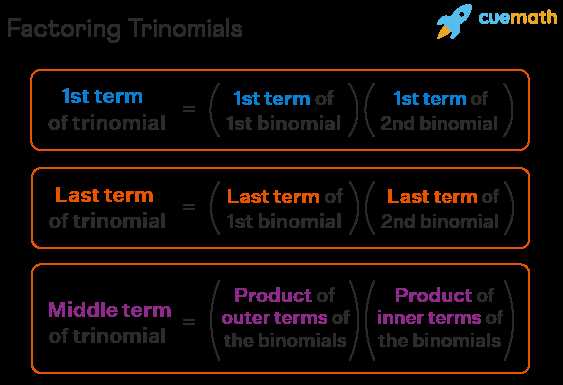
Begin by identifying the structure of the quadratic expression. If the leading coefficient is 1, the expression will be in the form of x² + bx + c. The goal is to rewrite this as the product of two binomials.
To solve this, focus on finding two numbers that multiply to the constant term c and add up to the middle coefficient b. This step is crucial for simplifying the expression into binomials that can be easily expanded back into the original form.
Once you’ve identified the correct pair of numbers, split the middle term and factor out common terms to create two binomial expressions. Always check your result by expanding the factors to ensure that they yield the original quadratic.
By practicing this technique with various examples, you will build fluency in breaking down quadratic expressions, making the process faster and more intuitive. Make sure to test your solutions for accuracy at every step, and review any mistakes to improve your factoring skills.
Breaking Down Quadratic Expressions with Leading Coefficient 1: A Step-by-Step Guide
Start by recognizing that the quadratic expression has the form x² + bx + c. The coefficient of the x² term is 1, which simplifies the process.
The first step is to identify two numbers that multiply to c and add up to b. These numbers will help break down the middle term into two parts, which can be factored into binomials.
Once you have the two numbers, rewrite the middle term bx as a sum of two terms using these numbers. For example, if b = 5 and c = 6, find two numbers that multiply to 6 and add up to 5, which are 2 and 3. Rewrite the expression as x² + 2x + 3x + 6.
Next, group the terms: (x² + 2x) + (3x + 6). Factor out the greatest common factor (GCF) from each group: x(x + 2) + 3(x + 2).
Finally, factor out the common binomial factor (x + 2)>: (x + 2)(x + 3). This is the factored form of the quadratic expression.
Check your result by expanding (x + 2)(x + 3). It should give you the original expression x² + 5x + 6. This confirms the factorization is correct.
Understanding the Structure of a Quadratic Expression with Leading Coefficient 1
A quadratic expression in the form x² + bx + c has three parts: the square term, the linear term, and the constant term. The key feature here is that the coefficient of the x² term is 1, making the factorization process straightforward.
The first term, x², is the square of the variable. It indicates that the equation represents a quadratic relationship between the variable and its coefficients.
The second term, bx, is the linear term. The coefficient b determines the degree of the slope in the graph of the equation. This term is essential for splitting the expression into factors.
The third term, c, is the constant. It shifts the graph of the quadratic function up or down and plays a crucial role in finding the correct factor pairs for the factorization process.
To solve such expressions, you need to identify two numbers that multiply to c and add up to b. These two numbers allow you to rewrite the middle term and then group terms to find the factors.
By understanding how the terms relate to each other, you can break down the quadratic expression into two binomials, making the problem easier to solve.
How to Identify the Two Numbers that Multiply to the Constant
To solve a quadratic expression, the first step is to find two numbers that multiply to give the constant term and add up to the coefficient of the middle term.
Follow these steps:
- Identify the constant term: This is the last number in the expression. For example, in the equation x² + 5x + 6, the constant term is 6.
- Find the factors of the constant term: List the pairs of factors that multiply to give the constant. In the example 6, the factor pairs are (1, 6) and (2, 3).
- Check the sum of the factor pairs: Look for the pair of factors whose sum equals the coefficient of the middle term. In the example x² + 5x + 6, the middle term’s coefficient is 5, and the pair (2, 3) adds up to 5.
- Write the factored form: Use the two numbers to break the middle term into two parts and factor the expression. For example, x² + 5x + 6 becomes (x + 2)(x + 3).
By following this method, you can efficiently identify the correct pair of numbers to factor the quadratic expression.
Using the Sum of the Factors to Split the Middle Term
To split the middle term of a quadratic expression, use the sum of the factors that multiply to the constant term and add up to the coefficient of the middle term. This method is key in simplifying the expression into two binomials.
Follow these steps:
- Identify the constant and middle term coefficients: Start by identifying the constant term (c) and the middle term coefficient (b) in the expression ax² + bx + c. For example, in the expression x² + 7x + 12, the middle term coefficient is 7, and the constant term is 12.
- Find the factor pairs of the constant term: List the factor pairs of the constant term (c). In this case, the factors of 12 are (1, 12), (2, 6), and (3, 4).
- Identify the correct factor pair: Look for the pair whose sum equals the middle term coefficient (b). For x² + 7x + 12, the pair (3, 4) adds up to 7.
- Split the middle term: Rewrite the middle term as the sum of the two factors. In this case, x² + 7x + 12 becomes x² + 3x + 4x + 12.
- Factor by grouping: Group the terms and factor out the greatest common factor (GCF) from each group. For x² + 3x + 4x + 12, group as (x² + 3x) + (4x + 12). Factor each group: x(x + 3) + 4(x + 3).
- Complete the factorization: Factor out the common binomial, (x + 3)>, leaving (x + 3)(x + 4).
For further examples and resources, visit Khan Academy’s Algebra lessons.
Steps to Create Two Binomial Factors from the Expression
1. Start with the quadratic expression in the form ax² + bx + c, where a is 1. For example, consider x² + 7x + 12.
2. Identify the constant term c and the middle term coefficient b. In the example x² + 7x + 12, b = 7 and c = 12.
3. Find two numbers that multiply to c and add up to b. In this case, the numbers 3 and 4 work because 3 × 4 = 12 and 3 + 4 = 7.
4. Split the middle term bx using the two numbers you found. The expression x² + 7x + 12 becomes x² + 3x + 4x + 12.
5. Group the terms in pairs: (x² + 3x) + (4x + 12).
6. Factor out the greatest common factor (GCF) from each pair: x(x + 3) + 4(x + 3).
7. Factor out the common binomial (x + 3)>: (x + 3)(x + 4).
This is the factored form of the original expression x² + 7x + 12.
Common Mistakes to Avoid When Solving Simple Quadratic Expressions
1. Incorrectly Identifying the Two Numbers
Ensure the two numbers you select both multiply to the constant term and add up to the middle term’s coefficient. A common mistake is choosing numbers that only multiply to the constant but do not add to the correct middle term. For example, for x² + 5x + 6, the correct pair is 2 and 3, not 1 and 6, as 1 + 6 = 7, not 5.
2. Forgetting to Group and Factor Properly
After splitting the middle term, always remember to group the terms and factor each group separately. A mistake occurs when terms are not grouped or combined too early, leading to an incorrect factorization. For instance, x² + 7x + 12 should be grouped as (x² + 3x) + (4x + 12).
3. Mistaking the Sign of the Constant Term
Always check the sign of the constant term. If the constant is negative, the numbers you select will have opposite signs. A common error is not adjusting for the negative sign, resulting in an incorrect factorization. For example, for x² – 5x + 6, the numbers should be -2 and -3, not 2 and 3.
4. Skipping the Step of Checking Your Work
After finding the binomial factors, always expand them back out to check the result. Many people skip this step, leading to overlooked mistakes. For example, (x – 2)(x – 3) should expand to x² – 5x + 6. If it doesn’t, recheck your factor pairs.
5. Using Incorrect Factors for Larger Coefficients
When the coefficient of x² is not 1, ensure you’re factoring correctly by identifying the correct multiples. Using the wrong pair for the middle term or constant can lead to incorrect results. For example, 2x² + 7x + 6 requires careful analysis of the factors of 2x² and the constant term to find the correct pair.
Verifying Your Factoring by Expanding the Binomials
To check if the factorization is correct, expand the binomials back out. Multiply each term in the first binomial by each term in the second. For example, if you have (x + 3)(x + 2), you expand as follows:
- x * x = x²
- x * 2 = 2x
- 3 * x = 3x
- 3 * 2 = 6
Combine like terms: x² + 2x + 3x + 6, which simplifies to x² + 5x + 6. If this matches the original expression, the factorization is correct. If it doesn’t match, review the binomial factors and correct the error.
For expressions with negative constants, use the same approach. For example, (x – 4)(x – 5) expands to:
- x * x = x²
- x * -5 = -5x
- -4 * x = -4x
- -4 * -5 = 20
Combine like terms: x² – 5x – 4x + 20, which simplifies to x² – 9x + 20. If this matches the original quadratic expression, the factorization is correct.
Practice Problems to Master Factoring Simple Quadratics
1. Factor the expression: x² + 7x + 10
- Identify two numbers that multiply to 10 and add up to 7.
- Answer: (x + 2)(x + 5)
2. Factor the expression: x² – 5x + 6
- Identify two numbers that multiply to 6 and add up to -5.
- Answer: (x – 2)(x – 3)
3. Factor the expression: x² + 8x + 12
- Identify two numbers that multiply to 12 and add up to 8.
- Answer: (x + 2)(x + 6)
4. Factor the expression: x² – 4x – 12
- Identify two numbers that multiply to -12 and add up to -4.
- Answer: (x – 6)(x + 2)
5. Factor the expression: x² + 3x – 10
- Identify two numbers that multiply to -10 and add up to 3.
- Answer: (x + 5)(x – 2)
To check your work, expand the binomials to confirm that the original expression is recovered. Keep practicing with different expressions to gain confidence and speed in recognizing patterns.
Additional Tips for Factoring Polynomials with Larger Coefficients
1. Use the “ac method” for trinomials where the leading coefficient is greater than 1. Multiply the leading coefficient (a) by the constant term (c), then find two numbers that multiply to ac and add up to the middle term’s coefficient (b).
2. Once you find the two numbers, rewrite the middle term as a sum of two terms using these numbers. This allows you to split the trinomial into four terms, making it easier to factor by grouping.
3. After grouping, factor out the common factors from each group. If done correctly, you should be left with two binomials that can be further factored or simplified.
4. Check your work by expanding the binomials. If you recover the original expression, your factoring is correct.
5. If the expression contains negative numbers, ensure you account for the signs when selecting the pair of numbers that multiply to ac and add up to the middle term’s coefficient.
6. Use trial and error with the larger coefficients if the standard approach doesn’t work. Although this method may seem tedious, it is effective for complex problems.