A Long Walk to Water Study Guide Insights for Plot Themes and Character Tasks
Prioritize close tracking of plot shifts and character decisions, as this approach gives immediate clarity for questions tied to chapter events. Focus on concrete actions taken by Salva and Nya, linking each step to specific outcomes rather than summarizing broad themes.
Strengthen preparation by compiling short lists of pivotal moments–such as separations, resource shortages, group conflicts, and rescue efforts–and pairing each moment with direct textual evidence. This method supports accurate responses across comprehension and analysis tasks.
Improve thematic work by mapping how perseverance, responsibility, and community support develop through repeated challenges in both timelines. Highlight patterns that influence later chapters, especially scenes revealing changes in confidence, fear, or leadership.
Reference Material for the Novel
Prioritize compiling chapter-specific notes that link Salva’s movements, Nya’s routines, and shifts in group dynamics to precise page indicators. This structure supports quick verification during comprehension tasks.
- Create a list of pivotal episodes–attacks, separations, resource scarcity, relocations–and pair each item with short quotations that confirm character motivation.
- Record recurring challenges affecting both timelines, noting how fear, resilience, and cooperation change with each obstacle.
- Track secondary characters by noting their first appearance, their role in assisting or obstructing progress, and the moment their influence peaks.
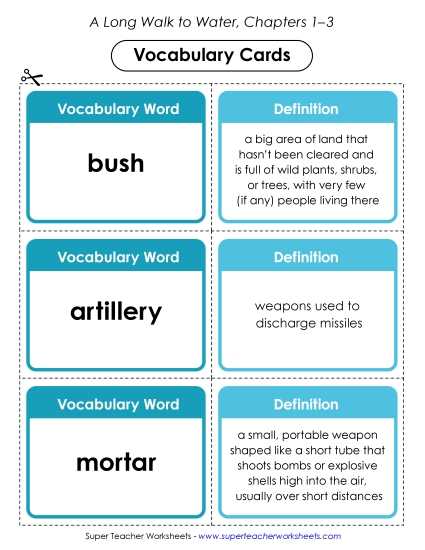
- Build a small glossary of regional terms and geographic references that frequently shape conflict or delay movement.
Strengthen thematic analysis by linking episodes of loss, survival strategy adjustments, and community support to broader moral ideas such as responsibility and persistence. Pair each idea with at least two concrete textual fragments to maintain accuracy.
Clarifying Chapter-Specific Question Requirements
Match each prompt with the exact event it references, ensuring that Salva’s location, companions, and immediate obstacles align with the chapter being assessed.
Focus on precise indicators such as shifts in terrain, new group arrangements, or sudden threats. These details typically form the backbone of comprehension items and eliminate ambiguity.
Verify the timeline by cross-checking the sequencing of Salva’s movement with Nya’s routine. Many questions rely on the contrast between their tasks, so situating each scene within its correct timeframe prevents misinterpretation.
When selecting textual support, use short segments tied to concrete actions–running, gathering, waiting, fleeing–rather than broad commentary. This keeps responses anchored to measurable details present in the chapter.
Identifying Evidence Needed for Text-Based Prompts
Locate short, concrete actions–such as gathering supplies, reacting to danger, or adjusting to group changes–since these moments often supply the most reliable support for task responses.
Prioritize lines that reveal emotional shifts, including fear, relief, frustration, or renewed determination. These signals frequently anchor prompts targeting character motivation or development.
Track recurring obstacles like scarce resources, lost companions, or shifting routes, and link them to cause-and-effect questions. Each obstacle usually corresponds to a specific inference expected by the prompt.
When a task focuses on thematic interpretation, extract brief statements that highlight resilience, responsibility, or community impact. Pair these statements with exact scenes that demonstrate the concept through action rather than commentary.
Tracing Parallel Timelines for Accurate Responses
Align each event by identifying whether it belongs to the earlier survival narrative or the later community-focused narrative; doing so prevents mixing scenes that differ in decade, setting, and character goals.
Verify dates, terrain changes, and shifts in political conflict to place every action in the correct sequence. When tasks require comparison, pair moments that share similar pressures–such as scarcity, displacement, or rebuilding–without merging unrelated plot points.
Highlight markers like age differences, environment descriptions, and the presence or absence of family members to determine which storyline a quoted line supports. This reduces misattribution and sharpens interpretation.
Consult a reliable reference for chapter structure and publication details at https://www.scholastic.com, ensuring consistency when cross-checking timeline cues.
Analyzing Salva’s Motivations in Key Scenes
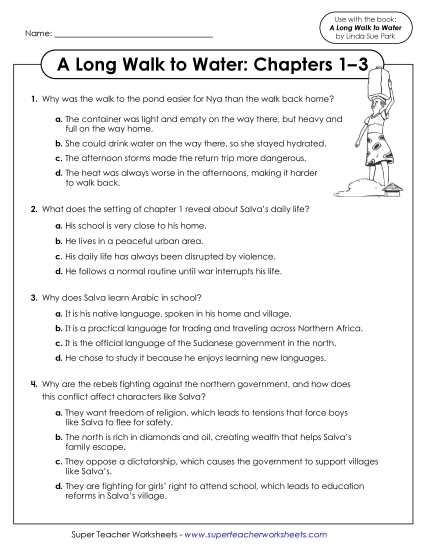
Identify his driving force by linking each decision to immediate pressures such as safety, loyalty to family members, or reliance on supportive groups; this narrows interpretation and prevents attributing choices to vague emotional states.
Track how external threats–armed conflict, separation, resource scarcity–push him toward specific actions. Focus on concrete triggers like loss, guidance from elders, or the need to protect younger companions, avoiding broad psychological labels.
Use character-specific milestones to interpret shifts in his determination. Note how mentorship, memories of home, and responsibility toward others shape his resolve in later chapters.
| Scene | Motivating Factor | Practical Indicator |
|---|---|---|
| Initial displacement | Urgent survival instinct | Choice to follow older peers for protection |
| Crossing hazardous terrain | Commitment to family | Repetition of advice received from parental figures |
| Protecting younger members | Emerging leadership | Offering direction when adults are absent |
| Transition to new environment | Search for continuity | Adapting to unfamiliar routines while preserving cultural ties |
Rely on explicit textual cues–dialogue, internal thoughts, and physical reactions–to justify interpretations of his motivation rather than inserting assumptions unsupported by the narrative.
Interpreting Nya’s Tasks to Support Thematic Responses
Link each of her daily duties to specific thematic claims by tying actions to tangible obstacles such as distance, load management, or time pressure; this grounds interpretation in measurable factors.
Highlight how repeated routines reveal social expectations placed on younger community members, focusing on responsibility distribution, sibling coordination, and risk assessment during solitary routes.
Use her interactions with relatives to map themes of resilience and resource scarcity, prioritizing scenes where she negotiates priorities, adjusts strategies, or responds to unexpected setbacks.
Extract thematic value from her problem-solving choices–tool selection, pacing, or dealing with terrain–by connecting these details to broader ideas like persistence, shared labor, and adaptation.
Explaining Cause-and-Effect Links in Critical Events
Connect each plot shift to a direct trigger such as conflict escalation, resource loss, or group displacement; this prevents vague interpretation and anchors reasoning in explicit narrative actions.
Prioritize scenes where characters alter decisions due to external pressure–ambushes, shortages, or sudden separation–because these provide clear causal chains that support thematic claims.
Track how one setback reshapes subsequent behavior; focus on altered pacing, changes in alliances, or shifts in emotional tone to illustrate behavioral outcomes that stem from specific catalysts.
| Event Catalyst | Immediate Outcome | Subsequent Impact on Character Choices |
|---|---|---|
| Armed confrontation | Forced relocation | New survival strategies and increased vigilance |
| Loss of supplies | Group tension | Redistribution of roles and revised priorities |
| Family separation | Emotional shock | Heightened dependence on peer groups |
| Encounter with aid workers | Access to support | Shift from desperation to structured planning |
Selecting Quotations That Strengthen Written Responses
Choose lines that pinpoint character intent or plot shifts; rely on moments where internal conflict or abrupt external pressure reshapes decisions.
- Use excerpts showing Salva’s resolve during displacement or loss, as these provide measurable emotional and behavioral markers.
- Prioritize Nya’s scenes involving repeated tasks, fatigue, or problem-solving, since these lines reinforce thematic claims about burden, responsibility, and change.
- Select sentences containing concrete actions rather than broad narration; this creates a direct bridge between cited text and analytical commentary.
- Verify that each quotation directly supports the claim made in the paragraph, avoiding lines chosen solely for dramatic sound.
- Locate the specific chapter event tied to your argument.
- Extract the sentence that reflects a turning point, not a summary.
- Connect the citation to a clear behavioral or thematic outcome.
- Remove quotes that repeat information without advancing your point.
Ensure that selected lines reveal stakes, tension, or internal shifts, providing clear textual evidence for interpretation rather than relying on vague description.
Resolving Common Misreadings in Student Assignments
Identify the specific moment where the misunderstanding arises and match it with a verifiable textual cue that corrects the claim.
- Clarify that Salva’s separation from his family is caused by external conflict, not voluntary choice; support this using dialogue showing urgency and forced movement.
- Correct the assumption that Nya’s routine reflects preference; demonstrate through descriptive lines showing strain, repetition, and physical impact.
- Address the mistake of merging both timelines into a single era; highlight explicit year markers and environmental clues that show distinct periods.
- Fix misinterpretations of character intent by citing verbs tied to fear, hesitation, or determination rather than relying on inferred emotion.
- Locate the claim in the assignment that conflicts with textual evidence.
- Quote the exact sentence disproving the misconception.
- Explain how the cited line contradicts or reframes the student’s claim.
- Replace the incorrect inference with a precise reading grounded in character behavior or scene context.
Focus corrections on verifiable actions, timestamps, and explicit narration to prevent speculative interpretations and reinforce accuracy.