Understanding Electron Orbital Activity and Its Impact on Chemistry
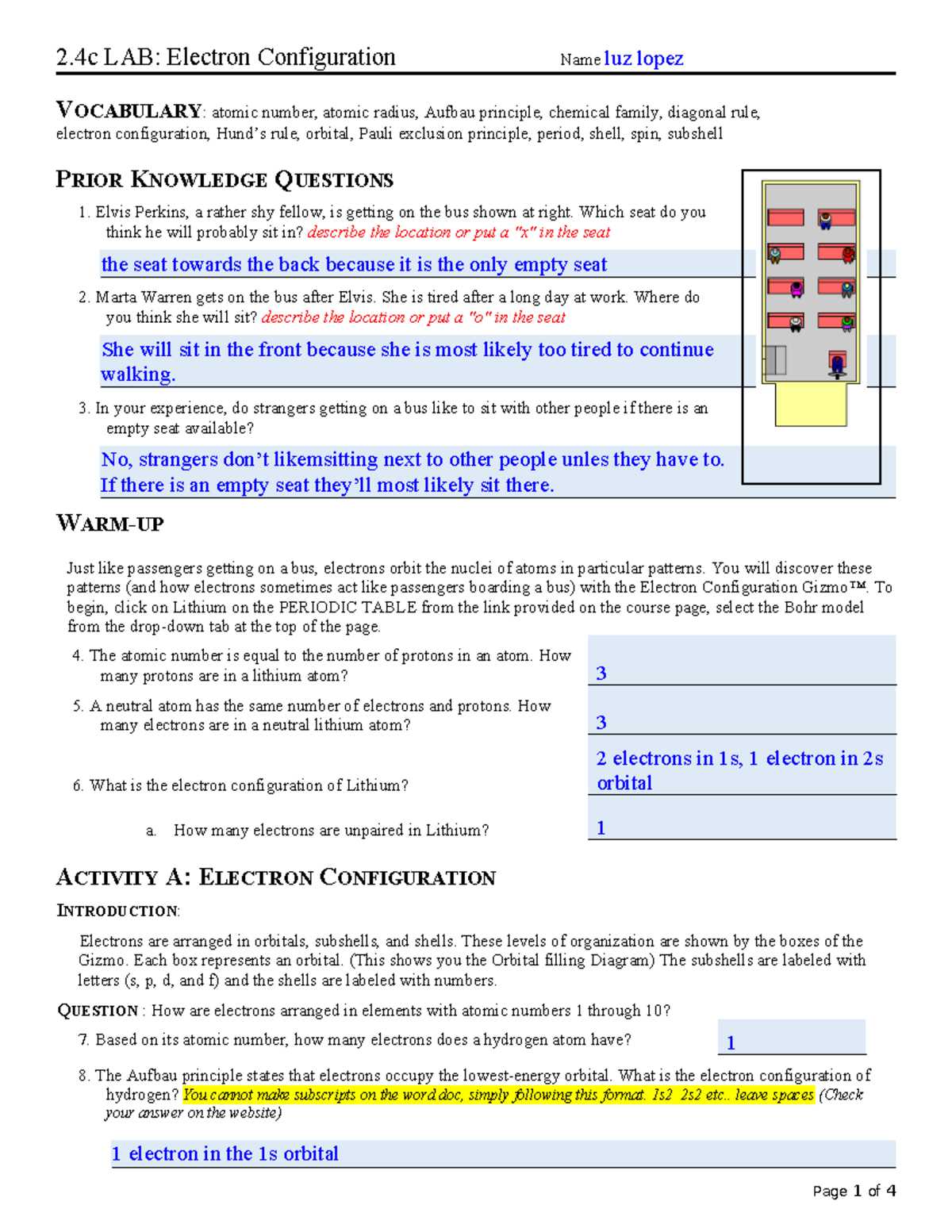
Start by understanding how the structure of atoms influences their behavior. In particular, the arrangement of subatomic particles in specific energy levels plays a key role in determining chemical interactions. This article will guide you through the process of identifying and organizing the arrangements of electrons in atoms, which is critical for mastering concepts like bonding and reactivity.
To properly determine the distribution of electrons in an atom, you must first familiarize yourself with how these particles occupy different regions around the nucleus. These regions, known as orbitals, have specific rules governing their occupancy, which influence the atom’s behavior in various chemical reactions. Mastering these rules will help you solve problems and predict atomic behavior with precision.
By practicing with structured exercises and reviewing the results, you’ll develop a strong understanding of how atomic structure directly affects properties like electronegativity, ionization energy, and more. This guide offers clear steps and methods to efficiently address any related problems, helping you strengthen your grasp on this fundamental concept in chemistry.
Understanding Atomic Electron Configuration
To correctly distribute subatomic particles in their respective regions, start by identifying the principal energy levels, or shells, surrounding the nucleus. Each shell can hold a specific maximum number of electrons. For example, the first shell can hold up to 2 electrons, while the second shell can hold up to 8. Begin by filling the lowest energy level first, and move outward in order of increasing energy.
The arrangement of electrons in these regions determines the chemical properties of an atom. Begin by noting the total number of electrons in the atom. Then, proceed to fill each shell following the 2n² rule, where “n” represents the shell number. After the first few shells are filled, the remaining electrons will fill the outermost shells according to specific orbital rules, including the Pauli exclusion principle and Hund’s rule.
For more complex atoms, consider the role of d and f orbitals. These orbitals are filled after the s and p orbitals, and they play a key role in defining transition metals and their unique properties. Organizing electron configuration in this way allows for a deeper understanding of reactivity, bonding, and atomic stability.
By practicing with examples, you’ll get accustomed to writing configurations and predicting how atoms will behave in chemical reactions. Understanding how electrons are arranged in an atom is fundamental to mastering concepts like periodic trends and molecular interactions.
Understanding the Basics of Electron Orbitals
To understand the behavior of subatomic particles, focus on the concept of electron regions around an atom’s nucleus. These regions, called orbitals, define where electrons are most likely to be found. There are four main types of orbitals: s, p, d, and f, each with different shapes and energy levels.
1. s orbitals: These are spherical in shape and exist in every energy level. The s orbital can hold a maximum of two electrons.
2. p orbitals: These have a dumbbell shape and begin in the second energy level. Each p orbital can hold a maximum of six electrons, with three distinct orientations (px, py, pz).
3. d orbitals: These orbitals have more complex shapes and appear starting from the third energy level. A set of five d orbitals can hold up to 10 electrons.
4. f orbitals: These orbitals have even more complex shapes and are found in the fourth energy level and beyond. There are seven f orbitals, which can hold up to 14 electrons.
Each energy level can contain a specific number of orbitals, and these orbitals fill up in a specific order based on increasing energy. Understanding this order helps predict how atoms bond and interact chemically.
Remember that the number of orbitals and their arrangement determine how atoms form molecules and their chemical properties. The arrangement of electrons in these orbitals directly influences an atom’s reactivity and its place on the periodic table.
Identifying Different Types of Electron Orbitals
Understanding the structure of atom components is vital for determining their chemical behavior. The regions around an atom’s nucleus where electrons are most likely to be found are categorized into different types, each with distinct shapes and capacities. These regions are classified as s, p, d, and f types.
- s Orbitals: These have a spherical shape and are the simplest type. Every energy level has one s orbital. They can hold a maximum of two electrons.
- p Orbitals: Shaped like dumbbells, p orbitals start from the second energy level. There are three p orbitals in each energy level, and they can hold up to six electrons.
- d Orbitals: These have more complex shapes and appear starting from the third energy level. A set of five d orbitals can hold up to 10 electrons.
- f Orbitals: These are found starting from the fourth energy level and have intricate shapes. Seven f orbitals can hold up to 14 electrons.
Each type of orbital has its own unique shape and energy level. The arrangement of these orbitals determines the behavior of electrons in an atom, influencing how atoms interact in bonding and chemical reactions.
It is important to know how to identify and differentiate these orbitals, as they play a crucial role in determining an atom’s properties and its place in the periodic table.
How Electron Configuration Affects Chemical Properties
The arrangement of electrons within an atom plays a significant role in determining its chemical properties. The distribution of electrons across different energy levels and sublevels influences how atoms bond with each other, react with other elements, and form compounds.
Elements with similar electron configurations in their outermost energy level often exhibit similar chemical behavior. For example, the noble gases, which have full outer shells, are chemically inert and rarely form bonds. In contrast, elements like alkali metals have one electron in their outer shell, making them highly reactive as they seek to lose that electron to achieve a stable configuration.
The valence electrons, which are the electrons in the outermost shell, are primarily responsible for the chemical reactivity of an atom. Atoms with fewer valence electrons tend to lose them more easily, resulting in metallic character, while atoms with more valence electrons are more likely to gain electrons, displaying non-metallic behavior.
Additionally, the energy levels at which electrons are located determine the strength of their interaction with other atoms. Electrons in higher energy levels are generally further from the nucleus and less tightly bound, making them more available for chemical reactions.
| Element | Electron Configuration | Chemical Property |
|---|---|---|
| Sodium (Na) | 1s² 2s² 2p⁶ 3s¹ | Highly reactive, readily loses one valence electron to form Na⁺ |
| Chlorine (Cl) | 1s² 2s² 2p⁶ 3s² 3p⁵ | Highly reactive, gains one electron to form Cl⁻ |
| Neon (Ne) | 1s² 2s² 2p⁶ | Inert, full outer shell, does not easily form compounds |
In summary, the configuration of electrons, particularly the number of valence electrons, directly influences how an atom behaves chemically. Understanding these patterns allows chemists to predict the reactivity and bonding characteristics of elements.
Step-by-Step Process of Writing Electron Configurations
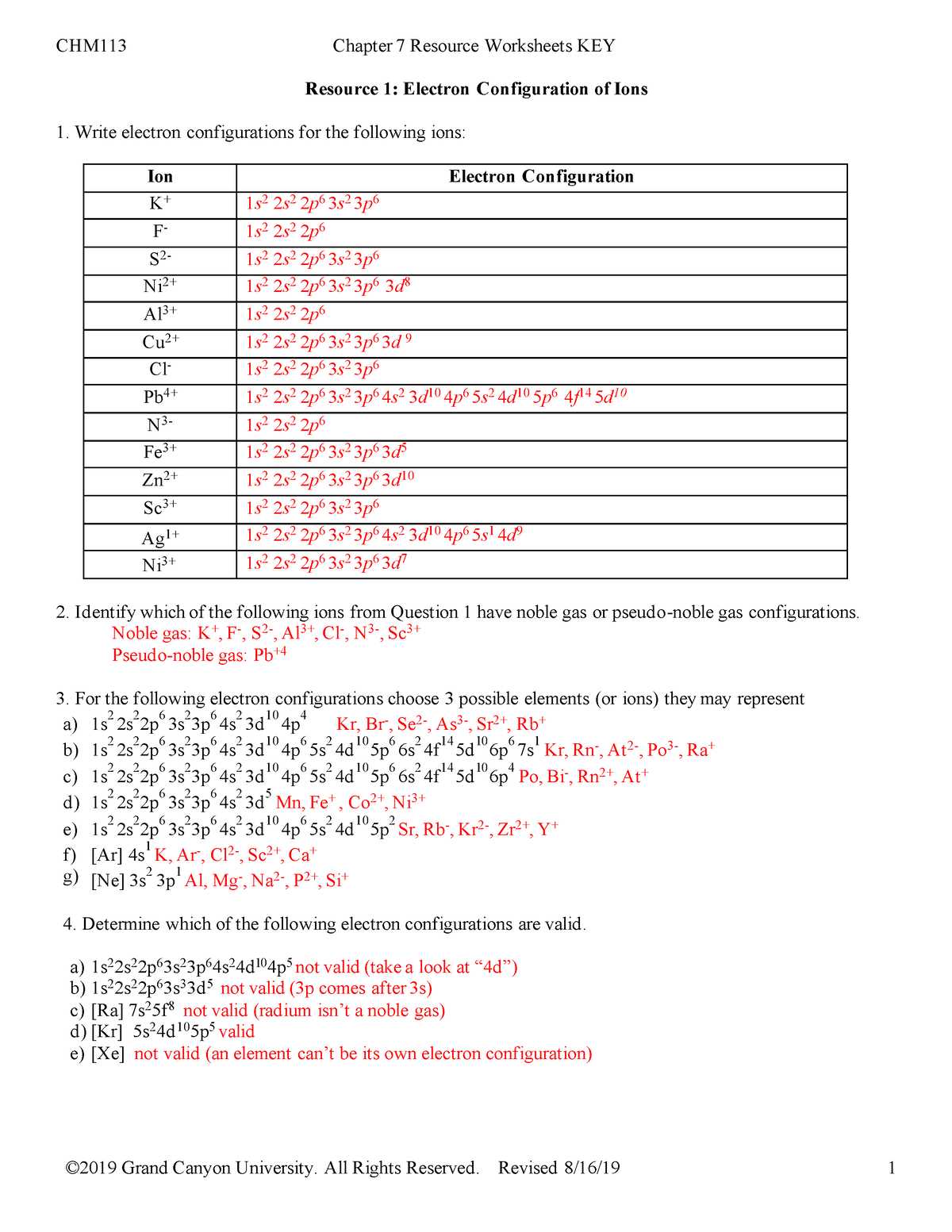
To write an accurate configuration for an atom, follow these steps:
- Identify the atomic number of the element. This represents the number of electrons in a neutral atom.
- Fill the lowest energy levels first. Electrons occupy orbitals in increasing energy order: 1s, 2s, 2p, 3s, 3p, 4s, 3d, 4p, 5s, 4d, 5p, etc. The order follows the Aufbau principle.
- Follow the Pauli exclusion principle. Each orbital can hold a maximum of two electrons with opposite spins.
- Use Hund’s rule to distribute electrons. When placing electrons in orbitals of the same energy (like the three 2p orbitals), place one electron in each before pairing them.
- Account for electron pairs. After filling orbitals with single electrons, pair up the remaining electrons in the available orbitals.
- Check the periodic table. Ensure the number of electrons corresponds to the element’s atomic number. The configuration should end once all electrons are placed correctly.
For example, to write the configuration for Oxygen (atomic number 8):
- Oxygen has 8 electrons.
- Start filling from the lowest energy: 1s², 2s², 2p⁴. This places all 8 electrons in the correct orbitals.
The completed configuration for Oxygen is 1s² 2s² 2p⁴.
Understanding Orbital Diagrams and Their Significance
Orbital diagrams visually represent the distribution of electrons in an atom’s energy levels and sublevels. These diagrams follow the Aufbau principle, Pauli exclusion principle, and Hund’s rule to indicate how electrons occupy orbitals. Each arrow in an orbital diagram represents one electron, with the direction of the arrow indicating its spin (up or down). This visual approach helps to easily grasp the electron configuration and predict the atom’s chemical properties.
The significance of orbital diagrams lies in their ability to:
- Visualize electron distribution: By representing each orbital and electron’s position, these diagrams clearly show how electrons are arranged within an atom.
- Determine chemical reactivity: Electron arrangements in the outermost orbitals, known as valence electrons, play a key role in the atom’s ability to bond with others.
- Predict magnetic properties: The presence of unpaired electrons in certain orbitals can lead to magnetic behavior, such as paramagnetism.
- Understand periodic trends: Orbital diagrams explain trends in ionization energy, electronegativity, and atomic size across periods and groups in the periodic table.
For example, the orbital diagram for Oxygen (atomic number 8) is:
| Sublevel | Electron Configuration |
|---|---|
| 1s | ↑↓ |
| 2s | ↑↓ |
| 2p | ↑↓ ↑ |
This diagram shows two electrons in the 1s sublevel, two electrons in the 2s sublevel, and four electrons in the 2p sublevel, following the appropriate electron distribution rules.
For further detailed reading on orbital diagrams and electron configurations, refer to resources like LibreTexts Chemistry.
Common Mistakes in Interpreting Electron Orbitals
Misinterpreting the arrangement of particles in an atom often leads to errors in understanding its chemical behavior. Some of the most frequent mistakes include:
- Incorrect filling of sublevels: The Aufbau principle dictates that electrons fill the lowest energy sublevel first. Skipping this step or incorrectly filling sublevels can lead to incorrect electron configurations.
- Ignoring Pauli exclusion principle: According to this rule, no two electrons in an atom can have the same set of quantum numbers. Misunderstanding this can result in incorrect placement of electrons, particularly in degenerate orbitals (orbitals of the same energy level).
- Misapplying Hund’s rule: Hund’s rule states that electrons occupy degenerate orbitals (orbitals of equal energy) singly before pairing up. Disregarding this rule can lead to incorrect representation of electron pairing and spin.
- Forgetting electron spin: Each electron has a spin, either up or down. It’s important to correctly represent both spins when placing electrons in orbitals. Omitting or incorrectly assigning spins can lead to confusion in understanding an atom’s magnetic properties.
- Incorrect representation of higher energy orbitals: Higher energy orbitals (e.g., 3d, 4d) are often filled incorrectly due to misunderstanding their relative energy levels compared to other orbitals. For example, the 4s sublevel fills before 3d, which is a common mistake when writing configurations for transition metals.
- Confusing orbital shapes and orientations: Each orbital has a specific shape and orientation in space. Mixing up s, p, d, and f orbitals, and assuming they all have the same shape, can lead to misunderstanding how electrons interact within different atomic regions.
To avoid these mistakes, ensure you understand the rules governing electron placement in atoms, such as the Aufbau principle, Pauli exclusion principle, and Hund’s rule. Familiarize yourself with the shape, orientation, and energy levels of orbitals, as well as the correct sequence for filling orbitals.
Applications of Electron Orbital Theory in Chemical Bonding
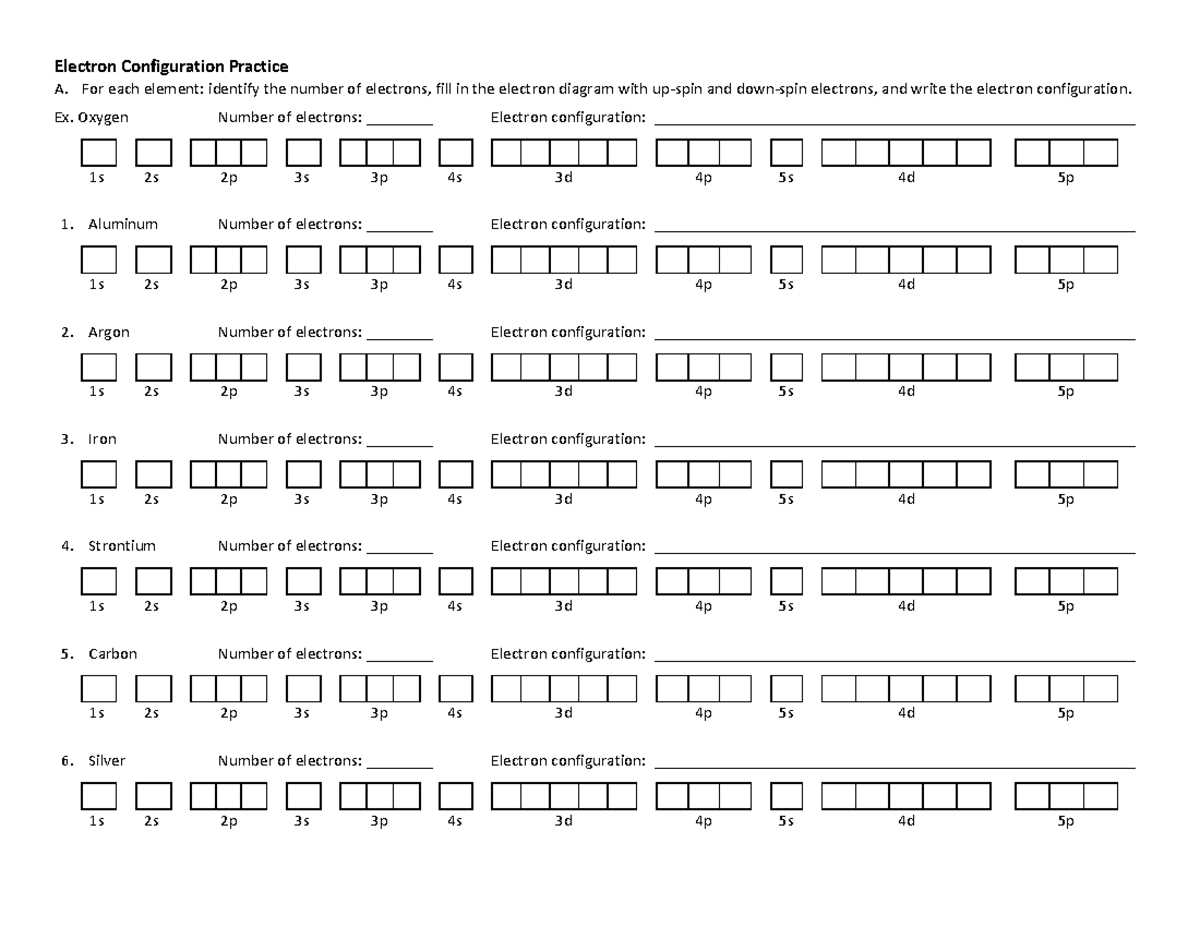
The theory of electron arrangement in atoms plays a central role in understanding how atoms form bonds. It helps explain the following key bonding types:
- Covalent Bonding: This occurs when atoms share electrons. The number of shared electrons is determined by the atom’s ability to fill its outermost shell, which is influenced by its valence shell configuration. For example, the sharing of electrons between two hydrogen atoms forms a covalent bond to complete their electron shells.
- Ionic Bonding: In ionic bonds, electrons are transferred between atoms, typically between a metal and a non-metal. The atom with a low ionization energy donates an electron, while the atom with a high electron affinity accepts the electron. The electron distribution in these atoms can be predicted by examining their valence electron configuration.
- Metallic Bonding: In metals, the electron cloud is shared among many atoms, allowing electrons to move freely. This is known as the “sea of electrons,” which accounts for many properties of metals, such as electrical conductivity and malleability. The distribution of electrons in the metal atoms is essential in explaining these behaviors.
- Hybridization: This concept explains how atomic orbitals mix to form new hybrid orbitals, enabling atoms to form stable bonds. For example, carbon’s sp3 hybridization explains the structure of methane (CH4), where four equivalent bonds are formed by combining one s orbital and three p orbitals.
- Bonding and Anti-Bonding Orbitals: Molecular orbital theory explains how bonding and anti-bonding orbitals form when atoms come together. The bonding orbitals lower the energy of the molecule, while anti-bonding orbitals raise it. This concept is key to understanding the stability of molecules and the types of bonds they form.
By examining electron distributions in atoms, orbital theory provides a framework for predicting how atoms interact during bond formation, which is fundamental in understanding molecular structure and reactivity.
How to Practice and Test Your Knowledge of Electron Orbitals
To strengthen your understanding of atomic structure, follow these steps to practice and test your knowledge:
- Work Through Examples: Start with simple exercises that require identifying the number of sublevels and electron distribution in various elements. Gradually increase complexity by including transition metals and elements with multiple electron configurations.
- Draw Orbital Diagrams: Practice drawing diagrams to represent the placement of electrons in different orbitals. This will help reinforce the concept of electron pairing and the rules governing orbital filling, such as Hund’s Rule and the Pauli Exclusion Principle.
- Memorize the Aufbau Principle: The Aufbau principle outlines the order in which electrons fill orbitals. By memorizing this order, you can predict the electron configurations for any element. Use flashcards or repetition to test yourself on the sequence of orbital filling.
- Use Online Quizzes: Take advantage of online quizzes that test your knowledge of electron configurations. These quizzes often provide immediate feedback, allowing you to identify areas that need improvement.
- Analyze Periodic Table Trends: Observe how electron configurations vary across periods and groups. This helps you understand the periodicity of chemical properties and how they are linked to electron arrangements.
- Apply Concepts to Chemical Bonding: Practice applying orbital theory to predict bonding types and molecular structures. Understanding how electron distributions influence chemical bonds will deepen your comprehension.
- Use Practice Tests: Take practice exams that include problems on electron configurations, orbital diagrams, and related concepts. This will help you gauge your understanding and identify any weak spots in your knowledge.
By consistently practicing these exercises and testing your skills, you will gain a deeper understanding of electron behavior and its impact on chemical properties.