Complete Guide to Solving Phet Radioactive Dating Game Problems
Start by identifying the half-life of the isotopes you’re working with. In the simulation, you will need to adjust the time intervals to match the decay rates accurately. Pay close attention to the number of decayed atoms at each interval, as this will help you calculate the age of the fossil or rock sample.
Use the graph in the simulation to visualize how the isotopes decrease over time. This will allow you to estimate the time it takes for half of the original isotope to decay, which is key for determining the sample’s age. Be aware that the accuracy of your estimate depends on how carefully you monitor the decay process and adjust your time intervals.
For best results, take note of the ratio between the remaining radioactive atoms and the decayed atoms. This ratio provides the foundation for your calculations and ensures that your estimations are based on solid data from the simulation. With practice, you’ll gain a deeper understanding of how radioactive decay can be used to measure the age of ancient materials.
Radioactive Decay Simulation Solution Guide
To successfully determine the age of a sample, start by identifying the correct isotope and its half-life. In the simulation, adjust the time intervals to match the expected decay rate for each isotope. Carefully track the number of remaining parent atoms and compare it to the number of daughter atoms that accumulate over time.
When analyzing the graph, look for the point where half of the original amount of parent atoms has decayed. This is known as the half-life, which is a key measurement in determining the age of the sample. Use this information to estimate the age by calculating the number of half-lives that have passed since the sample formed.
To refine your results, repeat the process multiple times using different samples or isotopes. This helps verify the consistency of your calculations and provides a deeper understanding of how radioactive decay is used to determine geological time scales. Accuracy in timing and proper interpretation of the data are vital for obtaining precise results.
Understanding Decay and Half-Life
Decay occurs when unstable atoms transform into more stable forms by emitting particles or radiation. This process continues until the atom reaches a stable configuration. The time it takes for half of the original amount of a substance to decay is known as the half-life.
The half-life is a constant for each isotope, regardless of the amount of material present. It’s crucial to understand that after one half-life, 50% of the original material will have decayed. After two half-lives, only 25% of the original material remains, and so on.
To calculate the age of a sample, you must track the number of half-lives that have passed. This can be done by comparing the ratio of parent to daughter isotopes in the sample. The more half-lives that have passed, the older the sample is.
How to Start the Radioactive Decay Simulation
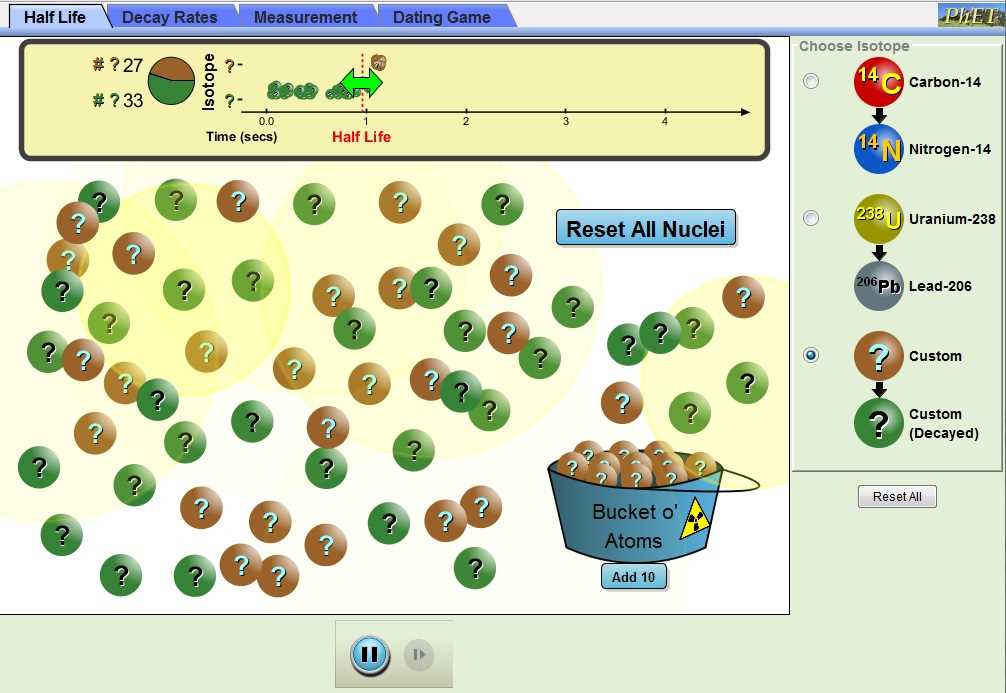
Follow these steps to begin the interactive simulation and explore the concept of decay in materials:
- Visit the website: Open the simulation on a compatible device. Use the official educational platform or a trusted site that hosts the tool.
- Choose your isotope: Select from a variety of unstable elements to observe how they decay over time. Each element behaves differently based on its half-life.
- Set up the environment: Adjust parameters such as the number of atoms, initial conditions, and observation time. This allows for controlled experiments.
- Start the process: Initiate the simulation. Watch the particles decay and note the changes in the sample over time. Track the remaining amount of the original material.
- Interpret the results: Use the data from the simulation to calculate the age of the sample by determining how many half-lives have passed.
This hands-on experience will help you better understand the principles of decay and the application of half-life in dating materials.
Step-by-Step Instructions for Determining Fossil Age
Follow these clear steps to estimate the age of fossils using decay principles and half-life data:
- Choose a fossil sample: Select the fossil you want to analyze. Consider factors such as the type of fossil and its preservation state, which may affect results.
- Identify the isotope used: Choose the appropriate isotope that is present in the fossil, like carbon-14 or uranium-238. Different isotopes have different decay rates.
- Measure the amount of the isotope: Determine how much of the original isotope remains in the fossil. This can be done through laboratory analysis.
- Calculate the number of half-lives: Use the formula or decay curve for the selected isotope to figure out how many half-lives have passed since the organism’s death.
- Determine the age: Multiply the number of half-lives by the duration of each half-life to calculate the age of the fossil.
These steps provide an accurate method to estimate the fossil’s age based on scientific principles of material decay and isotope half-life.
Common Mistakes When Using the Radioactive Decay Simulation
When using a simulation to estimate the age of fossils, users often make several mistakes that can lead to inaccurate results. Here are common errors to avoid:
- Ignoring the Correct Half-Life: Each isotope has a specific half-life, and using the wrong value can lead to incorrect calculations. Double-check the isotope’s half-life before proceeding.
- Misinterpreting the Decay Process: Some may misunderstand how isotopes decay over time. Remember that each half-life reduces the remaining parent isotope by half, not a fixed amount. Ensure you grasp this concept.
- Overlooking Calibration Errors: Ensure the simulation is calibrated correctly. Sometimes, settings in the simulation may be incorrect, causing inaccurate results. Verify the system’s accuracy before starting the calculations.
- Confusing Parent and Daughter Isotopes: Always confirm which isotope is the parent and which is the daughter. Mistakes here can lead to incorrect aging of the fossil.
- Relying on a Single Measurement: Use multiple trials to confirm your results. Relying on one data point from the simulation could introduce error.
By being aware of these common mistakes, you can improve the accuracy of your results when using the simulation. For further reading, visit the official University of Colorado’s Physics Education Simulation page for more resources and updates on simulations.
Interpreting the Results of the Radioactive Decay Simulation
To accurately interpret the results from the decay simulation, follow these steps:
- Check the Remaining Parent Isotope: The amount of remaining parent isotope directly influences the calculated age. If too much parent isotope remains, the fossil is younger; if little remains, the fossil is older.
- Evaluate the Number of Half-Lives: The number of half-lives passed is critical for determining the age. Ensure the simulation shows the exact count of half-lives that have elapsed, as this dictates the age estimate.
- Analyze the Daughter Isotope Percentage: The ratio of daughter isotopes to parent isotopes gives you an estimate of the fossil’s age. A higher daughter isotope percentage indicates more time has passed.
- Compare with Known Results: Cross-reference your results with known data to check for consistency. The calculated age should align with the expected range for fossils of similar type or material.
- Consider Calibration Errors: Double-check for any potential calibration mistakes in the simulation settings. Inaccurate settings can distort the results.
By following these steps, you will be able to properly interpret the simulation’s results and gain a better understanding of fossil ages based on decay rates. Always verify the consistency of your results for more accurate conclusions.
Understanding Isotope Ratios in the Simulation
To accurately assess the age of a sample, focus on the isotope ratios shown in the simulation. These ratios reflect the balance between the parent and daughter isotopes over time. Follow these key points:
- Parent Isotope Decay: The parent isotope steadily decays into its daughter isotope. As time passes, the proportion of parent isotopes decreases, while the daughter isotope increases.
- Half-Life Calculation: The isotope ratio helps determine the number of half-lives that have passed. Each half-life reduces the parent isotope by half, while the daughter isotope doubles.
- Impact on Age Estimate: The ratio between parent and daughter isotopes directly influences the estimated age. A higher proportion of daughter isotopes means the sample is older.
- Constant Decay Rate: The simulation assumes a constant decay rate, so the changes in isotope ratios reflect the passage of time. This provides a clear method to estimate the age of samples based on isotope behavior.
- Track Isotope Shifts: Monitor the gradual shift from parent to daughter isotopes. Understanding this shift will allow you to predict the sample’s age with greater accuracy.
Pay close attention to the isotope ratios and their shifts during the simulation to make informed conclusions about the age of the sample based on the decay patterns.
Tips for Completing the Simulation Quickly and Accurately
To finish the task efficiently, follow these strategies:
- Familiarize with Isotope Behavior: Understand the patterns of parent and daughter isotopes. This will help you quickly recognize trends and predict ages accurately.
- Use the Half-Life Clock: Set the simulation to display the number of half-lives passed. This feature is essential for quick estimation of sample age.
- Prioritize the Ratio: Focus on the ratio between parent and daughter isotopes. A higher daughter isotope ratio signals an older sample.
- Minimize Changes: Only make necessary adjustments to the simulation. Frequent or unnecessary changes can waste time and confuse the results.
- Track Progress: Keep an eye on the timeline to ensure you’re following a logical progression in the decay process. Use the provided tools to help you maintain a steady pace.
- Use the Reset Option: If you make a mistake, reset the simulation and start over rather than trying to adjust incorrect calculations.
- Keep a Mental Note of Decay Rates: Understand the decay rates for different isotopes. This will allow you to quickly estimate the time passed without relying entirely on the simulation’s feedback.
By applying these tips, you can complete the task both quickly and accurately, while ensuring reliable results.
Where to Find Additional Resources for Radioactive Decay Analysis
For a deeper understanding of decay processes and isotopic analysis, consider these reliable resources:
- NASA’s Education Portal: Offers detailed explanations and interactive tools on isotopic analysis and decay processes. Visit NASA Education for relevant materials.
- National Geological Survey: Provides articles, databases, and research papers on geological dating methods. Access their resources at USGS.
- Coursera – Online Courses: Explore free and paid courses on radiometric dating techniques and their applications in various fields. Check available courses on Coursera.
- University of California – Online Materials: UC offers free online resources and lectures on radiometric dating, including detailed notes on isotope behavior. Browse their site at University of California.
- Science Direct: A comprehensive resource for peer-reviewed articles and studies on isotope decay and dating methods. Visit Science Direct for in-depth research.
- Interactive Simulations: Explore additional simulation tools to practice and better understand isotopic decay. Check out platforms such as PhET Interactive Simulations.
These resources provide solid foundations for learning, improving your skills in radiometric analysis, and staying updated with current methodologies.