Understanding Action Potential Conduction and Synaptic Transmission
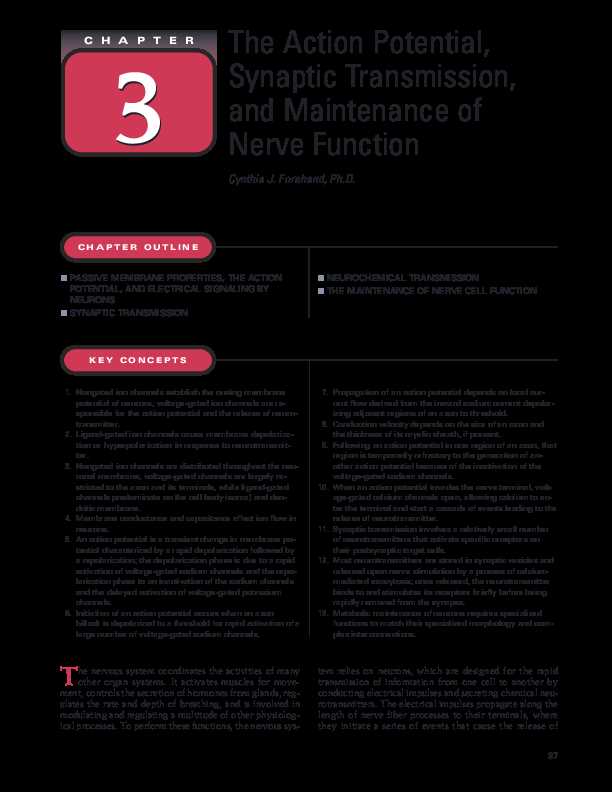
To fully grasp how nerve signals travel throughout the body, it’s important to focus on the role of ion movement and membrane potential shifts. These processes are fundamental in the generation and propagation of electrical signals along nerve fibers. The process begins when a stimulus causes a rapid depolarization of the membrane, triggering a cascade of ion channel activity that drives the signal forward.
Myelin sheaths play a significant role in increasing the speed of signal transmission. By insulating the nerve fibers, these layers of fatty tissue allow the impulses to “jump” between nodes, reducing the time needed to send messages across long distances. This is a critical factor in ensuring the efficiency of the nervous system, especially in systems that require quick responses, such as the reflex arc.
At the synapse, the process shifts from electrical to chemical, with neurotransmitters playing a key role in passing signals between neurons. The release of these chemicals, regulated by the arrival of an electrical signal, ensures that communication between nerve cells remains fast and efficient. Understanding these dynamics is essential for insights into everything from muscle contraction to brain function.
Conduction of Nerve Signals and Neurotransmission
The transmission of nerve signals begins with the depolarization of the neuron’s membrane, which triggers the opening of voltage-gated sodium channels. This rapid influx of sodium ions reverses the charge across the membrane, causing a wave-like effect that travels along the nerve fiber. Once the signal reaches the axon terminal, it triggers the release of chemical messengers, which are essential for the next phase of communication.
Myelination accelerates this process by insulating the axon, allowing the electrical signal to jump between nodes, which significantly increases the speed of transmission. This mechanism is vital in ensuring fast, efficient communication across the nervous system, particularly in long-distance signaling.
At the synapse, the electrical signal is converted into a chemical one. The arrival of the electrical impulse prompts the release of neurotransmitters from vesicles into the synaptic cleft. These molecules then bind to receptors on the post-synaptic neuron, either initiating or inhibiting the transmission of further signals, depending on the type of neurotransmitter involved. This process is fundamental to all neural communication, influencing everything from reflexes to complex cognitive functions.
Understanding the Role of Ion Channels in Signal Transmission
The proper functioning of ion channels is critical for transmitting electrical signals within neurons. These proteins create pathways for ions like sodium, potassium, calcium, and chloride to flow in and out of the cell, allowing the membrane potential to change in a coordinated manner. When a neuron is at rest, sodium and potassium channels remain closed, maintaining a resting membrane potential.
Upon stimulation, sodium channels open, allowing Na+ ions to flood into the cell. This influx depolarizes the membrane, reversing its charge and initiating the propagation of the signal. Once the peak of depolarization is reached, potassium channels open, allowing K+ ions to exit the cell. This repolarization phase restores the membrane potential back to its resting state.
Additionally, calcium channels play a significant role at the axon terminal, where they trigger the release of neurotransmitters from synaptic vesicles. This allows for the transmission of signals to the next neuron. The precise timing and regulation of these ion channels ensure that nerve impulses are transmitted efficiently and without delay, facilitating rapid communication throughout the nervous system.
How Myelination Affects Nerve Signal Transmission
Myelination significantly speeds up the transmission of electrical impulses along nerve fibers. This insulating layer, composed of lipid-rich cells, wraps around the axons of neurons, reducing the loss of electrical charge and preventing the signal from weakening. The myelin sheath allows for rapid signal propagation by forcing the impulse to jump between gaps in the sheath, known as nodes of Ranvier, through a process called saltatory conduction.
Without myelin, signals would travel much more slowly, reducing the efficiency of communication within the nervous system. In diseases like multiple sclerosis, where myelin is damaged, the transmission of impulses is disrupted, leading to slower reactions and impaired motor functions. Therefore, myelination plays a critical role in ensuring fast, coordinated responses within the body, especially for functions requiring quick reflexes, like muscle movement and sensory perception.
The Process of Synaptic Transmission at Chemical Synapses
At chemical junctions between neurons, the transmission of electrical signals involves several key steps. When an electrical impulse reaches the end of a neuron (the presynaptic terminal), it triggers the opening of voltage-gated calcium channels. Calcium ions flow into the neuron, initiating the fusion of neurotransmitter-filled vesicles with the presynaptic membrane.
These neurotransmitters are released into the synaptic cleft and bind to receptors on the postsynaptic neuron. This binding leads to the opening of ion channels in the postsynaptic membrane, causing a change in the membrane potential. Depending on the type of neurotransmitter and receptor, this can either excite or inhibit the postsynaptic neuron. If the signal is excitatory and reaches a certain threshold, it can trigger a new electrical impulse in the receiving neuron, continuing the signal transmission.
After neurotransmitters bind to receptors, they are quickly removed or broken down by enzymes, ensuring the signal does not persist longer than necessary. This precise regulation is vital for maintaining proper communication between neurons and coordinating complex nervous system functions.
Examining the Mechanism of Depolarization and Repolarization
Depolarization begins when the membrane potential becomes more positive, typically due to the opening of sodium (Na+) channels. When these channels open, sodium ions rush into the cell, driven by both concentration and electrical gradients. This influx of positive charge causes the inside of the cell to become less negative, eventually reaching the threshold for triggering a full depolarization.
Once the membrane reaches its peak depolarization, sodium channels close and potassium (K+) channels open. Potassium ions then move out of the cell, which leads to the repolarization phase. The efflux of K+ ions restores the negative charge inside the cell, returning the membrane potential to its resting state.
During repolarization, the sodium-potassium pump plays a key role in restoring the resting membrane potential by actively transporting sodium out of the cell and potassium back in. This process ensures the neuron is ready for the next signal transmission. The sequence of depolarization followed by repolarization is critical for proper nerve signal transmission and coordination.
How Synaptic Vesicles Release Neurotransmitters
Neurotransmitter release begins when an electrical signal travels down a neuron to the axon terminal, where voltage-gated calcium (Ca2+) channels open. The influx of calcium ions into the terminal triggers synaptic vesicles, which contain neurotransmitters, to move towards the cell membrane.
Once the vesicles reach the membrane, they fuse with it through a process known as exocytosis. This fusion is facilitated by specialized proteins, including SNAREs, which help the vesicle merge with the membrane. As the vesicle merges with the membrane, neurotransmitters are released into the synaptic cleft.
The neurotransmitters then bind to receptors on the postsynaptic membrane of the adjacent neuron, causing a change in the postsynaptic cell’s membrane potential. This process allows the signal to continue transmitting across the neural pathway.
Investigating the Differences Between Electrical and Chemical Synapses
Electrical junctions transmit signals directly between cells through gap junctions. These channels allow ions to flow freely, enabling rapid signal transmission without delay. This method is faster but less flexible than chemical communication.
Chemical junctions involve neurotransmitters. When an electrical signal reaches the terminal of one cell, it triggers the release of neurotransmitters into the synaptic cleft. These molecules bind to receptors on the next cell, triggering a response. This process takes more time but offers greater versatility in signal modulation.
- Speed: Electrical connections are faster due to direct ion flow, while chemical signals take longer as they depend on neurotransmitter release and receptor binding.
- Flexibility: Chemical signaling allows for greater modulation and control over responses, unlike the simpler electrical communication.
- Directionality: Electrical connections can transmit signals in both directions, while chemical connections are typically unidirectional, moving from presynaptic to postsynaptic cells.
- Location: Electrical connections are common in tissues requiring rapid responses, like heart muscle, while chemical signaling is more typical in the nervous system, where complex signaling is needed.
The Impact of Action Potentials on Synaptic Plasticity
The process of signal transmission through nerve fibers significantly influences synaptic strength and adaptability. Repeated depolarization can lead to long-term potentiation (LTP), where the connection between neurons is strengthened. This process plays a vital role in learning and memory formation.
On the contrary, prolonged inhibition or underuse of neurons may result in long-term depression (LTD), which weakens the synaptic connection. This form of plasticity is crucial for fine-tuning neural networks and removing ineffective connections.
| Effect | Mechanism | Outcome |
|---|---|---|
| Long-Term Potentiation (LTP) | Repeated depolarization leads to increased calcium influx, activating pathways that enhance synaptic strength. | Increased synaptic transmission, stronger neural connections, and improved signal efficiency. |
| Long-Term Depression (LTD) | Weak or infrequent signals reduce calcium influx, activating pathways that decrease synaptic strength. | Weakened neural connections, reduced efficiency of signal transmission, and potential pruning of unused pathways. |
Understanding these mechanisms helps in explaining how the brain adapts and changes in response to stimuli, making these processes foundational to cognitive functions.
Key Factors Influencing the Speed of Nerve Impulse Conduction
The rate at which nerve signals are transmitted is influenced by several factors that determine how quickly the electrical impulse travels along the neuron. These factors include:
- Axon Diameter: Larger-diameter fibers offer less resistance to the flow of ions, allowing faster transmission. Wider axons have a larger surface area for ion exchange, leading to more efficient signal propagation.
- Myelination: The presence of myelin, a fatty layer surrounding the axon, significantly speeds up signal transmission. Myelin acts as insulation, preventing ion leakage and promoting saltatory conduction, where impulses jump between nodes of Ranvier.
- Temperature: Higher temperatures generally increase the speed of nerve impulse conduction. This is due to the increased kinetic energy of ions, which accelerates the movement of electrical signals along the axon.
- Ion Channel Functionality: The density and function of ion channels in the axonal membrane directly affect how quickly an action potential can be initiated and propagated. Any dysfunction in these channels can delay signal transmission.
Understanding these factors is crucial for comprehending how neural communication works in different physiological conditions. For further details, consult reputable neuroscience sources such as NCBI.