Solutions and Explanations for Chapter 5 Exponential and Logarithmic Functions
Start by reviewing the key rules that govern the behavior of growth and decay models. Understanding the differences between continuous and discrete changes in variables will guide you in solving real-world problems related to population growth or radioactive decay.
Ensure you grasp how to transform equations to make them easier to solve. Simplifying equations using logarithmic properties or applying the inverse relationship between logarithms and exponents is crucial for solving these types of problems quickly.
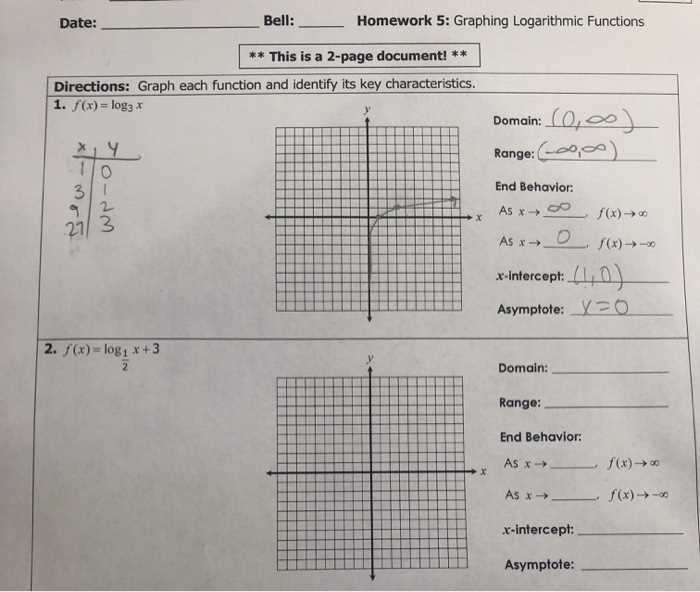
Next, practice graphing. A visual representation can help you spot patterns and understand the underlying behavior of the equations. Focus on key aspects such as intercepts, asymptotes, and rates of change.
Remember, consistency is key. Approach each problem systematically by breaking down complex equations into manageable steps. Refer to the guidelines for handling equations involving powers and roots, which will help you avoid common errors and improve your accuracy.
Solutions Guide for Exponential and Logarithmic Problems
To solve equations involving powers, start by isolating the variable. If you encounter a base raised to a power, take the logarithm of both sides to simplify the equation. This step will allow you to solve for the unknown more easily.
For problems involving growth or decay, identify the initial amount and the rate of change. Apply the appropriate formula, remembering to adjust for continuous or discrete compounding. Converting between different forms of expressions can help with clarity and reduce errors.
When working with inverse relationships, keep in mind the fundamental rule: logarithms and exponents are inverse operations. Use this property to transform equations into solvable forms, ensuring that you are applying the correct log base (e.g., natural log or base 10).
Graphing can provide insight into the behavior of your equations. Pay attention to key features like asymptotes, intercepts, and growth/decay rates. This visual approach can help you verify your solutions and detect any discrepancies in your work.
To double-check your solutions, substitute the results back into the original equation. This practice helps confirm that your solution is valid and minimizes the risk of calculation errors.
Understanding Growth and Decay Problems
For problems involving population growth or radioactive decay, use the formula P(t) = P0 * e^(kt), where P(t) is the amount at time t, P0 is the initial value, e is Euler’s number, and k is the growth or decay constant. Positive k values indicate growth, while negative k values indicate decay.
First, identify the given values: the initial amount, the growth or decay rate, and the time period. Once these are known, substitute them into the formula to solve for the unknown variable, such as the amount after a certain period of time or the rate constant.
If you’re working with half-life or doubling time, adjust the formula to reflect these specific cases. For instance, the formula for half-life is t(1/2) = ln(2)/k, which helps find the time required for half of the substance to decay.
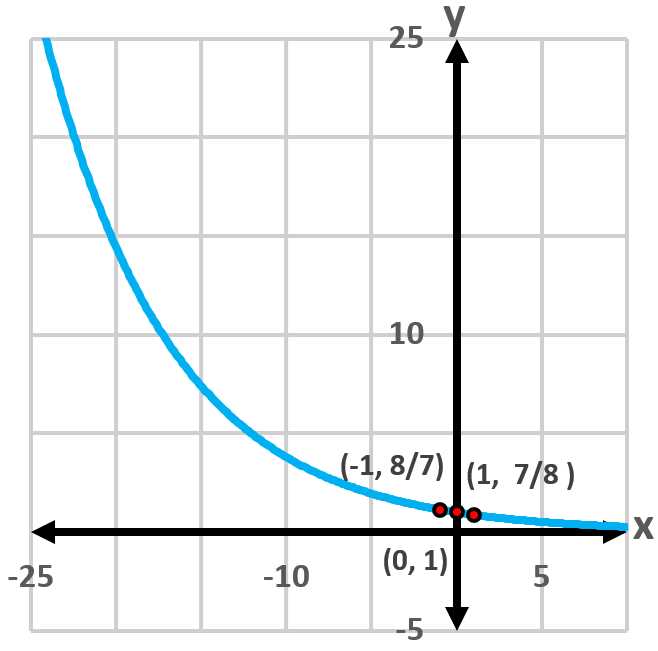
Graphing these problems will help you visualize the curve of growth or decay. Exponential growth curves rise sharply, while decay curves flatten over time. Be sure to label key features, such as intercepts and asymptotes, to understand the behavior of the model.
Lastly, check your solutions by substituting the results back into the original equation. This will confirm that the calculated values match the expected outcome based on the problem’s context.
Solving Logarithmic Equations Step-by-Step
To solve equations involving logarithms, start by isolating the logarithmic expression on one side. For example, in an equation like log(x) = 3, you can rewrite it as x = 10^3 by using the property of logarithms that states log_b(a) = c implies a = b^c.
If the equation has more than one logarithmic term, use logarithmic properties to combine them. For instance, log(a) + log(b) = log(ab) can be used to combine terms. Similarly, log(a) – log(b) = log(a/b) can simplify the expression.
Once the equation is simplified, convert it to an exponential form to solve for the unknown. For example, log(x) = 2 becomes x = 10^2.
In cases where the logarithmic equation contains a variable inside the logarithm, such as log(x + 2) = 3, first rewrite the equation as an exponential: x + 2 = 10^3, then solve for x.
After finding the solution, check for extraneous solutions by substituting the result back into the original equation. Remember, logarithms are only defined for positive values inside the log, so any solution that results in a negative or zero value should be discarded.
Graphing Exponential Functions: Key Concepts and Techniques
To graph equations like y = a^x, identify key components first: the base a, which determines whether the graph grows or decays, and the constant b if included. For example, with a > 1, the graph will rise steeply from left to right, while if 0 , the graph will decrease as it moves right.
Plot the horizontal asymptote, which is typically y = 0 for most exponential functions. This represents the line the graph approaches but never crosses as x tends to negative infinity.
Next, determine a few values of x and plot corresponding y values. Commonly used values for x include -1, 0, 1, which will help reveal the shape of the curve. For instance, with y = 2^x, plotting x = -1, x = 0, and x = 1 gives y = 0.5, 1, 2 respectively.
For transformations, identify shifts and stretches. A function like y = a^(x – h) + k involves a horizontal shift by h units and a vertical shift by k units. If k > 0, shift the graph up; if k , shift it down.
Lastly, note that exponential graphs have rapid growth or decay rates. For quick graphing, make use of the fact that exponential growth rapidly increases for positive x values, and similarly, for negative x, the graph approaches zero.
Exploring Logarithmic Properties for Simplification
To simplify logarithmic expressions, start by applying key properties that help break down complex terms:
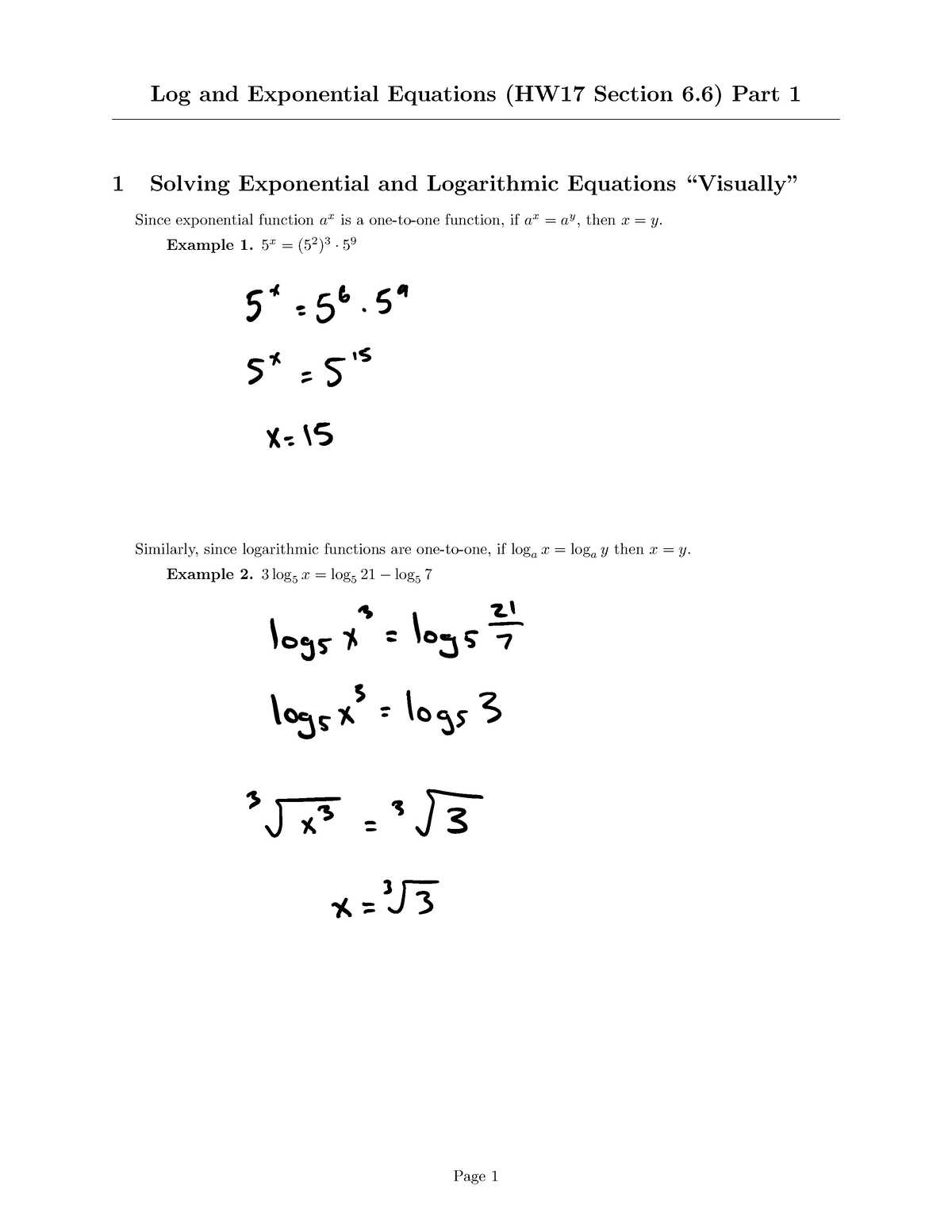
- Product Rule: log_b(xy) = log_b(x) + log_b(y) – This property allows you to separate a logarithm of a product into a sum of two logarithms.
- Quotient Rule: log_b(x/y) = log_b(x) – log_b(y) – Use this rule to express the division of two terms as the difference of their individual logarithms.
- Power Rule: log_b(x^n) = n * log_b(x) – This is helpful for handling exponents inside logarithms by bringing the exponent outside as a multiplier.
- Change of Base Formula: log_b(x) = log_c(x) / log_c(b) – This allows you to convert logarithms to a different base, useful when you want to use base 10 or base e.
For example, to simplify log_2(8) + log_2(4), apply the product rule:
- log_2(8) + log_2(4) = log_2(8 * 4) = log_2(32)
- Then, calculate log_2(32), which is equal to 5 because 32 = 2^5.
Understanding these rules will help you simplify more complex logarithmic expressions, leading to more manageable problems. For further exploration, refer to reputable resources like Khan Academy.
Real-World Applications of Exponential and Logarithmic Functions
Exponential growth models are commonly used to represent populations, financial investments, and the spread of diseases. For example, if a population of bacteria doubles every hour, its size over time can be modeled by an exponential equation like N(t) = N_0 * e^(kt), where k is the growth rate constant.
Similarly, logarithms are used to calculate the magnitude of earthquakes on the Richter scale. The scale uses a logarithmic function to express the difference in amplitude between two earthquake events. For example, a magnitude 7 earthquake releases 10 times more energy than a magnitude 6 earthquake.
In finance, the compound interest formula A = P(1 + r/n)^(nt) uses an exponential model to determine the amount of money accrued over time. Logarithmic functions are employed to solve for time or interest rates in these types of problems.
Logarithms also have practical uses in signal processing and acoustics. The decibel scale, which measures sound intensity, is logarithmic. A 10 decibel increase represents a tenfold increase in the intensity of the sound.
These are just a few examples of how powerful mathematical models based on growth and decay equations can describe a wide variety of real-world phenomena.
Common Mistakes in Exponential and Logarithmic Problems
Many students make errors when working with growth and decay problems. A frequent mistake is misapplying the properties of exponents and logs, leading to incorrect results. Here are some common issues:
- Incorrect use of the base in exponential equations: The base should match the context of the problem. For instance, in compound interest problems, using a base of 10 instead of e can lead to inaccurate calculations.
- Forgetting to adjust the equation for time: In growth models, time is often a crucial factor that needs to be accounted for correctly. Failing to use the proper time intervals can distort the outcome.
- Misunderstanding logarithmic properties: When simplifying expressions involving logs, remember that log(a) + log(b) = log(ab), not log(a) + log(b) = log(a+b).
- Incorrectly applying the change of base formula: The change of base formula log_b(x) = log(x) / log(b) is commonly misunderstood. Some students use the formula incorrectly or forget to adjust for the correct base.
- Not checking the domain of logarithmic functions: Logarithmic expressions are undefined for non-positive values. Always ensure the argument inside the log is positive before solving.
- Overlooking the inverse relationship: Logarithmic functions are the inverse of exponentials. Confusion often arises when students try to solve equations without recognizing this key relationship.
To avoid these mistakes, practice applying the correct properties, check your work at each step, and be mindful of the specific rules for exponential and logarithmic equations.
Step-by-Step Guide to Using Logarithmic Properties in Equations
Follow these steps to apply logarithmic properties effectively in equations:
- Identify the logarithmic form: Check if the equation contains a log expression and note the base of the logarithm. This helps you understand how to apply the properties correctly.
- Use the product rule: When you see a sum of logarithms with the same base, apply the product rule: log_b(x) + log_b(y) = log_b(xy).
- Apply the quotient rule: For a difference of logarithms, use the quotient rule: log_b(x) – log_b(y) = log_b(x/y).
- Use the power rule: If the logarithm has an exponent, apply the power rule: log_b(x^n) = n * log_b(x).
- Convert to exponential form: If needed, convert logarithmic equations to their exponential form using b^y = x from log_b(x) = y.
- Solve the equation: After applying the properties, solve for the unknown by isolating the variable. If the equation involves multiple logs, use the properties repeatedly.
- Check for extraneous solutions: After solving, always check if the solution satisfies the original equation. Ensure that the argument of any logarithm is positive.
By following these steps, you’ll simplify and solve logarithmic equations more efficiently and accurately.
How to Verify Solutions to Exponential and Logarithmic Problems
To confirm the accuracy of solutions in equations involving powers and logarithms, follow these steps:
- Substitute the solution back into the original equation: Insert the found value of the variable into the original equation and check if both sides are equal. If they are, the solution is correct.
- Check the domain: For logarithmic expressions, ensure that the argument inside the logarithm is positive. If the solution results in a negative or zero argument, discard it as invalid.
- Validate the base: For equations involving powers, confirm that the base is valid (positive for real-number solutions). Negative bases can sometimes lead to extraneous solutions, so check the context of the problem.
- Test with numerical values: If possible, substitute the solution into a calculator to verify it numerically, especially when dealing with complex expressions.
- Recheck applied properties: Ensure that the correct logarithmic or exponential properties were used during the solution process. Misapplying a rule can lead to an incorrect result.
- Consider potential extraneous solutions: In some cases, solving for the variable can introduce extra solutions that do not satisfy the original equation. Always check that the solution fits all conditions of the problem.
By following these verification steps, you can ensure that the solutions to your equations are accurate and valid.