Unit 2 Algebra Answer Guide with Detailed Solutions
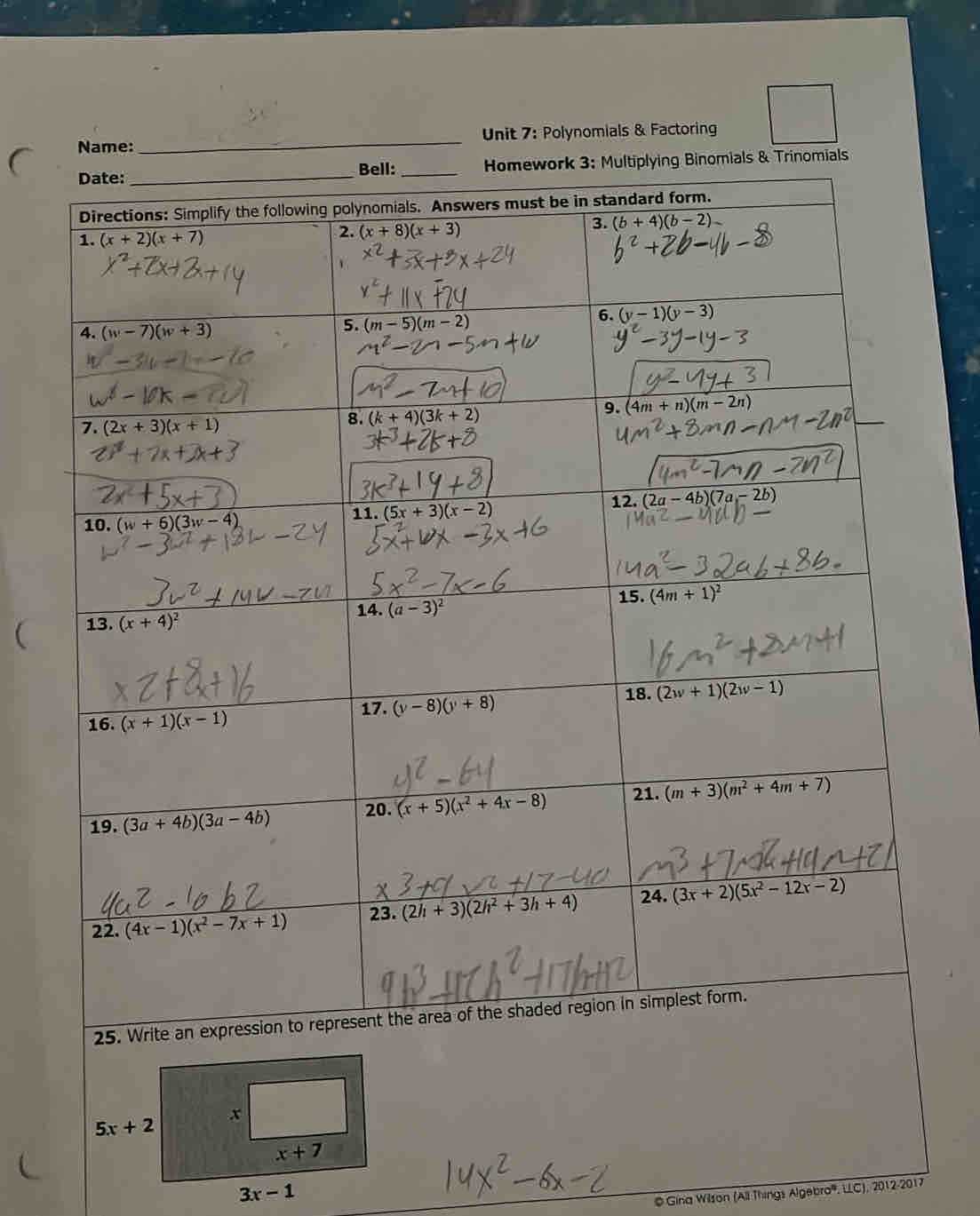
To solve linear equations, start by isolating the variable. Begin by eliminating any constants from the side of the equation where the variable is located. Use inverse operations like addition or subtraction to simplify the equation, followed by multiplication or division if necessary to solve for the unknown.
For quadratic equations, factoring is a crucial technique. Factor the equation into two binomials, set each factor equal to zero, and solve for the variable. If factoring seems difficult, consider using the quadratic formula or completing the square to find the roots of the equation.
When working with rational expressions, ensure you simplify each fraction by canceling out common factors from the numerator and denominator. Always check for restrictions in the domain of the expression to avoid division by zero.
To solve inequalities, remember that the same principles apply as with equations. However, when multiplying or dividing both sides by a negative number, you must flip the inequality sign. Graphing can also be helpful to visualize the solution set, especially for compound inequalities.
Unit 2 Algebra Answer Guide with Detailed Solutions
To solve the equation 2x + 5 = 15, start by isolating the variable. Subtract 5 from both sides to get 2x = 10. Then, divide both sides by 2 to find x = 5.
For the quadratic equation x² – 5x + 6 = 0, factor it as (x – 2)(x – 3) = 0. Set each factor equal to zero: x – 2 = 0 or x – 3 = 0. Solving these gives the solutions x = 2 and x = 3.
When simplifying the rational expression (3x + 6) / (x + 2), factor both the numerator and the denominator. The numerator becomes 3(x + 2), and the expression simplifies to 3 when x ≠ -2 (because division by zero is not allowed).
For solving inequalities, such as 3x + 2 > 8, subtract 2 from both sides to get 3x > 6. Then divide by 3, yielding x > 2. This represents all values greater than 2 on the number line.
When working with systems of equations, such as x + y = 7 and 2x – y = 3, use substitution or elimination. Solving these equations gives x = 5 and y = 2.
How to Solve Linear Equations in Unit 2
To solve the equation 3x + 5 = 14, first isolate the variable. Subtract 5 from both sides to get 3x = 9. Then divide both sides by 3 to find x = 3.
For an equation with fractions, such as (2/3)x + 4 = 10, start by subtracting 4 from both sides: (2/3)x = 6. Then multiply both sides by 3 to eliminate the fraction: 2x = 18. Finally, divide by 2 to get x = 9.
If you have a negative coefficient, like -4x + 7 = 3, subtract 7 from both sides: -4x = -4. Divide by -4 to get x = 1.
When working with equations that have variables on both sides, such as 5x – 2 = 3x + 6, start by subtracting 3x from both sides: 2x – 2 = 6. Then add 2 to both sides: 2x = 8. Divide by 2 to get x = 4.
For equations with parentheses, like 2(x + 3) = 12, first distribute the 2: 2x + 6 = 12. Subtract 6 from both sides: 2x = 6. Finally, divide by 2 to find x = 3.
Understanding Quadratic Equations and Factoring Methods
To solve a quadratic equation such as x² + 5x + 6 = 0, begin by factoring it into two binomials: (x + 2)(x + 3) = 0. Set each factor equal to zero: x + 2 = 0 or x + 3 = 0. Solve for x to get x = -2 and x = -3.
For equations like x² – 7x + 12 = 0, factor it into (x – 3)(x – 4) = 0. Then, solve for x = 3 and x = 4.
If factoring is difficult, use the quadratic formula: x = (-b ± √(b² – 4ac)) / 2a. For the equation x² + 4x – 5 = 0, the coefficients are a = 1, b = 4, and c = -5. Substitute into the formula: x = (-4 ± √(4² – 4(1)(-5))) / (2(1)). Simplifying, x = (-4 ± √(16 + 20)) / 2, and x = (-4 ± √36) / 2, which gives x = (-4 ± 6) / 2. So, x = 1 and x = -5.
For equations like 2x² + 3x – 5 = 0, begin by factoring out the greatest common factor, if any, and apply the quadratic formula to find the solutions.
Tips for Simplifying Rational Expressions
Start by factoring both the numerator and the denominator completely. For example, simplify (x² – 9) / (x² – 6x + 9) by factoring the expressions as (x + 3)(x – 3) / (x – 3)(x – 3). Cancel common factors to get (x + 3) / (x – 3).
Always check for restrictions in the domain. If the denominator contains factors like (x – 3), ensure that x ≠ 3 to avoid division by zero.
When dealing with complex fractions, simplify by multiplying both the numerator and denominator by the least common denominator (LCD). For example, simplify (1/x + 1/y) / (1/z) by multiplying through by the LCD, which is xyz, to get (yz + xz) / x.
If you encounter a rational expression with polynomials in both the numerator and the denominator, use synthetic or long division to simplify. For example, divide (2x³ + 3x² – x – 2) / (x – 1) using polynomial division to get the simplified expression.
Solving Inequalities in Unit 2: Step-by-Step Breakdown
To solve linear inequalities, begin by isolating the variable on one side of the inequality. For example, solve 3x – 5 > 7. First, add 5 to both sides: 3x > 12. Then, divide both sides by 3 to get x > 4.
When multiplying or dividing both sides of an inequality by a negative number, flip the inequality sign. For instance, if solving -2x > 6, divide both sides by -2 to get x , flipping the inequality direction.
For compound inequalities, solve each part separately. For 4 , first subtract 1 from all parts: 3 . Then, divide by 2: 1.5 .
Check the solution by substituting values within and outside the solution range. For x > 4, substitute x = 5 into the original inequality to verify it holds true. Then, test x = 3 to confirm it does not satisfy the inequality.
| Step | Example |
|---|---|
| Step 1 | Isolate the variable: 3x – 5 > 7 |
| Step 2 | Add 5 to both sides: 3x > 12 |
| Step 3 | Divide by 3: x > 4 |
Graphing Linear and Quadratic Functions
For linear functions, start by identifying the slope (m) and y-intercept (b) in the equation y = mx + b. Plot the y-intercept on the graph, then use the slope to find another point. For example, in y = 2x + 3, plot the point (0, 3) and move up 2 units and right 1 unit to plot the next point. Draw a straight line through these points.
For quadratic functions, the general form is y = ax^2 + bx + c. Start by finding the vertex, which occurs at x = -b/2a. Once you know the x-coordinate of the vertex, substitute it into the equation to find the y-coordinate. Plot the vertex, then find additional points by substituting values for x and solving for y. Plot these points and draw a smooth curve through them.
In the example y = x^2 – 4x + 3, the vertex is at x = -(-4)/(2*1) = 2. Substituting x = 2 into the equation gives y = 2^2 – 4(2) + 3 = -1, so the vertex is at (2, -1). Plot the vertex and additional points, such as (1, 2) and (3, 2), and connect the points with a parabola.
| Function Type | General Form | Steps to Graph |
|---|---|---|
| Linear | y = mx + b | Plot the y-intercept, use the slope to find another point, draw a straight line through the points. |
| Quadratic | y = ax^2 + bx + c | Find the vertex, plot additional points, draw a smooth curve through the points. |
Mastering Systems of Equations
To solve a system of equations, start by choosing an appropriate method: substitution, elimination, or graphing. Each method has its advantages depending on the problem.
Substitution Method: Solve one equation for one variable and substitute this expression into the other equation. For example, if the system is:
- 2x + y = 8
- 3x – y = 7
First, solve the first equation for y:
- y = 8 – 2x
Then, substitute y = 8 – 2x into the second equation:
- 3x – (8 – 2x) = 7
Now, solve for x:
- 3x – 8 + 2x = 7
- 5x = 15
- x = 3
Substitute x = 3 into y = 8 – 2x to find y:
- y = 8 – 2(3) = 2
The solution is (3, 2).
Elimination Method: Add or subtract the equations to eliminate one variable. Multiply the equations if necessary to align the coefficients. For example, with the system:
- 3x + 2y = 12
- 5x – 2y = 10
By adding the two equations, the y terms cancel out:
- (3x + 2y) + (5x – 2y) = 12 + 10
- 8x = 22
- x = 22/8 = 2.75
Substitute x = 2.75 back into one of the original equations to find y:
- 3(2.75) + 2y = 12
- 8.25 + 2y = 12
- 2y = 3.75
- y = 1.875
The solution is (2.75, 1.875).
Graphing Method: Plot both equations on the same graph. The point where the lines intersect is the solution. This method works best when the equations are already in slope-intercept form or easily convertible.
Always check your solution by substituting the values back into the original system to ensure both equations are satisfied.
Working with Polynomials: Addition, Subtraction, and Multiplication
Addition: To add polynomials, combine like terms. Like terms are terms that have the same variable raised to the same power. For example:
- (3x² + 5x + 2) + (4x² – 3x + 6)
Step 1: Group like terms:
- (3x² + 4x²) + (5x – 3x) + (2 + 6)
Step 2: Simplify each group:
- 7x² + 2x + 8
The result of the addition is 7x² + 2x + 8.
Subtraction: To subtract polynomials, distribute the negative sign across the second polynomial and then combine like terms. For example:
- (5x² + 4x + 3) – (2x² – 3x + 1)
Step 1: Distribute the negative sign:
- 5x² + 4x + 3 – 2x² + 3x – 1
Step 2: Combine like terms:
- (5x² – 2x²) + (4x + 3x) + (3 – 1)
Step 3: Simplify each group:
- 3x² + 7x + 2
The result of the subtraction is 3x² + 7x + 2.
Multiplication: To multiply polynomials, use the distributive property (also known as the FOIL method for binomials). For example:
- (2x + 3)(x – 4)
Step 1: Distribute each term in the first polynomial to each term in the second polynomial:
- 2x(x) + 2x(-4) + 3(x) + 3(-4)
Step 2: Simplify:
- 2x² – 8x + 3x – 12
Step 3: Combine like terms:
- 2x² – 5x – 12
The result of the multiplication is 2x² – 5x – 12.
Common Mistakes and How to Avoid Them in Unit 2 Algebra
1. Misidentifying Like Terms: One common mistake is incorrectly combining terms that do not have the same variable or exponent. Always ensure that the variables and their exponents match before adding or subtracting terms. For example, 3x² and 5x cannot be combined, but 3x² and 7x² can be added to get 10x².
2. Forgetting to Distribute Negative Signs: A common error when working with polynomials or inequalities is neglecting to distribute a negative sign across all terms in parentheses. For instance, in the expression (3x – 4) – (5x + 2), the correct distribution should result in 3x – 4 – 5x – 2. Simplifying this properly gives -2x – 6.
3. Overlooking the Zero Product Property: When solving quadratic equations or factoring, some students forget to apply the zero product property. If the equation is factored as (x – 3)(x + 5) = 0, then each factor should be set equal to zero: x – 3 = 0 and x + 5 = 0, which gives the solutions x = 3 and x = -5.
4. Confusing the Direction of Inequalities: When multiplying or dividing both sides of an inequality by a negative number, remember to reverse the inequality sign. For example, if the inequality is -2x > 6, dividing both sides by -2 results in x
5. Misapplying the FOIL Method: In some cases, students mistakenly apply the FOIL method to expressions that are not binomials. The FOIL method works only for binomials, so ensure the expression you are multiplying consists of two terms in each factor. For example, (x + 4)(x + 5) is valid, but (x + 4)(x + 5 + 6) requires a different approach.
6. Incorrectly Solving Systems of Equations: A common mistake when solving systems of linear equations is forgetting to eliminate one variable before solving for the other. Make sure to either substitute or eliminate variables properly to isolate one of the unknowns before solving.
For more tips and examples, visit Khan Academy, a trusted source for learning mathematics.