Complete Answer Key for Labeling the Parts of the Human Ear
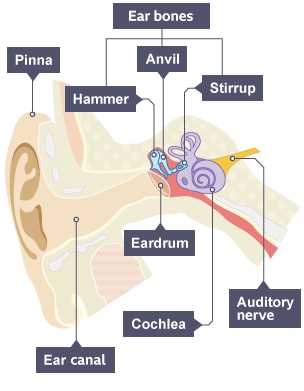
Begin by understanding the basic parts that contribute to sound detection and processing. Focus on labeling the components responsible for hearing, from outer to inner regions. Recognize the external structures that collect vibrations and transmit them inward. Highlight how these structures are interconnected for optimal function.
Pay close attention to the intricate roles of the inner chambers and fluid-filled spaces that support sound transmission. Mark the specific areas that facilitate the transformation of vibrations into electrical signals. Familiarize yourself with how these signals are relayed to the brain for interpretation.
Ensure to identify the sensory receptors and structures involved in balance and spatial awareness, as they share key anatomical features with auditory processing. This connection is crucial when distinguishing between hearing and equilibrium functions.
Incorporate clear visual representations to aid in differentiating each part. Use these visuals to reinforce your understanding of the path that sound travels, from external stimulation to cognitive interpretation.
Auditory Organ Components Identification
Begin with identifying the pinna, which captures sound waves. These waves travel through the auditory canal to reach the tympanic membrane. Upon contact, this membrane vibrates, sending vibrations through three tiny bones known as the ossicles: malleus, incus, and stapes. The stapes transmits the vibrations to the oval window, leading to the inner section.
In the inner part, the cochlea converts these vibrations into electrical signals, which are then sent to the brain via the auditory nerve. Additionally, the eustachian tube helps maintain pressure balance in the middle area. Clearly labeling these structures will provide accurate representation for further study.
How to Identify Main Parts of Human Ear
Begin by identifying the outermost structure: the pinna. This visible part captures sound waves and directs them into the auditory canal. It is shaped like a funnel and helps with sound localization. Move inward to locate the auditory canal, a tube-like structure that channels sound towards the eardrum, or tympanic membrane. The eardrum vibrates in response to sound and marks the boundary between outer and middle sections.
Next, observe the middle section. It houses three small bones: the malleus, incus, and stapes. These ossicles amplify vibrations from the eardrum and transmit them to the inner ear. The stapes connects to the oval window, a membrane-covered opening leading to the cochlea. The cochlea, a spiral-shaped structure, converts sound vibrations into electrical signals that the brain interprets as sound.
The final part is the vestibular system, responsible for balance. It consists of the semicircular canals and the vestibule. These structures detect motion and help maintain equilibrium. Understanding the anatomy of each component aids in recognizing how sound is processed and balance is regulated.
Steps to Label the Outer Hearing Structure Correctly
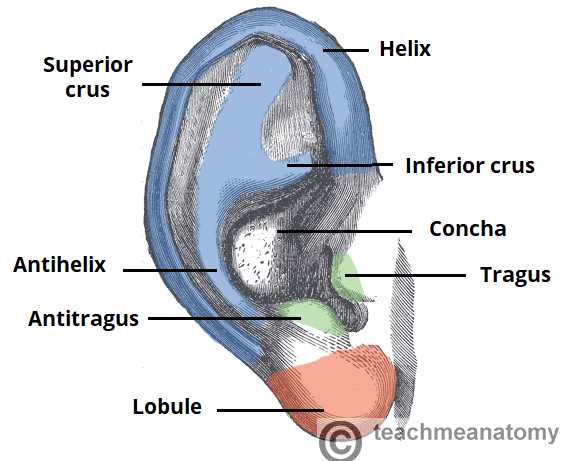
Focus on identifying each part of the visible auditory system. Begin with the outermost part, the pinna, also called auricle. This is the cartilaginous structure that catches sound waves.
- Pinna: Label the folded cartilage that collects sound.
- Helix: Mark the curved outer rim of the pinna.
- Antihelix: Identify the inward curve located just inside the helix.
- Lobule: Highlight the soft, lower part of the auricle, which lacks cartilage.
- Tragus: Locate the small prominence just in front of the ear canal.
- Antitragus: Mark the bump opposite the tragus, near the bottom of the ear’s exterior.
Next, focus on the auditory canal. It’s the tube-like structure that channels sound into the middle region.
- External Auditory Meatus: Label the canal leading inward from the pinna to the eardrum.
Finally, label the adjacent areas such as the ear canal’s opening and the junction where the pinna connects to the skull.
- Concha: Mark the deep, bowl-shaped area of the auricle that funnels sound toward the auditory meatus.
Understanding the Structure of the Middle Ear
The middle chamber of auditory anatomy houses three small bones, called ossicles: the malleus, incus, and stapes. These bones transfer sound vibrations from the outer section to the inner structure. The malleus, connected to the tympanic membrane (eardrum), vibrates in response to sound waves, transferring this motion to the incus. The incus then passes the vibrations onto the stapes, the smallest bone, which interfaces with the oval window, leading to the inner chamber. This setup amplifies and transmits vibrations effectively.
Another key feature is the Eustachian tube, linking the middle chamber to the throat. It helps regulate pressure, ensuring balance between external and internal air pressure. Dysfunction in this tube may lead to discomfort or hearing issues due to pressure imbalances.
Proper functioning of these structures is critical for clear and accurate sound transmission, without which hearing can be impaired. Understanding their interaction and anatomy assists in diagnosing hearing-related problems. When any of these components experience damage or malfunction, hearing may be significantly affected.
Key Differences Between Outer, Middle, and Inner Hearing Structures
Outer section: Comprised of the pinna and ear canal, this region collects sound vibrations from the environment. The pinna, shaped like a funnel, directs sound waves through the ear canal towards the tympanic membrane (eardrum). The primary function of this part is sound detection and funneling vibrations to the next section. It also plays a role in localizing sound sources.
Middle region: This area houses three small bones: the malleus, incus, and stapes, collectively known as the ossicles. Their job is to amplify vibrations from the eardrum and transmit them to the cochlea. The middle section also contains the Eustachian tube, which helps regulate pressure by connecting the middle space with the throat. It balances air pressure, allowing the tympanic membrane to vibrate correctly.
Inner portion: Located deep within the skull, this part includes the cochlea, semicircular canals, and the vestibular system. The cochlea, a spiral-shaped structure, converts mechanical vibrations into electrical signals that the brain interprets as sound. The vestibular system is responsible for maintaining balance by detecting head movements and spatial orientation.
How to Label the Inner Ear Components Accurately
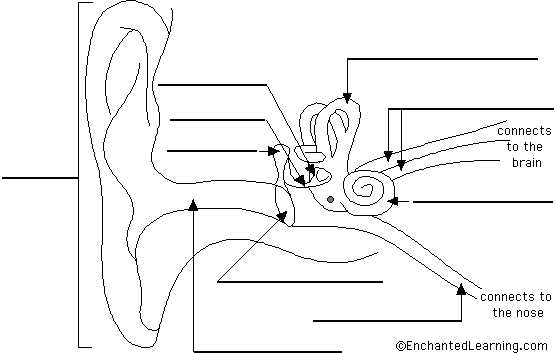
For clear identification, begin with the cochlea, a spiral-shaped structure responsible for converting sound vibrations into neural signals. It’s located centrally in the inner section and can be distinguished by its characteristic coiled shape. Next, locate the semicircular canals, which are three loop-like structures positioned perpendicular to one another. These are essential for balance and are positioned near the cochlea.
Behind the cochlea, you will find the vestibule, an oval-shaped area that connects both the semicircular canals and the cochlea. It’s important to distinguish the oval window, a membrane-covered opening within the vestibule, located near the base of the cochlea. The round window, located below the oval window, serves to release pressure within the cochlear structure.
At the base of the cochlea, mark the auditory nerve, which transmits sensory information from the cochlea to the brain. Ensure to identify its branching segments that extend from the cochlea, connecting the inner ear to the brain’s auditory centers. It’s crucial not to confuse this with the facial nerve, which runs alongside the auditory nerve but serves a different function.
For accurate representation, position each structure relative to the others: the cochlea sits centrally, the semicircular canals surround it, the vestibule connects both the cochlea and canals, and the auditory nerve extends outward. Double-check for accuracy by cross-referencing with anatomical diagrams to ensure proper orientation and scale.
Common Mistakes in Labeling Inner Structures
Misidentifying the external and internal parts is a frequent issue. A common error is confusing the tympanic membrane with the cochlea. The membrane, which vibrates in response to sound, is often mistaken for the spiral-shaped cochlea located deep within. The cochlea should be clearly differentiated as it plays a key role in converting sound vibrations into neural signals.
Another mistake involves misplacing the location of the ossicles. These tiny bones (malleus, incus, and stapes) are often inaccurately positioned within the structure, leading to confusion with other parts. Remember, they are located in the middle chamber, adjacent to the tympanic membrane.
Confusing the semi-circular canals with the vestibule is another common blunder. While both are part of balance regulation, the canals are curved tubes, and the vestibule is a central, oval-shaped chamber. Getting these confused can lead to inaccurate diagrams or models.
Accurately marking the external auditory canal is vital. It extends from the outer opening to the tympanic membrane. It’s easy to confuse this with the auditory meatus, but these terms describe slightly different sections of the auditory passage.
Lastly, be cautious about the labeling of the auditory nerve. This structure is often mixed up with other nerves, like the facial nerve, which runs in close proximity. Ensure the auditory nerve is placed properly in relation to the cochlea and vestibular structures to avoid errors.
Tips for Memorizing Parts of the Hearing Structure for Identification Tasks
Use mnemonic devices to associate each section with a visual or a word. For example, link “tympanic membrane” with the image of a “drum” since both are related to sound vibrations.
Practice with labeled diagrams daily. Start with identifying broad categories like “outer”, “middle”, and “inner” sections, then focus on specific components. Repetition is key.
Group related parts together. For instance, focus on the “ossicles” as a unit: malleus, incus, and stapes. By remembering them as a trio, the task becomes easier.
Use flashcards with images on one side and names or functions on the other. Shuffle them regularly to strengthen recall under pressure.
Break down complex structures. If you’re studying the cochlea, first learn its spiral shape, then identify its key features like the basilar membrane and hair cells.
Teach someone else what you’ve learned. Explaining the layout of hearing components to others reinforces your own understanding.
Explore reputable resources for detailed information on each part, such as those available at National Institutes of Health.
Resources for Practice Identifying Ear Parts
Interactive platforms like Quizlet offer customizable flashcards, allowing you to practice by testing your knowledge on human auditory anatomy. These cards can be paired with detailed diagrams to reinforce learning through repetition.
Apps like Visible Body provide a 3D model of the human body, which includes auditory structures. This feature allows you to manipulate and rotate the model for an immersive learning experience.
Printable worksheets are also a useful tool. Websites like Teachers Pay Teachers offer diagrams with labeled and blank templates, which help you test your recognition of auditory components in both labeled and unlabeled formats.
For hands-on practice, explore educational websites offering quizzes that focus specifically on auditory system components. These sites include visual aids and provide immediate feedback, enhancing retention.
Using YouTube channels dedicated to anatomy studies can help, too. Videos break down auditory parts and their functions, often with clear visual explanations that improve understanding of each section.